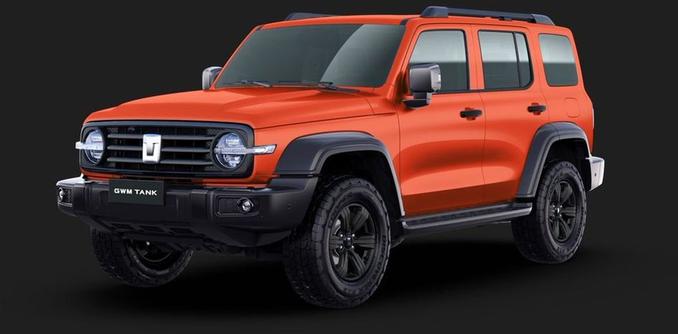
The 2023 GWM Tank 300 range of configurations is currently priced from $36,930.
Our most recent review of the 2023 GWM Tank 300 resulted in a score of 7.2 out of 10 for that particular example.
Carsguide Contributing Journalist Marcus Craft had this to say at the time: The GWM Tank 300 is an impressive 4WD wagon. It’s nice to drive on-road – smooth and refined – and very capable off-road.
You can read the full review here.
This is what Marcus Craft liked most about this particular version of the GWM Tank 300: Price-tag , Very capable off-road, Packed with features
The 2023 GWM Tank 300 carries a braked towing capacity of up to 2500 Kg, but check to ensure this applies to the configuration you're considering.
The GWM Tank 300 2023 prices range from $37,620 for the basic trim level SUV Lux Petrol to $52,690 for the top of the range SUV Lux Hybrid.
Straight back to the dealer with this one. You either have a problem with the actual stereo unit, the screen that controls it or perhaps even the body computer which has the final say over functions like this one. Either way, it’s a warranty job for sure.
The dealer may be able to reboot the system to return it to normal operation, but whatever happens make sure the dealership logs and records the problem in case it comes back in the future. Sometimes even a problem that returns after the vehicle is out of warranty, if it was first detected when the vehicle was still under that warranty, may mean the problem is what’s called a pre-existing condition and the manufacturer is still obliged to fix it.
Show more
If you were led blindfolded to the GWM Tank 300 and sat inside with all identifying badges covered, you would be forgiven for thinking you were inside a Mercedes-Benz G-Class Geländewagen.
A medium-sized SUV with ladder-frame construction and five seats, the Mercedes influence is very obvious, from the twin 12.3-inch display screens for instrumentation and multimedia/vehicle function systems, to the turbine-style dash air vents and general upmarket trim look and feel.
There’s even an analogue clock in the centre of the dash.
Yet, despite that, the GWM subscribes to classic 4WD wagon tropes inside, including the squared-off roof line, flattish windscreen and boxy proportions. There are even large grab handles for shorter occupants to help haul themselves up and inside the vehicle.
The Tank 300 offers more than sufficient space for five people, with a good driving position and easy reach of most switchgear and controls. Ventilation is ample but storage, while plentiful, is not especially volumous.
We’re not huge fans of the flat front seats, though, as they can be quite numbing after a while sat in them.
Modern and easy to fathom once familiarised, the electronic instrumentation is informative as well as multi-configurable, while the large touchscreen in the centre is colourful and features swipe technology to access the many and various screens.
Thankfully, GWM has fitted hard buttons for the main climate control and some vehicle setting systems, saving the driver from having to decipher apps and sub-menus whilst driving.
However, there are still too many vehicle settings within said touchscreen. The seatbelts rattle against their pillars. And the windscreen posts create big blind spots through roundabouts.
Entering the back-seat area, it features a 30:70 seat split, with the cushion tilting forward to allow the backrest to nestle in snugly and flatly to increase the load area as much as possible.
Two USB outlets, rear-facing air-vents, four grab handles, windows that drop all the way down, reading lights, some storage and a folding armrest with cupholders are all fitted.
To access the 400-litre cargo area, you’ll need to swing the left-side-opening door out. Note that the spare wheel is slung from behind, so there’s no need to worry about accessing that from inside the Tank 300.
There’s a very high loading lip up to the large aperture, but clear that, and you’re met with more nice finishes and flat if narrow floor area, with tie-down hooks, lighting, side storage nets and 12V outlets.
The floor lifts to reveal a few small storage options, but no luggage cover is fitted.
Even the base Tank 300 Lux includes seven airbags, Autonomous Emergency Braking (AEB), lane support systems, adaptive cruise control, two 12.3-inch digital screens, a 360-degree surround-view camera, Apple CarPlay/Android Auto, a nine-speaker audio system (but no DAB+ digital radio), a sunroof, LED headlights, powered front seats, side steps, roof rails and 17-inch alloy wheels.
Meanwhile, the Ultra adds items like heated/cooled front seats, a lumbar and massage function for the driver’s seat, Nappa-leather upholstery, an Infinity audio upgrade, wireless charging, multi-colour ambient lighting, a 220V power outlet, front differential lock and 18-inch alloy wheels.
The Tank 300 is available in five colours.
Only Fossil Grey is standard. For Lunar Red, Pearl White, Crystal Black or Dusk Orange, GWM charges an additional $595.
Under the Tank 300’s bonnet is a 2.0-litre turbo-charged four-cylinder petrol engine, delivering 162kW of power at 5500rpm and 380Nm of torque from 1800-3600rpm.
Tipping the scales at a hefty 2155kg, it produces a distinctly mediocre 75kW per tonne.
An eight-speed torque-converter automatic transmission sends drive to all four wheels via a part-time four-wheel drive system. It features 4H high and 4L low gearing for off-road driving.
| GWM Tank 300 Model | Body Type | Specs | Fuel Consumption |
|---|---|---|---|
|
Lux Hybrid
|
Body Type: SUV | Specs: 2.0L Hybrid 9 SP AUTO |
Fuel Consumption:
10.3L/100km
|
|
Lux Petrol
|
Body Type: SUV | Specs: 2.0L ULP 8 SP AUTO |
Fuel Consumption:
9.5L/100km
|
The GWM Tank 300 is a midsized body-on-frame SUV, with two rows of seats consisting of a pair of bucket-type seats up front and a three-person bench out back.
The front bucket seats slide and recline, with the driver’s side featuring electric adjustment. It also offers lumbar support. However, the seat itself is a bit flat and shapeless, and can lead to a numb posterior after several hours.
Meanwhile, the rear seats provide average comfort and support. They are split asymmetrically, with the left side divided as one-third and the right-side taking up the remaining two-thirds.
This allows for either a four-seater or three-seater configuration with the vehicle, with the folded section dedicated to longer loads as required.
Helpfully, the cushion tilts forward to allow the backrest to lay flat with the boot floor, extending the cargo capacity coverage considerably.
While the cushions tilt but do not slide, both backrests do have a slight reclining feature, allowing for a small degree of angle to help boost comfort. Also to that end, the middle portion comes with a folding armrest, complete with a pair of cupholders.
The Tank 300’s boot is accessed via a side-swinging tailgate that features the spare wheel on it rather than inside the vehicle.
The aperture is wide but high, meaning luggage and other cargo has to be hauled up and over. At least the space is square and nicely finished.
Due to a 70/30-split back-seat arrangement, the Tank 300’s cargo capacity increases substantially from a disappointing 400 litres with the backrests up.
The Tank 300 petrol can accelerate from standstill to 100km/h (0-100km/h) in around 10 seconds, on the way to a top speed of 170km/h.
The HEV hybrid, in contrast, can manage 0-100km/h in about 8.0 seconds flat.
The Tank 300 petrol is tuned to run on 91 RON regular unleaded petrol.
That’s just as well, since the official fuel-consumption average is 9.5 litres per 100km. Our pump-to-pump average was actually 13.8L/100km. At least that was better than what the trip computer read: 14.2L/100km.
Fitted with a 75-litre fuel tank, expect to average around 785km based on the official figure.