What's the difference?
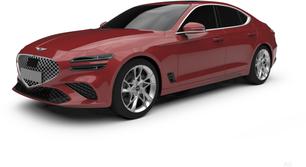
I’m family testing the updated Genesis G70 this week, which has seen some tweaks to its technology and safety systems.
The G70’s release also sees the line-up trimmed to one highly-specified Sport Luxury grade, available as a four-cylinder Shooting Brake wagon or the V6 sedan on test here.
It competes with other mid-size sedans like the Audi A4, BMW 3 Series and Mercedes-Benz C-Class. So, how does the G70 handle life with a small family of three? Keep reading to find out!
The camping world is so mad for forward-fold campers that it often forgets that, for a long time, the rear-fold, hard-floor camper were considered the 'In' thing.
That rings true for Sydney-based camper-trailer firm, Blue Tongue Campers, whose three hallmark campers are based on the forward-folding concept with an internal lounge. But it's the rear-fold, which quietly ticks along, almost in the background, which is still the most versatile, has the best storage and the best kitchen of the hard-floor campers. The Series 2 version has just been released so we took it out to see what's changed.
The updated Genesis G70 3.3T Sport Luxury is beautiful to look at and drive. It features premium features, trims and great power but the cabin is tight on space. Which makes it a little awkward to use, so this will suit a small family best or families where this may not be the primary mover. That said, I love the after-care program and it suited my small family of three, so it gets an 8.0/10 from us.
The Overland XR Series 2 isn't quite the perfect camper, there's a few little things in the set-up that preclude it from that. Still, at the price and with the features it gets as standard, it's a really good value trailer. It's comfortable, it'll handle off-road trips with ease, and it the kitchen is really quite good.
The practicality is hurt a little by the space available for passengers. The front row benefits the most when it comes to head- and legroom but if you’re ferrying passengers in the back seat, you’ll have to scoot your seat forward to accommodate them.
Especially if they’re tall because my knees brush the back of the driver’s seat when it’s in my driving position and I’m only 168cm tall!
The individual storage options throughout the car are okay for the class with the front enjoying a small middle console and glove box, two cupholders and two small drink bottle holders in each door.
The rear gets map pockets, two cupholders in a fold down armrest and two very small storage bins in the doors.
The other amenities are great in both rows and a high-level of comfort will be found for adults with the heat and ventilation functions on the front seats and the heat function on the rear outboard seats.
However, the width of the rear seat and the tall transmission tunnel means the middle seat should be strictly reserved for a kid. Think of the G70 as more of a four-seater if you have adults to carry.
The boot has a 330-litre capacity and it’s not too hard to reach to the very back if items roll that way. The back seat has a 60/40 split and there is a temporary spare tyre underneath the floor.
In terms of technology, you get a USB-A and USB-C port up front, as well as, a 12-volt socket and wireless charging pad to choose from. Rear passengers get two USB-C ports and the boot features another 12-volt outlet.
The 10.25-inch multimedia system looks great and is easy to use with a responsive touchscreen. It also has built-in satellite navigation, wired Apple CarPlay and Android Auto and the system now features over-the-air updates and Genesis Connected Services functionality.
The digital climate panel is responsive and very simple to operate, which is handy when on the go. The 12.3-inch digital instrument cluster is semi-customisable and it’s handy that the 8.0-inch coloured head-up display pulls through satellite navigation directions and traffic sign information.
As the lid becomes the floor, it's quite open inside the camper, with plenty of room to move around and space to do everyday things standing up, like get dressed, which is often more difficult in a forward fold, as there's not a lot of standing room inside them. There's also no stairs to climb getting in or out, as the hard floor is almost at ground level.
The tent seems quite well made. It's a 450gsm waterproof canvas with a tropical roof, windows all around the bed and three doors, one each side of the hard floor. Almost the whole passenger side can be rolled away, too, creating a giant opening into the camper, which offers a pretty good outlook on hot summer days at campsites by the beach.
There's no shortage of extra canvas, either. There are two awnings (although only one you'll use often, an ensuite tent and an optional kids room. The best of the awnings is the quick version, which is simply a rectangle of canvas that shelters the kitchen and only needs two poles to hold it up. A more complete awning, which also comes with walls and a floor, goes up reasonably easily, but it'd only be used if you were settling in for a week or more, I reckon, and then only if the weather was questionable. Its pitch has been improved over the Series 1, which had a flatter roofline and was more susceptible to pooling water. The ensuite room is gigantic – about the size of an actual small bathroom.
One of the biggest reasons to get a rear-fold over a forward-fold is the internal access to storage. As the rear-fold's is all under the bed, the four steel drawers make it easy to get to. Two of them are even accessible when the camper is shut, which just isn't the case in a forward-folding camper. A large, wide step makes climbing up into the bed easy, too. It has an innerspring mattress which is firm but comfortable and plenty big enough to spread out on if you are sharing it.
The Overland XR Series 1 was very well equipped electrically, maybe too well equipped. It was fitted with three 100ah batteries, which is not only a lot of extra weight, but that much battery takes ages to charge – if they were all flat, a day's driving probably wouldn't do it, especially if the car also had a second it needed to attend to. The Series 2 has dropped back to two batteries, which is far better suited to the camper and should easily be maintained by one of the optional 144W solar panel blankets. It can also be fitted with Redarc's Redvision, offering phone connectivity to the camper's electronics so you can not only monitor everything, but turn things on or off remotely.
The other side of the camper's forward storage is large enough to fit a generator or any other bulky camping appliance. As it can be accessed when the camper's open or closed, it's perfect for all manner of gear. A smaller box facing forwards is great for hoses and recovery gear or even a couple of jerry cans. Beware of loading this area up with too much really heavy gear, though, as the ball-weight's already on the heavy side. Fortunately, the camper has a flip-over luggage rack, which is ideal for heavier or bulkier items. Underneath, it can carry 155-litres of water in two tanks.
The G70 sedan is a lovely car to drive with graceful handling and a good well of power to dip into.
That oomph is there when you need it and it’s as easy to drive in the city as it is on the open-road.
The responsive steering makes the G70 sedan feel nimble and well-balanced in turns, even when you accelerate out of a hair-pin corner.
The suspension is on the firm side and that can lead to a few grunts when you hit bigger bumps but the ride is not unpleasant, even for back-seaters.
The cabin is generally quiet but you can get road/wind noise at higher speeds. It’s not enough to intrude on chatting but you don’t forget it’s there, either.
The G70 sedan is easy to park because it has an outstanding 11m turning circle. The 360-degree camera system is clear and the front and rear parking sensors make light work of a tight car park.
The Overland XR is very stable under tow, which has a lot to do with its ball-weight. Weight to the front of a trailer improves trailer stability (although reduces braking and steering efficiency), so there needs to be a compromise. At 180kg, that's actually a reduction on Series 1, and although that's quite heavy for a camper trailer, is on par with other modern rear-folds, like the Kimberley Kamper.
Well and truly off-road ready, the XR has independent coil-spring suspension and dual shock absorbers, standard, as well as an AL-KO 360° ball hitch, so obscure angles on a rough track won't cause any trouble.
The camper is quite tall, thanks to the spacing of the suspension arms, so clearance will rarely be an issue – when level, the ride height suits a lifted four-wheel drive.
Alloy wheels and 265/75 R16 all terrain tyres fit the bill nicely, and as they're a six-stud LandCruiser pattern, they, and the two tonne bearings, are easy to replace anywhere you find yourself.