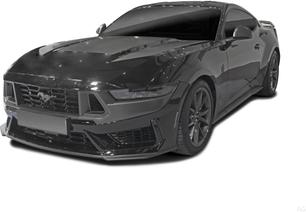
What's the difference?
The new Ford Mustang GT was not designed for Paris.
Fighting through the morning peak hour rush (which seems to extend through the middle of the day and the afternoon), the new Mustang feels like a caged animal. Which is appropriate, given the car’s namesake is a wild horse that exists to roam the American wilderness.
But once we finally break the shackles of Parasian traffic we find ourselves getting to let this Mustang gallop across the French countryside and unleash its full potential. But more on that later…
The reason we're driving the Mustang in France is because the American brand wanted to connect it to its new racing program at the famous Le Mans sports car race (you know, the one in the Matt Damon movie, Ford v Ferrari).
No less than Bill Ford, great-grandson of the company’s famous founder, was on-hand to see the Mustang at Le Mans, such is the passion for performance.
Ford (the man, not the company) took the opportunity to declare that the Blue Oval brand is not only committed to internal combustion engines for the foreseeable future, but it will retain the V8 under the bonnet of the Mustang GT for as long as it can legally do so.
Australians will have to wait a few more weeks (maybe months) before the seventh-generation Mustang arrives, but here’s what you can expect when it lands on local roads.
Even on its Australian swansong outing, the incredible R35 GT-R continues to perform beyond expectations.
Released in late 2021, the final batch of specials spearheaded by the T-spec in regular GT-R and SV in flagship Nismo guises sold out quickly and are already commanding twice and even thrice their recommended retail prices in private hands.
Nobody ought to be surprised. From its glitzy 2007 Tokyo Motor Show debut (on the eve of a global recession at that), the GT-R has been nothing less than an automotive force of nature, moving with calamitous calm to the beat of its own twin-turbo and all-wheel-drive thrum, like nothing else matters. The R35 has seen off countless assassins in its time, including the Lexus LFA and Honda NSX II.
Some 15 years later, this is what a GT-R in T-spec trim feels like in 2022.
Having driven the latest example of the Mustang GT, I hope Bill Ford is true to his word and keeps the V8-powered Mustang for as long as possible. It isn’t the most razor-sharp sports car or the most powerful muscle car, but it offers the kind of driving thrills and enjoyment that have made the car an icon.
The price increase is steep but the new technology inside drags the Mustang into the modern era and will add more youth appeal to a car that is largely unchanged in concept for the past 60 years.
But now that I’ve driven it in the USA and France, I can’t wait for it to finally reach Australia.
Note: CarsGuide attended this event as a guest of the manufacturer, with travel, accommodation and meals provided.
The GT-R of the famous R32 era was a direct response to immortals like the Audi Ur Quattro and Porsche 959 that preceded it in the 1980s.
But the Nissan’s true gift since then is that it has evolved over successive generations, to serve as a glimpse of what these long-discontinued European supercars might be like if they, too, were allowed ongoing development, rather than dropped.
As such, the last R35 GT-R as we know it in Australia is far from disadvantaged, even 15 years on from launch, because it was devised and developed outside of the usual constraints and compromises of mere mass production sports cars.
In 2022, then, the Nissan GT-R remains timeless and transcendental. It’s still an incredibly moving and thrilling driving experience… if you can get hold of one.