What's the difference?
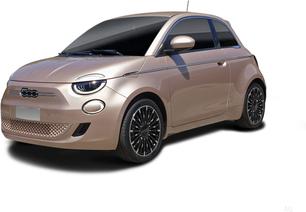
You wouldn’t know it to look at it, but this is a brand-new — as in really and truly all-new — Fiat 500.
That has got to be a big deal for fans of Fiat’s pint-sized city car, with a genuinely all-new 500 about rare as spotting Halley’s Comet soaring over Turin. The last time was way back in 2007, by the way, and that car will remain on sale alongside this new one for the foreseeable.
But that’s not the only surprise. This 500 is also entirely electric, properly modern inside, and it has actual technology in its cabin and on its safety list.
Fiat reckons this is a big reset for the 500. And that there will never be another all-new petrol model again.
So, how does this new 500e stack up against the recent flood of small EVs, predominantly from China?
Let’s go find out.
See if you can guess the name of the world's first ride-sharing app. You're thinking Uber, right? Nope. It was a company called Sidecar. It's broke now, shuttered for good in 2015. What about the first video-on-demand service? Netflix? Nope. Amazon beat them to it, for starters, but so did many other, now-defunct companies who tried it even earlier.
The point is, being first on the scene is no guarantee you'll be the best, or the most successful. I mean, just look at electric cars; plenty of manufacturers were doing all-battery models before (and arguably better than) Tesla, and every one of them is now parked in Elon Musk's gargantuan shadow.
Before full-electric there were hybrids, and first to arrive on that particular scene in any meaningful way was Toyota and its awkwardly shaped Prius, back in 2001. And they had that field to themselves for a while, but soon enough the other manufacturers trotted out hybrid and plug-in hybrid models of their own.
And so Toyota shook up the Prius offering, launching the seven-seat Prius V, and the bite-sized (and Yaris-based) Prius c we've tested here, in 2012, hoping to broaden the appeal of its hybrid offerings. Problem is, 2012 was an awfully long time ago, and so Toyota has waved its wand over the ageing Prius c for 2018, changing its design, tech offering and interior in an effort to keep it fresh.
So, is the Japanese giant still head of the hybrid class? Or has it been beaten at its own game?
A fun, funky EV which will no doubt appeal to lovers of Italian style, but also one which struggles a little on the range and price front.
Still, there’s no doubt that electrification has improved the Fiat 500 formula.
It's as if the the future is firmly rooted in the past at Toyota. The Prius is still undoubtedly clever, frugal and easy to drive, but it is feeling so old in places that the bad had begun to weigh on the good. If you're a tech-head or have a right foot crafted from lead, then there's nothing to see here. But if the thought of saving money at the bowser sets your heart aflutter, then step right this way.
It looks, well, it looks like a Fiat 500.
It’s actually bigger in every dimension than an ICE cinquecento, but it doesn’t really look like it, which is a good thing.
The 17-inch wheels look great, and big against the very small Fiat, and I like the hidden doorhandles, which make the already smooth-looking 500’s flanks look a little smoother still. But I can take or leave the little DRLs up front that are meant to act as little illuminated eyebrows for the headlights, which come over a bit too cutesy.
But I think the highest compliment I can pay it is that it looks like a regular Fiat 500 — one of the most successful reincarnations of a timeless design ever — and not some modern, eco-friendly version that would have killed the look.
In the cabin, however, it’s definitely a more modern affair, with the big screen, the horizontal push-button gear selector, and the nifty push-button door openers.
Still, it’s all pretty familiar Fiat 500, only a little nicer, even if some of the plastics are far too hard and scratchy for a vehicle this expensive.
There are five colours available: Ice white, Onyx black, Rose gold, Ocean green and Celestial blue.
The good news is that it doesn't look quite so quirky as the full-size Prius. The not-as-good news is that it's still no beauty-contest winner. Not helping matters was the fact our test vehicle was painted in a retina-burning yellow (they call it Hornet Yellow, and it's new for 2018) that looked almost nuclear.
Viewed front on, the blacked-out section of grille and bumper gives the littlest Prius a vaguely manta ray-shaped front-end, while the headlights climb both upwards and back into the body, lending a sense of sportiness to this very unsporty hybrid. From the back, the chunky bumper, vertical taillights and rear windscreen spoiler all add a little attitude to the design.
Inside, you'll find a small but premium-in-places space, with a gloss-black stereo surround that angles the main controls toward the driver, while the digital driver's binnacle is pushed toward the centre of the car, displaying speed, fuel and other key info above the stereo, rather than in front of the steering wheel.
The 500e is 29mm taller, 61mm longer and 56mm wider than the current ICE Fiat 500 (now 1529mm, 3631mm and 1683mm respectively), and it rides on a longer wheelbase, too .
That means more front-seat room and head room, but there’s still not oodles of space in the four-seat cabin, and especially in the back, where things are pretty tight.
I’m 175cm tall, and my head touches the ceiling in the back, and if I had another full-size human in the back with me, I’d want it to be someone I know well, because we’d be well and truly aquatinted by the time we got to our destination.
The front seats are more accomodating, but there is a strange tightness to the pedal area for the driver. It’s so tight, in fact, that when you rest your left foot, you have to be careful not to accidentally clip the brake pedal when driving.
The boot is a small 185 litres, too. But you’re not buying this for practicality perks, are you?
Not very. This is a Yaris-based city car, let's not forget.
That said, it never feels cramped up front, with enough shoulder and headroom to ensure you feel separated from your fellow passengers, where you'll also find two cupholders, and an infuriating USB connection housed in the touchscreen - so your cord dangles from the dash when connected.
Climb into the back, and you'll find yourself in a pretty snug space. Sitting behind my own (5ft-8inch) driving position, it's only the scalloped back of the driver's seat that affords me any clear air between my knees and the seat in front, and the space behind my head and the roof lining is minuscule, too. But again, we're talking city car space here, so you can't expect to lounge about back there.
The ambience in the backseat leaves a little to be desired, though. The door trim pushes into the passenger space, and the plastics used in the rear are rock hard. There's a single cupholder to share, and a seat-back pocket on the rear of the passenger seat, but that's it; there's no vents, USB or power sources. There's no bottle-room in the rear doors, either.
An easy-access boot space will swallow 260 litres with the 60:40 rear seats in place. And there are two ISOFIX attachment points, one in each window seat in the back.
The 500e is not cheap by modern small EV standards — we’re looking at you, China — but it does arrive in one well-equipped trim level, called La Prima, with paint the only available option.
It's also, quite shockingly for anyone who has driven an ICE Fiat 500 lately, stacked with some truly high-tech kit.
There’s heated seats for the first time ever, for example, and there’s 10.25-inch central screen with Apple CarPlay and Android Auto, and wireless charging.
There’s a digital driver display, too, plus there’s faux-leather on the seats and dash, a panoramic glass sunroof and fancy push-button front doors (though with a mechanical back-up lever hidden in the door pockets should something go pear shaped).
Outside, you’ll find 17-inch alloys, as well as LED lightning all around, including the DRLs, and there’s keyless entry and push-button start, too.
But, and it’s a significant but, the 500e lists at $52,500 before on-roads , which — when you consider its size, battery and range — really edges it into the premium EV space.
A similar-sized EV from China can be had for under $40k, which means you are going to have to really love the 500e to drop that extra $15k or so.
We've just spent a week behind the wheel of the Prius c i-Tech; the top model in the two-variant range, sitting above a cheaper model known simply as the Prius c.
At $26,540, it ain't cheap for a city car (and it's $4k more than the most-expensive Yaris on which it is based; more worryingly, it's only $1500 cheaper than an Audi A1), and the standard features list is more a novella than War and Peace.
Outside, you'll find 15-inch alloy wheels, remote unlocking, LED headlights and front fog lamps, while inside you'll leather-look seats (they're actually vinyl), sat-nav and climate-control.
Tech is covered by an (old-school feeling) 6.1-inch touchscreen that pairs with a six-speaker stereo, but there's no Apple CarPlay or Android Auto.
A single front-mounted electric motor delivers the power here, with 87kW and 220Nm on offer. Enough, Fiat says, to knock off 100km/h in 9.0 seconds. But it does feel quicker than that in real life, thanks to the way electric vehicles deliver their power.
There’s the usual EV single-speed gearbox, too, with power sent to the front wheels.
Under that little hood lives a 1.5-litre, four-cylinder petrol engine good for 54kW, which pairs with a 45kW electric motor. Toyota lists combined outputs at 74kW at 4800rpm and 111Nm at 4000rpm.
That hybrid setup partners with a CVT automatic, pumping power to the front wheels.
The Fiat 500e’s 42kWh battery provides a smallish 311km driving range on paper, but when we got in it was more like 290km at 96per cent charged. A city car, then, rather than a long-distance hauler.
When it does come time to charge, you’re set up for 85kW DC fast charging which should take you from zero to 80 percent in 35 minutes.
If that last section didn't impress, this one surely will. The little Prius c will sip a claimed 3.9L/100km on the combined cycle.
That's very low, and the fact it accepts cheaper 91RON fuel makes it a very affordable car to run. Except... the onboard computers revealed a slightly less-impressive 5.1L/100km after my time with the car.
Emissions are a claimed 90g/km of CO2, which is very good.
This is the probably the best-driving example of the Fiat 500 I’ve ever climbed into. Sure, it’s not quite as engaging as self-shifting a perky little manual, but it’s smoother, easier and more comfortable, and a whole lot better than ICE vehicles fitted with Fiat's odd dual-logic automatic gearbox.
The EV transition genuinely suits the little Fiat, admittedly sapping a little character, but also thoroughly modernising the drive experience, with smooth, constant acceleration, sharp-enough steering and a ride that’s mostly settled, only really becoming crashy over the bigger road imperfections.
The small dimensions here also help the EV reincarnation. Yes, it’s heavier than you might expect, weighing in at 1290kg (tare), with the batteries adding several hundred kilograms to the equation, but the 500e still doesn’t feel overly heavy, with the little Fiat remaining pretty light on its feet.
There are three drive modes on board, including the catchy Sherpa mode (because it will help get you where you’re going), which, when you’re running low on battery, kills the climate control and anything else it needs to preserve range and get you home.
But you can’t shake the feeling that the 500e is a little expensive for such a specialist tool. It’s unashamedly a city car, but one that will cost you more than $50k, and which doesn’t feel quite premium enough in the cabin to justify that asking price.
In much the same way that you don't buy an exotic performance car for its ability to run to the shops, you're unlikely to be buying the Prius for its ability to set your pulse racing.
But happily, it doesn't feel wobbly or disconnected, either. It's aided by being such a small package, and when you're not wafting silently about in electric mode, and you've coaxed that little petrol engine into life, it serves up more than enough poke to navigate the city, and even to leave the slow-reactors in your rear-view mirror at traffic lights.
The ride is good, too, feeling connected to the road below without feeling uncomfortable, although the little Prius does tend to track with the corrugations in the road, leaving you to wrestle it back into line. That's a job made easier by light and surprisingly direct steering, which feels tailor-made for the city.
Finally, the leather-look seats are comfortable, even over long distances, the razor-thin A-pillars make forward vision easy and it's a very simple thing to drive and manoeuvre into parking spaces. And all of those are good things.
Not so good? Well, the entire drive experiences feels a little beige and emotionless, it can get noisy and there are parts of the cabin that feel downright cheap. Worst of all, though, is that for a car that once heralded the future, it's feeling very, very dated.
But there are some amazing quirks attached to driving an (almost) electric car, including the delivery of eco awards for using the least amount of fuel (they were awarded for 2.6, 3.2 and 3.6L/100km over as much as 25km - none of which occurred during my tenure). The hardest thing to get used to was the absolute silence served up in electric mode. I counted four seperate occasions when I walked away from the car with it still turned on.
There’s a heap of active safety stuff on board (again, unusual for a 500), with active cruise control, traffic sign recognition, front, rear and side parking sensors, blind-spot monitoring, AEB with pedestrian and cyclist detection, and more.
Still, the 500e only secured a four-star ANCAP safety rating, scoring just below the five-star cut off in Adult Occupant Protection, Child Occupant Protection and Safety Assist, with a lack of a centre airbag not helping.
Every Prius c arrives with seven airbags, along with a reversing camera and... wait, that can't be it, can it? Oh... Forget AEB, lane-departure warning and the like, this future-focused Prius has a safety package firmly rooted in the past.
It was awarded the maximum five-star ANCAP safety rating, but was tested back in 2014.
The fly in Fiat’s ointment is its ownership proposition, with a three-year, 150,000km warranty now way below par in Australia these days, even if the battery is covered for the standard eight years.
Servicing is every 12 months or 15,000kms, and will cost $250 a pop for the first eight years, which is commendably cheap.
Toyota offers a three-year/100,000km warranty, while the batteries are covered for eight years or 160,000km. The car's six-month service intervals might sting a little, though, but with each service capped at $140 for the first three years, even taking two trips to the dealership a year isn't too expensive. Just annoying.