What's the difference?
Large SUVs like the Toyota LandCruiser, Nissan Patrol and Land Rover Defender have dominated in Australia for decades now, however there’s now something new to shake up the segment.
BYD’s luxury spin-off brand, Denza, has launched in Australia with two plug-in hybrid (PHEV) off-road SUVs. The B8, which is the larger of the two, is on test here.
With three rows of seating, a bucketload of standard equipment and a jaw-dropping starting price, the B8 is being pitched as a PHEV alternative to the currently diesel-only LandCruiser 300 Series among other more premium alternatives like the Land Rover Discovery and Mercedes-Benz GLS.
We’ve already driven the B8 over in China and this is the first time we’re getting to test it out on Australian roads, so let’s see how it stacks up.
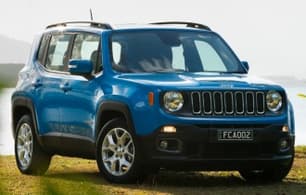
Jeep's Renegade might be late to the mini-SUV party but it comes with a pretty impressive back catalogue to suggest that this is a SUV that can cash the cheques its name can write.
The top of the range Trailhawk can write even bigger cheques than the lower models, bringing with it a range of off-road tech toys to let you really get down and dirty.
The Denza B8 is an incredibly luxurious car that has a lot going for it, including three rows of seating, a 3.5-tonne braked towing capacity and an eye-popping price tag, but it's held back by its overall heft and cumbersome ride.
If you don’t absolutely need the third row of seating, the smaller B5 is arguably the better pick and while it’s also not perfect, it’s a very compelling package and you’ll be saving thousands of dollars in the process.
Note: CarsGuide attended this event as a guest of the manufacturer, with travel, accommodation and meals provided.
Rugged, dependable and good off-road are the most obvious qualities of the Trailhawk. It stands out from the rest of the mini-SUVs by being able to do the S and the U with plenty of vigour.
It's just a shame that its on-road manners can't match that of its big brother, the Cherokee. Unless you're planning on proper off-roading, the Trailhawk might not be quite what you're looking for.
There’s no way around it, the Denza B8 is a big car. It’s almost 5.2 metres long which makes it larger than a LandCruiser 300 Series and more in line with the likes of the Land Rover Defender 130.
It looks quite boxy and tough on the outside, though it doesn’t have any features that define it specifically as a Denza beyond the inconspicuous badging. There are many angles that are reminiscent of the aforementioned Defender.
The body lines look crisper than the smaller B5, as does the semi closed-off grille and LED light script that connect the big LED headlights.
Unlike the B5, the tailgate-mounted spare wheel is much more prominent in the B8 and this therefore exaggerates its heft, not in a good way.
Inside, it’s luxurious and high-end with lots of visual appeal. I particularly like the amount of soft-touch finishes around the cabin and the overall lack of glossy piano black.
While luxurious, there’s also a rugged edge to the interior. This is most present in the large grab handles which you do need to use when getting in and out.
The amount of physical buttons and switches inside is a nice touch as you don’t need to relate on the touchscreen all the time. The fact the gear shift lever rises up when you turn on the car also adds to the special, luxurious feel.
In what is absolutely not a coincidence, the Renegade immediately conjures up the Wrangler. Upright grille from the Willys Jeep (references abound here), round headlights, squared off wheel arches to mimic the Wrangler's guards, short overhangs and big rear view mirrors.
The 17-inch wheels look completely lost in the wheelarches which are even more cavernous owing to the Trailhawk's 50mm of extra ride height. The wheels are also a bit cheap looking but will probably survive the belting the car is intended to take.
Less rugged is the interior, despite a fairly self-conscious effort to make it look and feel chunky. The front seats are flat and unsupportive with the rears just as lacklustre making sure everyone is sliding around together. Luckily, front passengers get a dash-mounted grab handle.
It seems quite well put together, however, but with carpets and easily-marked plastics, you'll hope your passengers don't bring the mud in with them too often. And the "Since 1941" stamped into the steering wheel can go.
The dashboard is reasonably clear and has plenty of information to share via the screen between the dials but whoever thought marking the redline with a water splash graphic in bright orange should probably rethink their design decisions.
Storage is limited to two cupholders up front, door pockets in each door and nets on the front seat backs.
The 2026 Denza B8 line-up starts at $91,000, before on-road costs, for the seven-seat version, which is strategically just under the Luxury Car Tax (LCT) threshold, whereas the flagship six-seat version is $97,990, before on-road costs.
Despite nearing $100K, this notably undercuts key rivals like the Toyota LandCruiser 300 Series and Land Rover Defender by a considerable margin, especially once you take the level of standard equipment into account.
The B8’s closest rival is currently the slightly smaller GWM Tank 500 PHEV which is priced even more competitively at $77,990, drive-away.
As a base there are 20-inch alloy wheels, adaptive LED headlights, soft-close doors, a 12.3-inch digital instrument cluster, a 17.3-inch touchscreen multimedia system, 18-speaker Devialet sound system, tri-zone climate control, leather upholstery, plus heated and ventilated seats in the first and second row.
Moving up to the six-seat version brings second-row captain’s chairs with adjustable legrests and a massage function, as well as a digital rear-view mirror, head-up display and Nappa leather upholstery.
This amount of standard equipment in a car that’s under $100K is wild and should definitely be enough to put in your consideration list if you’re after a big, three-row SUV. The smaller B5 offers similar levels of specification but goes without the third row.
The Renegade range starts at $28,000 for the 1.6-litre Renegade Sport manual front-wheel drive, climbing between $2000 and $3000 through the Sport Auto, Longitude Auto, Limited Auto with a final jump of $4000 to the 2.4-litre auto-only Trailhawk.
Standard is a nine-speaker stereo with Bluetooth and USB, 17-inch alloys, dual-zone climate control, reversing camera, rear parking sensors, keyless entry and start, cruise control, electric front seats with heating, satellite navigation, automatic bi-xenon headlights, auto wipers, leather trim, roof rails, front and middle bash plates, full size spare, heated leather steering wheel, privacy glass, trailer sway control and tyre pressure monitoring.
The lairy Omaha orange is $500, part of an eleven colour palette with only two no-cost paint options (black and white).
You can add lane departure warning, auto-parking and a black painted roof for $500 each, a removable and retractable roof called My Sky Roof for $2200 or a more conventional electric sunroof for $1900.
The Beats-branded nine-speaker stereo is run via Fiat-Chryser's UConnect system, accessible through the 6.5-inch touchscreen. While it improves with every attempt, it's still quite clunky and when the sat-nav is added, becomes a bit of a mess.
Thankfully, not every function has been crammed into the touchscreen interface, so you'll spend more time with your hands on the wheel rather than working out which bit of the screen has the climate control.
Power comes from a plug-in hybrid set-up combining dual electric motors and a 2.0-litre turbo-petrol four-cylinder engine.
Total system outputs are a meaty 425kW and 760Nm. They need to be, as the B8 has a kerb weight of 3.3 tonnes. Despite this, Denza claims it can still do the 0-100km/h sprint in just 4.8 seconds.
Power is sent to all four wheels with a rear mechanical diff lock as standard across the line-up. A front diff lock is only offered on the six-seat version.
What’s most surprising about this big beast is it offers a segment-meeting 3500kg braked towing capacity. It also has up to 700kg of payload, depending on the variant.
The Trailhawk is powered by Fiat's 2.4-litre four naturally-aspirated four-cylinder producing 129 kW and 230 Nm. Jeep reckons you'll get 7.5L/100km on the combined cycle. Our mostly city driving with a longish motorway run produced an 11.0L/100km average over a week.
The transmission is a nine-speed ZF automatic driving all four wheels.
The Trailhawk also has Jeep's five mode Selec-Terrain system which should cover pretty much every eventuality – Auto, Sport, Mud, Sand and, just for the Trailhawk, Rock. The Trailhawk is rated to tow 400kg unbraked and 907kg braked.
Behind the wheel, the Denza B8 primarily acts as an electric vehicle (EV), meaning it’s largely quiet inside the cabin when driving around normally.
Once the battery charge gets down lower, the petrol engine typically switches on to top up the battery. It largely acts as a generator and a lot of the time you can’t tell whether it’s on or off.
You’ll likely only notice it if you floor the accelerator or go up a steeper hill. Even then the engine largely stays quiet and in the background.
When the battery charge gets down low enough and you gun it, the petrol engine can directly power the front wheels. This is rare, though, because the car leaves at least 25 per cent battery charge in reserve.
With 425kW and 760Nm thanks to the dual electric motors and 2.0-litre turbo-petrol engine, the B8 is far from slow. In fact, for a 3.3-tonne beast it absolutely hauls thanks to the instantaneous torque the electric motors provide.
However in the standard drive mode there is a noticeable input lag from when you push the accelerator pedal hard and when the car starts accelerating. This is reduced in the 'Sport' drive mode.
Although the B8 may produce lots of power and torque, it feels its weight. When you accelerate hard it pitches back dramatically, much like the Jeep Grand Cherokee. It’s much more pronounced than in the smaller B5, but still smile-inducing.
As standard, the B8 line-up gets an adaptive hydraulic suspension system that is claimed to be able to self-level the car. Despite this, the B8 gets a considerable amount of body roll regardless of which drive mode you select.
Many Chinese cars have floaty, comfort-oriented suspension tunes over firmer and a more dynamic-feeling ride, and the B8 is no exception. It feels like a 3300kg+ SUV.
The kicker is, like many body-on-frame vehicles, the ride gets busy on harsher roads with more frequent bumps. As a passenger you get jostled about in the cabin.
The steering tries to disguise the overall heft of this SUV but as a result it can feel overly assisted and vague at certain points. Depending on the drive it either artificially adds or reduces resistance.
Unlike the related BYD Shark 6, the B8 gets diff locks and a low-range mode which uses a clutch pack on the rear electric motor to allow for more controlled, low-speed crawling.
The adaptive hydraulic suspension allows the car to be lowered down or lifted up. In its highest mode there is a 890mm maximum wading depth.
Interestingly, compared to the smaller B5, the B8 feels more sorted off the beaten path. Its added heft helps round off bumps more easily, plus there’s added momentum behind it.
Lastly, in terms of noise, vibration and harshness (NVH), the B8 is a very quiet car to drive. As I mentioned above, the electric-first nature automatically makes this a quiet car.
Surprisingly, given the B8 is a huge 3.3-tonne box on wheels, there is very little road and wind noise. It seems Denza has put a big emphasis on sound insulation.
The Trailhawk name suggest that things are going to get muddy – compared to the rest of the range, the range-topper rides 50mm higher and has exposed, easy-to-reach tow hooks in the fairly unlikely event you get stuck. It also has a 20:1 low-range crawl ratio and Active Drive 4x4 which means it can switch between front and all-wheel drive. It'll also wade through almost half a metre of water. It's a genuine mud-plugging proposition and will take on some much bigger machinery out in the bush.
On the road, where we spent all our time in the Renegade, it's not what you'd call particularly inspiring. There's a number of sources of noise that contribute to a less than quiet cabin and having to constantly correct your course at freeway speeds adds to the tiring nature of the Renegade.
It's much better at lower speeds, pottering around but then again, its nine-speed transmission needs a lot more work on the shift mapping because it seems to forget which gear it needs to be in when you sink the right foot. If you don't need the Trailhawk's extra off-road goodies, consider the 1.4 litre Limited or Longitude.
The Denza B8 received a maximum five-star ANCAP safety rating based on testing conducted on the related B5 in 2025.
There are 14 airbags which notably includes coverage for the third row, plus autonomous emergency braking (AEB), blind-spot monitoring, front and rear cross-traffic alert, adaptive cruise control, front and rear parking sensors and a surround-view camera.
The majority of the active safety systems do a good job, remaining in the background and only activating when absolutely necessary. However, the driver attention monitor is over zealous and struggles to detect your eyes when you’re wearing sunglasses.
Thankfully, you can turn this off using the touchscreen but it needs to be done every single time you drive the car.
Seven airbags (including driver's knee bag), traction and stability controls, roll mitigation, blind spot monitoring, ABS and brake assist.
The Renegade does not yet have an ANCAP star rating although it scored five EuroNCAP stars in 2014.