What's the difference?
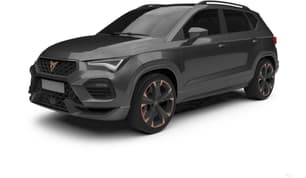
Meet the new Cupra Ateca. Actually, scratch that. Meet the new Cupra, the VW Group's Spanish performance brand that will be launching in Australia around the middle of this year.
Picture a pyramid, and then put VW at the top of it. Bottom left you've got Skoda, a brand that prides itself on practicality and clever features. Bottom right you've got Cupra, which promises to be the fun, sporty and energetic cousin, and to focus on performance, electrified or otherwise. But both are fed from Volkswagen.
Make sense?
The Ateca, then, is a nearly Tiguan-sized SUV that will launch in one hi-po trim level, and a significantly lower starting price than its better-known, R-badged relative.
It also promises to marry family duties with a fun-to-drive attitude. So how does it measure up?
The fact of the Suzuki Baleno's existence is one of the more puzzling features on the automotive landscape. It's a car that pits itself against all manner of worthy competition - some of it exceedingly so - in the small hatch segment.
People still buy what the industry calls light cars (in ever-diminishing numbers) so perhaps Suzuki thought offering two would be a good idea, as its Swift occupies the same patch of sales ground in this city-sized segment.
In this part of the market, you've really, really got to want it. You need to be stylish, sophisticated and packed with tons of safety gear if you've any hope of so much as laying a fingernail on the Mazda2. Or, let's face it, be dirt cheap to counter Yaris and (the soon to depart) Accent.
It's all the more puzzling because Suzuki does interesting cars like the Jimny, Swift, Vitara and Ignis. And the oddball S-Cross (RIP).
The Baleno seems far too tame, timid and, well, blergh. But according to VFacts, Suzuki shifts at least a hundred of these per month, sometimes over 200.
It's a racetrack taste test rather than a comprehensive road drive, but there's plenty to like about the Cupra Ateca, which fulfils its brief of injecting a little driving fun into the SUV space. The only question is whether its sportiness will be too sporty for your day-to-day, but for that, you'll have to wait and see.
CarsGuide attended this event as a guest of the manufacturer, with travel, accommodation and meals provided.
The Baleno is a disappointingly dull car from a company that makes plenty of un-dull cars. I suppose it's prudent for Suzuki to at least try to look like a grown-up, but as this car proves, there's no fun in that.
It will no doubt be dependable and if kept in metropolitan areas, will serve its owners well. But it's lacking in key safety gear, the servicing is a bit on the stiff side and the interior feels cheaper than most of its competitors.
And on top of all that, it feels really old.
Cupra talks about its born-in-Barcelona design inspiration, but you can still see plenty of VW in the Ateca's side profile. But that's no bad thing, with the Cupra managing to look both polished and performance focused, but without looking like it's trying too hard.
The big change is in the front-end treatment, with a smaller centre grille that houses the Cupra badge (which looks a bit like a fox, and a bit like the Decepticon badge from Transformers, but which was actually "modelled on the attitude of tribal civilisations.")
The cool DRL designs, the two-tonne bronzed alloys and the quad exhaust tips all point a pretty strong picture of performance here, and for mine, the Ateca cuts a handsome figure.
Inside, though, it definitely feels a little less premium than modern VW products, with a greater use of hard plastics, and last-gen air-con and media controls, which – if you've driven the new Golf, for example – feel a little old-school by comparison.
Suzuki says the Baleno's look reflects the brand's 'Liquid Flow' design language, but I'd much prefer it if they had stuck with the angular design of its other cars. Almost all of them are far better looking, or at least characterful.
The Baleno's recent facelift, which is mostly a new front bumper and a headlight tweak, was probably supposed to improve the looks but instead the car now appears to have had some fillers pumped into its cheeks.
It's not an attractive car from the front, with the grille overpowered by the lower fascia's sheer breadth. The rear and profile are fairly anonymous and to ensure its anonymity, there is little in the way of adornment. Looks basic, is basic.
Step in to the spacious-for-its-size cabin and you'll be greeted with the usual Suzuki staples of super-hard plastics, hardy carpets and tough cloth trim.
There is a little curvaceousness to the dash design but it just feels a bit half-hearted until the curves run into the centre console's alien-with-flappy-ears effect. There's nothing wrong with it but it does look dated.
The Ateca measures 4386mm in length, 1599mm in height and 1841mm in width, and there is some 485 litres of boot space with the rear seats in place, and a substantial 1579 litres with the back pews folded flat.
It's a strong back-seat story here, too, with ample leg and headroom, individual device charging ports, and a pull-down seat divider that houses two cupholders.
There are two more upfront, as well as storage in every door, along with the ISOFIX attachment points in each window seat in the back.
Now it must be said that our test was conducted on a racetrack, with limited laps, no on-road driving, and no chance to fill the vehicle with passengers or baggage, so for a full practicality play-by-play, you'll have to wait until we get the Ateca through the CarsGuide office for a more comprehensive test.
Here's some excellent news - there is plenty of space in the Baleno's tiddly sub-four metre frame. The awkwardly-proportioned body has delivered good space for front and rear passengers who would be happier on more comfortable seats, but for city driving, they do just fine.
If you're up to around 180cm tall, there's enough space for you and your legs in the back and headroom is adequate.
Storage is a limited to a couple of open trays but you can put your phone in the same place as the USB port. You get two cupholders at the front and if you don't mind losing the rearmost of your storage trays, the back seat passengers can share it as a solitary cupholder. Each door has a very handy bottle holder that will secure a 1.5-litre vessel.
The boot is a good size for the segment at 355 litres to begin with and 746 with the 60/40 split fold rear seat folded down.
Cupra describes itself as an "unconventional challenger brand", and it essentially sits below the mainstream VW line-up, with cheaper pricing and a focus on fun over finery.
So the Ateca – which is about the same size and offers similar outputs to the Tiguan R – lists at $60,990, or $65,990 drive-away, which is significantly cheaper than the VW product, which lists at $68,990 before on-road costs, or – according to Volkswagen's website – $77,279 drive-away for a NSW shopper.
Interestingly, Cupra has launched an agency model in Australia, which means you buy the vehicles from the brand itself, with the transition occurring online and for a fixed price with no negotiation, rather than from a dealer.
The Ateca might not deliver quite the same grunt as VW's R product, but that's a significant saving. Oh, and metallic paint is free, too – as is servicing for the first three years – which means more savings.
So what do you get? The Ateca arrives in a single VZx trim level, and outside you'll find 19-inch alloy wheels, LED lighting front and rear, roof rails, a powered boot, quad exhaust exits, auto headlights and keyless entry and start.
Inside, there's three-zone climate, blue leather-wrapped sports seats that are heated in the front, wireless charging for your devices and ambient interior lighting.
You're well served for tech, too, with the VW Group's 10.25-inch Digital Cockpit, a 9.2-inch centre screen with navigation, Apple CarPlay and Android Auto that works wirelessly as well as when you plug in, a nine-speaker (plus sub) Beats sound system, as well as Dynamic Chassis Control and custom driving modes - including full-attack Cupra mode.
For $16,990 drive away, Suzuki opens the range with this GL. That scores you 15-inch steel wheels with less than fetching hubcaps, a six-speaker stereo, air-conditioning, reversing camera, remote central locking, cruise control, sat nav, auto halogen headlights, power mirrors and windows, and a space-saver spare.
A 7.0-inch touchscreen that you can find in almost every Suzuki handles the sat nav and entertainment duties. It's not a bad piece of hardware except it doesn't have a proper volume knob, but more than makes up for that with Apple CarPlay and Android Auto. Then ruins it again with tinny sound. You can't have it all, I suppose.
Right, so the Ateca's 2.0-litre TSI petrol engine produces 221kW and 400Nm, which is slightly less than the 235kW and 400Nm generated by the new Tiguan R.
But the Cupra is faster, knocking off the sprint to 100km/h in 4.9secs compared to the VW's 5.1secs – and it feels plenty quick from the driver's seat with your foot pinned to the floor.
That power is fed through a seven-speed DSG, with AWD standard fit on the Ateca.
You'll not need to hold on to your hat in the Baleno. The 1.4-litre naturally-aspirated four-cylinder musters up 68kW at 6000rpm and 130Nm 2000rpm earlier. It's not a lot, but at 915kg, the Baleno isn't doing too badly.
There's an old relic in the transmission department. Power reaches the front wheels via a four-speed automatic transmission. There aren't many of those left in circulation on new car forecourts.
You can't buy a Baleno with the plucky 1.0-litre turbo anymore, which is a bit of shame.
Cupra is yet to reveal official fuel figures for the Ateca in Australia, but international guides claim an 8.9-9.5L/100km figure on the WLTP cycle.
That's not a small number, and it's one that will no doubt be made worse if you drive it the way you're almost certainly going to drive it, but such is the price of performance.
The Ateca will also demand 98RON fuel, which will sting at the bowser, too.
Suzuki says you'll get 5.4L/100km on the combined cycle, which isn't too far off reality, our time delivering around 6.6L/100km. Which was remarkable in itself given how much throttle you have to use to move along.
Another bonus is that even though the fuel tank is just 37 litres, you won't spend half your life filling up.
Choosing to launch your new SUV on one of Australia's fastest racetracks shows either supreme confidence or bewildering foolhardiness, but in this instance, it was also a necessity.
See, Cupra is mere months away from official launch now, with orders for launch editions to open in May, and the only vehicles the brand could secure for its media preview were brought in from New Zealand, and unable to be driven on public roads.
And so Sydney Motorsport Park would play host to our first experience behind the wheel of the Ateca, and after only a handful of flying laps it was beginning to feel like a masterstroke.
This is not your average family SUV, and any vehicle in which you can drop the kids at school before clipping 200km/h-plus down the main straight of your closest race track is something to be celebrated.
The downside is that it's next to impossible to tell you what the Ateca is going to be like on your local streets, or whether the sporty suspension is going to be firm enough to shake the hairs loose from your head should encounter some questionable road surfaces.
But I can safely report that the power is prodigious, the steering smooth and confidence inspiring, and the AWD grip impressive in both tight and high-speed bends.
But perhaps the most surprising thing about the Ateca is its ability to feel both planted and agile in dynamic driving situations, with the SUV feeling altogether more stable than the smaller Cupra Leon, and hanging onto the tarmac in corners with more tenacity than the 140kW Cupra Formentor.
On first blush, engagement and enthusiasm are standard fit here, and that's likely no bad thing no matter what your daily commute looks like.
Most Suzukis are fun to drive even if they're on the slow side. The Jimny bounces around like a fat puppy full of sugar, the Swift is a good laugh and the Vitara is quite handy. The Baleno fails to be any of these things, but it's not all bad news.
The first thing you'll notice is the very light steering that makes a high-pitched noise when you turn it.
The second thing you'll notice is the whine coming from the transmission or somewhere very like it, no matter how much throttle you have on. It shifts smoothly enough, though, which isn't very often given the lack of gears.
It's not often I yearn for a CVT, but that might be the better transmission for this car. Yes, I just checked outside for airborne pigs, too.
The Baleno does feel like it teeters a little on its skinny, high profile tyres. It's not a car to drive with enthusiasm, but if you're happy enough with its almost-lively off-the-mark acceleration, which then fades away rapidly, you'll be perfectly happy.
It's not very quiet, though, with plenty of noise passing through the trademark thin sheetmetal and sparingly damped shell. It's light, but you can hear why - there's not much sound-deadening to weigh it down.
On the open road the Baleno further reinforces its credentials as a city car - it wanders around on the tyres, the steering loses all its feel and the wind noise means you have to turn up the volume to either drown it out or make yourself heard.
The Cupra Ateca arrives with a swag bag of advanced safety kit – helped, no doubt, by only launching with one top-tier model – as well as the expected stuff like airbags (there are seven), and the traction and braking aids.
Expect active cruise control, AEB with pedestrian and cyclist detection, side and exit assist systems, front and rear parking sensors and a 360-degree parking camera.
On the road, functions like Lane Assist will help keep you between the lines, Travel Assist provides freeway autonomy, while a fatigue monitor will tell you if you're getting tired behind the wheel.
The Cupra Ateca is yet to be ANCAP crash tested.
Sadly, the Baleno is not among the frontrunners for safety features. It does arrive with six airbags, ABS, stability and traction controls and a reversing camera but misses out on every advanced safety feature we expect to see at least one or two of, such as AEB.
There are two ISOFIX points and three top-tether restraints for the baby and child seats.
The Baleno does not have an ANCAP safety rating.
Cupra are trying to minimise the stress here, so the Ateca wears a five-year, unlimited-kilometre warranty, with three years of complementary servicing built into the purchase price, with five-year packs also available to purchase.
Suzuki has joined the mainstream market herd with a five year/unlimited kilometre warranty for private use (ie not Uber) but there isn't even a solitary year of roadside assist.
Happily, since we last drove the Baleno, service intervals on the 1.4-litre have improved to 12 months/15,000km (rather than the previous 10,000km) and the company also offers five years of capped pricing up to 90,000km.
Services come in between $239 and $499, unless you've somehow covered 90,000km inside the five year window, and then it blows out to $649. That last figure aside, you can expect to pay $1635 over five years (or $2045 if you go nuts on the mileage). It's not especially cheap.