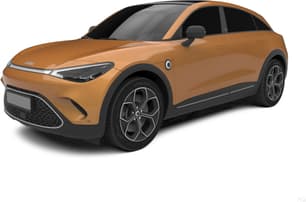
What's the difference?
Hybrid campers tread the line between caravan comfort and camper trailer-manoeuvrability and are touted as somewhat of a new thing; almost an evolution of comfort as more people look for a perfect camping experience.
But camper-trailers like the Cub Longreach LE prove that the concept has been around for decades.
It hasn't always been called the Longreach, but this high-walled, super-sized, off-road camper-trailer was one of the first to offer caravan-like comfort and space in a product that'll go anywhere off-road*. (* In terms of reasonable use and having obviously scrutinised your camper's warranty conditions before setting off to make sure you're covered for that sort of usage.)
The 2019 LE takes the comfort levels even further, so we grabbed one for a night to check it out.
Smart is back.
Not with the classic ForTwo two-seater city car, oddball four-seater ForFour hatch or dinky Roadster targa top. Those were yesterday’s cars.
Today, Smart – as a 50/50 joint-venture between Germany’s Mercedes-Benz (the brand’s originator) and China’s Geely – is all about SUVs. Electric SUVs.
The boxy #1 (pronounced “hashtag-one”) is a small SUV and the sleeker #3 is the coupe-esque performance crossover version. Both are made in China and use Geely technologies.
We take a long, hard look at the range-topping #3 Brabus, the speediest, sexiest and exxiest of the lot. Let’s go.
This isn’t the camper for everyone – my guess is that plenty of people look at this and find it too sparse, too basic. I kinda get it.
But there are very few campers which offer the same amount of open, internal space, or that are as easy to set up.
That the Longreach, albeit with a few different names, has lasted so long on the Cub Campers' product roster is a testament to its versatility and ability to accommodate a small family on off-road camper trips.
It's arguably one of the forerunners of the hybrid camper scene, and it's now starting to evolve with campers' desires for more comfort.
The #3 Brabus is very nearly one of the great bargains of 2024, with the sort of style, luxury, features, performance and grip you’d expect from the much-more-expensive GLA AMG 45. It’s that good.
What would make it great is a sunblock for the hot glass roof on a sunny day, Australian road tuning for the infuriating ADAS tech and a revised steering tune that didn’t make it feel inconsistent at times.
See past these, though, and the #3 Brabus exceeds expectations.
We’re glad Smart is back.
For a rear-fold camper-trailer, the space inside couldn't be more practical. The long body and high sides mean that when the camper is open and set up, it has a lot more space than most. Behind the bed, for instance, there is enough space for Cub to have fit a small dinette.
The dinette has cushioned benches for two and a swivel table that can also become a counter over the rear floor area.
The camper's length also means that the rear floor area is massive. It is easily big enough to lie a couple of kids on, or if your nest is empty, to set up some camp chairs and a table to enjoy a covered living area.
It is still a rear-fold camper-trailer, though so, despite the fact it has nearly twice the space of other hybrid-style campers, it's very sparsely furnished. There's no internal kitchenette or anything like that.
On first approach, you ask yourself whether the #3 is a crossover or a small-to-medium SUV. The low roof and cool frameless doors certainly suggest the former, as do the comparatively small apertures.
That said, with the windows down, those sash-less doors help entry and egress.
Once ensconced inside a long if slightly narrow cabin, the #3 offers ample room for even the tallest adults up front, as well as a reasonably spacious back seat area, though you’d call that more of a '2+1' seater given the lack of girth for three. Most folk shouldn’t struggle to find the right driving position, either.
Presumably keen to impart a generic Mercedes vibe, the #3’s interior is somewhat reminiscent of a GLA’s, albeit from last decade – down to the pronounced T-shape dash featuring a trio of circular vents in the middle, a standalone screen above and (unconvincing) metal-look plastic trim below.
Understandably, like so much of the Brabus, this might appeal to aspiring A45 AMG owners, but it seems oddly dated, given the advanced electrification going on underneath.
Likewise, none of the minimalism cleverness of the ForTwo city-car original is referenced, even digitally. A lost opportunity, really. The OG Smart is an icon.
Meanwhile, ahead of the driver, a narrow digital strip looks twee and cheap, as if ripped from a Japanese 'Kei' car. It’s a strange design detail for a $71K SUV.
Still, the #3’s cabin layout is largely a success, and much of that is due to the first-class quality and finish. Unlike some of the aforementioned Benzes of the previous decade, squeaks and rattles are notable by their absence.
Depending on your body, the racy sports seats up front are either perfectly bolstered or far-too snug, but they provide a decent level of comfort and support. And they position you just right for controlling the centre display, which dominates all.
The 12.8-inch touchscreen feels slick, responsive and right-sized for the car. At first, it can also seem like info-overload and perhaps a bit cheesy with its animal animations, but real thought has gone into it to provide an extraordinary level of functionality.
Across the top are icons for access to media, sat-nav, apps and camera view settings, while the bottom row is for various climate and trip info. While somewhat logically presented, the charging-station list seemed outdated and/or at-times incorrect in our test car.
Mercifully, the Smart has a row of short-cut buttons for 'Vehicle Modes' (including turning off the infernal lane assist and one-pedal accelerator/braking), 'Driving Mode' ('Eco'/'Comfort'/'Sport'/'Brabus'), glass demisters, climate and display-off.
Annoyingly, the latter is closest to reach, revealing the #3’s left-hand drive market bias, as the driver must stretch across to access the first two (and more important) settings.
There are also several handy screen-activated modes including 'Entertainment Mode' that temporarily leaves the accessories and climate control on; 'Rest Mode' reclines the driver’s seat down flat and dims the interior lights; 'Energise Mode' is designed to pep you up; and 'Pet Mode' keeps a climate-controlled atmosphere while deactivating all buttons that a stray paw might press. Clever.
There’s lots more besides, and using the touchscreen is better in this than most other Chinese vehicles, but it remains fiddly and distracting.
It’s also worth pointing out that the fixed glass roof needs a blockout for Australia. A Smart spokesperson said an aftermarket cover is available, but as supplied to us, sitting under it over a run of hot days is almost unbearable without a hat. This is not good enough.
Thankfully, the other basics are all A-OK.
The climate system coped well the hot sun bearing down through the glass, plenty of useful storage makes up for the disappointingly shallow glove box, while the chilled centre console and massive door bins proved especially handy.
USB access is easy, the wireless Bluetooth/Apple CarPlay performed more consistently than in any recent test vehicle and the standard Beats audio brings brilliant sound.
Out back, most people under 180cm should at least avoid scraping that glass ceiling, and there’s a reasonable amount of room for boots and long knees if the front occupants are sympathetic, but you’d be stretching the truth calling the rear seat packaging SUV-esque.
On the other hand, it’s beautifully presented, boasts a comfy and supportive backrest/cushion for outboard passengers and even a do-able centre pew for shorter-distance riders.
And it provides every expected amenity, including air vents, USB-C ports, door storage, a folding centre armrest with cupholders, and overhead handles/lighting/coat hooks.
And while we’ve already complained about the glass roof, it floods the cabin with light, to make it seem airier than it is. Narrow front seats with a see-through slit further enhance this feeling.
Further back, the 370-litre boot is reasonably long and surprisingly deep thanks to a removable upper floor that’s good for stuffing the optional home charging cables in.
And, of course, it can be extended to 1160L via the split-fold backrests to provide extra loading practicality. And there’s even a small (15L) amount of storage under the bonnet.
Maximum towing capacity is 1600kg for a braked trailer.
Cub Campers are famously good to tow, and even the largest of them lives up to the reputation.
As big as it is, the Longreach LE is quite light thanks to the effort Cub puts into engineering. As a result, it's not a strain, even for older dual-cabs like the D22 Navara.
And because it isn't any higher or wider than a modern SUV, there was very little wind-drag or buffeting as we cruised along the highway.
Cub developed the camper's Australian-made and -designed independent, coil-spring suspension and the set-up yields excellent ride in any conditions.
For the LE, Cub has added an extra shock-absorber each side to improve its performance even on the most corrugated roads.
An AL-KO off-road ball hitch is standard but can be upgraded to the Click-Lock version if you'd prefer that or need a more low-profile hitch.
In reverse, the long drawbar makes it an easy camper to manoeuvre around a campsite, plus it has enough size that the tow-vehicle driver never really loses sight of it while positioning it.
Whatever notions ‘Smart’ might evoke, the #3 Brabus obliterates them. This is no buzzy little city-car runabout, but a surprisingly mature and athletic driving machine. This is a seriously rapid performer.
A trio of driving modes give you a hint of what you’re in for. Eco is lightness and fluff. Not very Brabus, but smooth and calm enough for relaxed commuting. And it’s far from slow, scooting off the line with zip and zest. Enough for most.
Comfort is actually a good all-round setting to be in, with an eager yet controlled level of performance. Strong acceleration and instant accelerator reaction show you mean business – if you’re in the mood. Still civilised and serene otherwise.
Sport ups the ante, as you’d expect, providing a decent whack of speed and immediate response. Actually, this is enough to keep up with most sports car costing thrice the price, while maintaining the driver-assist safety net. Fun without the fear.
Brabus mode is off-the-leash fury, turning the #3 into a convincing AMG alternative thanks to blistering thrust and a powerful punch across the spectrum. More (artificial) noise, more drama, more speed, more fireworks. The 'Launch Control' pins you to your seatback.
Yet even in the latter setting, the Smart behaves with a maturity beyond the brand’s reputation, capable of quick corners with exceptional (AWD-enhanced) body control and roadholding grip, without a punishing ride.
Underneath, a unique suspension tune for the MacPherson-style struts up front and multi-link rear end keep the Brabus hunkered down more effectively at speed.
And even in pouring rain, there are no complaints about the Brabus’ assured and confident handling. Yes, the suspension is firm, but it’s far from uncomfortable, so, an acceptable trade-off.
Plus, though not strictly one-pedal driving, the regenerative braking pressure is enough for slowing down and speeding up in the ebb and flow of traffic in its strongest mode.
Where we’re less happy is in the #3’s steering. It brings three weight modes to the table – but only two are useful, 'Light' and 'Standard'. Super-easy yet not totally devoid of substance, Light is great for around town and general commuting.
But when you lean on it at speed, the steering, whilst crisp and reactive, is not always linear in feel or motion, especially when accelerating at the same time, as you might when coming out of a fast corner.
Depending on how hard you are on the accelerator, there can be a visible step when turned from the straight ahead that can be quite disconcerting. It’s a bit like when slurping in a lumpy bit in a smoothie.
So, what about 'Sport' mode? Here, the steering is just as described above, but with added weight and not much more. Not worth it. Best is Standard mode.
Another disappointment is the advanced driver-assist safety (ADAS) tech’s state of tune. It’s in a state, literally.
The intrusive and apparently non-permanently switch-off-able lane-keep systems, especially, end up resisting what the driver intends, and even fight to steer the car where it thinks it needs to be. This is frustrating and potentially dangerous.
It’s been reported that Geely, and not Mercedes, undertook the development of these ADAS systems. We’re getting sick of (mostly Chinese) manufacturers rolling the arm over and imposing this sort of nannying and ultimately counter-intuitive driving interference tech.
This needs to be fixed. It stops the #3 Brabus from being a great performance bargain.