What's the difference?
Citroen's C4 Cactus made quite an impression. A polarising machine, it was the Frenchest French car for ages which translated into almost no local sales but admiration for the bravery of those who signed it off.
It did quite well in its home market though and its designers took note. When the company turned its attention to a smaller SUV based on the C3 hatchback - complete with the baffling Aircross name - the Cactus was an obvious inspiration.
With the Hyundai Venue on the scene - as well as a wealth of larger machines at lower prices - the Citroen C3 Aircross needs to be good to justify a big sticker price.
I know, picture Ferrari and you'll likely be conjuring images of potent V12 or V8 engines, a scenery-shaking exhaust bark on start-up and a fuel bill that would make a Sheikh wince.
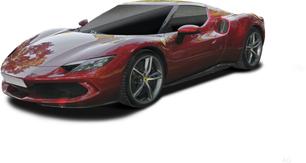
But this one, the 296 GTS, doesn't have, or do, any of those things. In fact, it doesn’t so much explode into life as it does kind of whirr gently, as though you’ve just switched on a photocopier.
And yet, people I trust on these matters reckon this just might be the best Ferrari to have ever worn the badge. So, I guess we better get to figuring out what the hell is going on with this plug-in Prancing Horse.
It's a good car, no question. Individuality is key to Citroen's brand appeal and you get that, too. A comfortable cabin, plush ride and hot damn, it's way too expensive, which is a crying shame. You could argue - as Citroen's product planners probably have - that it doesn't help to offer one in the mid-$20K mark because it won't make much money because so few people will buy it. Drop it at a premium, only lose a few opportunistic buyers but make more money per unit with committed fans? Why not, I guess?
Like most French cars, I'm glad it exists for weird French car fans like me to consider.
Anyone who says electrification somehow muddies the Ferrari formula is wrong. This plug-in Prancing Horse is among the most potent and direct vehicles I’ve ever driven, and the electric motor only adds to the experience.
As you might imagine, it's an individual design. Lots of Cactus cues, like the roof rails, bluff front end and stacked headlights Hyundai, uh, appropriated for the Kona. Curiously, no 'airbumps' along the side despite the C3 hatch having them...
The 17-inch wheels somehow look tiddly given the airspace over the wheels and I can report that black is not really this car's colour, even with the contrasting white roof and weird Mazda 121 Shades special edition venetian blind treatment on the quarter window. Bit of an '80s throwback there for you.
Lots more Cactus inside though, starting with the brilliant front seats, squared-off steering wheel and funky air vents. The little tray on top of the glove box is good, but it isn't rubber-lined, so that's annoying.
The Top Gun handbrake is hilarious but apart from the texturing of the fabric on the seats, it's a tad dark below the windowline.
It is hard not to swoon when you gaze upon the 296 GTS, and I say that with no bias - I don’t think all Ferraris have looked this good.
But this is Ferrari at its dreamy, sweeping best, from the tarmac-kissing front — which generates so much downforce and cooling it negates the need for active aero — to its swollen haunches and the glass-topped engine window.
So what’s the difference between this and the GTB? Largely it is the ability to drop the folding roof, meaning you can feel the wind in your hair and that exhaust in your soul. To be honest, though, I reckon it looks better top up...
It’s a cockpit-style driver’s set-up inside, and there’s lots I love and some things I don’t. But let’s start with the steering wheel, which might be one of the best in existence.
It feels magic under the touch, as do the giant flappy paddles which remain fixed in place as you turn the wheel.
It’s also surprisingly comfortable in the figure-hugging sports seats, though climbing in and out of them is not necessarily something you want to do in front of a crowd.
Downsides? There is plenty of tech in the 296 cabin, but it’s all controlled from the steering wheel, making it fiddly and annoying to use.
Also, there are F1-levels of complexity on the control-everything steering wheel, and if I’m being honest, there are some buttons or switches, the function of which I still don’t fully understand.
Even for a little car, the Aircross could do better. The lack of a proper cupholder provision for the car - a solitary spot at the rear of the centre console - is mildly baffling until you remember that this car is from France. The French hate a cupholder but, obviously, you can fit wine bottles in the doors.
It's worth repeating just how comfortable and supportive the front seats are on any given journey. Broad but supportive and somehow perfectly sprung, I would cheerfully rip out most other front seats and replace them with these.
The rear seats are less of these things and anyone who forces anyone to use the middle seat should be ashamed of themselves. The headroom is good back there, though.
The boot is a big one for the size of the car, swallowing 410 litres and expanding to 1289 litres with both rear seat sections folded.
What do you want to know around practicality? We’re talking two seats, about 200 litres of cargo space total and a couple of smallish storage spaces in the cabin. And… that’s about it.
Next question, please.
A perennial Citroen problem is the price - at $32,990, the tiny SUV is doing battle with cars that are really a size up, coming in closer in size to the Venue than, say, the ASX.
That Yaris Hybrid price (we're all still reeling from that number) scores you a 17-inch alloys, a six-speaker stereo, climate control, front camera, reversing camera, keyless entry and start, front and rear parking sensors, cruise control, sat nav, halogen headlights (yep, you read that right), head-up display, leather wheel and shifter, auto parking, auto wipers and headlights, wireless charging pad and a space-saver spare.
The central touchscreen is annoying in that there are almost no hardware switches for functions like climate control. The software is a bit on the slow side, too, but you do get Android Auto and Apple CarPlay. The stereo is fine.
Okay, hold your breath for a moment. The 296 GTS lists at $668,146, which is a sizeable jump over the hard-top GTB, which is more like $551,800. But what price a little open-air freedom?
What you get for that investment is a two-part (solid) folding roof, of course, but also what might be Ferrari’s most high-tech offering to date, with a plug-in hybrid system delivering potent performance rather than a usable EV driving range, a mega-clever braking system and an almost telepathic six-way 'Chassis Dynamic Sensor' designed to link the car’s key functions to make the experience, and the driver, somehow better.
Elsewhere, there are sports seats, Matrix LED headlights, 20-inch alloys, keyless entry and a very cool engine start touch-button on the even cooler steering wheel.
Oh, and there's wireless charging and Apple CarPlay, both thankfully standard in Australia, the latter controlled through the steering wheel and digital driver display.
It's all beautifully finished and a joy to behold and sit in.
One of the great engines in mass-produced road cars today has found its way under the bonnet of the Aircross. Peugeot-Citroen's 1.2-litre three-cylinder turbo is a cracking engine, serving up 81kW/205Nm through a six-speed Aisin-sourced auto to the front wheels.
While the 11.8-second dash to 100km/h is, uh, leisurely, the torque figure means that on the move it's not as sluggish as that number or its 1200kg kerb weight would suggest.
Now we're talking. The powertrain here is both tremendous and terrifying, pairing a 3.0-litre twin-turbo-petrol V6 with a rear mounted electric motor, and a 7.5kWh battery, to deliver a total 610kW and 740Nm. That power is fed through an eight-speed dual-clutch auto transmission.
Those are, frankly, scary numbers, and enough, Ferrari says, to dispatch 100km/h in just 2.9 seconds, and to push on to a top speed of 330km/h.
Citroen claims a handy 6.6L/100km on the combined cycle and my week with the fizzy Frenchie included a trip over the hills and far away as well as a lot of suburban running.
The digital display on the dashboard read 7.3L/100km, which isn't bad going without stop-start. It does require 95 RON premium fuel, though.
As well as the ability to start up and slink away silently, the Ferrari 296 GTS’s little battery will deliver a 25km EV-only driving range, and contribute to the overall claimed fuel use of just 6.5L/100km.
Charging is AC only, and the the brand reckons it takes around 90mins to top up using an 11kW charger. The self-charging is on-point, though, with the Ferrari able to quickly recoup energy from braking and the like to top up the battery without needing to plug in.
French cars have a very specific audience in this country, which includes weirdos like me. I've owned Peugeots and Renaults and loved every second of it.
Top of my list after my darling baby boy wrote off our family car (which was bought for him to drive), the Cactus was close to the top of the list. This fandom isn't blind, though - I know what I'm getting myself into having to dispassionately assess their faults and foibles as well as their triumphs and tangible benefits.
If I'm being honest - and it's just you and I here - I didn't think I'd like the C3 Aircross, there was just something about its SUV pretensions. I can't say the looks grabbed me and the inexplicable exclusion of the airbumps made me irrationally cross.
But once you slip behind that square-ish wheel into the comfortable embrace of those excellent seats, you forget the aesthetics (which did grow on me, even in black).
The 1.2 turbo is, as ever, eager to please and well-matched to the six-speed auto. The two work well together to get you moving, although the engine is the noisiest installation I can remember. In the Peugeot 308, it's virtually silent.
On the move, the lovely ride also impresses, soaking up the bumps (except those aggressive rubber speed humps in shopping centre car parks) while keeping body roll to an acceptable minimum.
It's perfectly fine in the suburbs, even with its limited power. Breaking into traffic can be a bit of a moment, but there are slower cars about.
Where the Aircross is really good is out on the freeway. It's quiet for such a small car and that torque figure makes joining the M4 freeway (west out of Sydney) fine, and it cheerfully kept up on the climb up the Blue Mountains and the brakes and transmission were great down the other side.
Citroen is unashamedly about comfort over handling, but the trade-off for the comfort is pretty good in that it still handles despite a plush ride and being up on stilts.
The engine is undoubtedly a highlight, and we’ll get to that in a moment, but I first want to talk about the steering in this car.
It might sound like a weird point to get hung up on, but it is sensational, and maybe the best I’ve ever experienced. Generally speaking, super-responsive steering can risk feeling overly sharp and uncomfortable when cruising, but somehow the 296 manages to feel super natural, super responsive, and super engaging, without every feeling sharp or darty. It’s just predictable, responsive, and spectacular.
Honestly, it is a highlight of a drive experience filled with highlights, with another being the dual-nature of this drop-top supercar. Long before I got anywhere near a twisting road I needed to navigate the usual nightmare that is Sydney, tackling traffic, suburbia, freeways, tunnels and expansion joints galore, and the 296 never felt uncomfortable.
Instead, the 296 slipped into a comfortable kind of lope, never jarring or rough, and eminently easy to get along with. And yet, when you arrive on the right road that veil of sensibility drops, and the Ferrari quickly reminds you of its potential.
For a start, the acceleration is properly, startlingly aggressive. Engage the 'Qualification' drive mode (which unlocks the full might of the Ferrari's electrified powertrain) and flatten your right foot, and you'll find the world suddenly hurtling past your windows, and your knuckles will no doubt whiten as you feel the rear tyres fighting for traction against the onslaught should you try it on anything but the straightest of roads.
It's addictive, but it's just one element of a near-perfect combination on offer here, with the 296 GTS the stiffest Ferrari drop-top to date, which becomes immediately clear as you start to attack corners with ever-growing confidence.
Grip, stability and stiffness in spades, the GTS delivers. And all accompanied by an exhaust howl so angry and evil it’s hard to believe it’s being generated by a V6.
It’s a thing of very near perfection.
Along with six airbags, ABS, stability and traction controls, the Aircross has low-speed AEB (up to 30km/h), blind-spot monitoring, lane departure warning, driver attention monitoring and speed sign recognition.
Three top tether anchors and two ISOFIX points complete the picture with a five-star Euro NCAP rating dating back to 2017. There is no corresponding ANCAP score, despite the agreement between the two agencies.
Not much chance of the 296 GTS being crash-tested in Australia — you’d be able to hear the Italians weeping across the ocean.
You do get front and side airbags parking sensors, a reversing camera, auto high beam and tyre pressure monitoring.
Citroen offers a class-competitive five-year/unlimited kilometre warranty with a five year service plan if you want to pre-pay.
That plan costs a stiff $2727 for your five visits (or every 12 months/15,000km). That's nearly three times what you'll pay for a C-HR or about $400 more than a Mazda CX-3.
Standard is a three year warranty, but you can extend that for up to five years. Then, if your car has less than 90,000km on the clock, you can opt into the 'New Power15', which gives you up to 15 years total warranty coverage and is fully transferable.
The first seven years scheduled maintenance is free-of-charge.