








True, the original Model T with its foot-operated gears was bordering on weird by modern standards, but it was produced in such numbers that it defined the mainstream.
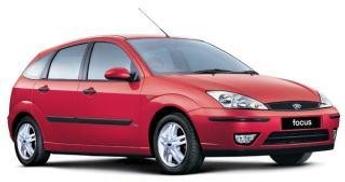
The Ford Focus by contrast joins the mainstream in midstream. It's a typical modern European Ford, thoroughly researched and conscientiously engineered. The result is far from radical but it is impressive. Cars designed to sell by the million are limited by the boundaries of public taste, but their huge production numbers mean opportunities for engineers to spend time refining the niggly little things while keeping costs reasonable.
Like the previous Focus, the new model is a high-bodied small car. Park one next to a Ford Laser from just four years ago and the difference is dramatic. While the Laser now seems cramped and low to the ground, there's head room to rival large cars in a Focus, despite the high-set seat cushion. A nice touch is that most drivers can still see the bonnet for low-speed manoeuvring. The boot in the hatch version is usefully sized while in the sedan it is truly enormous at 510 litres — although space in both is achieved at the cost of a compact speed-limited spare wheel.


The previous Focus had a unique interior with the sort of slashes and curves that result when designers are allowed to run free. The new model has a much more restrained dash design with echoes of Volkswagen Golf and BA Ford Falcon. Although it looks good, plastic quality to the touch is not quite up to Volkswagen standard and hardly better than the Falcon's.
There were trim rattles, a silver garnish that came loose from the handbrake lever and a driver's door that needed a mighty slam to shut properly on one of the test cars, raising quality questions about workmanship at Ford's factory in Pretoria, South Africa, where Australia's Focuses are made. But a second car we drove had none of these problems.
Actually, there is one thing the previous model Focus had in common with the Model T. The Focus was the first Ford in many years to be sold on all continents in essentially the same form. But it never had the success here that it saw in Europe and North America.
Uninspiring engine performance was one reason. The previous Focus came with several engines, a 1.8-litre and two separate 2.0-litre designs. On low-octane Australian petrol none felt as powerful as their specifications suggested. The new model takes the opposite approach with one engine driving all models.
The range consists of CL, LX, the sporting Zetec hatch and the fully loaded Ghia sedan. The only mechanical difference between grades is larger wheels and firmer suspension on the Zetec model.
In typical Ford fashion, the new Duratec engine shared with Mazda is thoroughly up-to-date without being cutting edge. For example, the engine block has been made stiffer for less noise and the alternator and aircon compressor are now mounted on the block rather than on brackets, again to reduce noise. Chain-driven valves require no adjustment for 250,000km, the spark plugs are designed to last 60,000km and there's an electronic throttle.
What all this adds up to is a much better engine. Critically, it no longer feels short-changed in Australian conditions. Stated fuel consumption of 7.1 litres per 100km is a 20 per cent improvement on the old model's 8.7 litres and is competitive by class standards. We got nowhere near that figure on test, however, with a result of 9.2l/100km.
More memorable than the Duratec's peak power is its easy-going ability to run smoothly and economically at low speed in high gears.
Those gears in the manual Zetec are nicely arranged, with a light, yet satisfyingly snickety action through the lever. The automatic sampled in the Ghia model is also above average in shift quality and timing for an auto in a small European car. But it has only four speeds, two short of the best in the class.
Handling was one of the few high points of the previous Focus and it's just as good in the new model. Like the two other cars built on its platform — the Mazda 3 and Volvo S40 — it's a very well sorted design.
Ford has sweated the details to create a car that feels right. The engineers who beavered away on matters as obscure as optimising torsional rigidity of the steering column did not waste their time. Nor did those who developed an electro-hydraulic power steering system that feels as natural to use as traditional engine-driven power steering. Turn into a corner and there's a quick initial response followed by a feeling of commitment as the rear wheels take their share of the cornering load. Impressive roadholding is accompanied by sensations of lightness, tightness and rightness. Pardon the expression, but it feels focused. While the Zetec is the sharpest handler in the range, all models share the same pleasing feel.
Ride is European, meaning that while it deals with bumps well it never creates an impression of softness or plushness. It's a small price to pay for precision and response on the road and the car is never harsh or jarring, even in the firmer sprung Zetec version.
What does jar is the lack of side curtain airbags and electronic stability control. ESC is an electronic system that detects when a car is about to skid and takes control to guide it through a corner. It's worth having and the fancier Focuses that pour from the Ford works at Valencia in Spain and Saarlouis in Germany have it and side curtain airbags too. But side curtain airbags were deemed too expensive for the South African market and Ford Australia turned down ESC for this Focus.
In its defence, Ford Australia says the take-up rate for the ESC system offered on the previous model Focus Zetec was under 1 per cent. Under their breath they say those buyers were mostly Ford staff who were both informed on safety matters and given a substantial employee discount. It's also true that the Focus's unusually tactile handling means it requires ESC less than a clumsy SUV would. But the lack of two modern safety systems is at odds with the up-to-date image the new Focus otherwise projects.
Those omissions and doubts over build quality might stop some buyers in the showroom. Supply problems from the South African factory mean some buyers might not even get to see a Focus in the showroom. But those who get behind the wheel of one are more likely to be convinced.
Related cars for sale on CarsGuide
See more Ford Focus for sale View cars for saleFord Focus 2005: Cl
| Engine Type | Inline 4, 1.8L |
|---|---|
| Fuel Type | Unleaded Petrol |
| Fuel Efficiency | 8.0L/100km (combined) |
| Seating | 5 |
| Price From | $2,040 - $3,190 |


Pricing Guides
Range and Specs
| Vehicle | Specs | Price* |
|---|---|---|
| Cl | 1.8L, Unleaded Petrol, 5 SPEED MANUAL | $2,040 - $3,190 |
| Lx | 1.8L, Unleaded Petrol, 5 SPEED MANUAL | $1,820 - $2,860 |
| Sr | 1.8L, Unleaded Petrol, 5 SPEED MANUAL | $2,640 - $4,070 |
.jpg)


.jpg)
.jpg)
.jpg)
.png)
.jpg)
.png)
.jpg)
.jpg)


.png)




