What's the difference?
The Cadillac Lyriq really flies in the face of what has become our reality in the world of new cars.
It’s a brand-new, EV-only brand in Australia, but for once, it’s not Chinese.
It’s built in America and shipped to Australia, but it’s not converted from left-hand drive by Walkinshaw or a similar outfit. It’s built in right-hand drive at the factory for us.
And it’s a new player fighting for market share, but it’s not really trying to massively undercut its premium competitors, with the range kicking off north of $120,000.
So, iconic American brand Cadillac seems destined to do things a little differently with the Lyriq. The question is, is it good enough to forge its own path?
Let’s find out.
There's something about Italy and four-wheeled transport. Even the most functional vehicles developed there somehow morph into high-performance hot rods.
For example, as the SUV phenomenon has swept the world Alfa Romeo, Ferrari, Lamborghini and Maserati have more than matched the German big three and others in elevating the humble family truckster to supercar status.
And the Grecale Trofeo is the latest example of Maserati's inability to let an SUV be simply practical. It's a mad twin-turbo V6 all-wheel-drive version of the more typically four-cylinder-powered mid-size SUV.
We spent a week with this ferocious beast to see how much spice it can add to family life.
It's got a couple of quirks, but the Cadillac Lyriq is a pretty convincing, and definitely American, take on a premium electric vehicle in Australia. The only issue, I think, is that, while the brand is obviously iconic in the USA, it's not that well known in Australia, and we are a market now awash with pretty good, and often much cheaper, EVs from China. It's a hyper-competitive market. Only time will tell if Cadillac can convince Australians that its badge belongs among the European premium marques.
In its surprisingly crowded premium performance SUV segment, the Maserati Grecale Trofeo offers something different. Next to the X4s, GLCs and Macans of this world, it's quietly confident and charismatic with the performance, practicality and value to back up its distinctive good looks. Despite some gripes around warranty, fuel consumption and ride compliance, it's a compelling alternative to those more predictable choices.
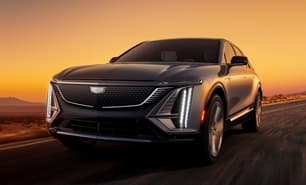
The Cadillac looks… well, it looks American, right? A kind of difficult-to-describe Americanness that’s somewhere between an SUV and state car.
That’s not an insult, by the way. I personally think the Lyriq looks kind of pretty, with its bold elements countered by the surprisingly gentle touch applied in places, like its razor-thin daytime running lights (DRLs).
I’ve got to say, it doesn’t look much like any of the other new SUVs arriving, or a knock-off German brand. It’s got its own persona.
The cabin of the Lyriq is predictably plush, with comfy massaging seats, soft-touch materials and plenty of tech, but it is a little shiny and busy in places for my tastes. Minimalist this is not.
But I do like the fact that – when I’ve got Apple CarPlay hooked up – I can just leave the screen be. My driving stuff is accessed by the wheel, and everything else I want is accessible through physical buttons.
There are some strange elements, though. The grab handle on the driver’s side, which isn’t replicated on the passenger side, is odd, and likely a byproduct of the factory moving the steering wheel. Some of the central storage bins are too small to be really useful, and I hate gloveboxes that can only be opened through the screen.
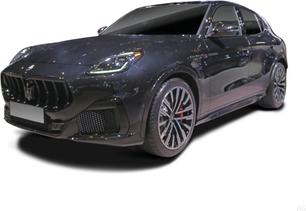
At close to 4.9m long, a fraction under 2.0m wide and less than 1.7m tall, the Grecale is a 'large' medium SUV with a robust, thick-set look and a low-key design approach relative to its often more overtly muscular competitors.
Signature Maserati elements include a trio of porthole vents in the front fenders, the broad vertically-slatted grille with trident emblem sitting proudly in the centre, and a smaller version of Neptune's weapon of choice adorning the broad C-pillar.
There's also more than a touch of MC20 around the raked headlights (including the DRL signature), a pronounced splitter-style nose piece and broad intakes on either side.
Staggered 21-inch rims fill the arches perfectly, while pronounced side skirts and a gently sloping turret also dial up the sporty look.
The rear is sleek, but again relatively low-key, the major clues to the car's performance potential being the quad exhaust outlets and the carbon nose panel, side skirts and diffuser.
The interior feels sleek and VIP special thanks mainly to the multi-tier dash design, quality of the materials used and multiple screens.
A central 12.3-inch multimedia touchscreen sits above an 8.8-inch 'comfort' screen devoted mostly to heating, ventilation and vehicle settings.
They're tied together in a single, angled panel that looks like an oversized foldable smartphone. Very cool.
The 12.3-inch digital instrument cluster is configurable through multiple custom set-ups and this time around the distinctive dashtop clock is in fact a small screen switchable through classic and contemporary faces.
It can also emit a response signal when it receives a voice command or morph into a G-meter.
From there, the double saddle stitched perforated leather trim, exposed carbon-fibre elements and brushed metal finishes complete a highly polished cabin environment.
It’s a big boat, the Lyriq, stretching more than five metres long and almost two metres wide. That’s not much shorter than, and in fact slightly wider than, something like a Nissan Patrol, just to put it into perspective. Though of course it’s nowhere near as high as a proper 4WD.
Predictably, though, its dimensions mean plenty of room in the boot, which opens to reveal a very useable 793 litres of luggage space. Drop the seats, and that number grows to a massive 1722 litres.
But the Lyriq does without any spare wheel of any kind. A tyre repair kit is your only option.
Now, the backseat. And I know this is likely only of interest to parents of newborn babies, but that’s me, so I noticed. These are some of the best ISOFIX attachment points I ever used. Usually you’re fumbling around between the seat cushions trying to line up the latch points, but the Lyriq's solution — while perhaps not the most visually alluring – puts the brackets beneath plastic lift-up flaps, and they're so damn easy to use.
But there are some quirks in the backseat, too. Those same ISOFIX attachment points, which are so great for baby seats, are less great for the adults actually sitting in the back. You can feel the hard plastic covers, and what feels like the bracing bar running across the backseat, beneath the cushions. It's not diabolical, and if you shift your rear-end forward slightly you can't feel it at all, but it's a strange quirk all the same.
Elsewhere in the backseat, there is plenty of room for backseat riders, and you can control your own temps, too.
At close to 4.9m long and nearly 2.0m wide, the Grecale is a big medium five-seater and with a 2.9m wheelbase to play with, interior space and practicality are more than respectable.
There's plenty of space up front and in terms of practicality, decent door bins, two cupholders in the centre console, a lidded oddments tray in front of them (housing USB-C and USB-A sockets), a large lidded box between the seats (which doubles as a centre armrest) with a 12-volt outlet lurking inside as well as a generous glove box.
Sitting behind the driver's seat set for my 183cm position, there's plenty of head, leg and foot room, not to mention a surprising amount of breathing space in general.
Enough width for three adults on short journeys and up to teenage kids will be fine. When it comes to baby capsules or child seats, you'll be good with two but three is a bridge too far.
For storage, there are door bins with room for large bottles, hard-shell maps pockets on the front seatbacks, adjustable ventilation as part of the three-zone climate control system, a fold-down centre armrest including two cupholders and a slot for a phone in between as well as another pair of USB (A and C) sockets.
Boot volume is a healthy 570 litres with all seats up, which is 35L more than the lower GT and Modena grades because rather than a space saver spare, the Trofeo cops a repair/inflator kit. Boo...
It's enough room to fit our three-piece luggage set or the CarsGuide pram with ease, and the 40/20/40 split-folding rear seat liberates even more space.
There are seat release handles in the cargo area as well as multiple tie-down anchor points, a 12V outlet, bag hooks and a two-piece load cover set-up to deter prying eyes.
You can have your Cadillac Lyriq in two flavours — the Luxury, yours for $122,000 plus on-road costs. Or the Sport, which is two grand more, listing at $124,000.
Perspective time. The new Polestar 3 starts at around $118k, but climbs to more than $130k for the dual-motor options. The similarly sized BMW iX starts at more than $140k, and the Mercedes-Benz EQE is north of $135k. So if you consider the Cadillac a ready-made premium brand, then its looking like a relatively sharpish one.
Cadillac says the changes between the trims largely focus on the “aesthetic signature” rather than any major equipment differences. The Luxury gets chrome highlights, for example, while the Sport gets a darkened design theme, including the wheels, body highlights and windows.
Both trims are otherwise identically equipped, which means 21-inch alloy wheels, full LED lighting, an electric sunroof, an auto-opening boot and a touch-to-open charging port.
Inside, there’s a 33-inch digital dash, with Apple CarPlay and Android Auto, wireless device charging, a thumping 19-speaker AKG stereo and USB connection points galore.
The leather-wrapped front seats have heating, ventilation and a massage function, there’s heating and cooling for the window seats in the back, tri-zone climate control and there’s 126-colour ambient interior lighting.
At $174,900, before on-road costs, the Grecale Trofeo sits in the middle of a pack of performance-focused mid-sized SUVs spanning a roughly $50,000 price band from around $140K to $190K.
Specifically, the Alfa Romeo Stelvio Quadrifoglio ($162,700), BMW X4 M Competition ($185,200), Jaguar F-Pace SVR ($153,570), Mercedes-AMG GLC63 S ($191,800) and Porsche's Macan GTS ($141,700).
That's a quality competitive set and to keep its head above water the Grecale Trofeo comes with a solid standard features list.
Aside from the performance and safety tech we'll cover shortly, highlights include the 21-inch alloy rims, auto LED headlights, 14-way adjustable heated sports front seats (with driver memory function), an electrically-adjustable steering column, alloy door sill finishers, full leather upholstery, 14-speaker Sonus Faber audio (with digital radio), three-zone climate control (with rear touchscreen), a panoramic sunroof and ambient lighting.
Then there are the screens for multimedia (12.8-inch), instrumentation (12.8-inch), ventilation and vehicle settings (8.8-inch) and the multi-mode clock, as well as ambient cabin lighting, adaptive cruise control, a power tailgate (with kick control), Android Auto and Apple CarPlay connectivity plus layers of carbon inside and out. Impressive, even in the 'around $200K' part of the market.
All Aussie Lyriqs are dual-motor affairs, with an electric motor at each axle producing a total 388kW and 610Nm, which in a car this big, which weighs just under 2.7 tonnes, is more than enough to get the Caddy up and moving, but not enough to make it feel like a supercar. The two motors mean AWD, of course.
Lurking under the Grecale Trofeo's bonnet is a 'wet sump' version of the 3.0-litre twin-turbo 'Nettuno' (Neptune) V6 that also found a home between the axles of the Maserati MC20 supercar.
It produces 390kW, which is well in excess of 500hp, and grinds out enough torque (620Nm) to pull a small cottage off its foundations.
It's brimming with performance and efficiency-focused tech. Everything from twin-spark dual-chamber heads and cylinder deactivation to high-pressure direction-injection and variable valve timing.
Drive goes to all four wheels via a ZF-sourced eight-speed auto transmission and an all-wheel-drive system incorporating an electronic self-locking limited slip diff at the rear.
The Lyriq is equipped with a 102kWh lithium-ion NCMA battery, which delivers an ok 530km on the combined cycle. I say 'ok', because the BMW iX offers 600km-plus, while the dual-motor Polestar 3 is more like 630km claimed. Energy consumption is a claimed 22.5kWh per 100km on the combined cycle.
When it comes to plugging in, the Lyriq is set up for 190kW DC fast charging, with the brand promising 128km of range in 10 minutes, or 10 to 80 per cent in just under 30 minutes. At home, a 7kW wall ox will deliver more like 43km an hour.
Maserati's official combined cycle fuel economy number for the Grecale Trofeo is 11.2L/100km, emitting 254g/km of CO2 in the process.
We covered urban, B-road and freeway running, not to mention some enthusiastic driving along the way, and recorded an average of 16.9L/100km. Which is thirsty, but not outrageous relative to the competition.
The fuel tank requires 64 litres of 95 RON premium unleaded to fill it which translates to a theoretical range of around 570km, dropping to just 380km using our real-world number.
Even if you're okay with the Trofeo's hefty consumption rate, regular visits to the fuel pump will be kind of a pain.
The first thing you notice behind the wheel of the the Lyriq is just how whisper-quiet it is on the road. Cadillac makes a big deal about its 'Active Noise Cancellation' tech that's deployed here – it uses sensors to monitor road vibrations and the like, and then uses the car's stereo to create what it calls an 'anti-noise' signal.
It all sounds pretty high-tech and complicated, but it also works, with the Lyriq a seriously quiet and composed way to get around, with only the artificial EV noise really noticeable in the cabin.
Even travelling past freeway speeds, the Lyriq remains quiet, which does lend the whole experience a sort of premium vibe.
The Cadillac is also one of those cars that thinks solidity means premium, from the solid 'thunk' of the doors shutting to a general heft and weight to the steering, there's nothing feather-light or agile about the Lyriq experience, but it does all feel a little artificial, and like it's trying to be heavy on purpose.
The Lyriq, then, is no out-and-out performance car – it's 2.5-tonne-plus kerb weight and Olympic swimming pool dimensions largely put an end that – but it's more than brisk enough to get up and moving, with its twin-motor powertrain finding grip even in slippery conditions. It's brisk, but not brutal.
The Lyriq hasn't been tested or tuned in Australia, but happily it doesn't have that floaty, wafty suspension style so popular in the USA. This one feels to have at least had an international tune, which removes some of that marshmallow softness and makes you feel connected to the road.
The steering, too, feels direct enough and easy to predict, and the overall impression is one of quiet, calm motoring, which is probably what it says on the tin of any premium vehicle.
Engage the standard launch control function, step through the blast-off procedure and Maserati says you'll rocket from 0-100km/h in 3.8 seconds, which is supercar fast.
And the way this twin-turbo V6 delivers that kind of performance is impressive; beautifully linear without a hint of lag.
Trundle along at 60km/h, pin the throttle and you'll be in 'lock 'em up and throw away the key' territory in the blink of an eye. This is a full-blown rocket sled.
All 620Nm of peak torque is available from 3000-5500rpm with maximum power (390kW) arriving at 6500rpm. No matter which drive mode you've selected (more on that shortly), thunderous performance is only an extension of your right ankle away.
And the aural accompaniment walks a perfect line between potency and civility, the signature Maserati exhaust growl stepping up a notch in the racier settings but rarely crossing over into bellicose 'boy racer' territory. We have no problem with an occasional pop and bang on the overrun!
At a touch over two tonnes, the Grecale Trofeo is far from a featherweight, but when you're racing up and down the quick-shifting auto transmission's eight ratios, it feels like one.
The elegant alloy, column- (not wheel-) mounted 'manual' shift levers add to the fun and there are five drive modes to play with - 'Comfort', 'GT', 'Sport', 'Corsa' and 'Off-road' - adapting the engine, transmission, steering and suspension.
The track-focused Corsa set-up starts to soften off some of the traction and stability controls, so we didn't go there, but can confirm off-road raises ride height by 30mm (FYI, we didn't head off-road, either).
Suspension is by double wishbones at the front and multi-links at the rear supported by active dampers and air 'springs' all around.
In the softer Comfort setting, ride compliance is on the firm side. Never harsh, but a little more communicative in terms of bumps and thumps than you might expect.
Not for the first time I found the best arrangement was Sport, dialling everything up to racier settings, and the suspension in 'Comfort' which can be achieved with the press of a wheel-mounted button.
The electrically-assisted rack and pinion steering is accurate and quick to respond with excellent road feel thrown in for good measure.
Just beware the flip side of this type of 'quick' steering rack is invariably a large turning circle, and the Grecale Trofeo is no exception.
The staggered 21-inch rims are shod with high-performance Bridgestone Potenza Sport rubber (225/40 fr / 295/35 rr) and the AWD system, complete with rear LSD, help the car feel securely planted and balanced in quick cornering.
Braking is professional grade with big ventilated and cross-drilled rotors front and rear with fixed Brembo calipers at both ends - six piston front and four-piston rear.
Maserati claims the Grecale Trofeo will slow from 100km/h to a standstill in less than 40m, which is not a lot of metres from that speed.
I had one telling 'will I, or won't I?' situation when presented with an amber light and in deciding to give the brakes a workout (there was no one behind me) was rewarded with a secure and insanely rapid stop.
In terms of general observations, the placement of the start button and drive-mode dial on the steering wheel is a nice touch, the front seats are superb in terms of support and comfort, the media interface is quick and easy to use and the only strong hint of Maserati's Stellantis ownership came in the form of familiar 'Jeep-style' audio control rocker switches on the back of the steering wheel.
The Lyriq hasn’t been crash-tested in Australia, but it did get a five-star equivalent in American testing. There’s autonomous emergency braking (AEB) with pedestrian protection and junction assist, as well as active blind spot monitoring and assist. There’s also a side bicycle alert to stop you opening your door into someone, rear pedestrian alert, adaptive cruise and a total eight airbags, including knee bags for the driver and front passenger.
Interestingly, the Lyriq ditches those annoying safety bings and bongs for a novel, and far less intrusive approach which involves sending gentle vibrations through, well, your backside if the vehicle senses incoming danger.
No independent ANCAP safety assessment at this stage but the Grecale Trofeo is fitted with active crash-avoidance tech including AEB (with pedestrian recognition) operating from 5.0-258km/h, adaptive cruise control (with stop and go function), 'Active Lane Management' (including lane-keep assist), blind-spot monitoring, rear cross-traffic alert and 'Drowsy Driver Detection'.
There's also a 'Surround View' camera system, 'Traffic Sign Assist' as well as front and rear parking sensors, and 'Rear Cross Path' (incorporating rear AEB).
If a crash is unavoidable, six airbags (dual front, front side and full-length side curtains) are onboard and there are three top tethers across the rear for baby capsules/child restraints, including ISOFIX anchors on the outer positions. There's even an emergency triangle and first-aid kit.
Cadillac has built a pretty convincing ownership package around the Lyriq, which begins with a five-year, unlimited-kilometre warranty, and an eight-year, 160,000km battery warranty. Beyond that, you also get five years of servicing, and five years of roadside assistance, free.
Then you get a year’s free public charging through the Chargefox network and a free home wall box charger. If you have a wall box, or don’t want one, you can trade the home charging for an extra two years of free public charging.
The Grecale Trofeo is covered by Maserati's three-year/unlimited km warranty, which is off the market pace, with five years/unlimited km the expected norm. Roadside assistance is included for the duration of the warranty.
Maintenance intervals are 12 months/15,000km, and service over the first three years will set you back $4639, or $1546 per workshop visit. Not cheap, but again, not out of line for a performance model in this part of the market.
Maserati also warrants the body for "perforation by rust corrosion" for four years, extendable up to eight if vehicle maintenance, from an authorised dealer, is up to scratch.