What's the difference?
The Cadillac Lyriq really flies in the face of what has become our reality in the world of new cars.
It’s a brand-new, EV-only brand in Australia, but for once, it’s not Chinese.
It’s built in America and shipped to Australia, but it’s not converted from left-hand drive by Walkinshaw or a similar outfit. It’s built in right-hand drive at the factory for us.
And it’s a new player fighting for market share, but it’s not really trying to massively undercut its premium competitors, with the range kicking off north of $120,000.
So, iconic American brand Cadillac seems destined to do things a little differently with the Lyriq. The question is, is it good enough to forge its own path?
Let’s find out.
Numerous commercial van manufacturers are adding battery-electric vehicle (BEV) variants to their model line-ups.
Anecdotal evidence suggests these vehicles are best suited to city and suburban fleet duties, in which they cover short-loop daily driving distances that are comfortably within a manufacturer’s claimed battery range and return to depots each day to be recharged.
However, given that it’s still relatively early days for electric vans, potential buyers are faced with numerous potential deal-breakers compared to conventional internal combustion engine (ICE) equivalents.
These include higher purchase prices, limited driving ranges, longer 'refuelling' times, heavier kerb weights (due to their large batteries) and resulting smaller payload ratings. And they are usually not rated to tow.
However, they can also offer lower operating costs. And they produce zero tailpipe emissions, which according to Mercedes-Benz "creates a powerful marketing tool (for buyers) to demonstrate their commitment to operating sustainably".
We recently trialled M-B’s Vito-based contender in this pioneering LCV market segment, to see how it measures up in Australia’s highly competitive medium-sized (2.5-3.5-tonne GVM) van market.
It's got a couple of quirks, but the Cadillac Lyriq is a pretty convincing, and definitely American, take on a premium electric vehicle in Australia. The only issue, I think, is that, while the brand is obviously iconic in the USA, it's not that well known in Australia, and we are a market now awash with pretty good, and often much cheaper, EVs from China. It's a hyper-competitive market. Only time will tell if Cadillac can convince Australians that its badge belongs among the European premium marques.
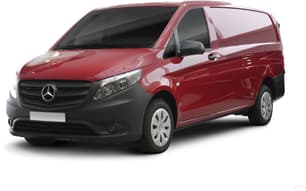
It’s arguably the best-looking mid-size van on the market, particularly with the optional enhancements fitted to our example. And its longer (km-based) service intervals and capped-price servicing costs offer substantial savings compared to a diesel Vito equivalent.
However, the eVito has a much higher purchase price, smaller payload, shorter driving range, can’t tow a trailer and feels a tad under-powered at low speeds. Plus filling its battery with fresh charge takes much longer than filling a tank with diesel, which may or may not be an issue depending on planned usage.
Therefore, a buyer would need to have not only a sizeable purchasing budget but also very specific and resolute criteria for this vehicle to shine in a commercial role.
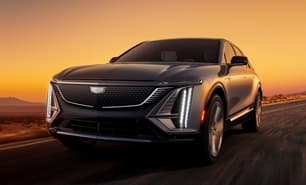
The Cadillac looks… well, it looks American, right? A kind of difficult-to-describe Americanness that’s somewhere between an SUV and state car.
That’s not an insult, by the way. I personally think the Lyriq looks kind of pretty, with its bold elements countered by the surprisingly gentle touch applied in places, like its razor-thin daytime running lights (DRLs).
I’ve got to say, it doesn’t look much like any of the other new SUVs arriving, or a knock-off German brand. It’s got its own persona.
The cabin of the Lyriq is predictably plush, with comfy massaging seats, soft-touch materials and plenty of tech, but it is a little shiny and busy in places for my tastes. Minimalist this is not.
But I do like the fact that – when I’ve got Apple CarPlay hooked up – I can just leave the screen be. My driving stuff is accessed by the wheel, and everything else I want is accessible through physical buttons.
There are some strange elements, though. The grab handle on the driver’s side, which isn’t replicated on the passenger side, is odd, and likely a byproduct of the factory moving the steering wheel. Some of the central storage bins are too small to be really useful, and I hate gloveboxes that can only be opened through the screen.
The eVito’s front-mounted electric motor drives the front wheels. Its lithium-ion battery is located beneath the standard Vito floor to ensure load volume is not reduced. This substantial battery is as wide as the load floor and extends from just behind the front wheels to just ahead of the rears. Its charging port is located behind a spring-loaded body flap ahead of the left front wheel.
It rides on a 3200mm wheelbase with 5140mm overall length, 1928mm width and a kerb-to-kerb 13-metre turning circle, with 1916mm height allowing access to underground and multi-storey carparks. It’s equipped with strut-type front suspension, semi-trailing arm/coil spring rear suspension and four-wheel disc brakes.
It’s a big boat, the Lyriq, stretching more than five metres long and almost two metres wide. That’s not much shorter than, and in fact slightly wider than, something like a Nissan Patrol, just to put it into perspective. Though of course it’s nowhere near as high as a proper 4WD.
Predictably, though, its dimensions mean plenty of room in the boot, which opens to reveal a very useable 793 litres of luggage space. Drop the seats, and that number grows to a massive 1722 litres.
But the Lyriq does without any spare wheel of any kind. A tyre repair kit is your only option.
Now, the backseat. And I know this is likely only of interest to parents of newborn babies, but that’s me, so I noticed. These are some of the best ISOFIX attachment points I ever used. Usually you’re fumbling around between the seat cushions trying to line up the latch points, but the Lyriq's solution — while perhaps not the most visually alluring – puts the brackets beneath plastic lift-up flaps, and they're so damn easy to use.
But there are some quirks in the backseat, too. Those same ISOFIX attachment points, which are so great for baby seats, are less great for the adults actually sitting in the back. You can feel the hard plastic covers, and what feels like the bracing bar running across the backseat, beneath the cushions. It's not diabolical, and if you shift your rear-end forward slightly you can't feel it at all, but it's a strange quirk all the same.
Elsewhere in the backseat, there is plenty of room for backseat riders, and you can control your own temps, too.
With its hefty 2318kg kerb weight and 3200kg GVM, the eVito has an 882kg payload rating. That is 183kg less than a diesel equivalent (119 Vito MWB RWD), given that the eVito is around 300kg heavier than the ICE version largely because of its battery.
And unlike the diesel alternative, which is legally rated to tow up to 2500kg of braked trailer, the eVito has no tow rating, which is consistent with other electric vans we’ve tested and a potential deal-breaker for tradies.
The cargo bay offers a competitive 6.0 cubic metres of load volume and is accessed through sliding doors on each side (822mm openings), with large internal assist-handles on the bulkhead. Rear cargo bay access is through a swing-up tailgate, which can limit the use of forklifts not fitted with extendable tynes. All doors and walls are internally lined.
The load area is 2678mm long, 1709mm wide and 1392mm high. With 1270mm between the rear-wheel housings, it can carry two 1165mm-square Aussie pallets or up to three 1200 x 800mm Euro pallets, secured by eight sturdy load-anchorage points.
The cabin bulkhead has a cavernous open storage area at its base which is handy for storing ropes, straps etc. The upper section of the bulkhead protrudes about 20cm into the openings of the side sliding doors which may obstruct loading of large items.
Cabin storage includes a large-bottle holder and bin in the base of each door, with smaller bins at mid-height. There’s also an overhead glasses holder, two cupholders and three open bins across the top of the dash, a single glovebox and a hidden compartment beneath the passenger seat which is handy for storing small items or valuables out of sight.
You can have your Cadillac Lyriq in two flavours — the Luxury, yours for $122,000 plus on-road costs. Or the Sport, which is two grand more, listing at $124,000.
Perspective time. The new Polestar 3 starts at around $118k, but climbs to more than $130k for the dual-motor options. The similarly sized BMW iX starts at more than $140k, and the Mercedes-Benz EQE is north of $135k. So if you consider the Cadillac a ready-made premium brand, then its looking like a relatively sharpish one.
Cadillac says the changes between the trims largely focus on the “aesthetic signature” rather than any major equipment differences. The Luxury gets chrome highlights, for example, while the Sport gets a darkened design theme, including the wheels, body highlights and windows.
Both trims are otherwise identically equipped, which means 21-inch alloy wheels, full LED lighting, an electric sunroof, an auto-opening boot and a touch-to-open charging port.
Inside, there’s a 33-inch digital dash, with Apple CarPlay and Android Auto, wireless device charging, a thumping 19-speaker AKG stereo and USB connection points galore.
The leather-wrapped front seats have heating, ventilation and a massage function, there’s heating and cooling for the window seats in the back, tri-zone climate control and there’s 126-colour ambient interior lighting.
Our test vehicle is the eVito Panel Van MWB (Medium Wheel Base), which comes equipped with a single 85kW/360Nm electric motor and a 60kWh battery for an eyebrow-raising list price of $91,051 plus on-road costs.
Our sparkling example looks more upmarket than the standard offering, as it’s equipped with the optional $2779 Sport Package comprising metallic paint (Brilliant Silver on ours), body-coloured front and rear bumpers, black roof rails, fog lamps, black leatherette upholstery and a choice of 17-inch alloy wheels. These good-looking rims are fitted with 225/55R17C Dunlop Econodrive tyres and there’s a standard full-size steel spare.
Other options, including premium infotainment and electronic interface functions, cargo bay wood-flooring/LED lighting and more, raise the as-tested list price to $99,871 - which means you’re looking at six figures to drive away in this stylish two-seater.
So, what’s a $100K electric Mercedes-Benz van include as standard equipment? Let’s start with a conspicuously long (8.0 metres) charging cable stored in a vinyl bag. There’s also a chrome grille, tinted windows and heated door mirrors, but headlights/daytime running lights/tail-lights are halogen when you’d expect to see LEDs at this price.
Inside, there’s a full steel bulkhead (with large window) separating the cabin from the cargo bay, a leather-wrapped and two-way adjustable multi-function steering wheel, two USB ports, high-gloss black trim appointments in the upper central console, and a chrome interior package including air-vents, air-con dials, door-handles and surrounds.
Also standard are ‘Comfort’ bucket seats for driver and passenger with heating, base-cushion length adjustment, fold-down inboard armrests and powered adjustments including height/reach lumbar support. The infotainment system has a relatively small 7.0-inch touchscreen, but there’s digital radio, voice command and multiple connectivity including Apple/Android devices.
All Aussie Lyriqs are dual-motor affairs, with an electric motor at each axle producing a total 388kW and 610Nm, which in a car this big, which weighs just under 2.7 tonnes, is more than enough to get the Caddy up and moving, but not enough to make it feel like a supercar. The two motors mean AWD, of course.
The eVito’s single electric motor drives the front wheels via a single-speed transmission. It produces 85kW of power and 360Nm of torque from the energy stored in its 60kWh battery.
Using the steering wheel paddles, drivers can switch between five energy-recuperation modes to optimise battery range and reduce manual brake use. These range from D- (strongest deceleration/recuperation) through D, D+ and D++ which progressively reduce these effects. DAuto uses a radar sensor to automatically adjust the recuperation level according to surrounding traffic.
There are also three switchable drive modes comprising E+, E and C, which allow drivers a choice of energy consumption/performance levels.
The Lyriq is equipped with a 102kWh lithium-ion NCMA battery, which delivers an ok 530km on the combined cycle. I say 'ok', because the BMW iX offers 600km-plus, while the dual-motor Polestar 3 is more like 630km claimed. Energy consumption is a claimed 22.5kWh per 100km on the combined cycle.
When it comes to plugging in, the Lyriq is set up for 190kW DC fast charging, with the brand promising 128km of range in 10 minutes, or 10 to 80 per cent in just under 30 minutes. At home, a 7kW wall ox will deliver more like 43km an hour.
The first thing you notice behind the wheel of the the Lyriq is just how whisper-quiet it is on the road. Cadillac makes a big deal about its 'Active Noise Cancellation' tech that's deployed here – it uses sensors to monitor road vibrations and the like, and then uses the car's stereo to create what it calls an 'anti-noise' signal.
It all sounds pretty high-tech and complicated, but it also works, with the Lyriq a seriously quiet and composed way to get around, with only the artificial EV noise really noticeable in the cabin.
Even travelling past freeway speeds, the Lyriq remains quiet, which does lend the whole experience a sort of premium vibe.
The Cadillac is also one of those cars that thinks solidity means premium, from the solid 'thunk' of the doors shutting to a general heft and weight to the steering, there's nothing feather-light or agile about the Lyriq experience, but it does all feel a little artificial, and like it's trying to be heavy on purpose.
The Lyriq, then, is no out-and-out performance car – it's 2.5-tonne-plus kerb weight and Olympic swimming pool dimensions largely put an end that – but it's more than brisk enough to get up and moving, with its twin-motor powertrain finding grip even in slippery conditions. It's brisk, but not brutal.
The Lyriq hasn't been tested or tuned in Australia, but happily it doesn't have that floaty, wafty suspension style so popular in the USA. This one feels to have at least had an international tune, which removes some of that marshmallow softness and makes you feel connected to the road.
The steering, too, feels direct enough and easy to predict, and the overall impression is one of quiet, calm motoring, which is probably what it says on the tin of any premium vehicle.
It’s easy to get comfortable given the height/reach adjustable leather-wrapped wheel and powered multiple seat adjustments, which include base cushion rake and height/reach lumbar support. The base cushion can also be manually extended for more under-thigh support by sliding the front section forward.
There’s good eyelines to the door mirrors and, thanks to the large window in the cabin bulkhead, the central rear-view mirror has an unobstructed view through the tailgate window. The passenger-side mirror’s wide-angle view, combined with active blind-spot monitoring, help to minimise the large blind-spot over the driver’s left shoulder that all solid-walled vans share.
Steering is nicely weighted and communicative, unladen ride quality is supple thanks to its four-coil suspension, and four-wheel disc brakes provided reassuringly strong braking response. However, there was also noticeable tyre noise intrusion at speeds above 60km/h on coarse bitumen surfaces.
Acceleration from standing starts feels leisurely at best, even when using full power. This is when the eVito’s 2.3-tonne kerb weight is noticeable, which is not surprising when you compare its weight-to-power and weight-to-torque ratios with a diesel Vito (MWB) equivalent.
For example, based on kerb weights, the 119 CDI Panel Van (140kW/440Nm) has to move 14.2kg/kW and 4.5kg/Nm compared to the eVito’s much heavier 27.3kg/kW and 6.4kg/Nm.
However, the power delivery is seamless and once up to cruising speeds the response noticeably improves, fortunately in the 60-80km/h range where much city and suburban travel occurs. The key to fluent progress in traffic is maintaining momentum.
To test its load-hauling ability, we inflated the tyres to the recommended pressures and forklifted 650kg into the cargo bay through the side doors. Combined with driver and equipment, this equalled a 750kg (three-quarter-tonne) payload which was about 130kg short of its maximum rating.
With the cargo bay load positioned well ahead of the rear wheels, the rear suspension only compressed 25mm with no risk of bottoming-out over bumps.
Our 50km test route comprised mostly city and suburban routes (for which this vehicle is tailored) plus some highway driving. There wasn’t a noticeable drop in handling, braking or ride quality with this payload, although standing-start acceleration felt more subdued as you'd expect.
The Lyriq hasn’t been crash-tested in Australia, but it did get a five-star equivalent in American testing. There’s autonomous emergency braking (AEB) with pedestrian protection and junction assist, as well as active blind spot monitoring and assist. There’s also a side bicycle alert to stop you opening your door into someone, rear pedestrian alert, adaptive cruise and a total eight airbags, including knee bags for the driver and front passenger.
Interestingly, the Lyriq ditches those annoying safety bings and bongs for a novel, and far less intrusive approach which involves sending gentle vibrations through, well, your backside if the vehicle senses incoming danger.
There is currently no ANCAP rating. Even so, it comes with a suite of standard passive and active safety features including front, thorax and window airbags, AEB, blind-spot monitoring with rear cross-traffic alert, lane-keeping, active parking assist, crosswind assist, front/rear parking sensors, DRLs, active cruise control, reversing camera and more. There’s no speed sign recognition, though.
Cadillac has built a pretty convincing ownership package around the Lyriq, which begins with a five-year, unlimited-kilometre warranty, and an eight-year, 160,000km battery warranty. Beyond that, you also get five years of servicing, and five years of roadside assistance, free.
Then you get a year’s free public charging through the Chargefox network and a free home wall box charger. If you have a wall box, or don’t want one, you can trade the home charging for an extra two years of free public charging.
The eVito has a five-year/250,000km vehicle warranty with an eight-year/160,000km battery warranty and a 24-hour roadside assist support package. Scheduled servicing is every 12 months/40,000km whichever occurs first. Capped pricing for first five scheduled services totals $2432 or an appealing average of $486 per service.