What's the difference?
Look, personally I found it amusingly weird when German car companies started sloping the roofs on sedans and calling them “coupes”, despite the fact that they had four doors. Their ability to imagine segments, and find buyers in them, that have no reason to exist is almost something to admire.
But turning SUVs, like the already very capable X3, into coupes? Frankly, it’s like turning an ass into an elbow. Lower the roof to reduce headroom and shrink the boot? Why? Because it will look so sexy people won’t be able to resist it. That’s BMW’s approach with the X4 and, somehow, it seems to work.
And, to be fair, sporty SUVs are not a BMW thing: the Range Rover Evoque, Audi Q5 Sportback, and Mercedes-AMG’s range of GLC Coupé models have all taken off, each contributing toward an unlikely trend that doesn’t seem to be going away any time soon.
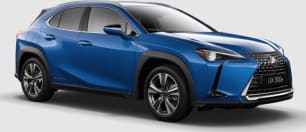
Lexus has released a revamped version of its smallest electric SUV, the UX300e and I’ve been driving the Sports Luxury grade this week with my little family of three.
This model sees a few key upgrades to its battery performance, driving range and technology.
These improvements should see it continue to be a solid competitor for its rivals, the BMW iX1 XDrive 30 M Sport, Mercedes-Benz EQA 250 and Volvo XC40 Recharge Pure Electric.
Okay, so the BMW X4 xDrive30i is neither an ass nor an elbow, to be fair, it's more of a bulky shoulder muscle, or two.
I can't say I'll ever love the X4, the idea of it is a bit too weird for me, but I can't help admiring the way it looks and the way it drives.
It's a bit like a sedan on steroids - or an SUV on a diet, depending on your perspective - but that doesn’t take away from the fact that it’s fun to drive, comfortable and retains just enough coolness, and just enough practicality, to make it worthwhile.
The Lexus UX300e Sports Luxury nails the luxury and standard features list! It certainly feels like a premium SUV inside and the updated technology and driving range were sorely needed to keep this competitive, but once you start looking at its rivals, which all offer similar specs and better driving ranges, the price point starts to feel a smidge high. However, the ongoing costs and the complimentary bonuses that Lexus throws in, are great.
So here's the thing. Obviously I have a personal beef with the existence of vehicles like this, but my eyes cannot deny the facts - the X4 looks fantastic. It's muscular, imposing and smooth all at once. Unlike the X6, a bigger and less visually successful attempt to play the same styling tricks with an X5, it doesn't have a ridiculous rear view that looks like it shoulders and buttocks have been fused (although it's hard to miss just how small the rear window is).
Even more impressively, there's no denying it looks better than the X3 that gave birth to it, so I can easily see why someone in a BMW showroom could be drawn to it. At least until they sit inside.
If the exterior style and eye-catching Sophisto Grey metallic paint don’t make an immediate impression then your eyes will surely widen at the interior, resplendent with bold Tacora Red seats, Aluminium Rhombicle trim finisher and the kind of sleek, classy styling that BMW excels in.
Both the adjustable ambient lighting on the doors (we were partial to lilac) and door projectors that shot out what looked like robot wings onto the ground every time we hopped out of the X4 at night walked a fine line between futuristic cool and “parked out the front of a nightclub entrance” chintz, but over time the scales tipped more to the former.
The big differentiator between the X4 and X3, of course, is the sloped coupé roof, a design feature that may make the X4 look a little cooler, but at the expense of cabin space, but more of that in a moment.
The design hasn’t seen much change and Lexus seems to be encouraging an understated EV design as it looks just like its fuel-based siblings.
I don’t mind that it’s not as futuristic as some of its competitors and that, at first glance, there isn’t anything to set it apart.
The front sports a classic Lexus 'spindle' grille and the external lights are large but the rear side lights jut out rather severely, reminding me too much of its Toyota counterparts.
The rear features a cool LED strip light for the brakes, which elevates its night-time presence.
The sporty-looking 18-inch alloy wheels are a nice touch but the plastic mouldings around the base of the car detract from the premium-level this model sits in. It’s not as slick-looking as it could be.
Having said that, the interior earns back points courtesy of its premium feel with leather-accented trims and Japanese Washi paper influenced accent panels. But there is a lot happening with the dashboard.
It’s a little overwhelming at first because it protrudes well into the cabin and features multiple cutaways, but you get used to it after a while.
There are also little knobs on either side of the instrument panel that look out of place to me and resemble horns.
For a car that is very much a mid-sized SUV on the outside, the interior can feel a bit too snug, like you’re driving a compact car that’s tried on a suit a few sizes too big (for reference, I’m 175cm tall - above-average height drivers may find the snugness soon turns to claustrophobia).
While comfortable - it is BMW we’re talking about, after all - there’s not an overly abundant amount of headroom available, a feeling that becomes more pronounced should you shut the big moon roof.
My two children felt slightly too close to “you’re annoying me” distance from one another, which is to say this isn’t really the kind of car you should be getting if you plan on regularly ferrying about passengers in the rear who are bigger than a child. But I really don't think many people with kids would choose the X4 over the X3.
Boot space also takes a hit when compared to the X3 (550 litres versus 525-litres in the X4 - I was surprised the difference wasn't larger - although that expands to 1430-litres with the rear seats folded down.
The boot opening is also mouth-shaped, which makes packing in wide-load items more of an issue.
Cupholders are plentiful - two in the front, two in the rear, and bottle holders in each door - and there’s a decent-sized storage cubby in between the front two seats.
The sloped roof, and big fat A pillars, also result in the X4 being a bit more pinched at the rear, which is not especially great for visibility, with the vehicle’s blind spots taking some getting used to.
As soon as you slide in, you’re reminded that the UX is a small SUV. Even with the driver's seat at its lowest position I still knock my knees on the steering wheel when getting in and out of the car.
The higher door sills also accentuate the penned in feeling despite there being plenty of head- and legroom in the front row!
Then comes the back seat, which is super tight on space. I’m 168cm (5'6") and my headroom is fine but the legroom sucks. My knees press into the back of the driver’s seat (set for my driving position).
There’s also not a lot of space underneath the seat for toes, so I wouldn’t recommend the UX to anyone who regularly transports tall passengers.
Having said that the seats in both rows are very comfortable and the leather trims feel lovely to touch. Both front seats are electric with heat and ventilation functions but only the driver’s side enjoys adjustable lumbar support.
Storage is good throughout the car, which is not usually the case for the small SUV class. Up front you get a glove box, two cupholders, two drink bottle holders and a middle console that opens from both sides, which is handy and cool.
In the rear you get two cupholders in a fold-down armrest and map pockets but no storage bins in either door unfortunately.
Other amenities in the back are very good for this class with the heated outboard seats, directional air vents, reading lights and two USB-C ports.
On that note, the upgraded multimedia system is now easier to use while on the go, is responsive to touch and looks great.
Some of the information on the system can be annoying to find but the customisations available on the 7.0-inch digital instrument panel more than make up for it.
There is a coloured head-up display, wireless Apple CarPlay, wired Android Auto and satellite navigation.
All are easy to use and won’t confuse you too much!
The charging options are great with each row getting two USB-C ports but the front also gets a USB-A port, 12-volt socket and a wireless charging pad. You’re seriously spoilt for choice.
The boot space sits at a small 314L, which is 100L less than the previous model but that’s because Lexus has made a little storage nook underneath the floor for the tyre repair kit and cable pouches.
It's a great boot because it sits high and is easy to access, and I have plenty of room for all of the gear needed for a week’s errands. The hands-free powered tailgate is great, too.
Cost-wise, the X4 is roughly in the same ballpark as the other cars in this strange sub-segment, but when you add in optional extras - metallic paint, panorama glass sunroof and BMW Laserlight headlights among them - the base price of $95,900 plus on-road costs sneaks up to $101,800, which is is no small figure.
It’s also a considerable $8000 more than the SUV-shaped X3, meaning you’re essentially getting the same car, but with less cabin and boot space, for more money. To be fair, this is just part of a long tradition of the style-conscious buyer being willing to pay more for less, one that the invention of the coupe pretty much invented.
That kind of money also makes exclusions like adaptive cruise control, heated seats and wireless charging a bit of a head-scratcher.
Still, there’s plenty to love, including an M Sport kit that comes standard with the X4 (a suspension/brake package and various styling embellishments), butter-soft Tacora Red Vernasca leather seats (Sport adjustable for the driver and front passenger), 20-inch M light alloy double-spoked wheels, a head-up display, adaptive LED headlights, and an automatic tailgate.
There’s also a generous high-resolution 12.3-inch control display and digital 12.3-inch instrument display, the former operated by touch or via the rotary iDrive Touch Controller.
Cable-free Apple CarPlay and Android Auto are also available, but BMW allows you the option to use its iDrive system instead, just in case you're some kind of mad Munich fanboy - or you hate Apple.
There are only two variants for the electric UX and our test model is the top-spec Sports Luxury but the gear isn’t the only thing that’s been upgraded. The before on-road costs price for this model has jumped by almost $7K to a hefty $87,665!
In comparison, the BMW is the nearest rival at $84,900 (MSRP) and the Mercedes-Benz is a bit more affordable again at $82,300 (MSRP) while the Volvo sits pretty at $76,990 (MSRP).
The UX300e is the most expensive but is well-specified by anyone’s standards.
The Sports Luxury grade maintains its premium features, like the sunroof, heated front and rear outboard seats, ventilated front seats, and a heated steering wheel.
But the technology has been retooled and a new 12.3-inch touchscreen multimedia system replaces the previous model's 10.3-inch touchpad arrangement. It’s a welcome addition as it’s much easier to use.
New features, like wireless Apple CarPlay, acoustic front glass and insulation around the bonnet and wheel wells provide additional on-road comfort and practicality.
Lexus also throws in an AC Type 2 charging cable, as well as a GPO (General Power Outlet) cable. The technology is robust but I’ll go into more detail in the Practicality section.
Other standard features are solid with 18-inch alloy wheels, a tyre repair kit, handsfree powered tailgate, full suite of LED exterior lights, 10-way electric driver’s seat and an eight-way electric front passenger seat (but only the driver enjoys adjustable lumbar support).
The leather-accented trims feel luxy and the steering wheel has mounted controls and paddles to customise the regenerative braking while on the go.
Now, prepare to be confused. In the past, the 3.0 in the xDrive3.0i nomenclature might have led you to believe you'd bought a BMW with a 3.0-litre straight six engine. But in this case, you have not, the 3.0 just means you have a more exciting version of the 2.0; a TwinPower turbo 2.0-litre inline four-cylinder engine, making 179kW and 353Nm that the xDrive system delivers to all four wheels.
The claimed zero to 100km/h time of 4.9 seconds feels completely realistic as this engine has plenty of poke. Put it in the Sport setting and you'll get some serious shove. Indeed, the switch between Comfort and Sport is very noticeable and changes the character of the car entirely.
The transmission is an eight-speed conventional torque converter automatic gearbox that’s both smooth and responsive.
The UX300e has a fully electric powertrain with a 72.8kWh lithium-ion battery that’s located on the front axle.
The power and torque remain unchanged at 150kW and 300Nm but that’s enough to produce a 0-100km/h sprint time of 7.5-seconds. Plenty of oomph for city-slickers and open-roaders to boot.
The update sees the battery increase in capacity by 34 per cent which means the driving range has jumped from 305km to 440km.
That's still a bit lower than some of the UX's competitors but it certainly helps ease range anxiety! And unlike some of its rivals, the UX300e only sports a front-wheel drive drivetrain.
The X4’s 65-litre tank needs to be 95-octane at a minimum, and BMW’s claimed combined fuel consumption is 7.9 litres per 100km. The temptation to use its rorty little engine is going to push you higher, though - you chose the one with the 3.0 badge on it after all - and we averaged 10.9 litres per 100km in our week together, which was mainly city driving, to be fair.
My energy consumption sat at an average of 19.5kWh, which is decent considering all of the open-road driving I did.
There are four levels of regenerative braking to help conserve battery percentage but even on the firmest setting, it’s not super noticeable.
When you’re at full charge, multiple notifications and sound alerts pop up on the instrument panel stating ‘Regenerative Braking Limited Press Brake to Decelerate’. It’s quite an intrusive feature but disappears after 20 to 30km.
Despite the bigger battery size, the UX300e can only accept up to 6.6kW on AC charging, whereas, all of its rivals can accept 11kW. On a 240-volt AC charger, expect to see a charge time of nine and a half hours to get to 80 per cent.
Curiously, the UX features two charging ports, on the right-hand-side, there is a Type 2 port and, on the left, a CHAdeMo port, which allows for faster charging.
You'd think it would be easier to simply add the CCS enhancement on the Type 2 port but still, expect to get from 10-80 per cent in 80-minutes on a 50kW fast charger.
The impressive trick that BMW continually pulls off with its SUVs is giving them the same sensual, muscular steering as its sedans, and an impressively similar ride and handling balance.
The steering is the highlight here, but it's also noticeable how planted to the road it feels.
The X4 speaks to its looks, in fact, by feeling sportier and more alive to drive than you'd expect an X3 to be.
This is less an SUV for soccer mums and dads, and more a bastard love-child that’s into loud leather and bright neon - a CEO who dressed punk rock-lite on weekends, if you will.
If those weekends are bereft of child taxiing and loading up the boot with several tons of kid stuff, then you’ll have a blast in the X4.
The UX300e comes into its own when you’re zipping around tight city streets. The power is responsive and the steering crisp with excellent cornering capabilities.
It feels well-placed on the road most of the time but can move around when it gets hit by high winds.
While the power is steady, the tyres can lose a little traction if you’re too quick to accelerate from a full stop.
The ride comfort is also very good with the new acoustic glass and extra insulation around the bonnet and wheel wells providing a whisper quiet cabin space.
The suspension is well-cushioned but not floaty and you won’t wince when you hit a bump, but occasionally you get a thump-thump shudder through the frame on certain rough road surfaces.
It’s not a massive size and you’ll be thankful for that when it comes time to park because it is seriously easy to slide into a spot!
The 360-degree view camera system is top-notch providing clear graphics and a cool feature where the car becomes invisible in the video feed, which makes it even easier to see all around you. Coupled with the front and rear parking sensors, you’re set.
A 2018 test gave the X4 a five-star ANCAP safety rating, and an easily located button on the dash brings up the vehicle’s safety suite if you’re the kind of driver who likes to make a few adjustments.
A 360-degree camera offers multiple viewpoints and is a godsend when parking the X4, since the cabin makes the car feel smaller than it actually is on the outside, and the range of safety features on offer are more than adequate.
Those include autonomous emergency braking, dynamic braking lights, dynamic stability and traction control, rear-cross traffic alert, speed limit information and hill descent control.
The UX300e has a bunch of great safety features that come as standard and I like the proximity alert that pops up a camera feed of your surroundings when you’re in stop/start traffic. It’s a practical feature to help identify pedestrians or cyclists in your blind spots.
Other standard safety equipment includes forward collision warning, blind-spot monitoring, daytime running lights, rear cross-traffic alert, lane keeping aids, lane departure warning, adaptive cruise control, intelligent seat belt reminders, traffic sign recognition, an SOS call button, and that awesome 360-degree view camera system.
Family-friendly features include two ISOFIX child seat mounts on the rear outboard seats plus three top-tethers but two seats will fit best.
The UX also has a rear occupant alert if it detects weight or seat belts in use in the back seat, which is always a great feature.
The UX has a maximum five-star ANCAP safety rating from testing done in 2019. It also has eight airbags, which includes knee airbags for both front occupants.
Despite all the brouhaha about other car manufacturers offering more generous warranty periods - seven years for Kia, for example - BMW has not shifted its stance, still offering its standard three-year unlimited-kilometre warranty. Frankly, it's just not good enough.
BMW also offer a Service Inclusive package for $2010 that covers owners for five years, or 80,000km.
The UX comes with a five-year/unlimited km warranty but the battery is covered by a 10-year or up to 160,000km warranty, which is better than most in this class.
This also comes with a five-year capped-priced servicing plan where services cost a flat $295, which is good but the servicing intervals are more in line with a fuel-based car at every 12-months or 15,000km, whichever occurs first. It’s typical to see intervals stretched out at every two years for an EV.
Lexus also throws in a few sweeteners for owners with three-year complimentary subscriptions to both ChargeFox and Lexus Connected Services, as well as, installation of an at-home wall charger. It’s not often you see the word ‘complimentary’ coupled with a luxury brand, so that’s a nice touch.