What's the difference?
If one is good, two must be better, right? Or twice as good. The question is whether that simple equation adds up for BMW's upgraded 1 and 2 Series siblings – the former, a range of five-door hatches, the latter, a line-up of cabriolets and coupes, with a major addition in the shape of the full-house, performance-focused M2.
Prices are up, and changes are mostly under the skin, so you're not getting big visual bang for your extra bucks. But the new and improved 2 has plenty to offer when it comes to added spec and tech.
BMW invited us to the new car's Australian launch program along Tasmania's wet and wild west coast.
Hyundai Venue, Mazda CX-30, Mitsubishi Eclipse Cross, Toyota Corolla Cross… the list of box-fresh SUVs that have cropped up in the last decade could go on and on, and it’s no secret why.
SUVs are absolutely hot property right now and everyone wants to get onto the bandwagon with the right model and the right size, which explains the all-new Honda ZR-V.
Positioned above the HR-V but below the CR-V, Honda calls the ZR-V its mid-size SUV competitor that is designed to steal sales away from the in-demand Mazda CX-5 and Toyota RAV4.
So, does this new Honda really have what it takes to take on the best-selling SUVs in Australia?
The BMW 2 Series coupes and convertibles combine understated good looks with great dynamics and top-shelf quality. Extra equipment, especially the iDrive6 multimedia system, has brought it up to speed in terms of tech and value, while the M240i sets the compact performance benchmark. And if you really want to push the envelope, the M2 is right there at the top of the under $100k performance pyramid.
Should you consider the Honda ZR-V if you are looking for a new family SUV? Absolutely, it offers the right blend of practicality, panache and poise to make it a serious consideration over the hot-selling Mazda CX-5.
What might dissuade some buyers is the smaller dimensions, but seriously, the ZR-V is a poster child for ‘making the most of what you got’. There are a few other nit-picky things about the new Honda, but those cons (collectively) aren't a deal-breaker.
Sorry, Civic Type R, the 2023 ZR-V might be the best car Honda Australia has in its line-up right now, and it deserves at least your attention and consideration, even if that doesn’t evolve into your outright commitment.
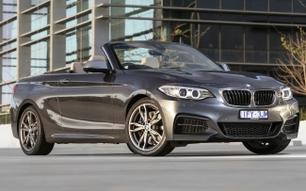
The biggest visual clue to the revised 2 Series is the circular design bi-LED headlights, now standard on the 2 Series entry 220i, and mid-range 230i models, while hexagonal adaptive LEDs are standard on the top-shelf M240i.
But BMW couldn't leave those little light-emitting diodes alone, with LED front fog lights joining one-piece L-shaped LED tail-lights across the range.
Luxury Line-equipped cars feature a subtly revised nose treatment with larger intakes and a reshaped 'kidney' grille. There are also four new alloy wheel designs – a 17-inch alloy fitted standard to the 220i Luxury Line, and three optional M alloys for M Sport models (all no-cost options on the M240i).
The 230i M Sport features black, high-gloss bars in its kidney grille, as well as a black chrome finish for the exhaust finishers.
On the inside, there's the addition of a 'Black Panel' digital instrument cluster, which remains matt with the ignition off, and lights up with sharp graphics, configurable across conventional speed and rev readouts, as well as gear position, engine-efficiency data, vehicle settings and nav guidance.
There are also high-gloss finishes across the centre stack and front console, and even greater attention to detail around panel joins, trim stitching and switchgear.
But the hero is the latest iDrive6 multimedia system, run through an 8.8-inch colour touchscreen (6.5-inch on 220i), providing access to live content, radio and audio, navigation and maps, phone functionality, and vehicle settings through a simple and customisable app-style interface. The iPhone really as inspired car companies.
The M2 boasts M-specific instrument display content and a go-fast red needle on the tachometer.
Honda is on a bit of a tear in terms of design, at least to my eye.
All models in its line-up look modern, sophisticated and properly upmarket. And yes, that’s counting the Accord mid-size sedan, too.
The ZR-V is certainly no different, and while it does crib more than a few design cues from the likes of the Porsche Macan and Maserati Grecale, for a mainstream mid-size SUV, that’s not necessarily a criticism.
The front end is characterised by tall headlights and a chiselled bonnet, but the component that draws the eye the most is the front grille.
With a trapezoidal shape and vertical slats, at first glance the ZR-V’s toothy grin sort of looks like the aforementioned Grecale, and it's a departure from the face of the Civic (on which it is based).
I’m still not one hundred per cent sold on the front styling of the ZR-V. It doesn’t look too cohesive or consistent with the rest of the Honda Australia line-up (the HR-V and CR-V SUVs have a horizontal-themed grille), but it’s not ugly.
Step to the side and there are shades of Macan thanks to its long bonnet, bulbous bodywork and short overhangs.
I like the top-spec VTi LX’s body-coloured wheel arches, too, invoking a little BMW vibe to make the ZR-V feel a touch more upmarket.
However, the rear is my favourite element of the ZR-V, thanks to a funky tail-light design, nicely-sized spoiler and a subtle contrasting diffuser with integrated twin exhaust outlets.
Step inside, and those familiar with the new Civic will feel right at home thanks to a honeycomb dashboard insert that hides the air vents, floating multimedia touchscreen and perfectly girthed steering wheel.
Everything about the cabin is laid out in a clear and sensible manner, but the soft-touch materials and contrast stitching throughout just elevate it from something you might expect from Honda.
And build quality in the ZR-V is excellent. Everything feels so solid and well put together, with nary a sign of squeak or rattle.
Is it the best-looking mainstream family SUV out there? It certainly comes close, but to my eye, Mazda’s CX-5 just edges it out due to a more consistent overall design.
Surprisingly, at a little over 4.4 metres long, the 2 Series (Coupe) is around 10cm longer than its 1 Series hatch stablemate (M240i +15cm), but aligns with its just under 1.8m width, and 1.4m height.
It seats four, with plenty of room up front and multiple storage options, including two cupholders in the console with an oddments tray behind, a 12-volt outlet, a lidded storage box between the seats with USB connection, a reasonably sized glove box, and segmented bins in the doors big enough for large water bottles.
While it was coupes only on the launch drive, we know the convertible has a pair of cupholders in the back, but not so in the coupe, and while headroom in the soft-top is okay (especially with the roof down) it's a squeeze in the hardtop.
More a 2+2 than a full four-seater, getting into the rear is an athletic exercise, and once installed, leg and headroom for this 183cm tester is tight. That said, kids up to teenager-size would be fine.
Boot volume is 390 litres (a 3 Series Coupe is 480 litres), with run-flat tyres on the 220i and 230i meaning there's no spare (or repair kit) under the floor, but the performance-focused M240i and M2, pack a 'BMW Mobility Kit' (compressor and tyre sealant to cover minor damage) in line with their high-performance (non-run-flat rubber).
A 60/40 split-folding rear backrest liberates extra load space, and a 'Through Loading System' with luggage compartment dividing net, and 40/20/40 split-folding rear seat is optionally available (220i & M2 Pure - $350 / 230i - $385 / M240i & M2 - $500).
And if you're keen on towing the 220i can pull 680kg of unbraked trailer, and 1500kg braked, with the minimum number stepping up to 715kg for the 230i. The M240i and M2 are no-tow zones.
Measuring 4568mm long, 1840mm wide, 1620mm tall and with a 2655mm wheelbase, the ZR-V is one of the smallest mid-size SUVs in Australia.
But don’t let the figures fool you, as this pint-sized family hauler has a few tricks up its sleeve.
From the front row, there is ample room to get comfortable, while storage options extend to door pockets, a glove box, a generous wireless smartphone charging pad, two cupholders and a handy storage shelf under the shifter.
However, the front seats found in the VTi LX grade of ZR-V feel insufficiently bolstered and flat, at least to my back and bottom.
I found myself sinking and sliding around in the seat more than I would have liked in my time with the car, so this could be an area of concern for slimmer people like myself.
In the second row, there is sufficient space behind the driver’s seat, set for my 183cm frame, while map pockets and a fold-down armrest also come into play alongside the door’s bottle holder.
Worth noting, however, that while there's plenty of space to fit a forward-facing kids car seat and a front passenger, the door trims are a little chunky and leave little room for my toddler to slide in and out of said safety seat.
Open the boot and you will find enough room for 370 litres of volume, which can expand to 1302L with the rear seats stowed.
Although this isn’t close to class-leading (even the CX-5 manages a 438L/1340L rating), the flat floor and easy-to-remove cargo blind make it a breeze to throw a pram, shopping or any sort of gear into.
I think boot space is one of those stats that will always sound good on paper, but how you use that space in reality is a better indicator of practicality, and in this regard, I was never wanting for more space in my week with the car.
The 2 Series coupe and convertible line-up ranges across four-cylinder, turbo-petrol models, in 220i Luxury Line, and 230i M Sport grades, with the six-cylinder M240i sitting at the top of the main line-up. Then for the more single-minded enthusiast, there's the hardcore M2; after a year on-sale it's now BMW Australia's best-selling M car (and it's easy to see why; it's fantastic).
Depending on the model, prices have risen by between $1100 and $1900 across the main range, largely because of the extra equipment, especially the tricky iDrive6 multimedia system.
At $52,990 for the coupe and $59,900 for the convertible version, the 220i Luxury Line is the entry-point to the 2 Series range. Equipment highlights include 17-inch light-alloy wheels, the previously mentioned LED headlights and fog lights, 'Driving Assistant' functionality (combines camera-based 'Lane Departure Warning and Approach' and 'Pedestrian Warning with the City Brake Activation'), digital radio, 'Navigation System Business' with 'iDrive6' accessed via a 6.5-inch display, dual-zone climate control air, reversing camera, a leather sports steering wheel, sports front seats, 'Dakota' leather upholstery, plus front and rear parking sensors.
Next rung on the 2 Series ladder is the 230i M Sport in Coupe ($63,000) and Convertible ($73,000) form, which adds M Sport suspension, aero, and brakes, 'Variable Sport Steering', 18-inch alloy rims, high-gloss 'Shadow line' exterior trim, a BMW Individual anthracite roofliner, a leather-wrapped M Sport steering wheel, cloth/Alcantara upholstery in the coupe, 'Dakota' leather and front seat heating in the convertible, electric (front) seat adjustment, plus 'Navigation System Professional' with iDrive6 and a customisable 8.8-inch touchscreen.
As its name implies, the M2 Pure ($93,300) makes spec sacrifices in the name of light weight.
Opt for the M240i as a Coupe ($76,800) or Convertible ($85,800), and you're getting more than extra performance from the 3.0-litre turbo six. On top of the lengthy equipment list detailed above, you'll also pick up 18-inch alloys in 'Bicolour Jet Black', 12-speaker, 360W harman/kardon surround sound audio, 'Adaptive M Suspension', 'Adaptive LED Headlights', the Dakota leather trim, and front-seat heating.
As its name implies, the M2 Pure ($93,300) makes spec sacrifices in the name of light weight, including manual seat adjustment and a base (yet, still seven-speaker) audio package, but one of the biggest pay-offs is a standard six-speed manual gearbox. Save the manuals!
It also features 19-inch BMW M light alloy wheels, an M rear spoiler, quad exhaust pipes in high-gloss chrome, bi-LED headlights (with variable light distribution, including cornering lights), 'Dakota' leather upholstery, carbon fibre trim finishers, an M leather multi-function steering wheel, cruise control (with braking function), 'Driving Assistant', 'Rear Park Distance Control', and a reversing camera.
The full-fat M2 Coupe ($99,900) reinstates electric seat adjustment, plugs in the 12-speaker, 360W harman/kardon sound system, and adds 'Comfort access' (keyless entry and start), 'Adaptive LED Headlights' (with variable light distribution), and 'Selective Beam with anti-glare High-Beam Assistant'.
A vast array of individual options and packages covers everything from steering-wheel heating to a smoker's kit (naughty), and (amazingly, given it's standard on the Hyundai Accent) Apple CarPlay (220i & M2 Pure - $436 / 230i - $479 / M240i & M2 - $623).
Honda’s 2023 ZR-V line-up can be had from as little as $40,200 drive-away for the base VTi X, while the top-spec e:HEV LX hybrid will set buyers back $54,900.
What we have is the highest grade available exclusive with petrol power, the VTi LX, priced at $48,500.
And for this sort of spend, you can expect a long list of equipment, similar to the fit-out you would usually see on luxury models wearing a German badge.
There’s a leather interior, heated and power-operated front seats, a heated steering wheel, heated rear seats, dual-zone climate control, a 10.2-inch digital instrument cluster, rear privacy glass, LED exterior lighting, a wireless smartphone charger and two-tone 18-inch alloy wheels.
Handling multimedia is a 9.0-inch touchscreen with Android Auto and wireless Apple CarPlay support, as well as in-built satellite navigation and digital radio.
Now, some might look at the ZR-V VTI LX’s near $50,000 price tag and think ‘Well, that’s just too expensive for a Honda’. But keep in mind that’s the drive-away price.
A similarly-priced Mazda CX-5 for example, the $44,300 before on-road costs Touring, misses out on features like rear heated seats and a powered tailgate, but also has a larger engine and all-wheel drive traction.
As for the Toyota RAV4, the equivalent variant would be the one-from-the-bottom $43,310 GXL that has a cloth interior, manually adjustable seats and an 8.0-inch multimedia screen.
All things considered, the ZR-V VTi-LX offers plenty of bang for buck for a family buyer, with enough of the modern conveniences that means you won’t be feeling the FOMO for many years to come.
The 220i is powered by a 2.0-litre 'TwinScroll' turbo-petrol four, featuring 'Valvetronic' variable valve control and 'Double-VANOS' variable camshaft control, and developing 135kW at 5000rpm, and 270Nm between 1350-4600rpm.
Using a retuned version of the same engine (lower compression ratio, more turbo boost), the 230i pumps out a solid 185kW at 5200rpm, and a grunty 350Nm from just 1450-4800rpm.
The same (8HP50) eight-speed auto transmission is used across the board, pushing drive to the rear wheels only.
Then, the M240i is powered by a 3.0-litre, six-cylinder, turbo-petrol, pushing out no less than 250kW at 5500rpm, and a thumping 500Nm between 1520-4500rpm.
The same (8HP50) eight-speed auto transmission is used across the board, pushing drive to the rear wheels only, and happily, a six-speed manual gearbox is a no-cost option on the M240i.
The full-house M2's 3.0-litre turbo six produces 272kW at 6500rpm, and 465Nm from just 1400-5650rpm (500Nm from 1450-4750rpm on overboost), driving the rear wheels through a seven-speed dual-clutch auto, although a six speed-manual is a no-cost option (and standard on the M2 Pure).
Powering the ZR-V VTi LX is a 1.5-litre turbo-petrol engine, the same one available across the model line barring the top-spec e:HEV hybrid.
The engine produces 131kW/240Nm, which isn’t all that much compared to larger engine rivals in the same segment.
Paired to the engine is a continuously variable transmission (CVT) that drives the front wheels.
And while a mid-size family SUV is never about outright power, and Honda’s powertrain options aren’t exactly plentiful at the moment, know that you aren’t getting the spiciest SUV with the ZR-V.
Claimed fuel consumption for the 220i Coupe, on the combined (ADR 81/02 - urban, extra-urban) cycle, is 5.9L/100km, emitting 135g/km of C02 in the process. The 220i Convertible rates 6.1L/100km (140g/km).
The 230i Coupe is line-ball with that at 5.9L/100km (134g/km), and the the 230i Convertible at 6.2L/100km (142g/km).
The price of performance starts to bite with the M240i consuming 7.1L/100km (163g/km) in coupe form, and 7.4L/100km (169g/km) as a convertible.
Then, as you might expect, the M2 is thirstiest of all, the dual-clutch auto consuming 7.9L/100km (185g/km), while the six-speed manual version slurps 8.5L/100km (199g/km).
Auto start-stop is standard, fuel tank capacity is 52 litres across the board, and although technically these engines can run on anything from 91-98RON unleaded, BMW recommends 95RON premium as a minimum.
Officially, the ZR-V VTi LX returns a combined cycle fuel economy figure of 7.4 litres per 100km, but in my week with the car I managed 9.8L/100km.
This figure is much closer to the city consumption number of 9.3L/100km and, given I only drove the car in Melbourne’s inner city, that explains why.
The ZR-V VTi LX needs just 91RON petrol at the bowser, helping to keep refill costs down.
Four 2 Series variants were offered for the launch drive program, a 230i Coupe (which BMW nominates as the most popular model in the range), M240i Coupe, M2, and M2 Pure.
Claimed 0-100km/h acceleration of 5.6sec for the 230i M Sport Coupe is quick, with the convertible stopping the clocks three tenths later.
Peak torque of 350Nm is plenty, and with that number available from 1450-4800rpm the mid-spec 2 Series is an entertaining drive.
It's M Sport (strut front, five-link rear) suspension keeps the body well buttoned down in quick going, while the beefier M brakes provide strong and progressive stopping power.
Even a firm squeeze of the throttle can't side-step some hesitation as the turbo spools up before right foot pressure translates into forward momentum, but despite the sporty tune, ride quality is good (even riding on notoriously harsh 18-inch run-flat rubber), while response and road feel from the variable-ratio steering are excellent.
The eight-speed auto is beautifully slick, with manual changes, via wheel-mounted paddles, sharp and positive.
Add the grippy leather sports wheel, snug sports front seats, and racy cloth/Alcantara trim (leather in the convertible), and you have a comfortable, nicely balanced and fun-to-drive package.
Accelerating from 0-100km/h in 4.6sec (convertible 4.7sec), the M240i effortlessly achieves 'genuinely rapid' status. Yes, it's fast, but never furious, in the sense that even under the pressure of enthusiastic peddling it remains civilised and composed.
Maximum torque of 500Nm is not to be sneezed at, and when you realise that mountainous maximum is actually a flat-top plateau stretching from only 1520rpm up to 4500rpm, satisfying urge is never far away. And the flexible 3.0-litre turbo-six is an aural treat as it howls its way towards a 7000rpm rev ceiling.
The standard 'Adaptive M Suspension' offers settings from 'Comfort' through to 'Sport+', but even in the most forgiving mode the car remains taut and communicative.
The 18-inch rims, shod with Michelin Pilot Super Sport rubber (225/40 front / 245/35 rear) don't upset the ride as much as you'd expect, although coarse-chip surfaces send rumble through to the cabin.
In terms of ergonomics and general function, the new iDrive6 system is simple and intuitive to use, the current BMW dash and console layout is a model of efficiency, but the two-stage (depress small button on stubby lever, then shift) process to select drive or reverse can be a frustratingly hit-and-miss affair if you need to get going quickly.
Then, the M2 is all business, with a properly focused feel, and the ability to accelerate from 0-100km/h in a claimed 4.5sec for the six-speed manual, and just 4.3sec for the seven-speed dual-clutch. Try not to smile as that g-force shoves you back in your seat. You won't succeed.
Although peak power arrives at a relatively high 6500rpm, maximum torque of 465Nm (500Nm for limited periods on overboost) is ready for action across a broad spread from 1400-5650rpm, so the M2 has adrenalin flowing through its veins at all times.
An electronically controlled 'Active M Differential' manages torque distribution across the rear axle to optimise power down, with the ability to send anywhere from zero to 100 percent of drive to either back wheel.
The 'M Servotronic' steering, switchable through comfort and sport modes, is feelsome and linear in its response, the mega 'M Compound Brake' package (borrowed from big-brother M4) is professional grade, and while the seven-speed dual-clutch may shift faster, snicking up and down the manual's six ratios is a rare pleasure.
Rolling on 19-inch, ultra-high-performance Michelin semi-slick rubber (255/35 front / 275/35 rear) the M2 is never going to waft like a limousine, but if you're signing on for this kind of performance and dynamic ability, some ride harshness over less than perfect surfaces goes with the territory.
For a mid-sized family SUV, the ZR-V proves surprisingly fun and engaging behind the wheel.
A large part of this is due to the fact that the steering feel is just so good.
With enough weight and feedback coming from the tiller, it makes it an absolute delight to thread the ZR-V through traffic, around a roundabout or even a twisty road.
Some mainstream SUVs have opted for overly light steering feel, which ends up straying too close to unnatural. But the ZR-V, at least in this VTi LX form, nails it.
Backing up the steering is a comfortable ride, which is another pleasant surprise in the ZR-V.
The 18-inch wheels fitted are shod with thick 225/55 tyres, meaning there is plenty of sidewall to help soak up the bumps and ruts of Melbourne’s roads.
Don’t get me wrong, we're not talking premium levels of isolation here, but the plush ride is a welcome in a mainstream SUV.
Aiding this feeling of serenity is the 1.5-litre turbo-petrol engine and CVT that is as smooth as they come.
I’ve never really warmed to CVTs in the past, but the ZR-V has a great one, ‘shifting’ smartly to avoid excessive drone, while the engine delivers enough kick to move things along briskly.
And, in a way turning a negative into a positive, the smaller dimensions of the ZR-V mean it doesn’t feel that big on the road, which makes car parks that much easier to navigate despite also offering enough practicality for a small family and some gear.
Across the mainstream 2 Series line-up (220i to M240i) driver-assistance tech including AEB, forward-collision warning, pedestrian-detection and lane-departure warning is standard.
There are also 'Approach Control Warning', 'Attentiveness Assistant', and 'Pedestrian warning' systems, plus 'Dynamic braking lights, DSC, ABS, 'Braking Assistant', 'Cornering Brake Control' (CBC), 'Dynamic Traction Control' (DTC), cruise control with braking function, a reversing camera, 'Park Distance Control' (PDC) rear (front and rear on 120i and up), and run-flat safety tyres (including a run-flat indicator) for the 220i and 230i. Tyre pressure monitoring is standard on the M240i and M2.
There are two child restraint top tethers across the back seat, with ISOFIX anchor points in each position.
On the passive safety side, all 2 Series models feature airbags for the front, side and head, as well as 'Intelligent Emergency Call' assistance.
The current BMW 2 Series Coupe/Convertible hasn't been tested by ANCAP or EuroNCAP.
Honda’s new ZR-V is yet to be crash tested by ANCAP or Euro NCAP and does not have an independent safety rating.
However, standard safety equipment includes forward collision warning, autonomous emergency braking, adaptive cruise control, traffic sign recognition and lane keep assist as part of Honda’s 'Sensing Suite'.
The VTi LX adds rear cross-traffic alert and a surround-view monitor to the equipment list.
Rear cross-traffic alert should really be standard across the range and not just on the top-spec model. Its absence is a bit of a disappointment.
In my time with the car, I also found the automatic high beams to be overly aggressive. They were slow to turn off around other cars, leading to a more than a few flashes from oncoming traffic. I ended up just switching the auto high beams off.
BMW uses 'condition-based' servicing, with the car effectively telling you when it's time to visit the workshop, but the 'BMW Service Inclusive' program offers distance and time options to fix maintenance costs (on a 'Basic' or 'Plus' plan) for up to 10 years/200,00km.
For example, a five year/80,000km service package for the 2 Series costs $1340 for the Basic option (oil service/top-up, annual vehicle check, microfilter, air filter, fuel filter, brake fluid, spark plugs), and $3550 for the Plus pack (adds brake pads and discs, wipers rubbers, and clutch disc and plate).
The standard BMW warranty covers three years/unlimited km.
Like all new Hondas sold in Australia, the ZR-V comes with a five-year/unlimited kilometre warranty, matching the period offered by many mainstream brands like Ford, Hyundai, Mazda and Toyota.
And while this falls short of Kia’s seven-year warranty and Mitsubishi’s (conditional) 10-year period, the ZR-V’s servicing costs are among some of the lowest in the segment.
For the first five years or five services, each is just $199, with scheduled maintenance every 12 months or 10,000km.