What's the difference?
You know when you're walking along the footpath and you come to a soft spongey bit that the council have put in around a tree and your mind goes: "Whoah, the ground is bouncy but it looks just like bitumen?!"
Well that's the kind of response you'll get from people when they think they're looking at a regular BMW 7 Series, only to have their world go a bit bouncy when they see the Alpina B7 badge on the back of this car as you're overtaking them at Warp Factor 9000.
And you will be overtaking them like a blur because, thanks to the elves at German tuning house Alpina, the B7 is hugely fast for a five-seat, 5.3m-long, 2.2 tonne limo. But then the B7 is fast for any type of car of any dimensions, because with its 330km/h top speed this beast will outrun a McLaren 570GT. Yes, seriously.
Based on the BMW 750Li long wheelbase, the B7 begins life rolling down the same production line as a regular 7 Series. Alpina then goes on to make so many changes to the engine and chassis that the German government requires the BMW VIN to be replaced with a new one.
Ready to find out more? Well there's so much to see here that things may go a bit weird and bouncy again. Be prepared.
I think auto journalists are supposed to see vehicles a bit like parents see their children. You know, view them all as equals. No favourites. That kind of thing.
But I'm going to let you in on a tiny little secret, just between us. I liked this potent M2 before I even sat in it. And I like it just a little bit more than I love other bite-sized performance cars.
In fact, I like it more than I like bigger, more powerful, and more expensive models in the BMW M family.
The BMW Alpina B7 is a special car destined (like all Alpinas) to be a collector's item, due to its rarity and exclusivity. I asked Alpina just how many current model B7s there are in Australia and the answer was "less than five", which is just as mysterious as most people find the car in general.
The B7 is fast – too fast to enjoy legally on Australian roads – but it is also supremely comfortable and well appointed. For Alpina fans lucky enough to be driven in on,e this would make for a truly rare and niche way to be chauffeured.
Proving good things still come in small packages, the pint-sized M2 remains my pick of the BMW M range. It's not the perfect daily drive, but I reckon the fun outweighs the foibles.
This is a good place to start because the B7 looks just like the 750Li it's based on, until you see the first tell-tale signs that it's not one.
There's the front wing with Alpina lettering and the boot-top spoiler, the graphics, which run the length of the car, and the 20-spoke wheels with Alpina badging.
This is late '70s, early '80s styling at its best (and possibly worst), but these special cars can pull off the irony-free look because this is how Alpina BMWs have rolled since 1975, when the E21 320-based Alpina A1/3 was launched.
BMW badges have been left on the bonnet and boot, but there's Alpina B7 BiTurbo lettering in place of the 7 Series identifier.
Most people walked by it in the street thinking it was just a big BMW, others scratched their heads wondering what I'd done to my big German limo and a handful almost dropped to their knees in praise and wonderment at spotting a rare beast like this in the wild.
These people all had their own Alpina stories – one was the third generation of an Alpina-owning family. You become a member a small and passionate club when you buy into this rarefied brand.
The standard B7's cabin is close to identical to the luxurious interior of the 750Li, save for Alpina-embossed stitching in the headrests of the soft, leather seats, the virtual instrument cluster and the Alpina plaque on the centre console denoting the build number.
The B7 is long, low and wide at just under 5.3m end to end, 1.5m tall and 1.9m across. A 3.2m wheelbase means cabin room is more than just spacious.
The B7 rolls off the Dingolfing production line in Germany and is then handed over to Alpina's facility in Buckle, where significant changes take place. Read on to find out how the B7 is different from a regular 750Li.
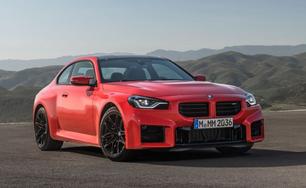
There have been mixed reviews of the design of the BMW M range, but I reckon this one looks pretty damn good. In fact, I've always thought this kind of hyper-aggressive styling looks better on smaller cars than it does on big ones.
And it certainly is aggressive, right? From the huge bonnet bulges to the meshed out grille and angry rear diffuser, to the staggered alloys and flared wheel arches, to the blocky rear end with its four massive exhaust exits.
But my favourite exterior item has to be the blacked-out carbon roof, which helps shrink the M2 visually, and makes the whole car look more potent.
Inside, it's plenty sporty feeling, with hard-backed sports seats, lashings of carbon-fibre-look trimmings and the bright red M buttons on the steering wheel.
It's nice, but some of the touch points – like the hard plastics on top of the doors, where, if you're like me, you rest your elbow when driving – feel less than premium.
Still, all the tech is present and accounted for, with its digital dash and huge centre screen, and there's no shortage of spaces to connect or charge your phone.
The B7 is a five-seater limousine although with the fold-down rear centre armrest which houses the media control panel the back is really set up to carry two.
That 3.2m wheelbase means cabin space is enormous. At 191cm tall I can sit behind my driving position with about 30cm between my knees and the seatback. Those rear doors open wide and the entrance is huge, making entry and exit almost as easy as just walking through a doorway. The air suspension also rises and lowers the B7's ride height for better access.
Storage is excellent, with two cupholders and door pockets for rear passengers, along with the area inside the centre armrest.
Up front, the driver and co-pilot have a deep centre console storage bin with split-opening lid, two cupholders and door pockets.
Luggage space is good, with a 515-litre boot.
The M2 pocket rocket measures just over 4.5m in length, just under 1.9m in width, and just over 1.4m in height, and it rides on a 2747mm wheelbase. That makes it longer, wider and lower than the model it replaces.
Remember that 'lower' bit, as it will come up again in a moment.
Up front, you don't feel cramped, and there's the requisite cupholders, door pockets and hiding holes, as well as wireless device charging and USB connections.
But remember, this is a two-door, four-seat affair, which cuts into the practicality a little, or a lot.
Swing open the wide front doors, and push the front seat-back forwards, and the entire chair will slide forward automatically.
It does help create more room to climb into the back, but it's still a slightly embarrassing challenge to make getting back there look anything like graceful.
Once there, it's tight. I'm 175cm and my head was firmly pressed into the roof.
You do get your own vents and temp controls, but that's about it. Even the pull-down divider only gives you access to the 390-litre boot, rather than extra cupholders.
You do get two sets of ISOFIX attachment points, though, and let's be honest – if you're buying this to make Bunnings runs, you've probably got it wrong.
The B7 lists for $389,955, while a 750li is about $319,000. At this level, $70K seems like a downright reasonable premium to pay for a faster, more powerful, better handling and comfier version of the 750Li.
In this case you're paying more but getting more, although standard features are close to identical. There's adaptive LED headlights, head-up display, night vision with pedestrian detection, a 10.25-inch touch screen up front and two screens in the second row for TV and other media functions.
There's a reversing camera, sat nav, harman/kardon surround stereo and Apple CarPlay. There's leather upholstery, seat massagers in the front and rear, four-zone climate control, heated and ventilated front and rear seats, front and rear parking sensors, auto tailgate, sunblinds for the rear and rear-side windows and proximity key.
The safety features are listed in the section below, and that list is also impressive.
Rivals to the B7 include the Mercedes-AMG S63, which lists for $375,000, the $331,700 Audi S8 and even the Bentley Flying Spur, which almost matches its price at $389,500.
First, the bad news. The M2 has only been getting more and more expensive over the years, and this new-generation model continues that charge.
Fun fact: When we first tested this model way back in 2016, you could get the Pure grade for less than $90K with a manual transmission.
Or you could spend just under $100K for the full-fruit version. This one, though, lists at $121,700, before on-road costs.
So, a little less bang for buck, but there's still a whole lot of bang on offer here.
You'll find staggered 19- and 20-inch lightweight alloys, while standard performance kit includes an 'Active M Differential', 'Adaptive M Suspension', 'M Compound Brakes' (with blue calipers), 'M Sport Seats' up front and, for the first time, a lightweight 'M Carbon' roof.
Elsewhere, there's adaptive LED headlights, a 12.3-inch instrument display and a 14.9-inch multimedia screen, a head-up display, a Harman Kardon 'Surround Sound' audio system and Android Auto and Apple CarPlay connectivity.
You'll sit on leather seats that adjust electrically and are heated up front. There's three-zone climate control, along with a heated steering wheel, wireless device charging and ambient interior lighting.
Alpina takes the 4.4-litre twin turbo V8 from the BMW 750Li and rebuilds the engine by hand. Alpina fits its own turbochargers, air-intake set -up, high-capacity cooling system and Akrapovic quad exhaust. Output is 447kW and 800Nm – an increase of a whopping 117kW and 150Nm over the 750Li's grunt.
It's interesting to note that the V12-powered 760Li has a smidge more power, at 448kW, and the same torque output as the B7.
How fast is the B7? Supercar fast – the B7 has a top speed of 330km/h, which will see it outrun a McLaren 570 and almost keep up with a Ferrari F12. That's quite incredible for a 2.3-tonne limousine with three TVs on board. A 0-100km/h time of 4.2 seconds is also hugely impressive.
In comparison, a 750Li has a 0-100km/h time of a not-too-shabby 4.7 seconds, but the car is electronically limited to 250km/h.
An eight-speed automatic transmission shifts gears smoothly, although a little slowly in Normal mode, while Sport and Sport+ add urgency and harder shifts.
Finally, the B7 is all-wheel drive, and those rear wheels are designed to steer slightly for better cornering performance.
Besides, this is what we're really here for, isn't it? The M2 gets the 'M TwinPower' 3.0-litre twin-turbo inline-six engine, producing a sizeable 338kW and 550Nm, sending that power to the rear wheels via an eight-speed auto or six-speed manual.
BMW says this engine is very, very close to the engine that powers the M3 and M4, and says it will rocket the M2 from 0-100km/h in 4.1 seconds, and to 200km/h in either 13.5 seconds in the automatic, or 14.3 seconds in the manual.
The B7 is probably not the car to own if you're concerned about either fuel prices or emissions, but then the twin-turbo V8 may not be as thirsty as you'd think, with Alpina stating that, after a combination of urban and open-road driving, you should only use 9.6L/100km.
My time in the B7 saw me double that usage but this could have had something to do with me turning off the stop-start system and driving in Sport mode constantly.
A small fly in the ointment is fuel use, with the M2 said to use 9.7L/100km on the combined cycle. It also drinks 98 RON premium, and is home to a 52-litre fuel tank. Your theoretical driving range is around 540km.
Now, be warned, you'll be bored stiff if you drive it in the way that's required to get it that low. When we were being gentle, we were somewhere between 10.5 and 11.5 litres per hundred kilometres.
Emissions are pegged a 220g/km of C02.
Who on Earth thinks a BMW 750Li isn't fast enough or comfortable enough, even with all its horsepower, luxurious cabin and technology? Alpina, that's who.
Redevelopment of the 4.4-litre V8 with new turbochargers, a high-capacity cooling system, different air suspension set-up and an exhaust system made by Akrapovic have made this already exceptional car better. Better to drive and better to be driven in.
The ride, even on those 21-inch wheels and low-profile Michelin Pilot Super Sport tyres (255/35 ZR21 on the front and 295/30 ZR 21 on the rear) is incredibly comfortable. I drove it and also had a chance to recline in the back and be chauffeured (by our photographer) and the ride was so composed and refined it was hard to believe I was travelling along some truly awful urban roads with their cracked and pot-holed surfaces.
And it's quiet, too. Which will suit those in the back being transported swiftly from the airport to their next meeting, but if you're after a loud and angry exhaust note then you won't find it in the B7. Sure, from the outside at full throttle the B7 has a menacing growl, but this isn't a BMW M car that will bark and snarl.
See, while BMW's M division makes brutal, loud, high-performance versions of their regular cars, Alpina makes comfortable, stealthy, high-performance ones.
All-wheel drive provides fantastic traction and ensures that grunt doesn't just tear the tyres off those rims when you sneeze on the throttle.
And while the air-suspension is soft and comfortable, adaptive dampers adjust for when the road goes twisty, providing impressive handling for a heavy and long car.
Really, though, the B7 is built for long, endless stretches of roads, and the acceleration beyond 100km/h is almost as startling as that from 0-100km/h, as it wants to push straight past 200km/h towards that 330km/h top speed.
Which, unless you know a good lawyer or happen to be one, will send you straight to jail. Yes, the B7 is probably too much car for Australian roads. Only on a German autobahn would a B7 be fully at home.
I felt like I was given a Melbourne Cup-winning racehorse for a week but could only ride it in my suburban backyard.
Let's be totally up front here: the BMW M2 isn't the most comfortable vehicle to live with. In fact, I recently climbed out of the M3 Touring, and found that to be more comfortable on broken city streets.
The M2 is fitted with adaptive suspension, but even in its most comfortable settings it can feel rough, bumpy and jarring on bad roads (of which Australia has lots), and unless you're gentle with the accelerator, it can feel a little jumpy when first taking off – a by-product of its prodigious power.
Now, let's be totally up front again: I don't care. The M2 is fun, plain and simple, and for mine, the above is a fair price to pay for something that brings so much joy.
The steering is lovely, the power immediate and the soundtrack intoxicating, and it's the kind of car that's fun no matter where, how far or how fast you drive it.
In fact, fun seems to be the very centre of the M2 proposition, which definitely doesn't take itself too seriously.
For evidence, look no further than the 'M Drift Analyser', buried in a hopelessly busy multimedia system that will have you praising the CarPlay and Android Auto gods.
It will rate your best drift out of four stars, measure it for distance, and basically give you a pat on the back for doing your best hooligan impression (not on a public road, of course).
Fun, then, is the order of the day here. And I bloody love it.
The Alpina B7 comes with all of the BMW 750Li's safety equipment – this includes AEB, lane-keeping assistance and lane-departure warning, blind-spot warning, active cruise control, night vision with object recognition, auto parking and surround view camera.
Along with the suite of airbags, there's traction and stability control and ABS, as you'd expect.
The 750Li and B7 have not been given an ANCAP score.
The BMW M2 hasn't been assessed by ANCAP, but it arrives with six airbags, as well as all your usual traction and braking aids.
Elsewhere, you'll find lane change and lane departure warning, active cruise control, front and rear parking sensors, tyre pressure monitoring, and AEB with pedestrian detection.
There's also blind-spot monitoring, rear cross-traffic alert and lane centring assist, as well as a tyre-pressure monitoring system.
The B7 is covered by BMW's three-year, unlimited-kilometre warranty. Servicing is recommended every 12 months or 15,000km. The B7 is covered by BMW special vehicles servicing plan, which means services are cost-free for the first three years of the car's life.
The BMW M2 is covered by a five-year, unlimited kilometre warranty, and servicing is 'condition based', in that the vehicle will tell you what maintenance is required, and when.
You can prepay your service costs at the time of purchase for all BMW vehicles, covering the first five years of ownership, for $3480 (which means $695 per service).