What's the difference?
Do you remember when you first saw an Audi TT? I can go first. It was 1998 and I’d been backpacking through Europe for months and had arrived in Paris just as all my money had run out.
Anyway, as I was beating myself up for spending way too much on a fridge magnet in a souvenir shop (it had a built-in thermometer) when one drove past me.
I saw the Audi badge but before I could work out what it was it turned the corner and was gone.
The mysterious Audi was silver and it looked like it was from the future, but actually it was the original TT, the first one, and being about October ‘98 it would have only just come out.
I would never have believed you if you’d told me at the time that 25 years later I’d be a motoring journalist and that I’d be reviewing the final Audi TT ever.
And here we are with the Audi TT Final Edition. That’s right, Audi has decided to discontinue this sports car after 25 years of production and it’s made this commemorative TT Final Edition that adds unique fettling and some nice features.
So, is the TT Final Edition worth buying? What’s so good about it? And how much more does it cost over a regular TT?
I found out after spending a weekend on some great roads to say goodbye to this icon. Oh, and I still have the fridge magnet.
As a child, my parents - who aren't car people - would see a Jaguar and point. It didn't matter if it was an XJ, Daimler Double Six or a Mark II, there was a great deal of mystique around these bastions of Britishness. It also didn't matter that these weren't necessarily good cars. The Seventies and Eighties saw the brand slide into a funk while being passed between owners like hot potatoes.
Somehow, the brand survived its brush with Ford's useless Premier Automotive Group strategy which only came good towards the end as Jaguar's management woke up and put in place a change in direction that produced the Ian Callum-designed XF. Riding high on that design, Jaguar then promptly introduced the very pretty Jaguar XJ.
It has been on sale for ages, but with the addition of a few bits and bobs to stay competitive, it's as compelling as ever. Most importantly, the performance-focused R has kept its unique supercharged V8.
Audi is finally saying hooroo to this model which has made the world stop and stare like I did on that Parisian street all those years ago.
The Final Edition is a fitting tribute to this iconic sports car and I’m glad Audi didn’t go ‘OTT’ and deck it out with gimmicky features.
At the same time the Final Edition’s big rear wing, blacked out badges, wheels and interior colour coding hint that this is not just any ordinary TT and those that know will know.
Farewell Audi TT, we hope something just like you but probably electric appears to stop us in our tracks again.
It might be old and facing German competition bursting with advanced technology, but the XJR is still a car you can buy with heart and head. But mostly your heart. It goes like stink, has a much better interior than the Quattroporte and is more interesting than just about anything this big or this grand.
It's also a better car than the Maserati Quattroporte if you want to get on with the driving yourself and is far prettier than the Porsche Panamera. It's a wonderful thing and even more wonderful that Jaguar continues to build it. Long live that supercharged V8 and the XJ is a great home for it.
The Audi TT’s shape has morphed over the past 25 years from the cute, rounded bubble car that first appeared in the late 1990s to the more aggressively and sleek looking sports car with the sharp creases we see today.
Still, there are the familiar pumped-out wheel arches and, while not as prominent as it used to be, that arching roof and the way it flows down to those tail-lights and stumpy tail remains so true to the original TT.
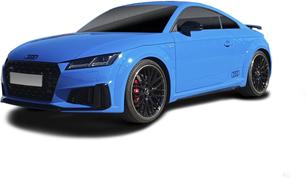
The TT Final Edition has a more menacing and athletic look than the regular 45 TFSI its based on thanks to the S Line Competition Plus exterior package.
So you’re getting the big fixed wing, an aggressive front bumper, and the 19-inch alloy wheels in gloss black.
There’s a black package, too, which add the decals down the side, the blacked-out badges, the black exhaust tips and black wing mirrors.
My test car’s paint colour was Turbo Blue and you can see in the images of the cabin how Audi matches interior elements in the same colour. The contrast stitching on the seats also lifts the sporty feel into high-end territory.
It’s a simple cabin, though, free from busy buttons and giant screens and the incorporation of climate controls into the air vents is genius.
If you’re wondering what the TT Final Edition’s dimensions are its 4191mm long, 1832mm wide and 1376mm tall.
The XJ has a marvellously exaggerated length, with a rear overhang redolent of Jag's sporting coupe and roadster pair of the time of its launch, the XK. There's nothing else in the segment like it, with the three Germans - Mercedes' S-Class, Audi's A8 and BMW's 7 Series - having gone all Hugo Boss and and in the latter two's case, almost shrinking violet. The only credible Japanese alternative, the Lexus LS, looks like a Lexused 7 Series. The XJR is a more emotional car, like Maserati's Quattroporte.
The R adds an aggro grille, 20-inch wheels with low-ish profile tyres, a bootlid spoiler, red brake calipers and vents in the bonnet. Bits and pieces get the black gloss treatment and there are V8 and R badges, as well as a rather large leaper on the bootlid. Capping it all off are four exhausts poking out from the bumper and distinctive vertical taillights.
Inside remains largely unchanged. The cabin is big and luxurious, leather-lined and very, very comfortable. The front air vents have to be modelled on the de Havilland Comet's integrated jet engine intakes and, again, the dash design stays away from the horizontal lines of its obvious competition.
There is probably a bit much chrome for my liking, particularly on the centre console and around the rotary dial shifter, which reflects sunlight into your face during the day.
The lovely 'Riva Hoop' - a band that sweeps from door to door across the top of the dash - is a great touch and remains a defining feature in the cabin. The last update brought an Audi-like digital dashboard, including maps, but it's not nearly as slick as the German. The graphics for the dials are good (and quick) but the maps are a bit so-so.
The Audi TT isn’t going to cut it as a family car, but it’s more practical than a lot of people might think.
First this is a '2+2' sports car meaning those two rear seats are there for the odd occasion when you might need them, because the space back there is limited.
But for most of the time having a place to throw a jacket or extra luggage and not have to ask your co-plot to rest it on their lap will feel like absolute luxury.
Up front head and legroom is good, even for me at 189cm tall. Being a coupe the doors are long and although the car is low I found getting in and out easy.
There’s a pretty clever use of space when it comes down to cabin storage. You’ll find door pockets, a glove box, a covered centre console box and a hidey hole/wireless phone charger in the dash.
Back seat passengers have built-in shelves near their armrests. Surprisingly there are four cupholders - two of which fold out of the dash.
The boot isn’t huge at 305 litres but you can fold the rear seats down to open up the cargo capacity to 712 litres.
So, compared to its two-seater sports car rivals, the TT is relatively and pleasantly practical.
It might be over five metres long, but the Jag's cabin isn't as gigantic as that might suggest - luckily, if you want space, the XJ L has it. The SWB version is roomy enough, though, just not palatial. You can fit five people, but the big transmission tunnel will limit the size of that fifth.
Front and rear passengers have a pair of cupholders each, with rubber bubbles to help hold smaller cups in tight. The front and rear doors have pockets but aren't really for bottles.
Boot space is a reasonable 520 litres, with a space saver spare under the floor.
Audi has taken the $84,000 TT Coupe 45 TFSI quattro and created this TT Final Edition with extra features for a list price of $88,749.
Here’s what you’re getting. First there’s the 'S Line Competition Plus' exterior package which beefs up the TT’s looks with the big, fixed rear wing and 19-inch Audi Sport wheels in gloss 'Anthracite Black' with red brake calipers.
There’s also the black exterior package which brings the black Audi rings badging, black chunky exhaust tips, black side trims and Audi logo decals.
Inside there’s Nappa leather S sport seats; an Alcantara and leather flat-bottomed steering wheel with paddle shifters; while the armrests, door handles and the centre console are covered by the 'Leather Package' which includes contrasting stitching.
Metallic paint is also included as part of the Final Edition’s features. Ours was 'Turbo Blue'.
Much of the rest of the Final Edition’s features are shared with the TT Coupe 45 TFSI quattro and includes a 12.4-inch 'Virtual Cockpit' digital instrument display, sat nav, CD and DVD player, eight-speaker stereo, digital radio, Apple CarPlay and Android Auto, wireless phone charging and proximity unlocking.
Our car had a couple of options fitted - the privacy glass which is $950 and the 20-inch gloss black alloy wheels for $1600.
Rivals to the TT include BMW’s Z4 which lists for $99,200, and its Toyota GR Supra twin for $87,380, while the Nissan Z Coupe is also part of that sporty coupe club at $75,800.
You might already know this but the TT doesn’t have a central media screen and that can appear odd in a new car world where big screens dominate the dashboard.
As is expected at this level, Jaguar was not mucking about with price or specification - the XJR starts at a mildly terrifying $299,995, which is very close to the rather more tranquil Autobiography long-wheelbase relax-o-mobile.
Standard are 20-inch alloys, a 20-speaker stereo, power everything with three memory positions, four-zone climate control, keyless entry and start, front and rear parking sensors, heated and cooled front and rear seats, sat nav, LED headlights and DRLs, leather everywhere, auto wipers and (LED) headlights, electric boot lid, heated steering wheel and a space saver spare.
The Meridian-branded stereo is an absolute cracker, powered by the improved but still laggy 'InControl Pro' system. Oddly, it's all crammed into an 8.0-inch touchscreen when there is seemingly room for the larger (and better-performing) 10.0-inch screen. The software is far superior than the version that preceded the last update, but the screen is hard to use, as targets are placed right in the corners and are hard to hit.
Apple CarPlay and Android Auto are also absent, and the sat nav is still fairly dopey.
A long list of options are available, some of which should probably be included in the big sticker price - DAB+ ($620), premium paint is a splutter-worthy $2060 (although, to be fair, the vast majority of the 19 colours are free), adaptive cruise with queue assist ($2200), adaptive headlights a further $2620 and 'Parking Assist', which adds side sensors and a front camera, a further $2780. Reverse cross traffic alert, blind spot monitoring and forward collision warning cost yet another $1460. Ouch.
The TT Final Edition has the same 2.0-litre, four-cylinder, turbo-petrol engine as the regular 45 TFSI TT Coupe with the same 180kW and 370Nm outputs.
The TT is light, though, at only 1460kg and that grunt is enough to slingshot it from 0-100km/h in 5.1 seconds.
The transmission is an eight-speed dual-clutch automatic which sends drive to all four wheels.
Sure, the TTS has more grunt and the TTRS is nothing short of wonderful with its five cylinder powerplant, but the 2.0-litre engine in the Final Edition feels perfectly suited to what is a fun and engaging sports car.
Jaguar's lovely 5.0-litre V8 with supercharger continues under the XJ's long and shapely bonnet, delivering a walloping 404kW and a tyre-shredding 680Nm. The sprint to 100km/h for all 1875kg of XJR is completed in an impressive 4.6 seconds, which was very competitive at the car's launch in 2009.
Power reaches the rear wheels via ZF's eight-speed automatic and you can control it with the tacky plastic paddles on the steering wheel. Oh, and it has stop-start.
Audi says that after a combination of open and urban roads the TT Final Edition should use 7.0L/100km.
My own testing took in a combination of the best country roads and worst city traffic and at the fuel pump I measured 10.9L/100km.
But most of my time was spent in 'Dynamic' drive mode with the fuel-saving idle stop system switched off.
The TT's 55-litre fuel tank means you should have a range of about 785km.
The combined cycle figure for the V8 is listed at 11.1L/100km but fully expect to see the 16.1L/100km we got, especially as you try and fail to tyre of the monstrous power delivery and lovely (if muted) V8 roar.
Luckily, even if you're belting it, the 82 litre tank is a generous size and you'll cover a fair amount of ground.
There are plenty of sports cars out there which are dynamically superb yet uncomfortable to sit in.
But the TT’s cabin is as ergonomic as it is stylish with a great, low sitting position and good pedal feel, a steering wheel that can be adjusted to be just right and still with plenty of space underneath for long legs like mine.
The shifter feels the right distance away, good visibility even out the rear window and plenty of ventilation. And we haven’t even started driving yet.
The TT Final Edition felt to me how a TT should. Fun. Not overpowered nor brutally firm and not ridiculously loud.
Instead, my drive in the Final Edition, which took me along some of my favourite country roads, was one of the most enjoyable runs I’ve had in any car.
This is a car which ‘listens’ to you and replies with exactly what you’ve asked for in the way it turns into corners and accelerates out of them, and pulls up when you need it too.
There’s so much connection to the road, you can hear the sticks and stones flying up into the guards, you can feel the coarse chip bitumen through the steering wheel.
But it’s all so easy, too. The suspension is firm but soft enough that you can drive this daily. The steering is light but still with great feedback.
Some sports cars leave you feeling exhausted, like you’ve just wrestled a bear but the TT Final Edition just leaves you feeling like you've been on a ride and all you want to do is run back around to line up and get back on it again.
Indecently quick, surprisingly agile and heaps of fun. While the first descriptor applies purely because of its size, the next two shouldn't when you're in command of 5.13 metres of motor vehicle. As with the Audi and now the 7, the Jag has a lot of aluminium to help keep the kilos off and good gracious, it has worked.
The R is based around the short wheelbase version of the XJ for perhaps obvious reasons. Even so, it appears to be the shorter-again XF's because this thing turns in like a demon. No, it won't stay with the dearly-departed XF-R but it does a mighty fine impression of one, just with a better ride quality.
Rear seat passengers should be prepared to feel a lot of wheelslip, especially when in Dynamic mode, as even the fat Pirelli P-Zero's struggle for purchase when the right foot hits the carpet. The V8 rumbles rather than bellows, but the rears cheerfully spin up until the computers and active differential rein things in. Traction control off and you've got a proper tyre-smoker if you're not playing by the rules. Jag's engineers are clearly hooligans at heart.
As always, ZF's eight-speed transmission does an incredible job of marshalling the horses in a rearward direction and when you're not after a bit of sound and light, have achieved a tremendous amount with the damping. When in normal mode, the car glides along, so much so that the lady of the house wasn't so sure it was a sporting sedan.
Once she was apprised of dynamic mode (you have to cycle the button through winter mode first, for some reason), her only complaint was that it was too long and the steering wheel too big for this type of car. I was persuaded of the latter, especially after stepping out of an Audi S3 which has a tiny wheel. Long story short, the XJR is now 'her' car (to be more accurate, the XFR is, but that hasn't arrived yet, so...), as it felt smaller than it was when not parking and she's a sucker for a torquey V8.
This could be a deal breaker for you. The Final Edition, like all Audi TTs, falls short in terms of safety equipment compared to its rivals.
This third generation TT only managed four ANCAP stars out of a maximum of five when it was assessed in 2015.
This was due to the model not having AEB or lane keeping assistance or rear cross-traffic alert.
The only assistance features it has are blind spot warning and self parking (which is handy). It doesn’t even have adaptive cruise control.
There are two top tether points for child seats in the second row but please be aware that the TT was also scored low by ANCAP for child occupant crash protection.
If you do have children and are looking for something safer but still small and sporty, the BMW 2 Series Gran Coupe or Mercedes-Benz A-Class are excellent choices.
Something to think about.
The whole XJ range has six airbags, ABS, stability and traction controls, emergency brake assist, reversing camera, three top tethers and two ISOFIX points. The XJ doesn't have an ANCAP safety rating.
The TT Final Edition is covered by Audi’s five-year, unlimited kilometre warranty.
Serving is recommended every 12 months or 15,000km and although Audi doesn't have capped price servicing there is a five-year/75,000km plan which will cost about $3000 in total for regular maintenance. Yep, that's $600 per workshop visit.
Jaguar offers a three year/unlimited kilometre warranty and roadside assist for the same period.
Like the F-Type, XJ owners benefit from three years/100,000km free servicing.