What's the difference?
If you’re looking for a sedan version of the RS 6 Avant, then you’ve come to the right place – sort of. See there is no RS 6 Sedan, but the RS 7 Sportback is the next best thing – you may even find it an even better thing because not only does it share RS 6 Avant’s outrageous engine and high-performance hardware, it’s also a sedan …but with a hatchback.
And if that kind of thing makes you happy, sit down – because the new generation RS 7 Sportback has just landed.
Jeep's Renegade might be late to the mini-SUV party but it comes with a pretty impressive back catalogue to suggest that this is a SUV that can cash the cheques its name can write.
The top of the range Trailhawk can write even bigger cheques than the lower models, bringing with it a range of off-road tech toys to let you really get down and dirty.
The new-generation RS 7 Sportback heralds the further evolution of this large majestic beast, with more features, a beautifully finished cabin and with more grunt with the looks to match. You’d be hard-pressed to find a better combination of power, dynamics and comfort in the Audi range – apart from in the RS 6 Avant of course.
Rugged, dependable and good off-road are the most obvious qualities of the Trailhawk. It stands out from the rest of the mini-SUVs by being able to do the S and the U with plenty of vigour.
It's just a shame that its on-road manners can't match that of its big brother, the Cherokee. Unless you're planning on proper off-roading, the Trailhawk might not be quite what you're looking for.
The big news is the RS 7 Sportback now comes with five seats. The previous generation car had just two seats in the second row. I'll talk more on practicality below but for now let's examine the new styling.
This RS 7 Sportback has new broad, black mesh grille, flanked by gigantic side air intakes, narrow headlights, and a thin upper air inlet which is a hat tip to early racing Audis.
While that new angrier, more angular and menacing face is a showstopper, everything about the new RS 7 Sportback seems to be accentuated further.
Look at the wheels. The previous generation came with 21-inch rims, now the new normal for the RS 7 are 22-inches – they're huge. Those wheel guards also flare out 20mm more than a regular A7's and the rear haunches have bulked up massively.
Come to the back of the car and the diffuser and bumper have also been beefed up. Nobody sitting behind you in traffic is going to think this is just a regular A7.
Don't expect the RS 7 Sportback's insides to be just as hardcore as its exterior. The cabin is almost identical to a regular A7's. It's a stunning cockpit dominated by a dash which protrudes back towards the passengers and houses the media screen. Anther display for climate is set into the big centre console which divides the driver and co-pilot into almost cocooned cells.
The cabin isn't without its RS touches though – there's the sports seats with honeycomb stitching, fully digital instrument cluster with RS specific meters, the RS steering wheel, the Nappa leather on the dashboard and the doors, the aluminium inlays. The level of fit and finish is up there with the best that I've seen on any production car.
The RS 7 Avant is 5009mm long, 1424mm tall and 1950mm across for a wide planted stance.
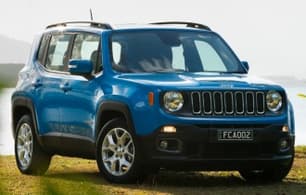
In what is absolutely not a coincidence, the Renegade immediately conjures up the Wrangler. Upright grille from the Willys Jeep (references abound here), round headlights, squared off wheel arches to mimic the Wrangler's guards, short overhangs and big rear view mirrors.
The 17-inch wheels look completely lost in the wheelarches which are even more cavernous owing to the Trailhawk's 50mm of extra ride height. The wheels are also a bit cheap looking but will probably survive the belting the car is intended to take.
Less rugged is the interior, despite a fairly self-conscious effort to make it look and feel chunky. The front seats are flat and unsupportive with the rears just as lacklustre making sure everyone is sliding around together. Luckily, front passengers get a dash-mounted grab handle.
It seems quite well put together, however, but with carpets and easily-marked plastics, you'll hope your passengers don't bring the mud in with them too often. And the "Since 1941" stamped into the steering wheel can go.
The dashboard is reasonably clear and has plenty of information to share via the screen between the dials but whoever thought marking the redline with a water splash graphic in bright orange should probably rethink their design decisions.
Storage is limited to two cupholders up front, door pockets in each door and nets on the front seat backs.
The Audi RS 7 Sportback lists for $224,000, which is exactly $8K more than the RS 6 Avant.
Coming standard are the enormous 22-inch alloy wheels, the matrix LED headlights with laser lights, metallic paint, a panoramic glass sunroof (which is new to the model), privacy glass, head-up display, soft-close doors and red brake calipers.
Inside there's the Bang and Olufsen 16-speaker sound system (that new, too), sat nav, the 12.3-inch virtual instrument cluster, wireless Apple CarPlay (new, as well), wireless charging, full leather upholstery with RS sport front seats that are heated and now come with ventilation as standard, and four-zone climate control.
I've left off all the standard RS mechanical equipment, but I'll cover that in the driving section below.
Is it good value? Well the Mercedes-AMG CLS 53 S is $186,435 but it has way less grunt, the Alpina B5 which I've also road-tested lists for $210,000 and there's the Porsche Panamera 4 Sport Turismo for $236,300.
The Renegade range starts at $28,000 for the 1.6-litre Renegade Sport manual front-wheel drive, climbing between $2000 and $3000 through the Sport Auto, Longitude Auto, Limited Auto with a final jump of $4000 to the 2.4-litre auto-only Trailhawk.
Standard is a nine-speaker stereo with Bluetooth and USB, 17-inch alloys, dual-zone climate control, reversing camera, rear parking sensors, keyless entry and start, cruise control, electric front seats with heating, satellite navigation, automatic bi-xenon headlights, auto wipers, leather trim, roof rails, front and middle bash plates, full size spare, heated leather steering wheel, privacy glass, trailer sway control and tyre pressure monitoring.
The lairy Omaha orange is $500, part of an eleven colour palette with only two no-cost paint options (black and white).
You can add lane departure warning, auto-parking and a black painted roof for $500 each, a removable and retractable roof called My Sky Roof for $2200 or a more conventional electric sunroof for $1900.
The Beats-branded nine-speaker stereo is run via Fiat-Chryser's UConnect system, accessible through the 6.5-inch touchscreen. While it improves with every attempt, it's still quite clunky and when the sat-nav is added, becomes a bit of a mess.
Thankfully, not every function has been crammed into the touchscreen interface, so you'll spend more time with your hands on the wheel rather than working out which bit of the screen has the climate control.
The RS 7 may look like a large, well-mannered business class car, but think of it as a thug in a suit because this thing is a monster with a 441kW/800Nm twin-turbo petrol 4.0-litre V8.
That's almost 600 horsepower and the supercar acceleration that goes with it is brutal: we're talking 0-100km/h coming in 3.6 seconds. That also matches the RS 6 Avant and it's a tenth of a second faster than the Audi R8 V10 RWD supercar, (and also the previous-gen RS 7 Sportback Performance) and this is a large, four-door, five-seater.
Compared to the previous generation RS 7 Sportback Performance the power is down by 4kW, but torque is up by a whopping 100Nm. Give me torque over power any day.
Shifting gears is an eight-speed automatic transmission, sending the drive to all four wheels.
The Trailhawk is powered by Fiat's 2.4-litre four naturally-aspirated four-cylinder producing 129 kW and 230 Nm. Jeep reckons you'll get 7.5L/100km on the combined cycle. Our mostly city driving with a longish motorway run produced an 11.0L/100km average over a week.
The transmission is a nine-speed ZF automatic driving all four wheels.
The Trailhawk also has Jeep's five mode Selec-Terrain system which should cover pretty much every eventuality – Auto, Sport, Mud, Sand and, just for the Trailhawk, Rock. The Trailhawk is rated to tow 400kg unbraked and 907kg braked.
I've never met an RS model that hasn't been great to drive – these cars are way more than just tough body kits and big wheels. The engineering which separates the RS 7 Sportback from the A7 makes them more distant cousins than siblings.
As I mentioned before the RS 7 Sportback and RS 6 share more than the same twin-turbo V8, there are also the giant brakes in form of 420mm discs at the front with 10 piston calipers and 370mm discs at the rear.
The optional carbon ceramic brakes are the largest ever to be fitted to a production vehicle at 440mm at the front and 370mm at the rear, saving 34kg in mass over the steel brakes.
Now standard for the first time is Audi's Dynamic Package, which adds dynamic steering (a variable ratio) paired with all-wheel steering, a sport differential, and a 280km/h top speed.
Coming standard is adaptive air suspension and for $2850 you can option the Dynamic Ride Control suspension, which is a hydraulically activated adaptive damper system
At the Australian launch, Audi supplied two RS 7 Sportbacks: one with the air suspension and the other with not only the Dynamic Ride Control system, but also the RS Dynamic Package Plus which adds the ceramic brakes and increases the top speed to 305km/h – this was the car I started off in.
I'm going to say right away that you don't need ceramic brakes for regular road use. Sure it means you can tell people that you have the biggest brakes in the world and they save you almost 35 kilos in weight, and, yes, they're resistant to fading, but they're expensive to replace and the steel ones are incredibly good.
I also feel the Dynamic Ride Control sports suspension isn't necessary in a car like the RS 7 Sportback. This is a Grand Tourer designed to eat up hundreds of miles at lightspeed in comfort.
So, while I found the first RS 7 Sportback with the big brakes and sports suspension sharper and firmer than the standard car, it didn't seem to fit with this vehicle's intent.
The regular RS 7 Sportback still accelerated with the same brutal force and roared at the scenery flashing past. It still handled through the tight corners superbly with excellent turn in, mind-boggling traction and grip, and excellent body control, but all in far more comfort.
This is the point – we covered hundreds of miles at the Australian launch of the RS 7 Sportback in a range of RS models, and sports suspension can go from great to gruelling on Aussie roads with their coarse-chip bitumen and potholes. The RS 7 Sportback, with its air suspension, not only made driving far more comfortable, but easier, too.
The Trailhawk name suggest that things are going to get muddy – compared to the rest of the range, the range-topper rides 50mm higher and has exposed, easy-to-reach tow hooks in the fairly unlikely event you get stuck. It also has a 20:1 low-range crawl ratio and Active Drive 4x4 which means it can switch between front and all-wheel drive. It'll also wade through almost half a metre of water. It's a genuine mud-plugging proposition and will take on some much bigger machinery out in the bush.
On the road, where we spent all our time in the Renegade, it's not what you'd call particularly inspiring. There's a number of sources of noise that contribute to a less than quiet cabin and having to constantly correct your course at freeway speeds adds to the tiring nature of the Renegade.
It's much better at lower speeds, pottering around but then again, its nine-speed transmission needs a lot more work on the shift mapping because it seems to forget which gear it needs to be in when you sink the right foot. If you don't need the Trailhawk's extra off-road goodies, consider the 1.4 litre Limited or Longitude.
ANCAP tested the A7 in 2018 and gave it the maximum five-star ANCAP rating, however, this rating does not apply to the RS 7 Sportback high performance model.
That said, the RS 7 Sportback is fortified with nearly every piece of advanced safety tech there is in Audi's cupboard. There's AEB which can detect and brake for cyclists and pedestrians at speeds between 5-85km/h and vehicles up to 250km/h; there's rear cross traffic alert and intersection crossing assistance with braking; lane departure warning and corrective steering to keep you in your lane, and blind spot warning.
Not a fan of parking, the RS 7 Sportback can do it by itself, or there's a 360-degree camera that'll help you do it yourself. There's an exit warning system, which will warn you if a vehicle is approaching as you go to get out, too, and if the RS 7 Sportback detects that it will be hit from behind, it will prepare the cabin by tensions the seatbelts and closing the windows, including the sunroof.
Along with all that there are Audi's new Matrix LED headlights with laser lights, rain sensing wipers and adaptive cruise control.
For child seats you'll find three top tether points and two ISOFIX mounts across the second row.
There's no spare wheel – instead, there's a tyre repair kit.
Seven airbags (including driver's knee bag), traction and stability controls, roll mitigation, blind spot monitoring, ABS and brake assist.
The Renegade does not yet have an ANCAP star rating although it scored five EuroNCAP stars in 2014.