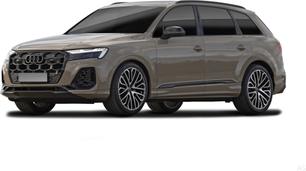
What's the difference?
The updated Audi Q7 is a bit of a game of ‘spot the difference’ - but even though it’s far from a new generation, the update is more than just some shiny new bits.
While the brand’s first SUV is still in its second generation, a bit of modernised design and some tech tweaks are aimed at keeping it in line with rivals, even as it nears a decade on sale.
As well as the new features, there’s also a new variant bound for Aussie showrooms. So, is it still up to the task?
Tesla’s Cybertruck truly is a giant wedge of cutting-edge technology, and not only because its edges are so sharp you could literally cut yourself, or chop kindling, with them.
No vehicle, nor indeed even any of his stupid ideas, so perfectly represents the manic mania, the whooping, wanton wackiness of Elon Musk as this comically angular, sharp-edged savager of pedestrians.
And yet people, and American people in particular as we discovered on a trip to Los Angeles to drive one, love the Cybertruck. Tesla is said to be holding as many as 2 million pre-orders for it in North America alone and many Australians have expressed interest in buying one, when the company finally manages to build it in right-hand drive, and get it on sale down here, almost regardless of the price (spoiler alert: it’s going to be a lot).
I’ve seen a lot of strange and wildly ugly cars over the years, but if you parked the Cybertruck next to all of them, they’d just disappear because you really can’t take your eyes off its pointy, almost dangerous looking lines. It’s like a human tried to engineer an echidna on wheels.
It does make me laugh, though, and so it was with a smile on my face and acid dripping from my pen that I arrived at a giant Tesla delivery centre in LA to drive it. Come with me.
Overall, changes to the Q7 aren’t quite revolutionary, but that’s okay because it was already a fantastic large SUV.
The fact Audi has kept the price around the same mark and introduced a cheaper entry-grade should be welcome news for prospective buyers.
But even the existing variants are capable and impressive family haulers… and now they’re just that little bit better.
Note: CarsGuide attended this event as a guest of the manufacturer, with travel, accommodation and meals provided.
Weird, wild, unnecessary, arguably horrific to look at, or at least challenging, too fast, too silly, the Cybertruck is many things, but all of the bad things are obvious from a distance while you only realise just how impressive, clever and intense it is once you take it for a drive.
The drive-by-wire steering alone is a revolutionary bit of tech that will surely bleed into the wider world.
Overall I thought I would hate it, but I walked away, head still shaking, with grudging respect approaching admiration for the Tesla Cybertruck.
The phrase ‘evolution not revolution’ is applicable here, cliche as it is, with the Q7 having been given a Botox-style lift at the front end.
The standard matrix LED headlights have a higher lighting signature than before, with the lighting elements leading into the lines down the shoulder of the SUV.
The grille now features a hexagonal honeycomb insert, the vertical line styling is now a thing of the past and the functional side vents are a little more aggro.
Overall, it’s a sharper look that brings the Q7 up to date with Audi’s current design language, down to the more angular wheel choices.
At the rear, the new tail-lights are ‘joined’ via a chrome strip spanning the rear, and the lower bumper (with real exhaust exits) has had a refresh.
Audi’s new CI badging (or ‘corporate identity’, pretty sexy stuff) is also present, which includes a new typeface for the ‘Q7’ badge at the rear, which is no longer italicised and is separate from the red ‘S line’ rhombus.
The four rings badge is also flatter and is white with black outlines, rather than a three-dimensional chrome badge.
Inside, the changes are more than skin-deep. In fact, the skin is the same, you’d be hard pressed to notice anything different about the Q7’s interior between pre- and post-facelift without diving into the electronics.
Is there anything interesting about a Narwhal, or a rhinoceros? It’s hard to know whether to give the Tesla Cybertruck 10 out of 10 for how interesting its design is, or zero for how offensive it is, but it would certainly get a solid 20 out of 10 for uniqueness.
Sure, in pictures it looks pretty out there, but when you stand before it in all its shiny steel it makes you laugh out loud, to the point where it has taken your breath away.
And then you start to notice all the fingerprints on it. Every time you - or any of its many admirers - touches it, you get nasty, oily stains and keeping it clean would make looking after a car painted in a matte finish look as easy as sleeping.
So, stainless steel as a choice for constructing a car? Perhaps there’s a reason no one else has ever followed the DeLorean’s lead here, but there’s no denying it grabs your eye, and provides a certain solidity to the whole structure.
Much like a Frank Gehry building, you’re either going to love the Cybertruck and think it a work of modern art, or dismiss it as a childish man’s fantasy made real (essentially that was the design brief for this vehicle, “make Elon a toy”, and it has nailed that brief), but either way you’ll definitely have strong feelings about it.
A car, or even a pick-up truck, with no round surfaces, nor subtlety of any kind, can’t really be described as beautiful in any way. But interesting? Definitely.
Audi has changed the layout and added new apps in the main 10.1-inch multimedia touchscreen, though fortunately it still has shortcuts to all the Big Dogs in terms of functions: media, navigation, phone, etc.
On top of that, everything is still in big, easy-to-see (and press) blocky buttons on the main screen.
The 8.6-inch screen below also still has climate controls readily available, and there are still physical buttons for a bunch of functions including drive modes.
The wide 12.3-inch driver display also remains familiar, though now has a higher resolution and more functionality in terms of on-road help and safety - which we’ll come to later in this review.
Aside from the tech, ‘spacious’ is an understatement when it comes to the big Audi’s cabin. In the front seats especially, the Q7’s central tunnel and dashboard are easy to reach without feeling like an enclosure as they wrap around the front passengers.
However, if I had to level one criticism at the usefulness of the Q7’s front row, it would be that despite there being physically plenty of room, storage is at a premium.
For something this big, there aren’t many places to put items that aren’t your phone or a drink.
There are door card holders for bigger bottles, some space for small items, and the cupholders of course, but the space under the central armrest including the phone charger is stingy.
Fortunately, the second row is not lacking space and is modular in its adjustability. Occupants can move seats, adjust their angle, and even sort out the middle seat separately.
Depending on how high up the variant chain you go, separate climate controls for the middle row and the panoramic sunroof help create a comfortable and roomy feeling.
The second row can also be tucked up behind the front row for easier access to the third row, which (if the second row is slid forward a tad) is just spacious enough for an average adult to be relatively comfortable for a short trip.
The third row seats are able to be folded or raised with switches that are accessible from the side doors or the (electric) tailgate, where there’s also a switch to lower or raise the rear suspension by 55mm to aid loading.
On that, the Q7 has a claimed luggage capacity of roughly 295L with all seats up, 780L with the third row folded down and 1908L with the second row lowered.
While the front and rear seats feel plenty spacious, that odd peaked baseball cap roof is a bit challenging in terms of headroom, and I smashed my noggin into it a few times trying to reach into the back seat for more Oreos and Mountain Dew.
You can pop up the bench seat in the back to create even more space for storage, or to provide a flat floor to sleep on.
You can also lie an American sized pizza box on the vast swathe of dash between you and the wildly angled windscreen, there’s plenty more storage on the floor between you and the passenger and then more storage bins at your hip, as well. A wireless phone charger sits twinned with the spot where you park your Tesla card key.
It’s a practical, semi-rugged feeling space, but with the usual kind of Tesla less is more feeling, except when it comes to the screen, which is stupidly large and requires far too much input when you’re driving to be safe. And there’s still no speedometer where you need one, in front of your eyes, and no head-up display, despite Tesla’s love of other jet-fighter tech, like drive-by-wire steering.
Four variants are available in the Audi Q7 line-up, excluding the performance-bent SQ7. Well, at the time of the launch event, one of those four is yet to arrive, that being the new entry-grade Q7 45 TFSI which starts from $108,815, before on-road costs. TFSI being ‘Turbo Fuel Stratified Injection’ or Audi-speak for ‘turbo-petrol’.
It’s joined by a diesel-powered 45 TDI which starts from $117,284, before on-roads. But ‘entry-grade’ for the Q7 doesn’t mean skint on goodies, both coming in with standard gear like leather-appointed upholstery with heated electrically adjustable front seats, an electric folding third row, wireless phone charging, screens and tech galore, matrix LED headlights, 20-inch wheels, adaptive air suspension, and a slew of safety features including some new stuff, but we’ll get to that later.
The matrix LEDs are one of the main new bits of kit, though a daytime drive route meant not getting to put those to use. They’re pretty, though…
The 45 grades can be upgraded with the $3900 'Premium Package' to add 21-inch alloys, four-zone climate control, black exterior styling and coloured interior ambient lighting.
Stepping up from the 45s are the 50 TDI S line and 55 TFSI S line, which together at $136,815 each form the next rung up from entry.
They’ve got 21-inch wheels and an S line exterior pack along with tinted privacy glass to tell them apart from the entry 45s from the outside, but inside there’s four-zone climate control, ambient lighting, a Bang & Olufsen sound system, a head-up display and proper leather upholstery for the seats.
Australian 50 TDIs and 55 TFSIs come standard with an S line interior pack that includes sports seats, leather steering wheel and shifter, aluminium inlays and door trim, plus black headlining and floor mats with contrast stitching.
There are two option packs at this level: the $4200 'Luxury Seat Package' adds S sports seats that feature an integrated headrest, Valcona leather with diamond stitching, ventilation for the front seats and heating for the second row’s outboard seats.
Then there’s a 'Premium Plus Package' for $5500 which brings 22-inch alloys, sport-tuned adaptive air suspension, dynamic all-wheel steering, a black exterior styling pack and power-assisted closing doors.
Given the update is all up relatively minor, prospective buyers will be pleased to know the same can be said for the pricing changes - even a year ago, the prices for the Q7 variants that were on sale at the time were within a couple of thousand dollars of where they are now.
How does one define value when it comes to the vehicular equivalent of a cockroach, one that seems capable of surviving the apocalypse with it indestructible (but possibly slightly rusty in appearance) stainless-steel exterior, HEPA filters (will protect you from pollution, pollen and “industrial fallout”) and (almost, kind of) bowling-ball proof super-strong windows (it can allegedly survive the impact of a baseball at 112km/h - handy if someone is trying to kill you with a baseball)?
And what price can you put on the kind of attention driving a Cybertruck gets you? Perhaps only a Bugatti or a Pagani could match the level of wide-eyed, slack-jawed excitement you see from other people when you drive this thing around.
Then there’s the fact that it accelerates like an actual rocket, is allegedly so cosseted in the cabin that it’s “as quiet as outer space” (this is a comparison test I am up for, if Elon’s Space X would like to arrange it), and can tow “an average African elephant”, or 4,990kg, and has a 1134kg capacity in that vast rear tray, covered by a standard, automatic tonneau cover that’s so tough you can stand on it.
In that rear tray you’ll find a bottle opener, and some storage tubs with drainage holes to keep your beer cold or your fish frozen. You could sleep in there, on the composite bed, which is tough you don’t need a liner, but why would you when you can sleep in the truck - the dash is so large you could comfortably lie under the windscreen to sun yourself - using 'Sleep Mode', which runs the air con all night from its giant battery to keep it at your set temperature.
Speaking of your battery, you can also charge things with it using the integrated power outlets, and that includes the ability to charge another Tesla, or to re-zap your Tesla Powerwall at home and run your house during a blackout. Or the Apocalypse.
Tesla has put a price on all this, of course, and in America it ranges from US$81,895 to US$101,985. Frankly, that seems like quite good value when you add it all up, or at least it would if the Cybertruck really could tow five tonnes further than the end of the street, and if range - surely something of an issue for an outdoorsy vehicle like this - really could be guaranteed at 547km.
If and when it gets to Australia, of course, its value will need to be reassessed on what is sure to be a much, much larger number.
The four drivetrain options for the Q7 line-up are split between the two ‘grades’, with the 45 TFSI and TDI powering the 'entry-level' cars and the 50 TDI and 55 TFSI as the feature-packed variants.
The most affordable option is the 45 TFSI, which runs a 2.0-litre, four-cylinder, turbo-petrol engine making 185kW and 370Nm.
Like all variants in the Q7 range, the 45 TFSI engine powers all four wheels via an eight-speed automatic transmission. Audi claims the 45 TFSI will hit 100km/h in 7.3 seconds, if that’s your thing when it comes to three-row SUVs.
The rest of the line-up is powered by different versions of the brand’s 3.0-litre V6, all turbocharged, and all with 48-volt ‘mild hybrid’ (MHEV) tech aiming to increase efficiency.
The 45 TDI is, of course, a turbo-diesel 3.0-litre V6 that makes 170kW and 500Nm, also sending power and torque to all four wheels via the same style transmission. Audi says this one knocks over 100km/h in 7.1 seconds.
Similarly, but with more power and torque, the 50 TDI is also powered by a turbo-diesel unit as the name suggests. This one puts out 210kW and 600Nm, making it likely the best choice for towing and such even though all V6 variants boast a 3500kg braked towing capacity. The 50 TDI’s figure to hit 100km/h is a claimed 5.9 seconds.
Finally, the 55 TFSI makes 250kW and 500Nm, and boasts a 5.9-second claimed 0-100km/h time.
Yes, I’m giving it 10. Because how could you want for more than a torque figure of 13959Nm, and a Ferrari-humbling 630kW of power to boot?
The Cybertruck is the perfect example of Elon Musk’s approach to what we’ll call science, or Twitter, or X. If it can be done, just do it, don’t ask whether it’s a good idea, or batshit insane.
So because he could fit a vast 123kWh battery and two crazy powerful motors to this pick up monster, and that could provide enough grunt to send three tonnes of mass to 100km/h in 2.8 seconds, they did.
Is it wise? Probably not. Is it wild and almost, somehow, strangely admirable? Yep.
As you might expect, diesel versions of the Audi Q7 are claimed to use less fuel than their petrol counterparts, so let’s start with those.
The 45 TDI boasts a claimed 7.0L/100km consumption figure, while the 50 TDI is a little higher at 7.1 litres. Both have 75-litre fuel tanks, and should therefore theoretically get more than 1000km out of a fill.
On to the petrol models, the four-cylinder TFSI 45 has a claimed 9.3L/100km efficiency figure and the V6 TFSI 55's number is 9.0L/100km.
Given the nature of the driving and groups sharing cars during the launch event, we’ll wait until we’re next in a Q7 for a longer time before doing our own efficiency test.
Tesla claims a range of 547km between charges and that even when towing something of “reasonable size” (a smaller Tesla perhaps) it will still get 400km. I, for one, very much doubt that.
Tesla also claims you can recover up to 235km of range with just 15 minutes of Tesla Supercharging, while a charge from 10 to 80 per cent on that same Supercharger would take 44 minutes. On a 110V American plug it would take 110 hours, or 4.5 days, to fully charge from zero to 100 per cent.
Aside from the mild-hybrid now standard on the Q7’s V6 models, there’s not a whole lot to report on in terms of new tricks or surprises from behind the wheel.
But that’s okay, because it means the Q7 remains a supremely comfortable and capable large SUV.
Our test route consisted of plenty of rural driving, with a combination of surfaces that would in some family haulers see the suspension and maybe even steering show cracks in their ability - but the Q7 remains composed.
Given its weight and size, it can feel a little hefty around sharper corners, but the Q7 in these variants (i.e, not its performance-focused SQ7 sibling) isn’t built to be hustled like that.
It feels like the kind of air-suspended loungeroom-on-wheels that would be at home barreling down the autobahn at 180km/h and being completely undramatic about it.
Still, this model shares some moving parts underneath with the likes of the extremely capable Porsche Cayenne, and while the Q7 isn’t quite a giant hot hatch, the sound foundations shine through dynamically.
Of course, when it comes to powertrains, there isn’t really a wrong answer, each engine fits a purpose.
If you’ll ever need to tow (and you can at up to 3500kg braked), the low-down steady urge of the 50 TDI is probably your best bet, but even the 45 TDI is a solid choice for long-range motoring.
The petrol models will better suit those in city situations, and while they never feel truly urgent, the 55 TFSI isn’t without some impressive push for something of this size.
It’s fair to say the Tesla Cybertruck is an intimidating prospect in the metal. It towers over you and seems to stretch into forever, because it does, at 5.68m long (too long to fit in a standard Australian parking space).
It’s also a full 2.0m wide, 1.8m tall and weighs 3.1 tonnes, but along with its size comes the fact that it just doesn’t look… right. There’s not a round surface on it but there are plenty you could cut yourself with, or lose a finger in.
It’s no less weird inside, as the giant A-pillars, vast dash, crazy yoke steering device and graphically lovely screen confront you, making it feel like you might be on the Starship Troopers ride at Universal Studios rather than in an LA car park.
Then, while you’re getting used to this and having a good laugh at the Easter egg on the touch screen (smash the windows on the graphic of the car with your finger and you hear the sound of Elon freaking out at the infamous failure demonstration of its unbreakable glass), you’re warned that it is going to be almost as weird to drive as it looks.
This is, in part, due to the Cybertruck’s unique drive-by-wire steering - a technology previously popular only with jet fighters and other planes - which allows it to have a yoke instead of a steering wheel without being annoying, because your hands will never cross over and be left grasping air.
Yes, the Infiniti Q50 debuted with 'steer-by-wire' a decade ago, but featured a full mechanical system as a fail-safe back-up. No mechanical safety net here.
The Cybertruck has less than one full turn lock-to-lock, and it has not just passive but aggressive rear wheel steering, allowing the back wheels to turn the opposite direction to the front ones at parking speeds, quite radically, which, once you’re used to it, makes it much easier to park than seems possible.
It also makes this Tesla incredibly sharp and direct and means that, for the first few minutes of driving it you will turn the wheel, sorry, yoke, far more than necessary.
Once you get used to it, however, it is fabulous, as long as you don’t think about what would happen if the software that’s the only thing connecting you to the wheels - rather than actual moving parts - failed.
The steering makes the Cybertruck shrink around you to the point where you forget, at times, just how big it is. Combined with the low centre of gravity and the bank vault solidity of the chassis, it also makes it turn-in and handle like a much smaller sports car (and it has a turning circle that defies belief, one that’s sharper than some sedans).
Speaking of sports cars, most of them won’t keep up with the Cybertruck if there’s someone brave in its driving seat. Indeed, you’d need a proper hypercar to match its constant, surging torque (no, I don’t believe it can really have 13,000-plus Newtons, but it’s a lot), and its purely outrageous, surging speed.
Tesla has a habit of calculating torque at the wheels, not the motor(s) and gearing reductions increase torque markedly.
Yes, I do believe it would do 0 to 100km/h in three seconds, maybe slightly less, but I’m also equally sure it’s not a great idea to try (I'm also very grateful I didn't experience the problems with the throttle sticking open on some examples that recently saw every Cybertruck recalled).
The problem is that 3.0-tonne weight figure, and all that mass. It feels beyond weird to move something this big, that fast, and it quickly makes you pause for a chilling thought about whether it’s all going to be able to stop again. It does, or it did for me, but boy, it puts the wind up you every time you try.
Overall, though, it’s hard to overstate just how surprisingly good, and yes, at times even fun, the Cybertruck is to drive.
Oh, and for the trainspotters out there, claimed efficiency is 22.4kWh per 100km, but we actually saw 27kWh during our two days of test drives. Our second Cybertruck was also making some distinctly weird metallic clanking noises from underneath, particularly when we switched between forward and reverse.
It might be worth waiting for the second generation of this thing before buying one, but that won’t be an issue for Australian fans, anyway.
As far as its off-road abilities, we managed to find a bit of beach in a car park and pointed the Cybertruck at it. After an initial fearful moment of being sure we were going to sink, we just put the foot down and let all that torque power us out of trouble. It felt effortless.
The Q7 is a maximum five-star car according to ANCAP, but the list of safety features is dozens long.
The highlights include adaptive cruise assist, lane assist and side assist, surround view cameras and new traffic sign recognition plus warnings for approaching cyclists and the like.
In fact, Audi claims there are more than 30 active safety features, and almost all of them are standard across the range. The only one that isn’t is 'Parking Assist' with 'Park System Plus', as Audi calls it - the base 45 TFSI is only equipped with Park System Plus and not Park Assist.
Basically, the 45 TFSI can’t take over the task of parking itself, while the others can.
It’s all handled through radars, cameras, and sensors and when you’re on the road functionality is relatively unobtrusive which is a plus!
For reference, the Q7 has eight airbags including dual-frontal, side-chest airbags for front and second row outboard passengers, plus side head-protecting or curtain airbags for both rows.
On top of that, there are ISOFIX points not only in the second row, but also in the third, totalling five spots all up.
Some unkind experts have referred to the Cybertruck as a “death machine” and a “guideless missile”, pointing out that putting a stainless steel body on top of a big old battery is inherently problematic. As is the lack of crumple zones.
Making all this very pointy metal move as fast as a McLaren supercar has also raised some questions about sanity.
Then there was the recent recall of every Cybertruck built so far:
"Cybertruck owners reported that their vehicles were at risk of getting stuck driving at full speed due to a loose accelerator pedal. Video showed the pedal itself falling off and the piece beneath wedging itself into the car’s interior, which would force the vehicle into maximum acceleration. One driver was able to save himself from a crash by holding down the brake pedal."
Elon Musk, has claimed, however, that the Cybertruck, is “much safer per mile” than its competitors.
Australia has different pedestrian safety regulations to the US and while some have posited that the Cybertruck will pass, pointing to the fact that you can buy an even bigger Ram truck here, others are not so sure.
The Tesla Cybertruck does have six airbags, and a suite of active safety features as part of its 'Autopilot' system, but it does not yet have 'Full Self Driving'.