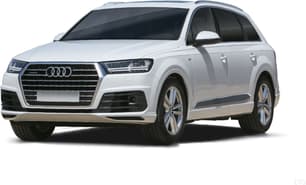
What's the difference?
Audi’s big banger Q7 relaunched late last year with a slimmer-hipped, lower slung replacement for the old bruiser.
Interestingly there was just the single variant, a 200kW diesel turbo V6 with a six-figure starting price. A few months down the track we’ve finally scored a lower-powered, entry-level Q7.
There are a few bits missing that are standard on the more highly powered version, so with a relatively narrow price difference, is it a good fit for options-box tickers?
Audi's Q7 burst on to the scene at the 2002 Frankfurt Motor Show. A big, bluff unit, it went into production in 2005 and hung around for what seemed like an eternity. Like many first-generation German premium SUVs, it was compromised, heavy and heavily US-market focused.
The second-generation arrived in 2015. Its styling polarised opinion but its shift in focus has - arguably - made it more appealing to more people. Lower, better-packaged and with a very impressive interior, the Q7 transformed into a proper, premium SUV.
The 200kW Q7 is a brilliant car and the 160kW is little different. It’s hard to make the economic case for spending less, though, as options will quickly land you in 200kW price territory unless, of course, you’ve stretched yourself for the $96,300 in the first place.
If you have stretched, you’re getting an even better overall car than the excellent BMW X5. The fundamentals of the Q7 are such that you could almost whack the 2.0 TFSI from the A3 in it and it would still be just fine.
It's difficult to pick between the 160 and the 200. Neither are particularly cheap but this is another of those occasions where it would be a waste of money to bring in a comparatively stripped-out entry level that nobody would buy.
If pressed, I'd say spend the extra on the 200 - it's got a fair bit more gear for the extra outlay and in both the theoretical and real worlds, it doesn't really use that much more fuel for the decent performance boost.
The e-tron is a long shot for a bigger wad of cash and is really only for those keen on a plug-in hybrid Q7. The limited competition isn't any better.
The Q7 is a belter of a large SUV - quiet, refined and reasonably capable off-road, despite its decidedly on-road focus. It goes about its business quietly, confidently and with a minimum of fuss . You know it's big, but it doesn't shout about it and, crucially, it doesn't feel like it from behind the wheel. That's a neat trick.
The new Q7 is, thankfully, a lot less imposing than the first generation. That car really did loom and as time went by it became ever more covered in bling. The restraint of the new car is admirable (and good business sense – there’s bound to be a bigger Q8 before long) and looks more like a jacked-up wagon than a full-on SUV.
As is Audi’s wont, there’s lots of aluminium, particularly in the MQB Evo chassis itself (shared with some pretty posh things like the Bentley Bentayga) as well as doors and bonnet.
Despite being smaller, there are still seven seats in the Q7, with a reasonably accessible pair of rear pews providing you’re at least four years old and in possession of two working legs. That third row gets its own air-conditioning vents, cupholders (there are six in total) and somewhere to store your ration of Smarties.
The middle row of seats can be slid fore and aft through about 15cm to liberate or rob the third row of space. The middle rear seat passenger does have to contend with a fairly solid transmission tunnel, however.
Storage is well scattered around the cabin, with four bottle holders, a shallow bin under the centre armrest and a few cubby holes here and there to supplement the good-sized glove box. Audi says the minimum boot volume is 770L with the third row of seats down and 1955 with both rows folded away. With the third row up, an educated guess says somewhere in the region of 300L is still available. There's also ISOFIX child seat mounts for all five rear seats.
The driver gets a clean, clear dashboard with two big dials flanking the central info screen and, as usual, everything is spot-on ergonomically. The dash is considerably less visually weighty than the old car, with full width air-con vents, the middle section blowing diffuse air so you’re not in a windtunnel from a 1980s music video clip.
The second-generation Q7 is a familiar sight on our roads. I remember the change from the first to second iterations clearly - I wasn't a fan of the old one's overbearing looks and it always looked as though it rode too high, especially on smaller wheels. As its long model cycle wore on, it became ever more bejewelled and the basic shape was lost in bling.
Thankfully, the second generation went light on the chrome and flashiness. Always riding on big rims, it looks less imposing than the original. There are some off-road nods, like vestigial wheelarch extensions, but anything with a rear diffuser is meant more for tarmac than gravel.
This Q7 is more a high-riding wagon (or higher-riding of you take the A6 Allroad into account) and seems more optimised for passenger space and utility rather than shouting 'Look at my massive car!'. Like the bulk of the current Audi SUV range, it's quietly elegant.
And inside, it's tremendous. The now de rigueur 'widescreen' feel to the interior means an airy, light space. Materials are spot on, the design coherent and sensible and the ergonomics are close to faultless. You'll want for nothing in here, with plenty of space, gadgets and style.
With a price just a few thousand down on the original 200kW version, it almost seems like Audi doesn’t really want you to buy the base model. The price difference is “only” $7600. Remember that bit.
Despite the lower sticker, there is a generous equipment list, particularly on the safety front. Standard are a 10-speaker stereo with DAB+, Bluetooth and dual USB ports, 19-inch alloys, dual-zone climate control, blind spot sensor, reversing camera, keyless entry and start, front and rear parking sensors and park assist, cruise control, electric front seats with driver’s seat memory, satnav, bi-xenon headlights with level adjustment, auto headlights and wipers, leather trim (some real, some not), electric tailgate and tyre-pressure monitoring.
Our car had the optional Audi Connect wifi hotspot feature ($750), metallic paint (at a hefty $2400), Assistance Package - which adds adaptive cruise, active lane assist, pre-sense front, traffic jam assist, collision assist and turn assist ($4075), LED headlights ($2800!), Parking Assistance Package, which adds auto-parking and 360-degree cameras ($1300), full body paint finish ($1300) and interior inlays of high gloss black and oak (an even more mystifying $1690). This brought the total to an eye-watering $110,615.
That’s only $5000 less than a similarly optioned 200kW, which has a few more standard additions, more power obviously, bigger wheels and the full digital “virtual dashboard” from the lovely TT. Of course, neither Q7 is particularly cheap. If you’re willing to lose all-wheel drive, you can have a BMW X5 starting at $86,200 for the rear-wheel drive 170kW 2.0 diesel (but only with five seats).
Audi’s MMI system controls the operation of the retractable 8.3-inch screen that rises majestically from the centre of the dash. MMI looks after the entertainment, satnav and various settings of the car and does a fine job of it, supplemented by a generous touchpad for you to write out your destination with your finger, or choose your radio station.
You can also speak in reasonably normal terms to the nav via voice activation and it will take you to the nearest public toilet, or a petrol station or a nearby Italian restaurant.
There are three Q7s in our model comparison, excluding the V8-powered triple-turbo SQ7. The range starts with the 160 at $97,800, with the 160 designation referring to the engine output in kilowatts.
The 160 starts the range with 19-inch alloys wheels, dual-zone climate control air-conditioning, reverse camera, front and rear parking sensors, bi-xenon headlights, LED daytime running lights, Wi-Fi hotspot, keyless entry and push button start via smart key, electric power steering, cruise control, hill-descent control, quattro all-wheel drive, power tailgate, floor mats, chrome exhaust tips, electric front seats, leather trim, air-quality sensor, park assist, electric everything, auto wipers and headlights and a comprehensive safety package.
Rather than supplying a spare tyre, Audi gives you a tyre-repair kit.
Stepping up to the 200, the price increases to $106,900, with an attendant increase in horsepower. The basic specification is roughly the same between the two versions, with detail differences.
The 200 adds four-zone climate control, a self-parking system, full body paint finish (body colour applied to the lower extremities of the car) and Audi's excellent 'Virtual Cockpit' digital dashboard.
The difference between the 160 and the 200 is small but useful. The diesel fuel economy is barely different, you get the same transmission, 4x4 system and overall comfort.
Both 160 and 200 buyers have a wide choice of colours: 'Night Black' and 'Carrara White' are free. 'Orca Black', 'Galaxy Blue', 'Ink Blue', 'Cobra Beige' (more gold, really), 'Argus Brown', 'Graphite Grey', 'Temperament Red' and 'Florett Silver' are all $2250. 'Sepang Blue' and 'Daytona Grey' are $7050.
The e-tron adds the hybrid electric unit, loses the third row of seating and some cargo capacity and comes with a full suite of safety systems, heated front seats, 'Audi Connect', LED headlights, e-tron styling and adaptive air suspension. The options list is way shorter, however, but few e-trons find their way into customers' hands.
Audi e-tron buyers are down to seven colours: Night Black, Carrara White, Orca Black, Ink Blue, Graphite Grey and Florett Silver are all freebies.
The many iPhone users out there will be very pleased that Apple CarPlay is standard on the Q7, while Android Auto is also available. As always, Audi's MMI mutlimedia system is excellent. The big 8.3-inch screen is run by a console-mounted rotary dial and touchpad, but it's not yet a touch screen.
GPS sat nav is available across the range. The navigation system can also have a Google Earth overlay. Obviously there is a mobile-phone bluetooth connection in addition to the USB. The multimedia gadgets include a CD player, DVD player, MP3 functionality and the usual AM/FM radio as well as DAB.
As it's an Audi, there's a huge options list as well as various packages to add to the lengthy standard features list.
The $6200 'Technik' technology pack adds the excellent head-up display, plus nine speakers to the stereo (19 in total, including sub-woofer) and wireless phone charging.
The Assistance package includes additions to the safety list (see below).
Of course, the drive-away price can be significantly affected by options choice. The standard price list is just the start, and the amount you can choose to spend on options is breathtaking.
You can upgrade the sound system to a thumping Bang & Olufsen with 23 speakers (including sub-woofer) for a whopping $13,990 (it's a good one), a panoramic sunroof for $3990, four-wheel steering for $2650, air suspension ($4690), 'Matrix LED' headlights ($4850), rear seat entertainment system, side steps, - you get the idea. If I have this right, you can almost double the cost of the Q7 with options.
The S-Line options are more an exterior design pack than the dynamic pack they used to be, offering ever-bigger alloy wheels, side skirts, darker tinted windows, subtle front spoiler and LED headlights.
Ceramic brakes with red brake calipers aren't available in 'standard' Q7s but are available on the sport edition SQ7.
Unavailable are autopilot self driving, tool kit, nudge bar, bull bar, auxiliary heater, heated steering wheel, sunglass holder, carbon fiber trim, 'Homelink', specific premium package and cargo liner.
The 160kW is the same basic unit as the 200kW, just with the lower power figure and 500Nm of torque (down from 600Nm) to push its 2135kg frame to 100km/h in 7.3 seconds.
Fuel economy, courtesy of the ZF eight speed automatic and stop-start, is a claimed 5.8L/100km and, it must be said, a fairly unlikely figure to achieve. We saw 9.2L/100km on the dash display, which is still pretty impressive for such a large vehicle.
The Q7 is also rated to tow 3500kg with trailer brakes.
All Q7s are available with same engine size - a turbo-diesel 3.0-litre V6. In the base model it spins up 160kW/500Nm. Step up to the second spec and with a bit of extra turbo boost and some software tweaks you have 200kW/600Nm.
The e-tron plug-in hybrid runs the same diesel engine with an electric motor added. The diesel specs come in at 190kW/600Nm while the electric motor brings 94kW/350Nm to the party. It's not as simple as adding the figures together, however - Audi quotes the combined specifications as 275kW/700Nm. The battery is a 17.3kW/h lithium-ion pack under the boot floor.
Charging times vary from 2.5 hours from a 400V/16-amp supply to 10.5 hours from a household socket.
All Q7s ship with an eight-speed automatic transmission (from ZF) with power going through all four wheels. All Australian Q7s are all-wheel drive.
Towing capacity is 750kg for unbraked trailers and 3500kg braked - the ratings are identical across the three trim levels. A tow bar is on the optional features list.
The 0-100km/h acceleration times are an impressive 6.2 seconds for the e-tron, 7.3 for the 160 and 6.5 for the 200. These are good performance numbers for a 2000kg-plus SUV with decent fuel mileage.
The question of whether the engines use a timing belt or chain has a simple answer - the Q7's engines all use a chain. The engine also features a diesel particulate filter and the turbocharger is inside the engine V for quick response. The oil type is listed in the owner's manual.
There is no manual transmission or LPG version.
It might be down 40kW and 100Nm of torque, but the Q7 still feels pretty nimble for what is a very heavy car, despite its average weight loss of 325kg. The mid-range is very strong, meaning effortless overtaking from rarely more than a toe on the throttle pedal. When your car is this big, the last thing you want to be worrying about is whether it will trip over itself when you’re in the cut and thrust of the school pick up or daily commute.
This is the first Q7 I’ve driven without the air suspension and it was a pleasant surprise. It rode and handled almost as well and you’d have to wonder whether it’s worth the extra outlay. When a press fleet has nothing but air-suspended cars, it makes journalists suspicious; I’m pleased to say there was no need. The only real difference is more noticeable body roll when you’re getting a bit ambitious in the corners. Not really a Q7’s core business.
The steering is quite light but weights up nicely in dynamic mode. It’s tidy in the bends and excels in the wet or dry; its stay with us coincided with some truly apocalyptic rain, which the car simply shrugged off. Needless to say, the cabin is extremely quiet, with just a slight rustle around the wing mirrors and a distant growl from the engine.
Hit the start stop button (like most cars, carefully hidden from view behind the steering wheel) and the 3.0-litre V6 starts quietly (or not at all in the e-tron). As soon as you're out driving, you realise how little road noise invades the cabin, even with the fat tyres all Q7s wear.
Acceleration is good in all of them, even the 160 feels quick. At speed, the cabin is super-quiet and with the air suspension the ride is almost supernaturally good. With the steel springs, you do feel the weight of the car more than with the air suspension, but it handles the bumps and grates of Sydney roads very well indeed.
The e-tron feels heavier, but the standard air suspension copes nicely with the extra bulk. In all other ways it feels extraordinarily similar to the 160 and 200, with the predictable penalty in handling. While the pure EV range might be a little disappointing, the stats tell a rosier story. Around town, you might see 0km in the digital display for electric range, but stepping off from a standstill - a big contributor to city fuel consumption - is electric, with the diesel quietly intervening at around 20km/h. All up, the MMI system told us electric drive accounted for half of city running.
From the day this Q7 landed on our roads, we've praised it for its overall refinement, good steering and handy chassis. Ride is excellent on the standard and air suspension, although the latter is clearly better but does add weight (and cost).
This isn't an off-road review, but the capability of Audi's SUV range surprised me last year on a trip to the Audi Driving Experience where I put Q5s and Q7s through a reasonably tricky set of obstacles and alarming angles, all without the aid of off-road tyres.
Eight airbags, blind-spot sensor, forward-collision mitigation, forward-collision warning, lane-departure warning, rear cross traffic alert and active safety bonnet all add up to the maximum five ANCAP safety stars.
The Assistance Package, which adds adaptive cruise control, active lane assist, pre-sense front (to keep you from crashing into the car in front), collision assist (helps you out with your braking and steering when the car thinks you’re heading into a crash) and turn assist (stops you turning into the path of an oncoming car).
The Q7 arrives with six airbags, reverse cross traffic alert, traction and stability controls (aka ESP), forward (up to 85km/h) and reverse AEB, around-view cameras as well as forward and side, blind-spot sensor and lane-departure warning.
The 'Assistance' package ($3850) adds active lane assist and adaptive cruise control.
Oddly, traffic-sign recognition isn't available.
You can fix your ISOFIX baby car seat with the supplied two anchor points or three top-tether points in the middle row and a further two in the third row where fitted.
All of these combine for a five-star ANCAP safety rating, awarded in December 2015.