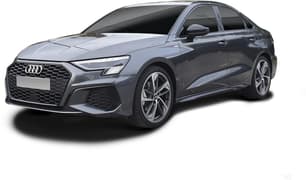
What's the difference?
If it was the original BMW 3-Series that invented the compact luxury car market segment all those years ago, then it’s probably fair to claim it was Audi’s A3 franchise that gave rise to the luxury small-hatch category.
On that basis, any new Audi A3 is news but, in the face of the SUV onslaught (including its own stablemate the Q3) the new small Audi has its work cut out for it.
With this update, there’s refreshed styling, a new interior layout and, for the launch of the new cars, two body styles, a conventionally styled sedan and what Audi calls the Sportback; fundamentally a five-door hatchback but with the German brand’s own flair plastered all over it.
As well as new connectivity and safety tech, the big news is the availability of a mild-hybrid driveline as well as a second powertrain option with more performance from a more conventional layout.
Interestingly, it’s that (mild) hybrid version of the A3 that represents the entry-level variant of the A3. A sign of the times? Perhaps.
As well as the two powertrains, there are two distinct chassis layouts, starting with a front-drive set-up and extending to the option of Audi’s Quattro all-wheel drive (AWD) system.
After teasing us with the S3, all-wheel-drive version of its A3 sedan and hatch (Sportback in Audi-speak), Audi has finally given us the full-fat, RS3 variant of the same car. Any time you see an `R’ and an `S’ on the badge of an Audi, you know it’s the full nine yards in terms of all-wheel-drive grip and engine performance. And the RS3 is no different.
The power is enormous, the grip prodigious and the attitude is way tougher than any other A3 variant. It’s also well equipped, safe and nicely put together. But is that extra `R’ worth the added price of admission? And is this more Audi A-Series than you really need?
The other question is, given that the S3 is such a resolved package with its own shot of high-performance, do the numbers stack up for the RS3 version? How much is too much?
Producing a car that takes the end result beyond appliance status is no given in a world car-park dominated by SUVs. But Audi has, over the last few decades, shown it is very good at doing just that and the latest incarnation of its A3 stalwart backs that up.
While it might take a bit of mental gymnastics to understand why the base model gets the hybrid driveline, or why the more expensive variant costs more to option with adaptive cruise-control, the fact remains these are driver’s cars from a company that understands that concept.
Yes, the A3 is a relatively expensive way to arrive at a compact hatch or sedan, but if you value the journey as much as the destination, it will all make sense.
While the technical aspects of the 35 TFSI are interesting, the extra power and all-weather grip of the AWD 40 TFSI seem to be worth the additional dollars to us. The A3 has always been a sporty alternative, meaning the sportiest version is the one for us.
CarsGuide attended this event as a guest of the manufacturer, with meals provided.
If conventionally powered cars really are on the endangered list, it’s vehicles like the Audi RS3 that will remind us what we’ve lost. There’s so much fun to be had in this car, that you really need to take it to a track to tap into it safely and responsibly. And there’s the rub.
While there’s no doubting the RS3’s potential, neither is there any doubt that the driveline absolutely dominates the experience. In fact, we reckon the S3 with its more modest (but still ample) performance and friendlier nature is probably the smarter car for the everyday. It’s also cheaper by about $20,000 and while it lacks the aggressive looks, it’s still a charming car. Perhaps all the more charming for its easier-going nature and balance of abilities.
So why buy the RS3? Because it’s the one that will keep you entertained for longer if you’re a serious enthusiast driver. But if you don’t plan to use the car for track days, there’s a strong argument that the RS3 is way more car than you’ll ever need. Of course, that sentiment never stopped performance-car lovers, did it?
It’s actually refreshing in 2022 to see a carmaker putting such an effort into something that isn’t an SUV.
That Audi has bothered with two distinct bodies and two equally distinct drivelines is also one for the books, really.
Technically, the mild-hybrid driveline as seen in larger Audis in recent years is probably the highlight of the new A3, and even though it doesn’t compare with a conventional petrol-electric hybrid, it demonstrates Audi’s attention to detail.
The same goes for the digital instruments which allows the driver to tailor the information displayed at any given time. Need a city map more than you need a tachometer at a particular point in you journey? That’s where this technology comes into its own.
While the overall shape of the RS3 suggests evolution rather than revolution, the RS3 treatment has led to a much sportier look. We still reckon the sedan is the pick of the two body styles, mainly because it looks a bit more aggressive. Certainly, though, an aggressive look is not something either version backs away from, and those deep, wide blacked-out honeycomb grilles front and rear give the thing lots of presence.
So too do the blistered fenders, allowing for the extra track width that gives the RS3 its unique footprint. The front track itself is 30mm wider, but the wider fenders also gave Audi the chance to do some creative aero-management. Unlike, say, the Toyota Supra, for instance, with its faux vents up each side, the RS3’s lower-front vents and aero-slits behind each front fender are fully functional, directing air into the engine bay and away from the brakes respectively.
Another really neat function is the LED daytime running lights’ one-act play when you unlock the doors. As the car unlocks its doors, the LEDs spell out `R’, `S’ and `3’in sequence. Blink and you’ll miss it, but it’s a lovely touch that some manufacturers will never understand.
Although it’s a compact car externally, clever packaging means there’s ample space inside. Even a tall-ish rear-seat passenger can sit behind a tall-ish driver, and the sculpted rear seat-backs help make that possible.
The only complaint would be that the dark headlining material makes the interior a bit of a cave at times.
Paying more for the 40 TFSI gets you extra cargo nets on the front seat backrests and luggage area, 12-volt sockets in the rear seat and boot. Both versions get floor mats and a centre arm-rest front and rear.
The rear seat in either is split 40/20/40 for a range of possibilities, with the Sportback offering 325 litres (VDA) for the Sportback quattro models, and 380L (VDA) for the 2WD models and its boot capacity is increased to 1145L (VDA) with the rear seat folded flat. The luggage space in the sedan is 390L (VDA) for the quattro AWD version, and a more capacious 425L (VDA) for the FWD model.
Like the rest of the Audi A-series range, the RS3 is available in two body styles, a five-door hatchback and a four-door sedan. The five-door hatchback layout is the most practical of the two RS3 layouts, but both feature plenty of front-seat space and a rear seat that folds 40:20:40.
Paddle shifters are mounted on the steering wheel rather than the column, so they move with the wheel. That can make it difficult to select the correct paddle in a hurry with lots of lock applied.
The Drive modes are operated by a switch low down on the centre-stack that is clearly designed for left-hand-drive cars. It’s too far from the driver and needs to be cycled through in one direction, rather than being able to select the next mode or the previous one.
Beyond that, the interior is a lesson to other car-makers on how to get an interior right. There’s a quality look and feel with the possible exception of the plastic trim below the passenger-side air-vents which looks and feels a bit cheap. There are plenty of cup-holders and cubbies around the cabin with two USB plugs in the front and two in the rear (for charging).
The RS3 loses some space compared to the regular A3 because of the performance hardware. Where the hatch can take 282 litres with all seats in place (1104L with second row stowed), the sedan can swallow 321 litres.
These are not bargain basement cars, and with a kick-off price of $46,900 for the A3 35 TFSI Sportback (the hatch version) and $49,400 for the sedan in the same specification, that much is obvious.
The fact is, both the new A3 variants represent a fair mark-up on the previous model. But if you look at the post-Covid car market in a macro sense, you can see the same trend across a lot of brands and a lot of previously entry-level models.
Ante up to the 40 TFSI, and the news is no different with an asking price of $53,500 (Sportback) and $56,000 (sedan).
If the price sounds steep on a per-kilo basis, you need to remember this is an Audi we’re talking about and that price premium is part and parcel of a prestige badge. Don’t like it? Go and buy a VW Golf. That’d be Audi’s advice, anyway.
To justify that viewpoint, the A3 is loaded with some impressive standard kit. The 35 TFSI starts things off with Audi’s vaunted 'Virtual Cockpit', wireless phone charging, voice recognition, Apple CarPlay and Android Auto, remote central locking, paddle shifters, park-assist, sat-nav, a 10.1-inch touchscreen, LED headlights, a multi-function steering wheel, automatic lights and wipers, digital radio, cruise-control and dual-zone climate control.
The 40 TFSI adds a range of aluminium trim pieces and garnishes, Audi’s 'Drive Select' system which allows the driver to choose the characteristic of the dampers, steering response, exhaust sound, throttle response and transmission shift points.
The 40 TFSI also adds sportier front seats, a rear spoiler, body kit, extra courtesy lights around the car and details such as a 12-volt socket in the luggage area.
Options on the base model include a 'Comfort Pack' consisting of adaptive cruise-control, electric front seats, heated front seats, auto dimming headlights, heated and folding mirrors, four-way electric lumbar control and 'Adaptive Drive Assist', including 'Emergency Assist.'
That will set you back $2600, while the 40 TFSI can be enhanced with Audi’s 'Premium Package' which adds those same items as well as aluminium-look trim pieces, a better sound system, head-up instrument display and a memory function for the driver’s seat. That adds $4500 to either the 40 TFSI Sportback or sedan.
What you’re buying here is not a car in a different size or luxury category compared with its S3 and A3 stablemates, but a car with a much broader performance envelope. So it’s no surprise to learn that a lot of the extra money goes into that type of hardware.
So rather than the class-standard four-cylinder engine, the RS3 gets a five-cylinder engine measuring 2.5 litres and enough performance to challenge many a supercar of just a handful of years ago. That philosophy also requires bigger brakes, firmer suspension and a more complex, track-oriented version of the electronic rear differential that can turn the car into a drifter or a race-track hero. Wheels and tyres are competition-spec, too.
In turn, those changes have forced other alterations such as the wider fenders and more intricate body kit, the former to physically fit the tyres, the latter to control air-flow for high-speed stability and for thermal management.
Other RS3 additions to what was an already well-equipped car in the S3, include lots of Audi’s trademark honeycomb styling panels around the car, RS3 puddle lighting, LED headlights and daytime running lights, carbon and aluminium interior inlays, RS sports seats with four-way lumbar support and a massage function.
There are two USB ports, wireless phone charging, another pair of USB ports in the rear, Bang and Olufsen stereo, head-up display, tinted glass, heated, folding exterior mirrors and Nappa leather throughout the interior. There’s also Android Auto, a wireless version of Apple CarPlay and digital radio.
The RS3 uses Audi’s celebrated virtual cockpit display with a choice of display layouts for the driver as well as a 10.1-inch touchscreen to control all the connectivity and infotainment settings. It uses the latest version of Audi’s MMI interface.
Like the other A3-based Audis, there’s a price premium for the sedan body over the hatchback, making the five-door RS3 a $91,391 purchase against the sedan at $93,891. Compared with the S3 CarsGuide tested earlier this year, that represents a pretty big jump from that car’s $70,700 (hatch) and $73,200 (sedan). That said, there’s a fair bit more going on in the RS3 in every department, but you get the sense that this comparison will be one nearly every potential buyer will make.
Like most Audis, there’s a range of optional packages, starting in the RS3’s case with the Carbon Package which brings carbon-matte inlays to the interior, side skirts, exterior mirrors and a carbon roof spoiler for the Sportback and a carbon roof-lip spoiler for the sedan. That costs $7400 on the hatch and $6300 on the sedan.
The Matte Aluminium Package is next with a few trim pieces finished in an aluminium material for $2000 extra and there’s also a panoramic sunroof on offer for $2600.
The RS Design Package gets you an Alcantara-covered steering wheel, seat belts in green or red as well as coloured elements to the seat shoulders, floor mats and the air-vent highlights. Yours for $2150.
The most serious option is the RS Dynamic Package which brings carbon-ceramic brakes with a choice of caliper colour as well as an electronic reflash to bring the top speed of the RS3 to 290km/h from its standard (limited) 250km/h. That adds another $13,000 to the price.
One thing that’s nice to see is that Audi has made even the pearl and metallic colours a no-cost option on the RS3. Other manufacturers should take note.
While both versions of the A3 use a seven-speed dual-clutch transmission (no manual gearbox will be offered) there’s not a lot of commonality beyond that.
So let’s start with the 35 TFSI’s mild-hybrid running gear. To begin with, mild-hybrid in this sense refers to a starter motor/alternator unit that is linked to a 48-volt battery (the car also has a conventional 12-volt electrical system).
When coasting, the engine can shut off and the starter switches to alternator mode and harvests the otherwise lost energy to charge the 48-volt battery. This 48-volt system also powers the car’s functions when the engine is switched off.
When the car needs to restart (when the traffic-light goes green) the starter kicks in, using that harvested voltage. There’s also a regenerative braking function, saving the car’s actual brakes for more severe stops.
Unlike a 'normal' hybrid system, there’s no electric motor to help drive the car, but Audi claims a potential fuel saving of 0.4 litres per 100km from the set-up. Any benefit will be most noticeable in urban running where the car is speeding up and slowing down regularly.
The rest of the 35 TFSI is technically interesting, too, with the 1.5-litre four-cylinder turbocharged engine featuring cylinder-on-demand where it can shut down individual cylinders during cruise conditions to save fuel.
When firing on all four, however, the engine is good for 110kW of power and 250Nm of torque, figures which have become almost an industry standard in this sized vehicle.
The 40 TFSI, meanwhile, ditches the hybrid gear for a conventional 2.0-litre powerplant with a turbocharger and 140kW of power. Torque is a handy 320Nm and is developed over a wide range of engine speeds (anywhere from 1500 to 4100rpm).
The other big difference is in the driveline. The 35 TFSI is a front-wheel drive platform while the 40 TFSI uses Audi’s Quattro AWD as it applies to Audis with an east-west engine layout.
That means the car behaves as a front-drive vehicle until the electronics decides more power should be sent to the rear wheels. At that point, anything up to 99 per cent of the available torque can be transferred rearwards via an electronically-controlled multi-plate clutch housed at the rear of the car, just in front of the rear axle.
While the five-cylinder engine is more or less a carry-over from the previous RS3 model, the end result is still a pretty stunning one. With 2.5 litres of capacity, the turbocharged unit accounts for 294kW of power (the same as the previous model) and 500Nm of torque (up 20Nm).
The transmission is a seven-speed dual-clutch unit that is quite a familiar sight around Audi by now, and the all-wheel-drive system uses a centre differential with an electronic clutch-pack on each rear axle to give the car a Drift mode (although Audi insists you don’t refer to it in those terms) as well as torque vectoring with the ability to shift 100 per cent of rear-axle torque to the either wheel to maximise grip.
There’s now also an RS-specific exhaust system with an active flap to increase or tame exhaust noise according to which drive model is selected. The drive modes themselves stretch form Comfort to Auto to Dynamic, altering shift points, gear-shift aggression, throttle response and suspension firmness as well as that exhaust flap.
Brakes are enormous 375mm front rotors with six-piston calipers, that hardware forcing the fitment of a 19-inch alloy wheel (specific to the RS3) for brake clearance.
With all its cylinder shut-off, hybrid tricks and small capacity, the 1.5-litre engine boasts a 5.0 litres per 100km combined cycle fuel economy figure.
Combined with its 50-litre tank, that’s a potential for 1000km between service-station visits. It’s also commendably close to the numbers you’d expect from a similarly sized vehicle with a turbo-diesel engine.
The more conventional 2.0-litre A3 variant, meanwhile, boasts a still-credible 6.7 litres per 100km for the same test. To counter its greater thirst, Audi has fitted a slightly bigger, 55-litre fuel tank.
The headline act, of course, is the base-model’s highway figure which, thanks to the small capacity engine and its reduced pumping losses at small throttle-openings, can get right down into the low-fives (5.0 litres per 100km) in the real world at real highway speeds.
With a tail-wind, you might even see a number starting with four. This is why you don’t need a diesel engine any longer.
Expect the 40 TFSI to use roughly a litre more across every 100km travelled. And in either case, you are stuck with paying for 95-RON premium unleaded.
Audi’s official combined fuel consumption figure for this car is 8.3 litres per 100km. Obviously, start using all that power and torque and that figure will grow significantly. Based on that, the car emits 190 grams of CO2 per kilometre, and with the 55-litre tank (which looks a bit small on paper) the range should still be around 600km between fill-ups.
The only catch with that is the high-tech nature of the engine means it requires the more expensive, Premium ULP at the bowser.
Let’s start with the less powerful 35 TFSI, if only because - even though we know better in 2022 - there’s a temptation to think a 1.5-litre engine will be underdone. The reality, however, is that you’re not going to drive this car and judge it as anything other than very resolved.
While it’s true the peak power of 110kW isn’t startling, it’s the way it’s delivered (along with the 250Nm of torque) that sets the mood here.
Like many late-model Audis, this one has an engine with a fizzy, zingy feel that makes you want to rev it just to hear and feel it. And when you do, it pays off with plenty of flexibility and a sophisticated, refined feel.
Whether the mild hybrid driveline is adding anything to the formula is debatable, because the technology is so seamless you won’t pick what it’s doing other than the engine stop-start function, which is one of the better ones we’ve sampled.
Move from the 35 into the 40 TFSI and you immediately notice the extra power and torque on tap. And although it’s still not a hot-hatch by modern standards, there’s always enough urge to make the 40 TFSI a convincing driver’s car.
Again, the power delivery is the key to it all, making more of what the engine has to offer by actively encouraging you to use it. The seven-speed dual-clutch transmission is your friend here.
The extra driveline functionality of the 40 (namely the AWD system) actually means less than you might imagine in day-to-day life. We didn’t get to drive the car in the wet, but it’s fair to say that those conditions (or a loose, gravel road) are really the only ones likely to make a difference to the way the basic platform feels.
That’s for two reasons; the first being the all-wheel-drive is fundamentally on demand anyway and, secondly, the basic platform is so composed and balanced in the first place, that the Quattro system will spend a lot of its time hiding in the background.
The 40 TFSI also get the selectable drive modes which break with tradition by actually making a difference to the way the car feels.
But the reality is that if you took the best bits of every other setting (Comfort, Dynamic and Efficiency) and loaded them into the Individual button, you’d probably wind up with something very close to what the non-adjustable 35 TFSI offers in the first place.
You have to admire the way Audi has made a front-drive car in the A3 steer, handle and talk to the driver in such a clear, precise way.
Yes, the 40’s selectable modes add another layer to that, but only if you can be bothered. Even more than that, the A3 in either form feels like its ultra-stable and safe, while the levels of feel and feedback give the impression they were decided upon by people who enjoy driving.
First impressions are that this is a typical Audi in the way it fits together beautifully and is made from quality materials. The ergonomics – particularly the virtual cockpit - are spot on and it even smells like an Audi. Noise is well suppressed, the controls feel quality and the front seats are comfy. But from there, the overarching view is dominated by that powerhouse of an engine.
This isn’t just a quick car, it’s actually brutal in the way it builds boost almost immediately and then hurls the car down the road. To be honest, it’s almost too much, and the way the RS3 reels in the horizon will leave some drivers ignoring other sensory inputs in order to keep up with the car. Brutality breeds brutality, too, and the subsequent steering and braking inputs required when the throttle is pinned will not always be the considered, gentle type; they’ll often be gut reactions.
Thankfully, the rest of the driveline and platform has the smarts to make all this work. There’s awesome grip from the Quattro all-wheel-drive system and the car stays flat and steers in a fast, neutral but pin-sharp way. The dual-clutch transmission feels perfect for the engine, too, with ultra-quick shifts that become more aggressive as you ramp up the drive modes. Ride quality is good but we reckon there’s less bandwidth in the various drive mode settings than exists in the same system fitted to the S3 model we drove a few months ago. While the latter offered a broad range of suspension firmness, the RS3 seems to be a bit of a prisoner of its own performance, with Audi leaning all the drive modes towards a firmer setting in the name of body control.
That’s supported by Audi’s decision to offer us some race-tack laps in the RS3 to safely explore its high-end tendencies. At this point, the car emerges as a proper track-day proposition, all that power and control blending into a car that loves being thrown around a circuit. Perhaps the front seats could do with a little more side bolstering at track-cornering speeds, but overall, it’s clear that the RS3’s brief does, indeed, include a degree of race-track use.
Possibly the headline (no pun intended) act here is the inclusion of a centre-front airbag. This is something we’ll be seeing a lot more of in the future, particularly in compact cars, where the proximity of the front-seat passengers can lead to head clashes in a side-impact crash.
Beyond that, the Audi has six airbags including side-curtain airbags.
In terms of driver aids, the A3 sets a high bar for its competitors, and with autonomous emergency braking including pedestrian and cyclist recognition, rear-cross-traffic alert, lane-departure assist and a rear-view camera, most bases are covered.
The major omissions are adaptive cruise-control, but that’s available in the 35 TFSI as part of the $2600 Comfort Package, and in the 40 TFSI as part of the $4500 Premium Package.
Yes, the Premium Package also includes heated, memory front seats, a head-up display, improved stereo and the multi-coloured ambient interior lighting (and more) but it does seem strange that it costs more to option up to adaptive cruise in the 40 TFSI than in the base-model.
The A3 scored the full five stars in ANCAP crash testing in 2020.
The RS3 hasn’t been crash-tested locally, but the A3 on which it is substantially based has been and scored five stars back in 2020. The caveat there is that that result related to the lighter front-wheel-drive version of the car, not the RS3’s all-wheel-drive variant.
The RS3 is well equipped from a safety perspective with seven air-bags including a head-level curtain airbag that protects occupants in both the front and rear seats. There’s also Audi’s Pre-Safe which closes the windows and sunroof and pre-tensions the seat-belts if the car thinks a shunt is imminent. In the RS3’s case, that program has been extended to include autonomous emergency braking which works at speeds up to 250km/h and can identify pedestrians and cyclists up to 85km/h.
There’s also a tyre-pressure monitoring system, lane-change warning, rear cross-traffic warning, lane departure warning with active intervention of the steering, parking cameras front and rear, park-assist, and a 360-degree camera system with various points of view.
Audi recently improved its factory warranty from three years to five years and unlimited kilometres. Any new Audi (including this one) sold after January 1 this year is the beneficiary of that change.
Audi specifies service intervals of 15,000km or 13 months.
There’s also the option of a fixed-price servicing program for the first five years of A3 ownership, and that will cost you $2250, for an annual average of $450.
Service intervals for the RS3 are every 12 months or 15,000km, whichever comes first. Audi offers capped-price servicing for the RS3 at $3580 which covers servicing costs for the first five years.
The car is covered by Audi’s five-year/unlimited kilometre warranty. The vehicle is also protected against body-rust perforation for 12 years.