What's the difference?
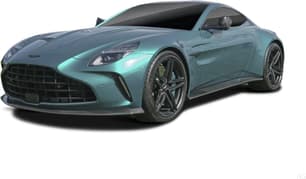
Aston Martin says the 2024 Vantage is designed to put the brand back where it belongs. And by that, it means thrust into the same conversation as Ferrari and Lamborghini when it comes to the ultimate in driver-focused supercars.
Which is why everything – and I mean everything – about this new model has been tightened, tuned or turned way the hell up in pursuit of performance.
Really, it has been a no-stone-left-unturned approach here. And the result, the brand reckons, is a car that delivers not just more power and more torque, but a near-telepathic connection between car and driver, too.
Well, that’s the promise anyway.
So how does the Vantage stack up in the battle for supercar supremacy? I was quite looking forward to figuring that out, to be honest.
I know, picture Ferrari and you'll likely be conjuring images of potent V12 or V8 engines, a scenery-shaking exhaust bark on start-up and a fuel bill that would make a Sheikh wince.
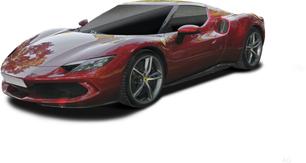
But this one, the 296 GTS, doesn't have, or do, any of those things. In fact, it doesn’t so much explode into life as it does kind of whirr gently, as though you’ve just switched on a photocopier.
And yet, people I trust on these matters reckon this just might be the best Ferrari to have ever worn the badge. So, I guess we better get to figuring out what the hell is going on with this plug-in Prancing Horse.
It’s either a comfortable race car or a bonkers grand tourer, but it’s that best-of-both worlds positioning that makes this new Vantage so appealing. Think of it as like a supercar for proper grown-ups, and one you don’t need to grunt and groan to extract yourself from.
Note: CarsGuide attended this event as a guest of the manufacturer, with travel, accommodation and meals provided.
Anyone who says electrification somehow muddies the Ferrari formula is wrong. This plug-in Prancing Horse is among the most potent and direct vehicles I’ve ever driven, and the electric motor only adds to the experience.
Ok, so the first thing you notice is this massive grille, which I now know is exactly 38 per cent bigger than before. That’s mostly for cooling, sucking in great lung-fulls of air – and any stray pets unlucky enough to wander into its path, I’d imagine — to keep that engine humming.
That air has to go somewhere, and the new bonnet vents complete the engine-cooling.picture.
Then there are 21-inch alloys are wrapped in performance rubber, and I love the swollen haunches at the rear tyres, giving the Vantage a mean and menacing vibe. At the rear, a very new and very loud quad-exhaust completes the picture.
In the cabin you'll find nothing in the way of hand-me-down Mercedes switchgear, which makes for change. This is all Aston Martin, and actually it all feels really nice.
The twin-screen setup looks tech-savvy and premium, the materials are all nicer than you'd find in something more track-obsessed, and even the optional race seats managed to be both snug-fitting and comfortable.
It is hard not to swoon when you gaze upon the 296 GTS, and I say that with no bias - I don’t think all Ferraris have looked this good.
But this is Ferrari at its dreamy, sweeping best, from the tarmac-kissing front — which generates so much downforce and cooling it negates the need for active aero — to its swollen haunches and the glass-topped engine window.
So what’s the difference between this and the GTB? Largely it is the ability to drop the folding roof, meaning you can feel the wind in your hair and that exhaust in your soul. To be honest, though, I reckon it looks better top up...
It’s a cockpit-style driver’s set-up inside, and there’s lots I love and some things I don’t. But let’s start with the steering wheel, which might be one of the best in existence.
It feels magic under the touch, as do the giant flappy paddles which remain fixed in place as you turn the wheel.
It’s also surprisingly comfortable in the figure-hugging sports seats, though climbing in and out of them is not necessarily something you want to do in front of a crowd.
Downsides? There is plenty of tech in the 296 cabin, but it’s all controlled from the steering wheel, making it fiddly and annoying to use.
Also, there are F1-levels of complexity on the control-everything steering wheel, and if I’m being honest, there are some buttons or switches, the function of which I still don’t fully understand.
You’ll be shocked to hear that Aston Martin didn’t dedicate too much of its limited track time to extolling the practicality perks of its new Vantage, mostly because there simply aren’t that many of them.
But the most obvious one, I think, is that most of the people in the market for a $400k-plus vehicle in this category are likely to be, well, of a certain vintage, and it’s for these people that the more traditional layout of the Vantage will no doubt appeal.
See, the engine is up front, and the doors open in the usual fashion, making getting in and out of the cabin easy, and free of the human-origami antics sometimes required to climb in and out of a scissor-door supercar.
But there have been practical improvements made to performance here, too. There’s 30 per cent more power, 15 per cent more torque, new cooling, better aerodynamics, retuned suspension and anti-roll tech, new brake booster tuning, improvements to the ESP system, more body stiffness. And it goes on.
What do you want to know around practicality? We’re talking two seats, about 200 litres of cargo space total and a couple of smallish storage spaces in the cabin. And… that’s about it.
Next question, please.
Let’s start with the big number, and that is the $410,000 you’ll need to park the new Vantage on your driveway. Interestingly, I was also on the launch of the previous Vantage, back in 2018, and that one was just under $300k. That’s quite the jump.
Anyway, for that spend you get a whole bunch of improved performance, obviously, but also quite a bit in terms of cabin tech and comfort. This isn’t a stripped-back supercar, and that’s a good thing, I reckon.
It starts outside with 21-inch five-spoke forged wheels wrapped in Michelin Pilot Sport rubber, matrix LED headlights and LED tail-lights, while in the cabin, there’s a 10.25-inch central screen with Apple CarPlay, a second 10.25-inch screen in front of the driver, an 11-speaker stereo, and wireless phone charging.
Okay, hold your breath for a moment. The 296 GTS lists at $668,146, which is a sizeable jump over the hard-top GTB, which is more like $551,800. But what price a little open-air freedom?
What you get for that investment is a two-part (solid) folding roof, of course, but also what might be Ferrari’s most high-tech offering to date, with a plug-in hybrid system delivering potent performance rather than a usable EV driving range, a mega-clever braking system and an almost telepathic six-way 'Chassis Dynamic Sensor' designed to link the car’s key functions to make the experience, and the driver, somehow better.
Elsewhere, there are sports seats, Matrix LED headlights, 20-inch alloys, keyless entry and a very cool engine start touch-button on the even cooler steering wheel.
Oh, and there's wireless charging and Apple CarPlay, both thankfully standard in Australia, the latter controlled through the steering wheel and digital driver display.
It's all beautifully finished and a joy to behold and sit in.
The 4.0-litre twin-turbo V8 is still borrowed from Mercedes-AMG, but this is the new-generation unit, making 489kW and 800Nm. It gets modified cylinder heads and bigger turbos, helping generate the extra grunt.
That’s fed through an eight-speed ZF automatic and channeled through to the rear tyres. The race to 100km/h? That 3.5 seconds. Meanwhile, the flying top speed is around 325km/h.
Now we're talking. The powertrain here is both tremendous and terrifying, pairing a 3.0-litre twin-turbo-petrol V6 with a rear mounted electric motor, and a 7.5kWh battery, to deliver a total 610kW and 740Nm. That power is fed through an eight-speed dual-clutch auto transmission.
Those are, frankly, scary numbers, and enough, Ferrari says, to dispatch 100km/h in just 2.9 seconds, and to push on to a top speed of 330km/h.
There’s the official figure, which is 12.1L/100km on the combined cycle, and then there’s the real-world figure. It’s not really fare to judge fuel use when you’ve just stepped off a racetrack, but rest assured it was a large number, which is to be expected really.
The Aston’s 73-litre fuel tank prefers 98RON fuel, too.
As well as the ability to start up and slink away silently, the Ferrari 296 GTS’s little battery will deliver a 25km EV-only driving range, and contribute to the overall claimed fuel use of just 6.5L/100km.
Charging is AC only, and the the brand reckons it takes around 90mins to top up using an 11kW charger. The self-charging is on-point, though, with the Ferrari able to quickly recoup energy from braking and the like to top up the battery without needing to plug in.
It's funny, I never felt like the old Vantage wanted for power, but now I suddenly wonder how we ever made do with it. This feels like the engine and the outputs that should have always been, such is the way it suits the nature of Aston’s most performance-focused model.
Everything is about the driver here. From the suspension tune to the gearbox mapping and the increase in stiffness everywhere. You’re supposed to feel like the main character, and you do.
Aston Martin have come under fire in the past for delivering cars that are a treat to look at, but didn't quite deliver the drive experience to match the appearance, and it's something the brand says it is actively rectifying with with the Vantage, and the Astons that will follow it.
The mission, it says, is to be spoken of in the same sentence as the Italian supercar makers when it comes to delivering driver engagement, and this 2024 Vantage is a considerable leap in that direction.
It is, above all else, fun. From the multi-stage ESP settings that you can pair to your bravery, to the retuned and raucous exhaust and the blistering acceleration.
More than that, it feels light and lithe on a racetrack, and super communicative, the front wheels talking through your wrists, and the back tyres through, well, the bit of you that hits the bottom half of the racing seat...
It is plenty fun, right across the park. The power is immense, but somehow it doesn't feel terrifying, partly because you're so dialled-in to the drive experience, and partly because the carbon brakes fitted to our test car were able to slow the Vantage so savagely it's as though we'd dropped anchor out the back window.
The Vantage does have a split personality, though, and it's one that really shows itself once you venture out onto the road. It's quiet, comfortable even, at suburban speeds, leaning more into grand tourer than bonkers track-day special.
The only downside being that, should you sit behind the wheel long enough, it becomes easy to forget you're driving something "super" at all. Well, until your right foot finds its way back to the accelerator, that is...
The engine is undoubtedly a highlight, and we’ll get to that in a moment, but I first want to talk about the steering in this car.
It might sound like a weird point to get hung up on, but it is sensational, and maybe the best I’ve ever experienced. Generally speaking, super-responsive steering can risk feeling overly sharp and uncomfortable when cruising, but somehow the 296 manages to feel super natural, super responsive, and super engaging, without every feeling sharp or darty. It’s just predictable, responsive, and spectacular.
Honestly, it is a highlight of a drive experience filled with highlights, with another being the dual-nature of this drop-top supercar. Long before I got anywhere near a twisting road I needed to navigate the usual nightmare that is Sydney, tackling traffic, suburbia, freeways, tunnels and expansion joints galore, and the 296 never felt uncomfortable.
Instead, the 296 slipped into a comfortable kind of lope, never jarring or rough, and eminently easy to get along with. And yet, when you arrive on the right road that veil of sensibility drops, and the Ferrari quickly reminds you of its potential.
For a start, the acceleration is properly, startlingly aggressive. Engage the 'Qualification' drive mode (which unlocks the full might of the Ferrari's electrified powertrain) and flatten your right foot, and you'll find the world suddenly hurtling past your windows, and your knuckles will no doubt whiten as you feel the rear tyres fighting for traction against the onslaught should you try it on anything but the straightest of roads.
It's addictive, but it's just one element of a near-perfect combination on offer here, with the 296 GTS the stiffest Ferrari drop-top to date, which becomes immediately clear as you start to attack corners with ever-growing confidence.
Grip, stability and stiffness in spades, the GTS delivers. And all accompanied by an exhaust howl so angry and evil it’s hard to believe it’s being generated by a V6.
It’s a thing of very near perfection.
You’ll never see a Vantage crash-tested by ANCAP, but it does arrive with a solid safety package.
There are front and side airbags, plus a heap of active safety stuff like AEB, forward collision warning, adaptive cruise, lane keep assist, lane departure warning, lane change assist with centring and front and rear cross-traffic alert.
Not much chance of the 296 GTS being crash-tested in Australia — you’d be able to hear the Italians weeping across the ocean.
You do get front and side airbags parking sensors, a reversing camera, auto high beam and tyre pressure monitoring.
Aston Martins in Australia are covered by a three-year/unlimited-kilometre warranty, but you can extend that for one or two years, at a price. You’ll be visiting the service centre annually, too.
Standard is a three year warranty, but you can extend that for up to five years. Then, if your car has less than 90,000km on the clock, you can opt into the 'New Power15', which gives you up to 15 years total warranty coverage and is fully transferable.
The first seven years scheduled maintenance is free-of-charge.