What's the difference?
Richard Berry road tests and reviews the new Alfa Romeo Giulietta Veloce hatch with specs, fuel consumption and verdict.
Nobody just buys an Alfa Romeo, in the same way that nobody goes out and just buys a top hat. Yes it's functional and yes you'll looking amazing in it whether you're male or female, and people will pay you compliments - possibly question your judgement, too, but it's not the obvious choice and buying one is a conscious decision. See, you don't even know if I'm talking about the top hat or the Alfa any more.
At backyard barbecues and dinner parties throughout Australia you'll overhear people saying: "My heart says yes but my head says no." They're not discussing robbing the convenience store on the corner after dessert, but they're more likely to be talking about buying an Alfa Romeo. See Alfas are famous for their stunning beauty, their racing pedigree and their performance, but in the past they've been infamous for their reliability issues. You knew that, right?
The top-of-the-range Giulietta Veloce with the dual-clutch auto is the best reference to the brand's performance pedigree. This version has only just arrived on the market, and follows a major styling and technology update to the Giulietta in 2015.
Like most test cars, we lived with it for a week. Is it too small to be a family car? What's wrong with the glovebox? Is it as racy as it looks? What's with all the water? And is it just me or are my hands too small to drive this car? We'll even be able to point you in the right direction for a guide to Giulietta's reliability.
It's not often a car is elevated to 'icon' status, cars like the VW Beetle, Porsche 911, Toyota LandCruiser or Ford Mustang - but the Mazda MX-5 has quietly been the best choice for keen drivers who don't want to break the bank with a big sticker price or costly maintenance.
The ND MX-5 has been around since 2015, and while it’s been praised as a return to the original, simple formula of the NA MX-5 from the late 80s and early 90s, it’s getting close to a decade old.
So, a little refresh with some new tech and a mechanical tweak is here to make the roadster feel like a playful pup once more.
And what better place to test that out than a combination of the winding roads of the Adelaide Hills wine region, paired nicely with a main course of track driving at The Bend Motorsport Park?
So much right and some things not quite right – the Giulietta has the Alfa Romeo mix of highs and lows which the brand is famous for. There’s no mistaking that this is a unique and sexy looking car, with the practicality of a five-door hatch plus impressive handling and performance. More heart than head decision here though it seems, but romantic Alfa enthusiasts should adore it.
Ultimately, the design and tech changes to the ND MX-5 will be the biggest day-to-day advantages of the updated model, because the mechanical changes don’t make themselves hugely obvious on the road.
If you’re into track days, it’s still a satisfying car to hustle as fast as you can, but it’s at its most accessible on winding roads for weekend drives, where the new differential and track DSC mode won’t come into play as much.
But in a world where accessible sports cars are becoming a rarity, there’s only one rear-drive convertible with a sticker price appropriate for financial mortals, and it’s a pretty damn good thing that it’s the ND MX-5.
Note: CarsGuide attended this event as a guest of the manufacturer, with travel, accommodation and meals provided.
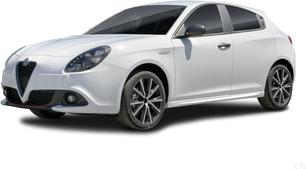
Alfa Romeo couldn't design a boring car even if it was handed a picture of a Toyota Camry and told to copy it or else. The Giulietta is no exception.
There's the deep 'V' grille shared with the new Giulia sedan and 4C sports cars that make up the current Alfa model line-up. There's the bug-eye headlights with pretty inset LEDs and the chiselled bonnet, a side profile which looks like that of a mini Porsche Cayenne and a cute-but-tough bottom with its elegant taillights and twin exhausts.
The latest update brought a honeycomb mesh grille and a slightly different design to the headlight and LED foglight surrounds. The tail pipes were also given a styling tweak, so too were the alloy wheels.
Despite its coupe looks it's actually a five-door hatch with ‘hidden' handles for the rear doors.
The cabin saw new materials and finishes added. The Veloce had the Alfa Romeo logo stitched into the integrated headrests, shiny sports pedals, and lashings of faux carbon fibre trim on the doors and dash.
You can tell a Veloce from the outside by the red Brembo brake calipers behind the front wheels, 18-inch alloys, its chunkier exhaust tips poking out of the diffuser, red pin-striping to the front and rear bumpers, and the black window surrounds.
Okay, how big or small is it? Here's some dimensions for you. The Guilietta is 4351mm long, 1798mm wide, 1465mm tall and the Veloce with its sports suspension is 9mm lower than the others with 102mm of ground clearance.
Compared to say a Mazda3 hatch the Giulietta is 109mm shorter end-to-end and only 3mm wider. But if you're considering an Giulietta why are you looking at the Mazda3 anyway? That would be sensible - Like comparing Cancer Council hats to top hats.
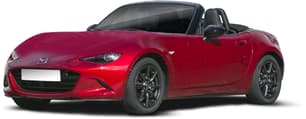
Alright, we’ve all seen ND MX-5s, you don’t need me to tell you about its proportions or explain its design elements to you in too much detail, so I’ll give you the headline changes.
At the front and rear are new pairs of LED head- and tail-lights, respectively… obviously, fitting into the spaces the old ones took up.
The DRLS and reverse lights have come off the bumpers for both, and are now part of the main lights at each end - no more DRLs in the front bumper, and the reverse lights have been replaced by reflectors.
There are new 17-inch wheel designs for the base and GT trim levels, too, and there’s a new colour - Aero Grey.
Inside, it’s a shame that the tan Nappa leather interior of the RF Black Roof can’t be had in a manual roadster, because it’s gorgeous, even though the inside still looks refined enough for a simple sports car in its base cloth trim.
Beautiful things tend to favour form over function. The Giuletta tries to do both and succeeds…but also fails in places.
Successes first: despite its coupe looks it's actually a five-door hatch with ‘hidden' handles for the rear doors placed up at window level near the C-pillar. So good is the two-door disguise that our photographer climbed into the back seat through the front door.
Rear legroom is a bit tight back there and at 191cm I can sit behind my driving position but I'd hate for me to be sitting behind me because my knees are digging hard into the seat back.
Headroom isn't much chop either and I literally can't sit in the back seat and hold my head high – a combination of that sloping roofline and the optional double sunroof reduces the head space.
A major practicality fail is the lack of storage throughout the cabin.
Ordering drive-thru is possibly out of the question.
My wife's phone kept mysteriously appearing in the footwell every time we left it in the glove box, like there was a tear in the time-space fabric, but then we realised it was slipping through a gap.
There's no centre armrest storage bin in the front – actually there's no centre armrest. There is a pop-up hidey-hole on the dash but with only enough room for a pair of sunglasses.
The two cup holders in the front are small. It's safe to say that unless you have somebody with hands at the ready, ordering drive-thru is possibly out of the question.
Or if you have long arms and can reach the fold down armrest in the back there are two decent sized cup holders along with a small storage space. There are no bottle holders any of the doors, but there is fortunately room for a phone and wallet because there isn't space for them anywhere else.
But wait, the Giulietta is saved from a total storage fail by a large-for-the-class 350-litre boot. That's 70 litres bigger than a Toyota Corolla's and only 14 litres less than the Mazda3. We could fit the pram, the shopping and the rest of the gear which goes with a military operation such as a trip to the park with a toddler in there.
One thing Mazda has significantly changed for the ND is the multimedia screen, now a larger 8.8-inch touchscreen running Mazda’s updated software.
It brings the MX-5 up to date without sacrificing simplicity and makes it a little easier to use. The physical dial and buttons for controlling the screen also remain. The USB-C ports are also new.
Oh, and the MX-5 is the first Mazda model to get Connected Services, which is coming to other Mazda models eventually.
Connected Services allows owners to find, lock, and get alerts for their cars from a phone app, even letting them set curfews to notify them if the car is started during certain hours.
Aside from that, another small tweak is the simplified instrument cluster, which aims to be easier to read even when the roof is open and the sun is bright.
The cabin isn’t built to be plush, it’s built for ‘Jinba Ittai’, Mazda’s philosophy that applies most strongly to the MX-5 which means ‘horse and rider as one’.
And trust me, you feel one with the horse- er, car, when there’s not ample room to move. It’s not restrictive, but it’s cosy.
Everything’s quite well-placed and it’s not busy with buttons or features in here though, it’s made for focusing on driving.
One downside is the lack of storage, not even a glovebox, in front of the passenger, and the central storage spot under where your elbow sits is tiny, good for keeping the key fob snug though. Also, the cupholders are able to be removed or swapped between the space behind your elbow, or above the passenger footwell.
There’s also a small storage space between the seats behind where your elbow would sit, though it’s tricky to access while you’re driving.
Then there’s the boot, which is usable for a small amount of luggage at 130 litres in the Roadster and 127L in the RF hardtop.
Finally, as a huge positive, probably the biggest advantage of the ND over any other convertible is how easy it is to open and close the roof in the Roadster. You can do it single-handed, which is great if it starts raining and you’re at a traffic light or able to quickly pull over.
The RF hard-top has a switch that automatically opens and closes the roof section.
The 2016 update saw the Giulietta variants renamed. There's the entry grade $29,990 Super Manual which has a six-speed manual gearbox, then buyers can step up to the Super TCT with a six-speed dual clutch automatic transmission for $34,900 and then there's our test car – the Veloce for $41,990. There's 10 paint colours at your disposal from the colour of our car (Alfa Red) to Perla Moonlight. Only Alfa White comes at no extra cost, the rest are a $500 option.
The Veloce collects the same features as the Super TCT such as a 6.5-inch touch screen, with sat nav, front and rear parking sensors, three drive modes and then adds bi-xenon headlights, 18-inch alloys, leather and Alcantara seats, a flat-bottomed steering wheel, the big exhaust tips and the sports diffuser, tinted rear glass and then less cosmetic features such as sports suspension and launch control.
There's no reversing camera which is disappointing, considering they come standard on some cars half the price.
At this price you'd shop the Veloce against a BMW 120i hatch for $41,900, a Volkswagen Golf GTI for $43,490 or possibly a high-end Mazda3 SP 25 Astina for $37,040.
Getting into an MX-5 is now a little more expensive, with the base manual Roadster up by $2310 to now start from $41,520 before on-roads.
The top-spec soft-top GT RS is now $51,640, or $2800 more than before.
Pricing for the RF hard top is also similarly bumped up, a base manual costing $46,250, and the most expensive GT RS at $56,140.
There’s also a Black Roof edition which comes with tan Nappa leather inside, but that’s only available in an automatic RF, which is possibly the biggest downside to the 2024 range.
Base models get cloth seats, while GT and GT RS models get heated leather seats. The GT RS also comes with stiffer Bilstein dampers, Brembo front brakes, a bracing strut between the front suspension towers and a DSC-Track mode. The difference there is noticeable, so it's worth the extra spend for the more keen driver.
The higher overall costs bring updated tech, a new 8.8-inch touchscreen and a new limited slip-diff in manual versions, plus tweaked mechanicals like improved acceleration response and lower steering rack friction.
But they do look a tiny bit different too.
The Giulietta Veloce has a 1.75-litre four-cylinder turbo-petrol engine which produce 177kW of power and 340Nm of torque. It's a great engine that lets loose a wonderful scream when pushed hard and the little grunts it makes when it changes gear when driving around normally sound like a giant enjoying his food.
The transmission is a dual-clutch auto which Alfa calls a TCT or twin-clutch transmission. I'm not a fan of them regardless of the brand of car they're in but the Alfa version is better than most of the others in its smoothness at lower speeds and decisiveness.
There's so much potential here for a great driving experience.
What about the Giulietta's reliability over time? This version of the car is less than two months old so we can only comment on what it offers as a brand-new vehicle, but you'll find good context in our used review of the earlier 2011-2014 Giulietta.
Up front, you get one option: a 2.0-litre naturally aspirated four-pot. It makes 135kW and 205Nm, and it’s a delightful little thing, driving the rear wheels only - as it should.
It used to be that the smaller 1.5-litre engine was the more revvy, keen option, rest its soul, but Mazda updated the 2.0-litre to be more eager (and deliver more power) at high revs and basically made the little 1.5-litre redundant.
Anyway, you can have it with a six-speed manual in any variant, or a six-speed automatic in GT guise if you find manual gearboxes difficult or a hassle.
Alfa Romeo says you should see your Veloce drink at a rate of 6.8L/100km during combined driving, but the dash showed more than double that during mainly urban driving while channelling Enzo Ferrari.
Mazda says the MX-5 uses 6.8L/100km as a manual Roadster, or 7.0L/100km with an automatic gearbox. Or, in the heavier RF 6.9L for a manual and 7.2L for auto.
Not great for a tiny car like this, but pretty good for a sports car!
It’s got a 45-litre fuel tank, takes premium 95 RON or higher, and while it should hypothetically be able to travel more than 600km with its on-paper claims, expect fuel use to sit closer to 8.0L/100km if you’re driving it anything like it deserves.
There's so much potential here for a great driving experience such as the accurate and direct steering and great suspension which provides a comfortable ride and great handling, only for all to be let down by turbo lag which kills the responsiveness in the car.
Of the three steering modes: Dynamic, Natural and All Weather, the Dynamic setting was kept on almost always with the other two just feeling too lethargic.
The Giulietta is front-wheel drive and there's a lot of torque being sent to those wheels, but unlike a stack of Alfas in the past there's next to no torque steer. That said, our hill start test on a wet night saw those front wheels scrambling for traction as it accelerated up the slope. Cornering grip from the tyres is excellent, however.
There's some Alfa Romeo ergonomic issues in the cabin we've gotten used to over the years, but just because you're accustomed to something doesn't mean it's okay. For example, the cramped driver's footwell with the brake and accelerator pedals so close that it's easy to hit both at the same time.
Such is the intensity of the spray from both the window washer and the headlight washers it's like you're captaining a fishing trawler that's hit a massive wave at sea.
The indicator and wiper stalks are also so far from the steering wheel rim that they're almost out of reach – I don't think I have small hands, nobody's ever pointed them out or laughed at them.
And speaking of wipers, the Giulietta is obsessed with keeping itself clean. Pull the wiper stalk towards you to clean the windows and such is the intensity of the spray from both the window washer and the headlight washers it's like you're captaining a fishing trawler that's hit a massive wave at sea. Put the car into reverse and the rear wiper starts squirting and washing.
For Christmas I want Alfa to upgrade their media unit or bin it – the UConnect system disconnected my phone without prompting and isn't intuitive to use.
It feels like every motoring journo under the sun (literally if the roof is off) owns or has owned an MX-5 of some sort.
And the first time you drive one, you might understand why.
If you spend your days testing and driving a bunch of different cars that aim to be many things at once, it’s refreshing to drive something that aims to be one: fun.
That’s it, the MX-5 feels like it was built to be fun. Not for convenience, not for power, certainly not for the school run.
And fortunately its simplicity remains with this update. All Mazda has done to change the way it drives is attempt to improve the rear limited-slip differential and improve the steering a little by reducing friction in the rack, as well as improve throttle response.
Has any of that changed the way it feels to drive on-road? No, not massively, but the ND was already such a delight that Mazda could have kept this update to purely design and interior tech changes and it would have still been one of the best-value buys around in terms of fun.
The MX-5 still feels relatively softly sprung while still being a dynamic and communicative sports car that’s engaging to drive even at low speeds, and rewarding (or frustrating) to drive fast.
On tight, winding roads, the MX-5 is at home, its soft suspension keeps you humble with its shifting weight and its relatively meagre outputs keep your licence safe.
In fact, despite being slightly compromised as a daily drive, the MX-5 is still plenty of fun even in traffic, there’s something about the satisfying click as the shifter slips into gear, or the little rev matches heading back down through the cogs when approaching a red light.
The 2.0-litre four-pot is a keen unit, and the six-speed manual is light and easy to work with, plus its steering is light without sacrificing road surface feedback - that feedback can quickly turn into cabin noise on a coarse highway which could become a little irritating on a long trip.
But the MX-5 can still be plenty of fun on track, where you’re more likely to get the most out of its new limited-slip differential and Track DSC mode.
It’s equally frustrating and satisfying to hustle the MX-5 around the East Circuit at The Bend in South Australia, where the track is twisty, busy, and unforgiving. Get it wrong, and the MX-5 lurches or slides to let you know you’ve made an error.
Get it right, however, and the little roadster glides through the corners, camber changes and even over apex kerbs smoothly and carrying impressive speed.
Plus, the electronic assistance won’t usually kick-in until you really need it, a welcome change from cars that are constantly trying to keep you from having fun behind the wheel.
The Alfa Romeo Giulietta has been given the maximum five-star ANCAP rating. It doesn't have the advanced safety technology such as AEB and lane keeping assistance which is now standard on any small hatches for a lot less money.
For child and baby seats there's two top tether and two ISIOFIX points in the back seat.
The ND MX-5 actually scored five stars with ANCAP back in 2016, even though its score has now expired. It’s not obvious how well it would fare under newer, stricter tests, given the small car’s lack of advanced driver assistance - not that that’s a bad thing in the case of a sports car.
Still, for a two-seat convertible, the MX-5 has a decent list of kit to keep you safe including front and side airbags, alerts for driver attention, blind spots, lane departure and rear-cross traffic, parking sensors and a reversing camera, belt pretensioners and side-impact door beams and even automatic Smart City Brake Support.
The Giulietta is covered by Alfa Romeo's three year/150,000km warranty. Servicing is recommended at 12month/15,000km intervals with a major service every two years. Alfa Romeo doesn't have capped price servicing but there is Mopar Vehicle Protection which customers can purchase with the vehicle for $1995.
Mazda’s five-year, unlimited km warranty covers the MX-5, including five years of roadside assist.
Servicing costs are pre-set, with intervals every 12 months or 15,000km up to seven years or 105,000km. They cost between $447 and $638, averaging out at about $544 each.