What's the difference?
Alfa Romeo. A brand with more re-boots than success stories. Yet one which driving enthusiasts the world over can’t seem to shake the allure of.
Of course, these are not cars for just everyone. Most mainstream buyers are scared away by what I like to call the three Rs. Rust. Reliability. Resale.
Alfa’s tumultuous (and often overstated) past is one it has trouble putting behind it. Reputations are hard earned and easily lost, and besides, the majority of the voting public aspire to own something German, which they see a lot more of on the road.
It doesn’t help that Alfa also dragged its feet on committing to a five-year warranty in Australia (in early 2022), hardly a statement of confidence in its product.
You’re probably wondering by now why anyone would buy one, and why it’s the car which most enthusiasts wish they were brave enough to own.
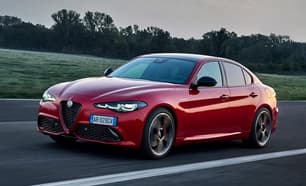
Well the Giulia is the Alfa Romeo. The low-slung, sporty, sexy car which a few of us out there still use as a reference-point for how to make a sedan in 2023 good-looking, and how to make one drive like it has heart.
The brand can throw all the SUVs at us it wants, but for those who see Alfa Romeo for the brand it should be, this car is it.
Parting sorrow, perhaps, the version we’re looking at for this review may be one of the last - under its new Stellantis management, Alfa has said it will leave this fantastic, promising Giorgio platform behind it in a move to be more electrified.
Travel with me, dear reader, as we celebrate a car which is the culmination of Alfa’s past, at a moment before it steps into the future.
People with camper-trailers are increasingly looking to push their travel boundaries and so they head off the bitumen, onto dirt roads and go bush.
But on-road camper-trailers are not suited to cope with the extra stresses that dirt-road or gravel-track driving bring, which is why campers better equipped for light-duty bush driving, such as Jayco’s Outback versions of its models, are finding favor with buyers.
We took an Eagle Outback into the bush to check it out.

The Giulia is a love letter to the increasingly lost art of the sporty executive sedan. As refined as it is beautiful and oh-so elegant to drive, it’s a reminder of why we always love Alfa Romeo, even when the odds are against it.
Emotional cars like this are hard to come by and they will soon be gone, replaced by something new. The future is not necessarily worse, but it will be different, so if a sporty European sedan with a combustion engine is calling out to you don’t miss your opportunity to drive the Giulia while it still exists in this form.
The Jayco Eagle Outback, for me, is an example of a camper-trailer getting closer to what I reckon a truly off-road-capable Jayco camper will be like.
There's nothing in Jayco's current line-up that offers comfort and full functionality and is also capable of tackling decent off-roading, so we're looking forward to testing Jayco's first line-up of dedicated off-road campers, including the JTrak Outback and Outback X.
The Giulia is an old-school low-slung sports sedan. Many will prefer the SUV sensibilities of the Stelvio, with its bigger hatch-opening boot, and its higher ride height can better accommodate less mobile passengers, and makes it easier to fit child seats and the like.
For those willing to trade those things away for a superior drive experience, the Giulia is still solid to live with every day, but has a few drawbacks.
For example, those strangely basic door cards offer only a tiny map pocket with a nook I’d hardly describe as a bottle holder.
The centre console offers two larger bottle holders with variable edges, but there’s also not much else in the way of storage in the cabin aside from a smaller-than-average glove box and armrest console box.
The big win for me is the physical dial set and shortcut buttons for all the key climate functions, making it easy to operate while you’re concentrating on driving.
At least the seats are well bolstered, and front passengers are treated to plenty of adjustability. Visibility is okay, and it was easy for me to find a comfortable driving position at 182cm tall.
The rear seat is a similar story. It’s tighter, and you have to duck down below the roofline to get into it.
Once inside, I was pleasantly surprised to find enough room for my knees and somewhere for my feet to slide behind my own driving position, although the centre position is all but useless thanks to an enormous raise for the driveshaft.
Headroom is passable, but you wouldn’t want to be much taller than me.
There are, again, tiny bottle holders in the doors, and a further two in the drop-down armrest. Rear seat passengers get dual adjustable air vents on the back of the centre console, one USB 2.0 outlet, and elastic nets on the backs of the front seats.
The boot measures 480 litres which is up there with a lot of mid-size SUVs, but because it’s a sedan, access is more limited, and it won’t accommodate as many awkwardly-shaped objects.
These Jayco camper-trailers have a familiar touring-friendly floor-plan – check out the accompanying photos for proof of that – and most adhere to a similar approach to interior functionality – neat and simple – and that’s well suited to those who venture off the blacktop and hit the dirt.
Interior height is 2070mm, standard for campers of this type, so there’s plenty of stretch space for those of us not gifted with the vertical inches of Collingwood’s Mason Cox. Bench height, also standard for a camper-trailer, remains just lower than an average bloke’s hip so stooping to work in the kitchen is still an issue, but that’s part and parcel of the lifestyle, so stop whinging and get used to it.
Looking from the door, to the left is the front bed and club lounge; along the wall is the kitchen area (replete with four-burner stove, Dometic 95-litre fridge*, storage drawers and pantry); and to the right is the rear bed and dinette area. (* Outback models get the 95-litre fridge; Touring models get the 90-litre fridge.)
Overhead interior lighting includes LEDs for the main area and reading lights for the beds; there’s a fan for the beds.
There are also power points and USB port.
Put simply: The Giulia is a celebration of Alfa Romeo. Yes. Even with a humble 2.0-litre turbocharged engine and an automatic transmission, this is a deeply emotional car. A riveting experience from behind the wheel.
Fly round corners, your eyes wide, exclaiming ‘magnifico!’ as the Giulia gracefully leans in, the rear LSD, sporty tyres, and wonderfully tight steering working together in harmony as you eke out just a smidge of tyre roar.
Laugh out loud to yourself, as you plant the accelerator, hear the muted rumble of the surprisingly angry little engine, and feel the turbocharger kick in half a second later as you power out.
‘Eccezionale!’ You’ll think, as you feel the click of the immensely satisfying metal paddle-shifters, and the transmission responds in-kind, the engine roaring up the revolutions with enthusiasm.
Sure, the Veloce grade is not as raw, or as wild, or near as fast as the top-grade Quadrofoglio, but all of the exciting spirit of that car is still here, and at a little over half the price, too. The Veloce is an absolute delight to drive.
It has such poise, makes such a fine sound, and does it all so gracefully. This is how you make a car feel as one with the driver.
Even the ride is deeply impressive. It’s not too harsh or noisy, while gifting the chassis just the right amount of lean in the corners and allowing enough play for it to remain controlled over bumps.
Not only does it work well when you’re driving as it's clearly intended to be driven, but around town it’s quiet and refined inside, living up to the promise of a luxury sedan.
The seats and bolstering are great, the visibility isn’t too bad, and while I’ll complain about the slightly laggy software on the multimedia screen, the digital dash is responsive and the physical climate controls are welcome.
It’s not all perfect. If it were, I think it might cease to be an Alfa Romeo and start sprouting BMW badges.
For example, our test car, with less than 2000km on the odometer, had various inconsistent rattles emanating from the plastic garnish around the digital dash, and somewhere behind the back seat.
Regardless, driving this car has made me a little sad Alfa will be putting this wonderful platform behind it in pursuit of more electrified goals.
I can only hope wherever the Giulia nameplate goes next, it retains the spirit of this version.
This single-axle camper – at 5060mm long (including drawbar), 1910mm high, 2240mm wide, and with a 1270kg tare weight – towed smoothly behind the Mitsubishi Pajero Sport we used on this review.
It sat snug and steady on the towball (with a 150kg download) during open-road driving, as well as during short sections of slightly bumpy gravel track and undulating dirt road.
The Eagle Outback has a hot dip galvanised Endurance Chassis riding on Jayco’s own JTech coil-spring suspension set-up.
Please note: Jayco’s Outback models are designed and engineered for, at worst, dirt roads and gravel roads, not 4WD tracks. Do not think that because these campers have been branded ‘Outback’ that they are actually able to tackle hard-core off-roading.