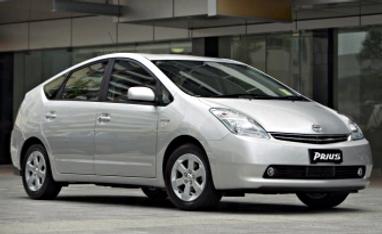
Used Toyota Prius review: 2003-2008
By Graham Smith · 14 Aug 2009
When Toyota released the Prius hybrid the green debate was in its infancy and climate change sceptics poured scorn on this radical newcomer, but the debate is now driving our choice in cars and the just-replaced second generation Prius has become an option for environmentally aware used car buyers. For many years now we've had laws to limit the emission of unburnt hydrocarbons, carbon monoxide and nitrous oxides, the stuff that causes smog and leads to all sorts of health problems, but those gases are only part of what comes out of the tailpipes of our cars. The bulk of what is emitted is carbon dioxide, now better known as greenhouse gas and blamed for causing global warming and climate change. While it's possible to effectively control hydrocarbons, carbon monoxide and nitrous oxides by treating the exhaust gases before they enter the atmosphere the only way to cut carbon dioxide is to reduce the amount of fuel burnt. Enter hybrids like the Prius that reduce our reliance on the petrol engine, and therefore the amount of fuel burnt, by combining it with an electric motor. MODEL WATCH Toyota launched its first generation Prius hybrid here in 2001 with claims it would cut fuel consumption by 50 per cent and tailpipe emissions by 80 per cent. In 2003 it followed up with the improved second-generation model and claimed it would better those numbers. Driving a Prius was a completely new experience, one that was mostly silent. Silence was something the Prius driver had to come to terms with because there was little of the noise they'd become used to with cars over the decades. The front-wheel drive Prius five-door hatch used a combination of a small 1.5-litre four-cylinder petrol engine and an electric motor for motivation, and depending on the driving circumstances, one or both could be in use. When at rest, at traffic lights or wherever the Prius comes to a halt, there's an eerie silence as neither motor is running. When it comes time to move off the electric motor does the work, it's only when more acceleration is called for that the petrol motor starts and joins in to help out. Once a cruise is reached it's the petrol motor that does most of the work, as it's at its most efficient when running at a steady speed. At that time the electric motor becomes a generator and feeds the system's batteries. Energy is also harnessed during braking and that's also fed into the batteries to keep them charged. The Prius drives smoothly at all times and the changeover between petrol power and electric motivation are seamless. Best of all the driver can observe what's happening with the drive courtesy of an energy readout in the dash, which informs them of the energy being consumed, or better still, that being stored for future use. While the primary aim of designing the Prius was to be frugal and environmentally friendly, Toyota didn't do it at the expense of the driving experience. The Prius was a good car to drive, quiet and smooth with decent performance in traffic and out on the highway. When pitted against the clock it would match a Corolla for acceleration. If the focus was on the hybrid drive system there was also all the features you could want in your daily driver. It came standard with climate-controlled air, cruise, remote central locking, immobiliser, power windows and mirrors, and six-speaker CD sound. The I-Tech model boasted all of that plus a six-stacker CD, leather trim, nine-speaker sound system, reversing camera, and sat-nav. IN THE SHOP Driving a Prius effectively links you to a Toyota dealer, as they are the ones with the knowledge and equipment to service and repair it. The hybrid technology is still relatively new and hasn't flowed on to local workshop level yet. There is some concern about the life of the batteries used in the Prius, for good reason, as they are expensive to replace at around $4000. That said, Toyota says they will last the life of the car, and better still the company says it has only sold a handful through its spare parts service in the eight years the Prius has been on the market here. Because of the complexity of the Prius it's best to adopt a cautious approach when thinking of buying one second hand, and have it checked by a Toyota dealer to make sure all is well. Apart from checking the operation of the hybrid system make the usual checks for crash repairs and regular servicing. IN A CRASH The Prius was packed with all the safety features going. It has dual front airbags, and seat belt pretensioners standard, plus head airbags and side front airbags in the I-Tech. For active safety there was ABS antiskid brakes, brake force distribution, emergency brake assistance, and traction control, but if you stepped up to the I-Tech you also had electronic stability control. AT THE PUMP While the Prius is primarily about reducing greenhouse gas emission owners are keen to point out its fuel-saving virtues as well. But the amount of fuel you save with a Prius is very dependent on the type of driving you do. The more stop-start city driving the more fuel you will save; the savings out on the highway where the petrol engine is used more are much less. Tests of a Prius by carsGuide in 2005 showed that around the city the hybrid would comfortably do 4.1 L/100 km, whereas out on the highway it would run in the high-fives and wasn't any more economical than a small four-cylinder petrol or diesel car. LOOK FOR . Deafening silence . Smooth driving . Low fuel bills . Complexity beyond local mechanic . Comfortable and roomy . Environmentally friendly THE BOTTOM LINE It's not a gimmick, the driving future is here, but it isn't cheap and it is yet to be fully proven over the long term. RATING 80/100