What's the difference?
The smallest car in Skoda’s local line-up is also its most affordable, but only just.
When the current generation Fabia launched with the halo Monte Carlo variant at almost $40,000, it was a bit of a surprise for a small hatch from what’s seen as an affordable brand.
Now, there’s a new entry-level version of Skoda’s bub and, while it’s not nearly as cheap as it once was, it offers a choice that’s more within reach for anyone keen on a premium small car.
Can the Fabia Select convince customers looking at the likes of the Mazda 2 or Suzuki Swift to go Euro and cross the $30,000 threshold?
Maserati's Quattroporte is part of a dying breed. A decade or so ago, the European manufacturers took a huge amount of pride in their range-topping big luxury sedans, cars you can either drive or be driven in, bristling with the latest technology.
In 2015, all we hear about are the range-topping SUVs from those makers, with cars like the S-Class and 7 Series fading slowly into irrelevance.
While by no means low-tech, the Maserati Quattroporte takes the high style route, focussing on a luxurious interior with that handmade feel.
Once you get past the shock of the Fabia no longer being a sub-$25K car (because let’s face it, what is anymore?), the fact that it remains refreshingly simple to live with and engaging on the road should be celebrated.
It has its downsides if you need space, and you can buy a light (or even small) SUV for the same price, but you’ll be compromising in other areas.
The Skoda Fabia can’t do everything, but what it can, it does well. Plus, it’s certainly less common than the similarly priced Toyota Yaris.
Beauty is way more than skin-deep in the Quattroporte and while the 330 doesn't have the punch of the S, it's hardly that much slower. Maserati reasons you will want to spend the $25,000 saved on options, concentrating on the Italian craftsmanship rather than the outright performance available in the V8 or the efficiency of the less aurally attractive diesel.
As with any car of this type, you've got to want one in the first place, but for a big, beautiful sedan, there's nothing as good looking this side of an Aston Rapide. The Quattroporte 330 does nothing to dim the allure of Modena's big mover and, if you're that way inclined, nobody on the outside will ever know.
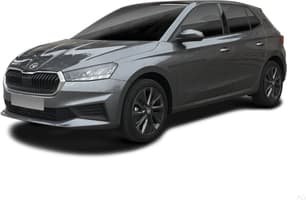
The Fabia’s design hasn’t departed dramatically from its predecessor, but the evolution into the current generation has the little Skoda looking more mature and smoother than before.
Some elements like its grille and headlights are a little sleeker and the car looks less boxy, but still has a unique Skoda design language that’s instantly recognizable.
Its chrome grille trim and its set of unusual 16-inch alloy wheels are the clues that this is the entry Select, plus the lack of much badging.
Inside, the change in generation is most obvious in the step-up in materials and some of the aforementioned tech (screens in particular), though the steering wheel is a carry-over even if it doesn’t look dated.
The new instrument display cowl which features the model name on its side, the round air vents, and the fabric across the dash bring the interior into the current decade, though the centre stack’s modernity is betrayed by climate controls that could have existed in 1998.
There are a fair few hard plastic surfaces, though none of them are in poorly thought-out places and don’t let the cabin down too much.
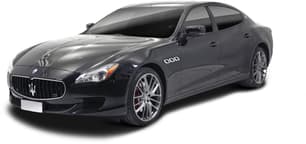
Long, flowing lines mark out the Maserati as something quite different to its German, British and Japanese competition. This Quattroporte has increased in every dimension but the lines cover its size beautifully.
Big wheels, long wheelbase, low ride but it still looks like a sedan rather than pretending to be a coupe.
The elegance of the lines is complemented by a distinct lack of bling – there's little in the way of chrome work or shouty details. There's plenty satin finishes available and the beautiful paint, while available in pretty much any colour you like, is best kept to a restrained, deep hue. Or silver.
The cabin will doubtless age well. Classic shapes house a fairly conventional but hugely comfortable cabin. The front seats have heaps of adjustment and are large but supportive. Naturally, the leather is soft and supple.
The central screen isn't the dominant feature, like a 50-inch LCD screen in a small living room while buttons are kept to a minimum.
The rear seat is sensationally comfortable, with hectares of available space and a seat comfortable for either lounging or working.
The Skoda Fabia has fallen prey to the same upward-creeping prices as many other light cars have, quite hard.
What was a sub-$25,000 car in its previous generation’s entry grade is now a $32,390 offering, plus on-road costs.
For an entry-level light hatch, the Fabia Select has a decent list of features, though is decidedly more basic than the already-launched Monte Carlo ($39,690 MSRP).
The headline tech features in the base Fabia include an 8.25-inch touchscreen covering multimedia functions, with wireless Apple CarPlay and Android Auto, an 8.0-inch driver display, two USB-C ports, plus drive mode selection and a host of safety features (covered later in this review).
For reference, the Monte Carlo gets a larger 10.25-inch digital instrument cluster and a 9.2-inch multimedia touchscreen.
The Select makes do with manual-adjust cloth seats, but does have keyless entry and start, a leather ‘sports’ steering wheel, automatic windscreen wipers, an auto-dimming rear view mirror and auto LED headlights and LED tail-lights.
Skoda says the Select’s features list aims to line up as “similar to rivals’ mid-specification models” and it’s about bang on. But its price might still be a turn-off for some seeking a budget-friendly light car.
The current Quattroporte has been with us now for a couple of years in diesel and petrol turbocharged V6s and turbo V8 forms.
The 330BHP uses the same, Ferrari-built V6 but detuned to 'just' 330 bhp. The price has been detuned too, dropping $25,000 from the V6 S's entry price to kick off at $210,000.
Maserati 330bhp benefits from an overall specification improvement across the range, landing in your garage with a ten-speaker stereo with USB and Bluetooth, power everything, dual-zone climate control, keyless entry and start, front and rear parking sensors with reversing camera, cruise control, sat-nav, auto headlights and wipers, double glazed windows and an interior covered in leather and wood.
Later in the year, your Quattroporte will be available with a new silk trim from Zegna
Only very occasionally does it become clear that Maserati is part of the Fiat Group and that moment comes when you use the 7.0-inch central screen in the dash.
eight-speed ZF automatic transmission
The software is based on the group's UConnect and it isn't great. It's not bad, but it feels its age (however, it's much better than the system on the Gran Turismo), needing a lot more work or a quick surrender to Apple's CarPlay or Android Auto.
Once you work your way through the weird menus, it's fine to use and is miles ahead of the not-much-cheaper Lexus LS unit which is almost unusable.
Sound from the ten speaker stereo is crystal clear and the phone performance is also very good.
The Fabia’s turbocharged 1.0-litre, three-cylinder, petrol engine makes 85kW and 200Nm in this guise, mated to a seven-speed dual-clutch transmission driving the front wheels only.
Given the Fabia weighs 1265kg, getting to 100km/h in under 10 seconds - which it should be able to do, just - might depend on how many passengers you have.
While it’s not very fast or powerful, the Fabia’s outputs sit about average for its class and price.
Like the S, the 330bhp is powered by Maserati's twin turbo 3.0 litre V6, made with more than a dash of Ferrari involvement. As the name suggests, it produces 243kW and a chunky 500Nm. With just under two tonnes to shift, the ubiquitous eight-speed ZF automatic transmission whisks the Quattroporte 100km/h in 5.6 seconds, only half a second down on the 301kW V6 S.
Maserati claims 9.1L/100km on the combined cycle (with the help of stop-start), which seems reasonable given our figure of 10.8L/100km, which we got a with a mix of city and highway running as well as a very enthusiastic blast through some secret back roads.
If you’re someone who doesn’t need a big car and likes an engaging drive, the Fabia ticks those boxes.
In fact, it feels like it punches above its weight. Well, not literally, because while it actually weighs in at over 1.2 tonnes, it feels lighter than even that.
Tight corners don’t faze the Fabia, and its steering and suspension both feel more dialled-in than a car with 85kW has any right to.
Yep, even though its engine is only slightly more powerful than some budget sports cars from the 1980s it feels peppier than it should.
It has some low-speed hesitancy thanks to its transmission - taking off from a stop sign if you’re not in Sport mode can be annoying - but with shift paddles (or a manual gearbox… ) the Fabia could be a hidden gem for enthusiasts.
Its suspension is firm, but not sharp enough that it allows bumps and rough roads to make their way into the cabin as shocks or rattles, and even holds its own on unsealed surfaces at sensible rural speeds.
The Fabia feels playful even on a commute, and the follow-through from the rear-end on a spirited bit of cornering speaks volumes about its chassis, even in urban driving.
Just a few hundred metres behind the wheel is all it will take to convince you the Maserati belongs in the same class as the competition. It's incredibly quiet – courtesy of the acoustic double glazing – and all occupants benefit from supreme comfort.
While the 330 is 58kW down on the full fat V6, you won't really miss them. There's a fat torque curve, with all 500Nm available from 1750 to 5000rpm, meaning easy progress for the 5.2 metre sedan.
The Quattroporte has two sport buttons to choose from – one looks after the drivetrain and exhaust valving while the second stiffens up the Skyhook suspension.
With the first sport button pressed, you get a more lively throttle, sharper shifts and a glorious noise from the exhausts, although they are a long way from your ears.
It's still a fast car, with strong acceleration from standstill and in the gears, the power as linear as you like with no real turbo lag and a most un-turbo noise to go with the performance.
The only dynamic problem is the electric steering – it seems to get confused between your inputs and feedback from the road, the tyres feeling like they're 'nibbling' an uneven surface, tweaking the wheel in your hands.
The assistance is a little spotty, too, unexpectedly changing weight. It's just a bit weird. In normal driving, you'll never notice it.
The Fabia wears a maximum five-star ANCAP safety rating from assessment in 2021, under recent but now-surpassed criteria.
That’s not to say its safety kit is outdated, as occupant protection scored well (58 per cent for adults, 81 per cent for children) while pedestrian and active safety were also adequate (70 ad 71 per cent, respectively).
The Fabia Select comes with autonomous emergency braking (AEB), pedestrian and cyclist detection, multi-collision braking, driver monitoring, lane assist, rear cross-traffic alert and six airbags - though no front-centre airbag.
It also features cruise control, though it’s not adaptive and requires a little more attention than most new cars - not necessarily a bad thing, mind you.
On the road, its safety tech is unobtrusive, leaving you to focus on driving while knowing there are features there to keep you safe should the unexpected happen.
Six airbags, ABS, stability and traction controls, brake assist, blind spot monitoring and rear cross traffic alert.
There is no ANCAP or EuroNCAP safety rating for the Quattroporte.