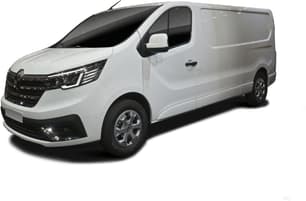
What's the difference?
After more than four decades in production and global sales exceeding 2.2 million units, the Trafic has established a loyal following in Australia.
In fact, according to Renault, Australia is the largest market for its popular mid-sized van outside of Europe. Perhaps this is not surprising given our thriving light commercial vehicle market, in which the 2.5-3.5-tonne GVM van segment is one of the most competitive with eight brands vying for buyers.
The current (third) generation Trafic, which was given a facelift and upgraded equipment/safety in 2022, is available in eight configurations. These include a crew van variant plus two wheelbase lengths and three equipment levels comprising Pro, Premium and Lifestyle.
We recently became reacquainted with the Trafic, in base model workhorse guise, to see how it compares to the current crop of rivals from a tradie’s perspective.
Hybrid campers tread the line between caravan comfort and camper trailer-manoeuvrability and are touted as somewhat of a new thing; almost an evolution of comfort as more people look for a perfect camping experience.
But camper-trailers like the Cub Longreach LE prove that the concept has been around for decades.
It hasn't always been called the Longreach, but this high-walled, super-sized, off-road camper-trailer was one of the first to offer caravan-like comfort and space in a product that'll go anywhere off-road*. (* In terms of reasonable use and having obviously scrutinised your camper's warranty conditions before setting off to make sure you're covered for that sort of usage.)
The 2019 LE takes the comfort levels even further, so we grabbed one for a night to check it out.
The Renault Trafic is a practical and capable workhorse, but then so are some other mid-sized van rivals which sell in greater numbers and come standard with five-star safety credentials. Therefore, a potential buyer must be prepared to accept the Trafic’s inferior standard safety menu (or pay extra to enhance it) to exploit its numerous strengths in a working role.
This isn’t the camper for everyone – my guess is that plenty of people look at this and find it too sparse, too basic. I kinda get it.
But there are very few campers which offer the same amount of open, internal space, or that are as easy to set up.
That the Longreach, albeit with a few different names, has lasted so long on the Cub Campers' product roster is a testament to its versatility and ability to accommodate a small family on off-road camper trips.
It's arguably one of the forerunners of the hybrid camper scene, and it's now starting to evolve with campers' desires for more comfort.
With its relatively light 1816kg kerb weight and 3070kg GVM, our test vehicle has a substantial 1254kg payload rating which is almost 200kg higher than Toyota’s HiAce LWB (1055kg).
Its 1630kg braked tow rating is also higher than the HiAce’s 1500kg limit and with its 4700kg GCM (or how much it can legally carry and tow at the same time) the Trafic (like the HiAce) can haul its maximum payload while towing its maximum trailer weight.
Standard cargo bay access is through a single kerbside-sliding door or glazed swing-up tailgate, but a right-side sliding door and glazed symmetrical rear barn-doors with forklift-friendly 180-degree opening (the latter as fitted to our test vehicle) are available as options. The cargo bay walls and doors are lined to mid-height.
The load floor is 2937mm long and 1662mm wide, with 1268mm between the rear-wheel housings. So, it can carry up to two standard 1165mm-square Aussie pallets or up to three 1200 x 800mm Euro pallets, secured by a choice of eight load-anchorage points.
The cargo bay offers a competitive 6.55 cubic metres of load volume. Our example is fitted with a 12mm-ply non-slip floor kit and cube shelving kit provided by local industry supplier Autosafe. According to Renault, this tradie-focused set-up retails for $5254 including freight and installation.
The fixed two-passenger bench seat has a lap-sash belt for the central passenger and even someone my height (186cm) can get reasonably comfortable in the middle of a crew of three, albeit with knees competing for space with the prominent dash protrusion that houses the gearshift. By contrast, the outer passenger has ample knee and foot room.
The cabin is equally generous with headroom and displays optimum use of storage space. This includes a large bin in each door which can fit large bottles, with a smaller bin above.
There’s also small-bottle/cupholders on each side of the dash-pad plus a clamshell-lid compartment ahead of the driver, a large open tray in the centre (with two USB-C ports), small closable bins in the lower dash on either side of the driver and a single glove box.
If you choose the glazed bulkhead option, the centre-seat backrest folds forward to reveal an elaborate three-tier workstation, starting with a clipboard on top that can also be detached to use outside the vehicle or mounted vertically in the workstation to face the driver or passenger.
Beneath the clipboard is a hinged work desk, which when raised reveals a shallow felt-lined compartment that’s ideal for hidden storage of phones, tablets, lap-tops etc.
Folding the bench seat’s front-hinged base cushions forward also reveals a cavernous hidden storage compartment underneath.
For a rear-fold camper-trailer, the space inside couldn't be more practical. The long body and high sides mean that when the camper is open and set up, it has a lot more space than most. Behind the bed, for instance, there is enough space for Cub to have fit a small dinette.
The dinette has cushioned benches for two and a swivel table that can also become a counter over the rear floor area.
The camper's length also means that the rear floor area is massive. It is easily big enough to lie a couple of kids on, or if your nest is empty, to set up some camp chairs and a table to enjoy a covered living area.
It is still a rear-fold camper-trailer, though so, despite the fact it has nearly twice the space of other hybrid-style campers, it's very sparsely furnished. There's no internal kitchenette or anything like that.
The driver’s seat offers good comfort with its firm bolstering, fold-down inboard arm-rest and adjustable lumbar support. The only thing missing is a left footrest, just like the one residing in the outer passenger footwell which is of course the driver’s footwell in LHD models.
The synthetic leather-rimmed steering wheel feels nice in your hands and has a premium look. Eyelines to all mirrors are good and the large window in the optional cabin bulkhead allows a clear view through the rear barn-doors, but only if you remove the centre seat’s headrest when the middle seat is unoccupied.
Engine response is at its most energetic from 1500rpm where maximum torque is tapped and it continues to pull strongly all the way to maximum power at 3500rpm.
The decisive shifts of the dual-clutch automatic in Normal (default) drive mode feel well calibrated in terms of optimising the engine’s performance in all driving conditions, which is confirmed by only small differences in response when using the Eco and Performance modes.
Its gearing also ensures the Trafic is well-suited to highway work, requiring only 2000rpm to maintain 110km/h. It’s even better with the optional bulkhead/cargo barrier as fitted to our test vehicle given it insulates the driver from most cargo bay noise, which can become intolerable in vans at these speeds without this item fitted.
To test its payload rating we forklifted 975kg into the cargo bay. Combined with the weight of the Autosafe fit-out and driver, it equalled a total payload of 1150kg which was only about 100kg less than its legal limit.
The rear suspension compressed about 50mm under this loading, yet still had ample travel to ensure there was no bottoming-out during our test drive. It hauled this one-tonne-plus payload with commendable ease in city, suburban and highway driving, with negligible effects on handling and braking.
It also impressed on our 13 per cent gradient, 2.0km set-climb at 60km/h, quickly downshifting to third gear to easily haul this load to the top.
Engine-braking on the way down, in a manually-selected second gear, wasn’t as robust, but in our experience typical of small displacement (sub-3.0L) turbo-diesels trying to restrain one-tonne-plus payloads on steep descents. Even so, the four-wheel disc brakes comfortably kept speeds under control without a hint of fade.
Cub Campers are famously good to tow, and even the largest of them lives up to the reputation.
As big as it is, the Longreach LE is quite light thanks to the effort Cub puts into engineering. As a result, it's not a strain, even for older dual-cabs like the D22 Navara.
And because it isn't any higher or wider than a modern SUV, there was very little wind-drag or buffeting as we cruised along the highway.
Cub developed the camper's Australian-made and -designed independent, coil-spring suspension and the set-up yields excellent ride in any conditions.
For the LE, Cub has added an extra shock-absorber each side to improve its performance even on the most corrugated roads.
An AL-KO off-road ball hitch is standard but can be upgraded to the Click-Lock version if you'd prefer that or need a more low-profile hitch.
In reverse, the long drawbar makes it an easy camper to manoeuvre around a campsite, plus it has enough size that the tow-vehicle driver never really loses sight of it while positioning it.