What's the difference?
It might not be as tribal as Ford vs Holden, but there’s a rivalry between BMW and Mercedes-Benz that occasionally becomes more obvious - the launch of the new Mercedes E-Class only months after the BMW 5 Series being one of those times.
But Mercedes has done something different. Instead of multiple variants and electric cars under the E-Class banner, Australia gets just one, the E300.
Is it enough to tackle the big Bavarian sedan in the sales race? We attended the Australian launch just north of Melbourne to find out.
Aside from gull-winged supercars, stunning sports cars and coupes, plus saloons of all sizes that define status around the globe, Mercedes-Benz is also famous for its elegant yet very practical station wagons. Or Estates in Merc-speak.
Long before SUVs really existed (and two years before the industrial G-Class first appeared), the three-pointed star was offering wagon-bodied versions of its core sedan models that allowed owners to mix pleasure with business, or simply pleasure while carrying vast cargo in the back.
Merc Estates have never simply been an extended roof tacked onto the back, with a depth of design that integrates cargo restraints like the characteristic retractable net, but also generally including an extra two seats that fold neatly into the floor. No, your giant Mazda CX-9 wasn’t the first to do this.
Fast forward to 2017, and the popularity of the ever-expanding array of Merc SUVs and SUV-coupe spin-offs is threatening to render the Estate obsolete, outside Europe at least.
We’re still big fans of the wagon bodystyle, and Mercedes says there are enough loyal Merc wagonists to keep them on the radar for Australia. The latest C-Class Estate is actually proving more popular than the version it replaced, but the bigger E-Class is more of a niche offering.
Which is where the new E 220 d All-Terrain comes in. For the first time, Mercedes has added a bit of off-road SUV flavour and ability to the E-Class Estate, and with this extra sparkle it makes sense for it to be the sole long-roof version of the W213-generation E-Class to be brought down under.
But does this extra sparkle retain the elegance that keeps E-Class Estate buyers coming back for more?
The E-Class is stacked with kit, looks great, and is an effective and comfortable way to get around in built-up areas or across the countryside.
While it’s not the most dynamically engaging - it’s pipped by its Bavarian rival there - it offers more comfort-oriented features than most, and the cabin is a pleasant place to spend a day driving.
If you're disposed towards stumping up the asking price, the extra outlay for the 'Plus Package' will probably be most relevant to you if you’re covering long distances due to the Airmatic suspension.
Otherwise, even a simple-spec E300 provides a step up from what you might expect from an executive sedan.
Note: CarsGuide attended this event as a guest of the manufacturer, with accommodation and meals provided.
Given Mercedes-Benz's rich heritage with station wagons, it is a bit of a shame Australia’s preference for SUVs has reduced the line-up to just one variant this time around.
I'm glad they've picked the All-Terrain to fly the flag though, and Merc wagon loyalists should appreciate the extra versatility of its dirt road ability - if they're not mourning the loss of the extra two seats in the rear. Like the rest of the current E-Class range, the E 220 d All-Terrain is an excellent product overall.
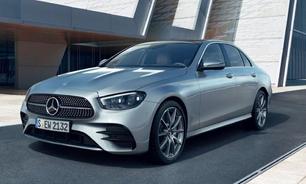
Evolution rather than revolution is obvious when it comes to the E-Class’ styling, but that’s in Mercedes’ best interests, because it’s still a good-looking thing, and being a bit subtle is warranted in the executive sedan game.
The biggest changes come in the headlights and tail-lights. Up-front there are now more than one million pixels in the LED headlights, which have adaptive high beam as standard and are more connected to the grille via black trim, as has been seen in EQ electric models.
Underneath, the bumper now features an AMG-style 'A-wing' apron as part of the 'AMG Line' exterior package as standard. A set of 20-inch AMG alloys are also included.
To the rear, and the digital tail-lights feature a Mercedes-Benz star motif, making its lighting signature now more recognisable from behind.
The German Rainbow is well-represented with mostly shades of grey, black, or white available, though 'Verde Silver Metallic' is a slightly retro green, and 'Nautic Blue Metallic' is a subtle and classy tone.
The daring ‘Manufaktur’ shade of 'Patagonia Red Metallic' is a $2500 option, as is 'Opalite White Bright' while 'Alpine Grey Solid' is $2900.
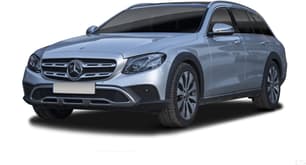
The All-Terrain styling pack is comprised of tough-looking front and rear bumpers, with unpainted plastic side skirts and wheelarch flares on all corners. This will all be welcomed by anyone who travels regularly on dirt roads, but the All-Terrain bits will also provide a handy disguise from urban parking scrapes.
The double-blade grille, wheels and roof rails are also bespoke to the All-Terrain, and the net result is a distinct personality that should satisfy the majority of previous E-Class Estate buyers previously opting for the AMG styling pack.
Interior trim is based on the regular E-Class Avantgarde package, but with specific rubber studded pedals and All-Terrain branded floor mats to align with the exterior treatment.
In the default suspension setting, the All-Terrain sits 29mm higher than a regular E-Class. Taller tyres make up 14mm of this, while the remaining 15mm is thanks to an elevated 'Air Body Control' air suspension. A further 20mm of lift is available with the All-Terrain drive mode selected, but only at speeds up to 35km/h.
The All-Terrain’s 20-inch alloys are a staggered fitment with 245/40 tyres up front and 275/35 at the rear, while taller-sidewalled 245/45R19 at each corner are a no-cost option, and essential if you wish to use snow chains.
Like the Estate available internationally, the All-Terrain rides on the same 2939mm wheelbase as the E-Class sedan but gains an extra 24mm in rear overhang to measure 4947mm overall.
The wagon body, extra kit and all-wheel drivetrain also add an extra 240kg to the kerb weight over the E 220 d sedan, with the All-Terrain tipping the scales at 1920kg.
Inside, the E-Class should feel familiar to anyone who’s spent time in a recent Benz, though the Superscreen might be the main point of difference. It’s an immediately comfortable place, though, with a relatively visually busy cabin.
The seats and their adjustability mean most drivers and passengers, regardless of height and size, should feel supported (and ideally relaxed), while touch-points are mostly either leather upholstery or digital screens.
The steering wheel, also seen in plenty of other Mercedes models, is a bit of a let-down, however, with its haptic touch pads on a slightly busy two-tier layout. This millennial found it irritating, surely too will the usually older E-Class buyer.
There are a few other small annoyances, one being that the MBUX Assistant sometimes won’t hear a command, or that not everything seems to be able to be controlled by it. The climate control vent positions are electrically adjustable to certain pre-sets through the menu, but the MBUX Assistant isn’t able to do this for you.
And while the driver display and central multimedia screen are fairly user-friendly, it’s not always immediately apparent what the quickest way to find some information or a setting is.
Our test car was fitted with the 'Plus Package', which means four-zone climate control available to the rear seats, which my 180cm-tall self found spacious with plenty of headroom, kneeroom, and even a fair bit of room under the driver’s seat.
Behind the rear seats, there’s a generous 540 litres of boot space, exactly the same capacity as the previous generation E-Class.
Aside from the All-Terrain’s rugged looks, the greatest departure from E-Class Estate tradition is the omission of the third row of seats, which makes this one a strict five-seater.
One could argue that the Estate’s traditional rearward-facing third row is a bit old school next to the forward-facing setup used by seven-seat SUVs like the GLS, but it's a shame given the third row is still available in other markets.
The All-Terrain does offer a vast cargo area however, with an extra 130 litres (VDA) over the sedan with the seats up to total 670 litres (VDA). Seats down, this extends to 1820 litres (VDA), but it’s worth noting that both wagon figures are marginally smaller than the previous Estate’s 695/1950 measurements.
Facilitating full use of this space is the classic Merc Estate retractable cargo net, and a 670kg payload promises good scope for loading beyond a full passenger count. The air suspension will also automatically maintain a level ride height regardless of load.
As with all current E-Classes, there are bottle holders in each door plus two cupholders front and back and ISOFIX child seat mounts in the outward rear positions.
As per the non-AMG Mercedes passenger car norm, run flat tyres take the place of a spare tyre, but a space saver can be optioned to sit above the boot floor.
While cross-shopping the E-Class and a BMW 5 Series would normally be relatively easy, the Merc’s $131,500 starting price, before on-road costs, puts it plenty north of the base 520i, the only petrol one available, at $114,900. The electric i5 eDrive40 starts from $155,900, more than $20K over the Mercedes.
But the E-Class is stacked with features as standard, and while there are a couple of option packs, Mercedes Australia has tried to streamline the most popular features and specifications into the E300.
Its $131,500 price gets you a tech-heavy sedan with Merc’s latest 'MBUX' system housed in a visually impressive, if perhaps unnecessary, 'Superscreen' dash.
The dual-screen set-up incorporates a main 14.4-inch central multimedia touchscreen and a 12.3-inch display for the passenger, allowing the driver to keep, for example, a map visible while a passenger sorts out media or comfort settings.
The system is also designed to avoid taking users through sub-menus, though can be bypassed by wireless Android Auto or Apple CarPlay.
It also features a selfie camera mounted to the dash, which is disabled for the Australian market at present. Mercedes-Benz Australia hopes to change this soon.
Mercedes also plans to allow the MBUX system to learn what settings and functions will be most useful to the driver under certain conditions, but currently users are able to manually create so-called ‘Routines’ such as setting the climate control and seats to warm up if it’s below a certain temperature, and can even adjust the ambient lighting to a warmer colour.
More automation comes in the brand’s MBUX ‘Hey Mercedes’ system, which can now respond to commands without the driver needing to say “Hey Mercedes”.
Heated and vented front seats, leather upholstery, wireless phone charging, and a 17-speaker Burmester sound system with Dolby Atmos 4D sound are also standard - the latter being a clever feature that positions different elements of the audio, usually music, to give a 360-degree feeling, as well as turning bassier tones into a physical vibration via “tactile transducers” in each front seat’s backrest. Good for bassline junkies, then (apologies to Mr. Rascal).
With the $9400 'Plus Package', the E-Class also comes with 'Airmatic' suspension and rear-axle steering (which I’ll touch more on later), power-closing doors, 'Urban Guard' to monitor your vehicle while it’s parked, an illuminated grille up front, a more capable version of the MBUX 'Interior Assistant', four-zone climate control and Mercedes’ 'Digital Light' function, which uses the more-than one-million pixels in the headlights to project onto the road or surface in front of you when turning the car off or in driving situations to alert road users of potential danger.
A $6200 'Energising Package' adds multicontour front seats with comfort headrests, upgraded climate controls with 'Air-Balance' and fragrances, upgraded seat heating with armrest heating for the front occupants and heated seats for the rear.
The All-Terrain theme follows the same path taken by key rivals Audi and Volvo with the A6 Allroad ($112,855) and V90 Cross Country ($99,900), which leaves BMW’s upcoming 5 Series Touring as the sole option in this segment not to adopt the semi-SUV look.
The $109,900 Mercedes is priced right between the Audi and Volvo, but note that the Audi brings a more powerful V6 to justify its slight premium.
The All-Terrain is available with a V6 internationally, but the 220 d four-cylinder diesel was selected for Australia as it's the closest match for the E 250 d that proved the most popular variant last time around.
Compared with a similarly specified E 220 d sedan (which kicks off at $92,900), Mercedes reckons they're about the same on price, but the All-Terrain throws in the wagon body and all-wheel drive pretty much for free. The All-Terrain also offers a significant value improvement over the previous E 250 d Estate which bowed out at $107,900.
Key inclusions for the All-Terrain over the already opulent E-Class are genuine leather trim, proximity unlocking, widescreen dash instrument that spans two thirds of the cabin, LED 'Multibeam' headlights, underbody protection and 20-inch twinned five-spoke alloys.
This lone E-Class variant is powered by a turbocharged 2.0-litre engine pumping out 190kW and 400Nm, assisted by a 48-volt battery system. Under EQ boost, an extra 17kW and 205Nm is available for a short time.
It’s hooked up to a nine-speed auto that drives the rear wheels, and it’s all pretty traditional… for 2024, that is.
Mercedes says the E300 is able to hit 100km/h in a respectable 6.3 seconds.
The All-Terrain’s excellent 2.0-litre turbo-diesel engine and nine-speed torque converter auto are carried across from the E 220 d sedan, which produces a decent 143kW/400Nm. Max torque is available from 1600-2800rpm.
The All-Terrain is the only Australian E-Class to pair this engine with the '4Matic' all-wheel drivetrain though, which uses a slightly rear-biased (45/55) torque split in this application.
Mercedes claims the E-Class drinks 7.2L/100km on the combined cycle, and though we weren’t able to test that properly at the pump on the launch program, the trip computer showed up to 9.4L/100km after some quite spirited driving, which gradually averaged out to about 8.6L/100km in the afternoon once some more calm, E-Class-appropriate distance had been covered.
With its 50L fuel tank, the E-Class should theoretically be able to cover 694km on a single tank if the 7.2L/100km is achieved, though realistically it would be much less, 550-600km depending on driving style.
The All-Terrain’s extra 240kg and no doubt less slippery body add 1.6L/100km to the E 220 d sedan official combined fuel consumption figure, but the wagon’s 5.7L/100km claim is still very impressive for a taller body nudging two tonnes.
At this rate, the E-Class All-Terrain has a theoretical range of 1157km from its 66-litre fuel tank.
While the E-Class has taken fairly sizeable steps in terms of its tech, it remains a fairly traditional car from behind the wheel, save for a few small changes like its mild-hybrid system and rear-wheel steering.
It’s still a petrol-powered rear-drive sedan, and it feels built more for eating up highway kilometres than it does tackling twisty turns. But that’s okay, because it will still do the latter.
Comfort is the main focus, clearly, for the E300, and the big Merc does it well. We weren’t offered a car without Airmatic air suspension on the launch, but the E-Class doesn’t seem like it would be particularly rough without it.
With it, however, large bumps and minor road annoyances only make their way into the cabin in the sense that you’re aware of them, but not bothered by them.
That slight dulling of feedback does extend to the steering wheel however, where, despite the rear-wheel steering making the car more nimble, the feedback to the driver is less encouraging of eager driving.
While 190kW on paper doesn’t seem like enough, the E-Class makes do with its meagre engine quite well - and even though it can seem like it’s working a bit too hard at times, the E-Class’ natural state isn’t responding to a planted foot, so it’s unlikely to be a daily bother.
Engine noise, as well as wind and road noise are suitably dulled by the E300’s NVH fitout, too.
The tuning of its drive modes, in particular Comfort and Sport, seemed well-judged on our drive loop, with the option to set the 'Individual' mode to a custom configuration, most elements in Comfort while the drivetrain is set to Sport is particularly helpful when on gentle, high-speed country roads.
If you do start to approach the limits of the big sedan’s capability, it’ll let you know fairly early on. The heavy E-Class isn’t prone to sudden lurching or poor handling, and isn’t much phased by mid-corner bumps.
It’s not as dynamically engaging as some rivals, particularly the 5 Series, but it does appear to be a better provider of cross-country comfort.
Climbing aboard the All-Terrain, there’s a sense you're seated higher than its 29mm static ride height lift suggests. It's probably mostly psychological, and borne from the All-Terrain styling treatment, but something SUV fans will probably appreciate.
Otherwise it's mainly W213-generation E-Class from the driver's seat, which is a very good thing.
However, the extra 240kg of Estate body and All-Terrain spec over a regular E 220 d sedan is just enough to put a dent in the 2.0-litre diesel's performance. Mercedes claims an 8.0sec 0-100km/h figure, which is still more than enough to keep up with traffic, but just not as spritely as the sedan’s 7.3sec figure.
The combination of airbag suspension and the All-Terrain’s slightly taller tyre sidewalls help the wagon ride commendably well. There's no disguising the large-diameter 20-inch wheels over sharp potholes, but the experience is generally even better than we recall from any other existing E-Class.
The steering also feels slightly heavier, as though the level of assistance has been tuned for a touch more weight to add to the All-Terrain’s semi-SUV aura. If our perception is correct, it only adds to the sense of substance from the driver’s seat.
Its overall composure is maintained on dirt too, with the All-Terrain’s Victorian launch route offering a good dose of gravel and muddy unsealed roads. The all-wheel drive system keeps you pointing where you want and enables clean acceleration from the greasiest of corners. All of this highlights the All-Terrain’s potential as a ski field chaser.
We also detoured via some moderate fire trails, which gave us the chance to try the All-Terrain driving mode that lifts the suspension an extra 20mm and slackens the stability control and ABS to better suit low grip scenarios.
At speeds above 35km/h it reverts to Comfort mode, but will return to All-Terrain settings if you slow down again. In Sport mode or above 125km/h, the suspension lowers 15mm below normal to reduce aerodynamic drag. Even at full height it won’t challenge a GLE for clearance, but it’s significantly more capable than regular E-Class models.
ANCAP hasn’t had a go at crash-testing the E-Class yet, and it might not given the relatively small number that will be sold here compared to volume models, but Mercedes’ track record with safety is pretty stellar, and it’s extremely rare for a Mercedes to not cop the maximum five stars.
In the new E300 there are 11 airbags - plenty for a sedan. Mercedes lists front airbags, knee bags and pelvic/thorax airbags for the driver and front passenger, side bags for the rear and a front centre airbag.
It also comes with a fairly extensive suite of safety tech, including the usual ABS, lane-keep assist, blind spot monitoring and surround-view parking cameras.
But on top of that, there’s also ‘Evasive Steering Assist’, semi-automated cruise control with sign recognition, distance assist for following leading vehicles and can even project light arrows onto the road if leaving your lane, when 'Digital Lights' are optioned.
The E-Class also has a function if an imminent collision is detected in which it can, depending on the type of collision, take occupant protection measures. In the case of a side-on collision, the E-Class can “move an affected front occupant towards the centre of the car” before impact.
Like all versions of the current E-Class, the All-Terrain carries the maximum five star ANCAP and EuroNCAP safety ratings. A brilliantly integrated suite of active and passive safety features represents the forefront of occupant and pedestrian protection, which goes well beyond its AEB, nine-airbag count, 360-degree parking cameras, rear cross-traffic alerts, and a pedestrian-protecting active bonnet.
These systems work in harmony to enable semi-autonomous driving, which is perhaps the greatest technical advancement of cars since we stopped riding horses.
The E-Class comes with Mercedes’ fairly industry standard five-year, unlimited kilometre warranty, though Mercedes-Benz Australia was unable to confirm exact servicing pricing on the launch.
It does however list pricing for the E-Class on its website for a three-service pack at $3325, four at $4535, and five at $6800, the latter averaging out to $1360 each.
This could increase with the new generation car, and Mercedes doesn’t list estimated serving pricing for new E-Classes yet in its booking system (I checked with one of the test cars).
Servicing intervals are every 12 months or 25,000km, whichever comes first.
The E220 d All-Terrain is covered by Mercedes’ three-year, unlimited kilometre warranty, with service intervals pegged at either 12 months or a generous 25,000km.
Mercedes is yet to confirm capped service pricing for Australia, but we don’t expect the All-Terrain to stray too far from the $556, $1112 and $1112 figures applied to the E220 d sedan’s first three services.