What's the difference?
If you want a Mercedes-AMG A45 sedan, you’re dead out of luck - there isn’t going to be one. Your alternatives are the sleeker, more style-focused CLA 45 four-door ‘coupe’, or the A45 hatch, which is more often associated with boy racer types… with deep pockets.
Or you could buy this car - the Mercedes-AMG A35 4Matic sedan. A lot of pundits have questioned the two-prong AMG strategy in the hatchback range, with the A35 slotting between the already-pretty-hot A250 4Matic and A45 S.
In the sedan line-up, however, there’s a different approach, with the Mercedes-AMG A35 4Matic topping the range. So is it a fitting flagship for the small sedan line-up? It certainly has the tech, safety and equipment levels to live up to buyers’ expectations.
And as a rival to the likes of the Audi S3 sedan, BMW 2 Series Gran Coupe and its own sibling, the Mercedes-AMG CLA35, does it offer a compelling alternative?
Let’s go through it, criteria by criteria.
Subaru struck gold when it first launched the BRZ in 2011.
It, alongside the related Toyota 86 (now GR86), has been the standard for budget two-door sports cars for 15 years now. Nothing besides the MX-5 convertible is in the same class.
However, buyer’s preferences have changed dramatically over the years and sports cars are at risk of becoming more mundane and vanilla to please the general public. It’s great that Subaru continues to offer the BRZ, importantly with the availability of a manual gearbox. Hallelujah.
Last year Subaru made some slight tweaks to the BRZ, including adding active safety tech and a ‘Sport’ mode to the manual trims, plus a full-size spare wheel on the top-spec tS grade.
Speaking of, we’ve got the BRZ tS manual on test here, so let’s see how it fares in 2026.
The Mercedes-AMG A35 sedan is a genuinely fun small car. To me it’s a more mature offering than the A35 hatch, while not being quite as pretentious as a CLA35. Therefore I like it on principle.
Would I personally choose it over an Audi S3? Probably not - but there are plenty of objective reasons why you would.
The Subaru BRZ is a classic modern-day sports car that is a driver’s car through and through. This top-spec tS tester with the litany of accessories is a great example of what’s possible straight from the dealer, but it’s definitely not the best bang for your buck.
Thankfully you still get virtually every benefit the BRZ offers in the entry-level model. You’ll save thousands of dollars which you can use to pay for fuel on a road trip or modify your car exactly how you’d like.
This is the first AMG A-Class sedan ever, so that’s an interesting design decision. I wasn’t sure whether Mercedes needed a CLA ‘Coupe’ and an A-Class sedan to sit alongside one another, but there are distinct differences in terms of the look and intent of the two compact models.
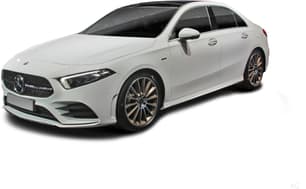
The A sedan carries over the A-Class hatchback’s aggressive styling, with sharp, angular headlights, a strong presence courtesy of its black exterior highlights (including AMG flics on the front bumper and black side skirts, rear spoiler and rear diffuser for this test vehicle). The black 19-inch black-finish rims fitted to our test car are also optional, with silver being the standard finish.
It has a stumpy little boot with a broad stance thanks to its triangulated tail-lights and horizontal reflectors, while the twin exhaust pipes with black tips are rather pleasant to look at, too.
It’s a very attractive sedan, with nothing clumsy about its proportions at all. Is it gorgeous enough to make you think twice about the Audi A3/S3/RS3 as the ruler of the pretty little sedan? Maybe… it’s not quite there for me, although it’s close. But it is certainly a distinct design, one that Merc fans will undoubtedly adore.
The dimensions of the A35 sedan aren’t what a lot of people would actually consider “small”. It’s 4549mm long (on a 2729mm wheelbase), 1796mm wide and 1446mm tall. For context, that’s longer, wider and taller than the substantial Mazda3 small sedan, if not quite as big as the a Corolla sedan.
And if you’re wondering about how that compares to a CLA, that car has the same wheelbase but is 4688mm long, 1830mm wide and 1439mm tall. That’s bigger than a C-Class. Gosh, how confusing.
What does it all mean when it comes to interior space? Check out the interior images and details below to see for yourself.
The Subaru BRZ has a timeless exterior design that screams dynamic sports car from every angle.
Even though the second-generation BRZ is around halfway through its lifecycle now, the design is aging like fine wine. It’s also a lovely evolution of the original which dates back to 2011.
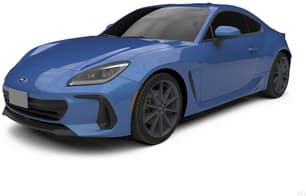
The BRZ is low slung, has an aggressive front fascia plus the rear has prominent exhaust pipes. All of this stacks up to make a tough-looking car.
Thankfully this test example is also finished in 'WR Blue' exterior paint, which in my books is still the best colour for a Subaru performance car.
Adding all the genuine accessory goodies onto this car not only amplifies its street appeal, but also harnesses its racing intent. The carbon rear wing in particular has a swan neck design much like the Porsche 911 GT3. Many interested car-spotters craned their necks to get a good look.
Despite this, all the accessories are too flashy for my taste, especially for a car likely to be driven daily. I’d go for the stock look to retain resale, or something subtle like a small rear lip spoiler.
Inside the BRZ has all of the hallmarks of a sports car, as well. These include a steering wheel with minimal buttons, a prominent rev counter and contoured seats.
The manual gear shifter in this car is prominent and nice to hold. It’s great to still see manual options as they’re slowly but surely falling out of favour with buyers.
The manual handbrake is also a nice touch from a design perspective, but it limits overall interior practicality. More on that in a bit.
You can tell the interior is getting a little dated due to the older central multimedia system. But at the end of the day sports cars are more about the driving experience than the flashy tech.
I admit, I thought I’d get a bit more in the cabin of the A35 sedan. There’s no electric steering wheel adjustment, no heated steering wheel, and the fact adaptive cruise control is optional (it’s standard on some $25K cars!) is a bit rude, too.
That isn’t to say that it’s not an eye-catching space, one that will hit hard on the bling-o-meter, and will definitely impress anyone who isn’t familiar with Mercedes’ recent cabin design traits.
The twin screens are dazzling - crisp and beautiful to behold, and with graphics that are extremely high resolution. The menus have been designed to be simple, but honestly, it’s a bit confusing until you’re initiated.
Also, I found the media screen to be very glitchy. On multiple occasions it would not respond to touch, and once it even reset itself. I also had several problems connecting to Apple CarPlay. Note: I was using a Mercedes-Benz USB-C adaptor to USB-Lightning cable with an iPhone XS, and I think maybe the adaptor had a part to play in the problems I encountered.
The touchscreen is just one way to interact with the media controls, as there’s a touchpad between the front seats, and the driver has a thumb-controller on the steering wheel to jump between screens. And there’s voice control as well, with the MBUX system’s ‘Hey, Mercedes’ recognition allowing you to ask for things to be adjusted.
Furthering the wow-factor up front are beautifully designed air vents that light up blue when you turn the temperature down or red when you up the heat. There’s configurable ambient lighting for the cabin, which makes the A35 a bit of a showstopper at night, and our car had the no-cost optional red and black Lugano leather trim, which is either going to be your thing, or not.
The space for adults up front is decently accommodating, with good headroom and width, plus nice soft touch points where there should be, and there are bottle holders in the doors. There are three USB-C points up front, a pair of cup holders between the seats, and a wireless (Qi) phone charging bay.
The steering wheel is a nice shape and easy to hold, though I’m still not convinced by the little digital displays for the drive-mode dials - they’re toy-like teeny-weeny screens and look a bit pixelated compared to the other displays in the cabin.
Rear seat space is not as good as you might hope or expect, given the size of the car. As a 182cm (6.0ft) man with the driver’s seat set for me, my knees were hard against the seat in front, my toes were squashed and my head was just brushing the headliner, too.
That mightn’t be a problem for you - maybe your only rear seat riders will be short, or young. There are dual ISOFIX child-seat anchor points and three top-tether restraints for baby seats, if that’s the case.
And they’ll be well catered for, with a pair of USB-C ports, as well as directional air-vents, mesh map pockets, and bottle holders in the doors as well as a fold-down armrest with pop out cup holders.
Boot space will likely matter to you if you’re buying a sedan over the hatchback model, and you’ll find an additional 60 litres of boot space here over the five-door model, with 430L of cargo capacity.
That should, in theory, be large enough to fit all three of the CarsGuide cases (124L, 95L, 36L), but the shape of the cargo hold meant I only managed to fit the smallest case with the middle or largest case, but not all three together. Soft luggage could help.
There’s no spare wheel under the boot floor, as the A35 has a tyre repair kit.
Hopping into the BRZ you’re immediately aware you’re getting into a sports car. It’s low-slung and the driving position feels like you’re almost sitting on the road. Perfect for this kind of machine.
The front seats are beautifully contoured and lock you in for when you’re driving through the twisties. Thankfully, the bolstering isn’t too aggressive and it’s still comfortable for everyday driving.
Ahead of the driver, the leather-wrapped steering wheel has a thin rim and is lovely to hold and turn. There aren’t many buttons but the few that remain are purposeful and have a lovely tactile click.
Behind this there is a 7.0-inch digital instrument cluster that permanently displays the rev counter in the middle. It’s a cool set-up that almost has a retro look to it, plus you’re able to configure the content that is displayed on the left-hand side.
Moving across, the central touchscreen multimedia system is classic Subaru. Nothing revolutionary, but I appreciate the physical shortcut buttons and dials on both sides of the screen.
It’s very easy to navigate around the screen, though as the photos show it is prone to glare, especially in bright scenarios.
Disappointingly there is only wired Apple CarPlay and Android Auto, with no wireless versions offered. You need to plug your phone in with a USB-A cable in a slot under the split-fold centre armrest.
While this means your phone will reliably charge, rather than having your phone overheat on a wireless charger, there’s no nice spot to put your phone given the physical handbrake takes up so much valuable centre armrest space.
You can put your phone in one of the cupholder spots, but when you do you don’t get a centre armrest. It’s too compromised for my liking.
While I’m on the topic of storage, there isn’t a great deal of it. There’s a small glove box and if you want, you can technically use the backseat area as they’re way too compromised for adults to fit into.
The rear seats are so small I didn’t even bother trying to fit as in my default driving position there is zero legroom. Even kids would struggle.
In terms of boot space, there is 201L available with the rear seats upright. It’s a fine space, though it’s impeded by the full-size spare wheel poking above the load floor. As a result you need to pack around the wheel.
Folding the rear seats makes the boot space more usable, though the envelope to slot things into the boot is narrow.
While the full-size spare wheel impedes the boot area, I’m glad it’s there because it’s much more usable than a dinky space-saver spare wheel or nothing at all. It gives you peace of mind in the event you have a puncture in the middle of nowhere.
The Mercedes-AMG A35 4Matic sedan has a list price of $72,500, which is the manufacturer’s recommended list price (MRLP, also known as MSRP). That’s the price before on-road costs and extras.
What cars does the A35 compete with? The most obvious rival is one from within, the Mercedes-AMG CLA35, which is $85,500. Then there’s the Audi S3 sedan ($65,800) or RS3 sedan ($86,500). Or the BMW M235i Gran Coupe, which is actually its closest competitor on price, at $72,990.
You might have made your mind up about wanting the three-pointed-star badge though, so what do you get for your cash when it comes to the A35 sedan?
The standard equipment includes: 19-inch wheels, AMG body kit and 'Night Package' (blacked-out exterior trim), Lugano leather seat trim, heated and electric adjust front seats, keyless entry and push-button start, adaptive AMG Ride Control suspension, AMG drive modes, ambient lighting and a panoramic sunroof.
The cabin is equipped with a pair of 10.25-inch screens - one controlling media via the brand’s MBUX system and featuring Apple CarPlay and Android Auto, and the other a configurable display for driver info. There’s sat nav, five USB-C ports, wireless phone charging, and a nine-speaker sound system.
Other features include an auto-dimming rearview mirror, LED headlights and daytime running lights, semi-autonomous parking, front and rear parking sensors, a reversing camera and a number of active safety items beyond that. See the safety section below for more info.
Our car had a couple of options, including: black-finish 19-inch alloy wheels ($790); the 'Driving Assistance Package' - incorporating adaptive cruise control with front and rear cross-traffic alert, active lane-change assist, and 'Route-Based Speed Adaptation' - more on that below ($1890); the 'Vision Package' - with 'Multibeam LED' headlights and selective adaptive high beam assist, and a 360-degree surround view camera ($990); and the 'AMG Aerodynamics Package' - with front flics, side skirt trims, rear spoiler and rear diffuser ($2490).
All told, the as-tested price for this car was $78,660 plus on-roads.
The 2026 Subaru BRZ line-up starts at $47,890, before on-road costs, for the entry-level model regardless of whether you opt for the manual or automatic.
On test here, however, is the flagship tS trim which starts from $52,790, before on-roads. That's $4100 more expensive than it was when it first launched in 2024.
It’s worth noting this is overlooking the limited-edition tS Kiiro ($53,590, before on-roads) with its bright yellow paint.
As a base, the BRZ comes with a solid amount of kit. This includes 18-inch alloy wheels, LED headlights, power-folding side mirrors, an 8.0-inch touchscreen multimedia system with wired Apple CarPlay and Android Auto plus dual-zone climate control.
One of the few things missing is wireless Apple CarPlay and Android Auto. This is becoming commonplace in many cars and while it can be a hassle to plug into a USB port, it also means your phone will reliably charge.
You need to step up to the S trim if you want features like leather-accented upholstery and heated front seats. The top-spec tS in particular gains STI-tuned suspension, Brembo front and rear brakes, black door mirror covers and tS badging.
Adding to this, our particular tester comes equipped with a wealth of optional accessories. These include an STI body kit, STI alloy wheels and an STI carbon boot spoiler, totalling just over $14,500 fitted… Goodness me. For reference, the carbon rear wing is almost half of that.
Altogether, this kitted-up BRZ tS tester costs around $67,300, before on-road costs. While this is much more than the top-spec Toyota GR86 and Mazda MX-5, it’s still less than an entry-level Ford Mustang Ecoboost or BMW 2 Series.
You could look at this one of two ways: 1) this is the least powerful AMG on sale today; 2) this is a seriously powerful small car.
If you’re glass-half-full-biased like me, you’ll see the engine specs and park yourself in the latter camp.
There’s a 2.0-litre turbocharged four-cylinder petrol motor which isn’t short on horsepower: it has 225kW of power and 400Nm of torque - those were class-killing power outputs not too long ago.
The grunt numbers give the AMG A35 sedan a claimed 0-100km/h time of just 4.8 seconds, while the top speed is limited to 250km/h. Five years ago these power figures and performance numbers would have pegged the A35 in A45 territory - this is a seriously powerful little jigger.
The engine is teamed to a seven-speed dual-clutch automatic transmission, and the A35 runs Benz’s 4Matic all-wheel drive system, which is front-biased but can shuffle torque 50:50 if needed.
The combined cycle fuel consumption figure - that’s what the brand says the car will use over a mix of driving - is 7.4 litres per 100 kilometres.
I saw a little higher than that over my 650km of driving, which was heavily biased towards highway testing, but also included a few traffic snarls and a couple of stints of performance testing. I saw 8.4L/100km, which is okay, but I expected better given 80 per cent of my time in the car was in easy-going open road driving.
The fuel tank capacity for the A35 sedan is 51 litres, and you’ll need to fill it with 98 RON premium unleaded petrol.
Subaru claims the BRZ manual consumes an average of 9.5L/100km on the (ADR 81/02) combined (urban/extra-urban) cycle.
We almost matched this during our largely urban-based testing, achieving an average of 9.7L/100km. There’s a 50L fuel tank which means there’s a total theoretical range of 515km using our as-tested fuel consumption.
A minimum of 98 RON premium unleaded petrol is required which isn’t uncommon for sports cars, but it still hurts your hip pocket nerve.
On paper this seems like the ideal option for those who know they’ll never really be able to take advantage of the outputs of an A45 or CLA45’s ludicrous power and torque figures.
In practice? It mostly lives up to that notion - though just like an A45 or CLA45, you’re going to enjoy it a lot more when you’re giving it the beans.
Driving with intent, the engine and transmission work together amazingly well. The transmission itself is thoughtful and smart shifting, swapping cogs exactly when you think it should - while you have paddle shifters available to use, in most cases you’re not going to need them.
The engine itself is an absolute weapon. There’s lots and lots of pulling power, it’s linear in the way it delivers its power, and there’s a little bit of pop and crackle from the exhaust - personally, I would like even more. I guess that’s where an A45 or CLA45 comes into its own.
The steering is superb for an all-wheel drive car, too. It’s direct and accurate, and while you can feel the electronics shuffling the power and torque between front and rear axles it’s a really nicely balanced and very easy car to drive fast – at times even faster than you really should be.
In Sport mode and Sport Plus mode the suspension and steering are tightened up, with taut responses but the suspension is never crunchy or uncomfortable. Braking performance is very good, too.
In Comfort mode though, I struggled to come to terms with the A35 a little. In my mind, it lived up to the notion of a sporty sedan a lot more readily than it did that of a compact luxury sedan. It just feels like it’s meant to be on a twisty road, not dealing with daily drudgery in commuting.
One not-very-luxurious element was the road noise intrusion, which was the worst of any new car I can recall experiencing. That might seem a dramatic claim, but the booming tyre roar on coarse chip road surfaces, including major Sydney freeways, was verging on unbearable. I measured it on my smartphone, and 78 decibels was the maximum readout.
And while very impressive under pressure, the powertrain is somewhat doughy in less demanding situations. There’s some lag to contend with, and a little bit of lunging from the transmission, too. However, it was during downshifts that I found the transmission’s behaviour most questionable, with some shift-shunts when slowing to a halt in urban driving.
One unexpected finding was the 'Route-Based Speed Adaptation' system’s behaviour, which was active in the car I was driving. The tech uses the car’s mapped position to guide its adaptive cruise control behaviour. In theory it’s a very smart idea - the car will slow itself down if it predicts you’re about to approach a tight bend and you’ve got it set at the speed limit. Or if you’re approaching a roundabout, it’ll think ahead, too.
But during my time in the car, I had an issue that I found could be potentially dangerous. Having set the speed at 80km/h in a relatively new tunnel in Sydney’s west (the WestConnex M4, opened July, 2019), the system couldn’t place the car’s location, which meant the car believed it was still on surface streets.
On multiple occasions the car slowed dramatically thinking I needed to turn a corner that didn’t exist on the road I was driving on. My instant thought was: “What if the person behind me wasn’t looking at the road ahead?” I’ve seen enough drivers with their eyes aimed at the phone in their lap and not the road ahead, to know this is a distinct possibility.
There’s also a risk from tailgating trucks, which seem to be more prevalent in Sydney’s west than anywhere else on the planet. It’s a potential risk, even if the Benz has clever tech that can flash the tail-lights if the car’s systems predict there’s a chance of being rear-ended.
Mercedes-Benz’s Aussie team let me know that the map software wasn’t up to date, which is why the car didn’t understand the situation. It’s technology you can disable by simply delving into the menus on the MBUX system, but I’d recommend you try it out to see if you’re comfortable with it.
This is where the BRZ has always excelled and this kitted-out tS manual is no exception.
Firing up with a cold engine, you’re immediately aware this is powered by a horizontally-opposed 'boxer' engine. It has that classic high idle that eventually simmers down once the engine has warmed up a bit.
Setting off you need to acquaint yourself with how this manual gearbox works. Every manual is a little different, however this BRZ is easy to pick up and understand quickly.
I particularly like the notchy and direct gear throw. It makes changing gears easy, fun and engaging.
If I am to be critical, the clutch bite point is a little high and there is a touch too much rev hang when changing gears, especially in the ‘Sport’ drive mode, but you get used to it eventually.
In everyday driving scenarios there is enough power available. Some more wouldn’t go astray due to the lack of a turbocharger, but this constraint makes the car more fun to drive as you have to work harder with the gears.
Speaking of, the gearing is short, which means you will be shifting gears quickly. At 60km/h, for example, the car can be driven around in sixth gear, which is clearly focused on maximising efficiency.
Once you’ve reached your set speed there’s enough torque to maintain it without having to dive back through the gears. This is nice because you don’t have to shuffle through the gears to keep up with traffic.
Out on the open road is where the BRZ comes into its own. The steering in particular highlights how balanced and poised the car feels. It’s so fun to chuck around on twisty bends and feel the weight transfer.
The STI-tuned suspension in this particular trim also highlights how sporty and dialled-in this car is. It can feel a little rough and taut on pimpled urban roads, though you need to remind yourself this is a sports car, not a comfort-oriented SUV.
In a similar vein, at higher speeds there is a lot of road and tyre noise that transfers into the cabin. This is made worse when the rear seats are folded. While more sound insulation would likely fix this, I like it being left out in the name of lighter weight (kerb weight is only 1.3 tonnes).
The A-Class range was awarded the full five-star ANCAP crash test rating based on 2018 criteria, and the scoring measures have progressed since then. According to ANCAP, the rating applies to all Mercedes Benz A-Class variants, though the Mercedes-AMG A35 (hatch and sedan) and A45 (hatch) are not shown on the scorecard.
However, the entire A-Class range comes with auto emergency braking (AEB) that operates between 7-200km/h and has pedestrian and cyclist detection (7-50km/h), active lane keep assist (LKAS, 0-250km/h) and lane departure warning (LDW), traffic sign recognition (TSR), and blind spot monitoring (BSM) and rear cross traffic alert (RCTA) with auto-braking. There’s also driver fatigue monitoring, cruise control with speed limiter, and speed sign recognition.
But despite being the top-of-the-range A-Class sedan, you still have to pay extra for the safety of front cross traffic alert with braking, and the brand’s Distronic adaptive cruise control system. Those are part of the Driving Assistance Package ($1890), which also incorporates active blind spot assist, active lane change assist, a system called Evasive Steering Assist (which sharpens up the steering to be more direct if a crash threat is predicted), and the aforementioned Route-Based Speed Adaptation.
The current-generation Subaru BRZ hasn’t been crash-tested by ANCAP and is therefore unrated.
In 2025, the manual BRZ joined the auto version when it gained Subaru’s 'EyeSight' camera system, which brings autonomous emergency braking (AEB), lane departure warning and even adaptive cruise control. It’s rare for manual-equipped vehicles to feature the latter.
This is above and beyond the seven airbags, blind-spot monitoring, rear cross-traffic alert, lane change assist, reverse camera and tyre pressure monitoring.
It’s worth noting manual versions of the BRZ do not have any parking sensors, front or rear, as standard. Automatic versions gain rear parking sensors and a rear AEB system.
There are two ISOFIX anchors and two top-tether points for child seats in the second row, though space is rather limited.
Mercedes-Benz Australia recently joined Korean luxury brand Genesis in meeting the market with a five-year/unlimited kilometre warranty plan for all of its models, including AMG variants.
Service intervals for the A35 sedan are set every 12 months/25,000km - yes, that’s a generous maintenance schedule, as most cars require servicing every 15,000km.
Buyers can opt to pre-pay servicing costs and roll it into their finance package, and there’s a level of discount applied if you do that.
For a three-year/75,000km service plan, you’ll pay $2150, saving you $500 over pay-as-you-go capped price servicing. There’s also a four-year/100,000km plan ($2950) or a five-year/125,000km plan ($4000). That’s surprisingly decent for a luxury car, though keep in mind it doesn’t include wiper inserts or brake pads/discs.
Buyers get roadside assistance included for the duration of the new-car warranty, too.
Subaru BRZ owners are covered by a five-year, 100,000km warranty which is now commonplace in the mainstream segment. Many carmakers are now extending their coverage out to seven years and beyond.
Logbook servicing is required every 12 months or 15,000km, whichever comes first. The first five services cost a total of $2595.51, which averages out to around $519 per service. For the performance car space this isn’t cheap but not as exorbitant as more premium offerings.
Subaru has a total of 128 dealers around Australia, with a spread across metro, rural and regional areas.