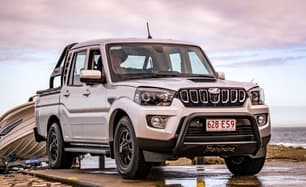
What's the difference?
The current generation Mahindra PikUp has been with us since 2007, which is a long time given major players in this market tend to introduce a new generation every decade, or close to it.
However, with Mahindra reportedly developing an all-new ute, based on the underpinnings of its latest Scorpio SUV, the budget-priced PikUp is destined for retirement within a few years.
Better late than never, the latest MY23 version of the S11 dual-cab has for the first time been equipped with an automatic, which is sure to increase buyer appeal in a market in which self-shifting transmissions rule.
We recently revisited this Indian-built dual cab to see how it measures up for tradies in such a competitive market.
Tesla’s Cybertruck truly is a giant wedge of cutting-edge technology, and not only because its edges are so sharp you could literally cut yourself, or chop kindling, with them.
No vehicle, nor indeed even any of his stupid ideas, so perfectly represents the manic mania, the whooping, wanton wackiness of Elon Musk as this comically angular, sharp-edged savager of pedestrians.
And yet people, and American people in particular as we discovered on a trip to Los Angeles to drive one, love the Cybertruck. Tesla is said to be holding as many as 2 million pre-orders for it in North America alone and many Australians have expressed interest in buying one, when the company finally manages to build it in right-hand drive, and get it on sale down here, almost regardless of the price (spoiler alert: it’s going to be a lot).
I’ve seen a lot of strange and wildly ugly cars over the years, but if you parked the Cybertruck next to all of them, they’d just disappear because you really can’t take your eyes off its pointy, almost dangerous looking lines. It’s like a human tried to engineer an echidna on wheels.
It does make me laugh, though, and so it was with a smile on my face and acid dripping from my pen that I arrived at a giant Tesla delivery centre in LA to drive it. Come with me.
Its sub-$40K pricing undercuts the cheapest Ford Ranger or Toyota HiLux 4x4 equivalents by $10-15K and it’s backed by a decent warranty and 60-strong dealer network (mostly regional). It’s also largely absent from the federal government’s vehicle-recall listings, which suggests solid build quality.
However, it’s also short on safety, has relatively high servicing costs and numerous design quirks. Fact is, such low pricing comes with compromises, so, if you can learn to live with those, this sturdy and willing auto-equipped workhorse could represent good value for those shopping on a budget.
Weird, wild, unnecessary, arguably horrific to look at, or at least challenging, too fast, too silly, the Cybertruck is many things, but all of the bad things are obvious from a distance while you only realise just how impressive, clever and intense it is once you take it for a drive.
The drive-by-wire steering alone is a revolutionary bit of tech that will surely bleed into the wider world.
Overall I thought I would hate it, but I walked away, head still shaking, with grudging respect approaching admiration for the Tesla Cybertruck.
The PikUp has a 3040mm wheelbase and 5175mm length, 1820mm width and 1915mm height.
So, compared to a Ford Ranger XL equivalent, it’s 230mm shorter in wheelbase, 195mm shorter overall and 98mm narrower, so it’s relatively compact for a dual cab ute.
Built on a traditional ladder-frame chassis, its twin-wishbone front suspension uses torsion bars instead of the more common coil springs, while under the tail is a leaf-spring live rear axle. Brakes are front discs and rear drums.
With 210mm of ground clearance, its steep 34-degree approach angle is excellent but its 15-degree departure angle is less than half that figure, so it's prone to tail-dragging in the rough stuff.
And its bafflingly large 13.4-metre turning circle (kerb-to-kerb) demands numerous three-point turns.
The interior appears to have a good standard of finish and provides a visually-pleasing mix of black and grey surfaces with satin chrome highlights throughout. Driver controls are easy to see and operate and the front bucket seats are comfortable.
The rear bench seat is quite firm with good lumbar support, but it’s a squeeze for three adults given its relatively narrow width.
Even so, there’s adequate kneeroom and heaps of headroom even for tall adults, which is no doubt appreciated by hat-wearing farmers and tradies.
Is there anything interesting about a Narwhal, or a rhinoceros? It’s hard to know whether to give the Tesla Cybertruck 10 out of 10 for how interesting its design is, or zero for how offensive it is, but it would certainly get a solid 20 out of 10 for uniqueness.
Sure, in pictures it looks pretty out there, but when you stand before it in all its shiny steel it makes you laugh out loud, to the point where it has taken your breath away.
And then you start to notice all the fingerprints on it. Every time you - or any of its many admirers - touches it, you get nasty, oily stains and keeping it clean would make looking after a car painted in a matte finish look as easy as sleeping.
So, stainless steel as a choice for constructing a car? Perhaps there’s a reason no one else has ever followed the DeLorean’s lead here, but there’s no denying it grabs your eye, and provides a certain solidity to the whole structure.
Much like a Frank Gehry building, you’re either going to love the Cybertruck and think it a work of modern art, or dismiss it as a childish man’s fantasy made real (essentially that was the design brief for this vehicle, “make Elon a toy”, and it has nailed that brief), but either way you’ll definitely have strong feelings about it.
A car, or even a pick-up truck, with no round surfaces, nor subtlety of any kind, can’t really be described as beautiful in any way. But interesting? Definitely.
With its 2115kg kerb weight and 3150kg GVM, the S11 PikUp offers a 1035kg payload rating so it’s a genuine one-tonner.
It’s also rated to tow up to 2500kg of braked trailer but given Mahindra doesn't publish a GCM rating (or how much it can legally carry and tow at the same time) we don’t know if it can retain its maximum payload while towing that weight.
Strangely, the load tub does not have any internal load-anchorage points. The only option for securing ropes or straps are external hooks, which are located along both upper sides of the tub and across the tailgate.
However, these would be ineffective in securing loads that are lower than the tub sides.
Front cabin storage is limited, as there are only narrow bins and no bottle holders in the front doors and you won’t find any cup/bottle holders or storage for small items in the dash, either. However, there is a single glove box and an overhead glasses holder.
The centre console has an open storage tray at the front and single cup and bottle holders in the centre, which are fine for one occupant but not two.
In contrast to the front doors, there are no bins in the base of each rear door, but they do get a large-bottle holder and what looks like a phone holder at mid-height.
There are also pockets on each front seat backrest, but the fold-down centre armrest does not have any cup/bottle holders.
The rear bench seat’s base cushion is fixed, so it can’t swing up and be stored vertically (like many dual cabs) if more internal cargo space is required.
However, it does at least provide some open storage space underneath for soft items like jackets etc.
While the front and rear seats feel plenty spacious, that odd peaked baseball cap roof is a bit challenging in terms of headroom, and I smashed my noggin into it a few times trying to reach into the back seat for more Oreos and Mountain Dew.
You can pop up the bench seat in the back to create even more space for storage, or to provide a flat floor to sleep on.
You can also lie an American sized pizza box on the vast swathe of dash between you and the wildly angled windscreen, there’s plenty more storage on the floor between you and the passenger and then more storage bins at your hip, as well. A wireless phone charger sits twinned with the spot where you park your Tesla card key.
It’s a practical, semi-rugged feeling space, but with the usual kind of Tesla less is more feeling, except when it comes to the screen, which is stupidly large and requires far too much input when you’re driving to be safe. And there’s still no speedometer where you need one, in front of your eyes, and no head-up display, despite Tesla’s love of other jet-fighter tech, like drive-by-wire steering.
Our S11 PikUp test vehicle is available only with a 2.2-litre four-cylinder turbo-diesel engine and new Aisin-sourced six-speed automatic, for a list price of $38,500, drive-away.
Our example is also equipped with a Mahindra genuine accessory winch-compatible steel bull-bar which adds $3500 (fitted).
The S11 comes standard with 16-inch alloy wheels and 245/75 R16 tyres with a matching spare.
There’s also LED daytime running lights and dusk-sensing halogen headlights with static bending (which automatically illuminates inside kerbs when cornering at night), front fog lights, rain-sensing wipers, side-steps, rear sports bar, load tub-liner, automatic rear diff-lock, reversing camera and more.
There’s fabric-trimmed seating for up to five occupants, with the front bucket seats equipped with unusual but welcome fold-down inboard armrests.
There’s also a USB port, two 12-volt outlets, centre console air-vents for rear passengers and a multimedia system controlled by a 7.0-inch touchscreen with multiple connectivity options, including links for Apple and Android devices.
Mahindra also offers a genuine accessories range, from towbars, nudge bars and bullbars to engine snorkels, wheel options and lots more.
How does one define value when it comes to the vehicular equivalent of a cockroach, one that seems capable of surviving the apocalypse with it indestructible (but possibly slightly rusty in appearance) stainless-steel exterior, HEPA filters (will protect you from pollution, pollen and “industrial fallout”) and (almost, kind of) bowling-ball proof super-strong windows (it can allegedly survive the impact of a baseball at 112km/h - handy if someone is trying to kill you with a baseball)?
And what price can you put on the kind of attention driving a Cybertruck gets you? Perhaps only a Bugatti or a Pagani could match the level of wide-eyed, slack-jawed excitement you see from other people when you drive this thing around.
Then there’s the fact that it accelerates like an actual rocket, is allegedly so cosseted in the cabin that it’s “as quiet as outer space” (this is a comparison test I am up for, if Elon’s Space X would like to arrange it), and can tow “an average African elephant”, or 4,990kg, and has a 1134kg capacity in that vast rear tray, covered by a standard, automatic tonneau cover that’s so tough you can stand on it.
In that rear tray you’ll find a bottle opener, and some storage tubs with drainage holes to keep your beer cold or your fish frozen. You could sleep in there, on the composite bed, which is tough you don’t need a liner, but why would you when you can sleep in the truck - the dash is so large you could comfortably lie under the windscreen to sun yourself - using 'Sleep Mode', which runs the air con all night from its giant battery to keep it at your set temperature.
Speaking of your battery, you can also charge things with it using the integrated power outlets, and that includes the ability to charge another Tesla, or to re-zap your Tesla Powerwall at home and run your house during a blackout. Or the Apocalypse.
Tesla has put a price on all this, of course, and in America it ranges from US$81,895 to US$101,985. Frankly, that seems like quite good value when you add it all up, or at least it would if the Cybertruck really could tow five tonnes further than the end of the street, and if range - surely something of an issue for an outdoorsy vehicle like this - really could be guaranteed at 547km.
If and when it gets to Australia, of course, its value will need to be reassessed on what is sure to be a much, much larger number.
The latest version of the S11’s 'mHAWK' 2.2-litre four-cylinder turbo-diesel meets tough Euro 6b emissions standards using AdBlue.
Armed with an intercooler and common-rail fuel injection, it produces a modest 103kW at 3750rpm. Its 320Nm, available across a 1300rpm-wide torque band between 1500-2800rpm, highlights good flexibility particularly under load.
It’s coupled with an equally refined Aisin-sourced six-speed torque converter automatic transmission, driving the rear wheels and offering the choice of sequential manual-shifting.
There’s also a Borg Warner part-time dual-range 4x4 transfer case and an Eaton automatic rear diff-lock.
Yes, I’m giving it 10. Because how could you want for more than a torque figure of 13959Nm, and a Ferrari-humbling 630kW of power to boot?
The Cybertruck is the perfect example of Elon Musk’s approach to what we’ll call science, or Twitter, or X. If it can be done, just do it, don’t ask whether it’s a good idea, or batshit insane.
So because he could fit a vast 123kWh battery and two crazy powerful motors to this pick up monster, and that could provide enough grunt to send three tonnes of mass to 100km/h in 2.8 seconds, they did.
Is it wise? Probably not. Is it wild and almost, somehow, strangely admirable? Yep.
Mahindra claims an official combined average of 9.3L/100km. At the conclusion of our 265km test, which was conducted without a load and in mostly city and suburban driving, our ‘real world’ figure based on fuel bowser and trip meter readings came in at 9.4 which is lineball.
So, it should deliver an excellent driving range of around 850km from its 80-litre tank.
Tesla claims a range of 547km between charges and that even when towing something of “reasonable size” (a smaller Tesla perhaps) it will still get 400km. I, for one, very much doubt that.
Tesla also claims you can recover up to 235km of range with just 15 minutes of Tesla Supercharging, while a charge from 10 to 80 per cent on that same Supercharger would take 44 minutes. On a 110V American plug it would take 110 hours, or 4.5 days, to fully charge from zero to 100 per cent.
The fold-down inboard armrest combined with the door’s armrest allows the driver to evenly rest both elbows, which reduces strain on shoulders and arms particularly during long highway hauls.
This set-up could work even better if the wheel had reach adjustment in addition to its adjustable height.
There’s no rake adjustment in the seat’s base cushion, either, but fortunately there’s a big left footrest to help the driver to maintain a comfortable posture.
The driving position is high relative to the bonnet and the tops of the doors, which is ideal for vehicle placement when off-road driving as it provides commanding views over the front and out the sides.
Unladen ride quality is quite firm, as you’d expect of a 4x4 designed to carry one tonne of payload, but is supple enough to provided acceptable comfort.
The steering weight is linear with easy turning effort; handling and braking response is satisfactory and engine and tyre noise are pleasantly low.
Our only major gripe is the huge turning circle, which is nudging that of a full-size American pick-up. The need to often do three-point turns, in situations that you really shouldn’t have to in a vehicle of this size, is annoying (and in some situations embarrassing).
Although its 2.2-litre diesel has modest outputs, it provides decent performance in city and suburban driving with its smooth-shifting auto.
It’s also a low-stressed highway cruiser, requiring less than 2000rpm to maintain 110km/h which is comfortably within its peak torque band.
We didn’t get to do our usual GVM test due to a hiccup with our weight supplies, but we have previously tested a cab-chassis PikUp with just under one tonne of payload (990kg) which it hauled with an all-round competence that belied its relatively small engine output.
It’s fair to say the Tesla Cybertruck is an intimidating prospect in the metal. It towers over you and seems to stretch into forever, because it does, at 5.68m long (too long to fit in a standard Australian parking space).
It’s also a full 2.0m wide, 1.8m tall and weighs 3.1 tonnes, but along with its size comes the fact that it just doesn’t look… right. There’s not a round surface on it but there are plenty you could cut yourself with, or lose a finger in.
It’s no less weird inside, as the giant A-pillars, vast dash, crazy yoke steering device and graphically lovely screen confront you, making it feel like you might be on the Starship Troopers ride at Universal Studios rather than in an LA car park.
Then, while you’re getting used to this and having a good laugh at the Easter egg on the touch screen (smash the windows on the graphic of the car with your finger and you hear the sound of Elon freaking out at the infamous failure demonstration of its unbreakable glass), you’re warned that it is going to be almost as weird to drive as it looks.
This is, in part, due to the Cybertruck’s unique drive-by-wire steering - a technology previously popular only with jet fighters and other planes - which allows it to have a yoke instead of a steering wheel without being annoying, because your hands will never cross over and be left grasping air.
Yes, the Infiniti Q50 debuted with 'steer-by-wire' a decade ago, but featured a full mechanical system as a fail-safe back-up. No mechanical safety net here.
The Cybertruck has less than one full turn lock-to-lock, and it has not just passive but aggressive rear wheel steering, allowing the back wheels to turn the opposite direction to the front ones at parking speeds, quite radically, which, once you’re used to it, makes it much easier to park than seems possible.
It also makes this Tesla incredibly sharp and direct and means that, for the first few minutes of driving it you will turn the wheel, sorry, yoke, far more than necessary.
Once you get used to it, however, it is fabulous, as long as you don’t think about what would happen if the software that’s the only thing connecting you to the wheels - rather than actual moving parts - failed.
The steering makes the Cybertruck shrink around you to the point where you forget, at times, just how big it is. Combined with the low centre of gravity and the bank vault solidity of the chassis, it also makes it turn-in and handle like a much smaller sports car (and it has a turning circle that defies belief, one that’s sharper than some sedans).
Speaking of sports cars, most of them won’t keep up with the Cybertruck if there’s someone brave in its driving seat. Indeed, you’d need a proper hypercar to match its constant, surging torque (no, I don’t believe it can really have 13,000-plus Newtons, but it’s a lot), and its purely outrageous, surging speed.
Tesla has a habit of calculating torque at the wheels, not the motor(s) and gearing reductions increase torque markedly.
Yes, I do believe it would do 0 to 100km/h in three seconds, maybe slightly less, but I’m also equally sure it’s not a great idea to try (I'm also very grateful I didn't experience the problems with the throttle sticking open on some examples that recently saw every Cybertruck recalled).
The problem is that 3.0-tonne weight figure, and all that mass. It feels beyond weird to move something this big, that fast, and it quickly makes you pause for a chilling thought about whether it’s all going to be able to stop again. It does, or it did for me, but boy, it puts the wind up you every time you try.
Overall, though, it’s hard to overstate just how surprisingly good, and yes, at times even fun, the Cybertruck is to drive.
Oh, and for the trainspotters out there, claimed efficiency is 22.4kWh per 100km, but we actually saw 27kWh during our two days of test drives. Our second Cybertruck was also making some distinctly weird metallic clanking noises from underneath, particularly when we switched between forward and reverse.
It might be worth waiting for the second generation of this thing before buying one, but that won’t be an issue for Australian fans, anyway.
As far as its off-road abilities, we managed to find a bit of beach in a car park and pointed the Cybertruck at it. After an initial fearful moment of being sure we were going to sink, we just put the foot down and let all that torque power us out of trouble. It felt effortless.
ANCAP only awarded it three out of five stars - and that was back in 2012. There are dual front airbags for driver and passenger, electronic stability control and ABS plus a reversing camera and LED daytime running lights.
There are also ISOFIX child seat anchorages and top tethers on the two outer rear seating positions.
Some unkind experts have referred to the Cybertruck as a “death machine” and a “guideless missile”, pointing out that putting a stainless steel body on top of a big old battery is inherently problematic. As is the lack of crumple zones.
Making all this very pointy metal move as fast as a McLaren supercar has also raised some questions about sanity.
Then there was the recent recall of every Cybertruck built so far:
"Cybertruck owners reported that their vehicles were at risk of getting stuck driving at full speed due to a loose accelerator pedal. Video showed the pedal itself falling off and the piece beneath wedging itself into the car’s interior, which would force the vehicle into maximum acceleration. One driver was able to save himself from a crash by holding down the brake pedal."
Elon Musk, has claimed, however, that the Cybertruck, is “much safer per mile” than its competitors.
Australia has different pedestrian safety regulations to the US and while some have posited that the Cybertruck will pass, pointing to the fact that you can buy an even bigger Ram truck here, others are not so sure.
The Tesla Cybertruck does have six airbags, and a suite of active safety features as part of its 'Autopilot' system, but it does not yet have 'Full Self Driving'.