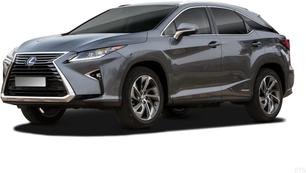
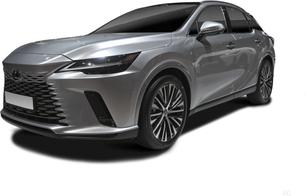
What's the difference?
Remember when Lexus design was about as adventurous as a warm cup of tea and a good lie down?
The Japanese luxury brand (and Toyota’s more expensive little brother) wasn’t exactly famed for taking risks on boundary-pushing looks. And that's not even me being mean - its own executives say they favoured conservatism over all else when working on an a new model. And thus everything looked like it was designed by a 75-year-old Japanese man, largely because it had been.
But gazing upon the angry, jutting jawline of the Lexus RX, those play-it-safe days suddenly feel a long time ago. If this RX isn’t the most striking (for better or for worse) SUV in its premium field, it’s got to be pretty darn close.
The cheapest and most youth-oriented model in the RX family is the 200T, making use of a 2.0-litre turbocharged petrol engine to propel the big SUV. And the one you see in these pictures is the F-Sport model, which scores a bespoke bodykit, unique alloys and other styling stuff to make it look even more aggressive on the road.
Having received its last major update in 2015 (but with a mid-life tweak just around the corner) this RX is starting to get on a little bit. So we spent a week in the 200T to see if it's still able to mix it with the best in the segment.
The Lexus RX holds broad appeal. Families with a bit of money that don’t need a third seating row, older people who love the brand and want a bit of space, and people stepping up into the premium marque from a mainstream brand are all potential buyers.
The fifth-generation version that launched in early 2023 proved to be a significant step up over the previous RX.
Lexus made it more dynamically capable, and there’s been a sharpened focus on refinement, value-for-money and safety credentials.
We spent three weeks getting to know the most affordable RX - the entry-grade Lexus RX350h Luxury two-wheel drive - to see whether it’s worth putting it at the top of your premium family SUV shopping list.
Big, practical and comfortable, the Lexus RX 200T F-Sport deserves its place in the premium SUV pantheon. And don't let the little engine fool you, the turbocharged four-cylinder unit serves up plenty of poke to get the RX moving. But if it's fancy new technology that really excites you, prepare for mild disappointment, with the RX's in-cabin tech feeling a little underwhelming.
It’s hard to look past the value equation of the RX350h Luxury 2WD when comparing it to almost all its competitors. The pricing is on point, but there are some features missing.
However, there are very few (if any) rivals with a true hybrid powertrain (sorry, mild hybrids do not count), so the RX will capture buyers looking for environmental credentials and efficiency without going full EV.
The drive experience is much better than before and it’s all wrapped up in a very stylish package. The Lexus RX should not be ignored.
Angry, aggressive and very un-Lexus, with a jaw that looks like Ivan Drago somehow transformed into an SUV - that pretty much sums up the RX.
Lexus is already on record as saying its designers had mistakenly tried to make their cars appeal to everyone in the past, and so they ended up boring and tame as a result.
Now they're happy if one person in 10 really loves them. Exactly where you sit on that scale is up to you.
Up front, that 'Spindle Grille' (shaped a little like the Predator’s mouth) serves up plenty of road presence, while the sharply angled fog-light housings and deeply domed bonnet give it a more powerful stance than perhaps is justified by its 2.0-litre engine.
Side on, the big and shining alloys, deep curve above the base of the doors and flared, squared-off wheel guards add plenty of personality to what could have (and in the past, would have) otherwise been a long and featureless stretch of metal.
Step inside and the cabin is premium-feeling, if a little busy, with the doors and dash covered in a combination of soft-touch materials and padded leather. The brushed aluminium-look central tunnel that separates the front seats is super wide, as it houses the the cupholders, drive-mode selector and the strange mousepad that controls the entertainment system, but feels nice under the touch and becomes a kind of focal point in the cabin.
Across its five generations, the RX has held significant visual appeal - especially the still-handsome second-gen version that was the first RX sold Down Under. The first-gen model skipped Australia.
The new model that launched in 2023 is a clear evolution of the car that came before, but it’s been softened and sharpened in the right areas, giving it one of the most appealing designs in its segment.
The proportions and design elements like the squat stance, unique C-pillar treatment, slimline headlights and nicely sloping roofline give it a sporty look.
In fact, I reckon it might be the best looking Lexus available today - not including the jaw-droppingly beautiful LC coupe and convertible, of course.
The interior is modern and feels like an evolution of Lexus’ previous cabin design - but elevated. The gloss black section of the dash helps here.
Levels built into the dash break up the bulk, but the interior is very grey. It could do with a dash of colour.
The synthetic leather seat trim doesn’t look premium. If you want a more expensive feeling RX, you need to pay more for a higher grade.
Australia’s laser focus on small and city-sized SUVs has been so intense that’s it’s easy to forget the joys of our bigger cars. Stretch out in the 4890mm long and 1895mm wide Lexus NX and it all comes flooding back.
There’s plenty of space for up-front riders (even with the football pitch-sized centre console), as well as two cupholders and extendable pockets in each of the front doors. The cubby that splits the front seats is ridiculously deep, too, and is home to two USB connections, a power outlet and and aux-in point.
Step into the back seat and you’re greeted by plenty of space in each of the window seats, although the central stack that houses the air vents and another power outlet does jut out into the legroom of the middle-seat passenger. There are two bonus cupholders hidden in a pulldown divider that drops from the middle seat, and two ISOFIX attachment points, one in each window seat in the back.
Rear seats in place, the RX serves up 453 litres of luggage space, although you can stretch that to 924 litres by folding the backseats flat.
The RX is a five-seat only proposition in this generation - the previous model had a seven-seat option - so if you need a third row you can look at the Lexus LM people mover or massive LX 4x4 SUV, or at any number of other three-row lux SUVs like the Volvo XC90 or new Mazda CX-90.
That doesn’t mean the cabin isn’t practical.
Up front the seats offer excellent comfort levels and ample upper body support, but not a lot of hip support.
Lexus has changed up the door handles for the new RX and it can be complicated - initially.
The interior handles bamboozled every new person that got in my press car over the three week loan. But once you realise it’s a simple push of the thumb on the handle’s thumbpad and a gentle push, it all makes sense.
Lexus calls the electrically activated door handles an ‘e-latch’. Is it tech for tech’s sake? Probably.
I recently reviewed the Lexus LM and commented on how much I like Lexus steering wheels and that’s true of the RX, too.
It has clearly identifiable controls and feels nice in your hands. Thankfully, the cruise control buttons are housed on the wheel too, so no annoying stalk on the wheel.
There’s plenty of space across the front row so you should avoid the awkward driver-passenger elbow bump on the centre armrest.
Under the armrest is a huge central bin that opens on the driver and passenger side. There’s also a big covered storage nook forward of the shifter and another ledge above that, as well as a sizeable glove box.
The doors have ample storage room for bottles, but the space is almost too wide. My bottle slid around when driving so I had to lay it down.
The centre console houses two big cupholders with adjustable depth in one of them. Clever touches like this and the central bin add to the appeal.
As with the Lexus LM, I am a fan of the new Lexus multimedia set-up. It has an easy-to-navigate menu along the side, easy wireless Apple CarPlay connection, and visually appealing graphics.
It’s a world away from Lexus’ previous system. That frustrating touchpad is, thankfully, in the bin.
I quite like the gear shifter with its unusual gate and even the indicator feels and sounds premium.
Small rear windows make for a rear three quarter blind spot, but visibility is otherwise good.
On a side note, the RX has very strong air conditioning - perfect for an Australian summer.
Jumping into the second row, there’s plenty of space all around and no shortage of head, leg, knee and shoulder room. Although foot room under the front seats is tight.
As with the front seats, the rear row offers comfortable seating. Kids should be happy back there.
There’s only a small transmission tunnel so middle-seat legroom is good. And in great news for passengers, the rear backrests recline.
Lowering the 40/20/40 split-fold rear seats for more cargo space is done via a lever on the side of the outboard seats, or by a button in the boot area. There are ISOFIX clips on the two outboard seats.
Other amenities in the second row include map pockets, two USB-C ports, knee-level air vents, climate control, and a pull-down armrest with pop-open cupholders.
Open the power tailgate and you’ll find cargo space of 612 litres with all seats in place, or 1678L with the second row stowed.
That’s a decent amount of space but not class leading. The Mercedes-Benz GLE has 630L and the VW Touareg can swallow 810L.
There’s no under-floor storage because that’s where some hybrid hardware is housed. You will find audio speakers, nice carpet, a cargo blind, two 4.0kg hooks and three top tethers. No spare, only a tyre repair kit.
You’ll part with $86,551 for the Lexus RX 200T F-Sport - about $12k more than the non F-Sport model. And that’s not chump change. But your money does buy you 20-inch alloy wheels, proximity unlocking, LED head and tail-lights, roof rails, a powered boot and a huge powered sunroof.
In the cabin, you can expect leather seats, dual-zone air-con and push-button start, while technology is handled by a nav-equipped 12.3-inch screen that partners with a 15-speaker Mark Levinson stereo that's standard on this F-Sport-stamped model (the cheaper version makes do with a smaller screen and fewer speakers).
The range-opening RX350h Luxury 2WD petrol-electric hybrid starts at $86,904, before on-road costs, and for that amount, the standard specification list is healthy. But it doesn’t include everything.
As well as a long list of standard safety gear (see section below), the RX350h comes with three-zone climate control, heated and eight-way adjustable power front seats, electric steering wheel adjust, rain-sensing wipers, a 14-inch multimedia set-up with wired Android Auto and wireless Apple CarPlay, digital radio, sat nav, a 12-speaker audio system, five USB-C (and one USB-A) ports and more.
It is missing a few items, however, that should be standard, such as a head-up display and wireless device charging. Those features are available as part of an options pack - or 'Enhancement Pack' in Lexus speak.
For $5000 more you get those two things and a panoramic sunroof, ventilated seats, a more digital instrument cluster and other goodies.
You can opt for an all-wheel drive version of the 350h and that adds just over $3500 to the price. If you want the same powertrain but more gear then you’ll need to step up to the $110,575 Sports Luxury.
There’s also the petrol-only RX350 in F Sport and Sports Luxury guise, as well as the flagship RX500h F Sport Performance hybrid that tops out at $124,675.
Looking at the opening price of some of its rivals, Lexus has most of them beat.
The Mercedes-Benz GLE300d starts from $144,900, the BMW X5 xDrive30d is $134,900, Porsche Cayenne starts at $138,700 and the Volvo XC90 B5 Ultimate Bright kicks off from $100,990.
Only the Volkswagen Touareg 170TDI ($89,240) and Jaguar F-Pace P250 R-Dynamic ($83,700) are close on price.
There was a time not so long ago when the thought of fitting a four-cylinder, 2.0-litre engine to a near two-tonne SUV would be truly torturous.
But turbocharging has become so clever that the smallest engine in the RX range never feels underpowered. It'll serve up 175kW at 5600rpm and 350Nm at a low 1650rpm - enough to push the big Lexus from 0-100km/h in just 9.2 seconds. That power is fed through the a six-speed automatic and sent to the front wheels.
Powering the RX350h is a series parallel hybrid system consisting of a naturally aspirated 2.5-litre four-cylinder petrol engine, a front-mounted motor and a nickel-metal hydride battery.
Lexus doesn’t provide combined torque outputs for the hybrid, but total power for the system is pegged at 184kW.
This drives the front wheels only via a continuously variable transmission (CVT).
Lexus claims a 8.1 litres per 100km on the claimed/combined cycle (though we returned a much less happy number - one that started with an 11...).
Emissions are pegged at 189g/km of CO2 on the combined cycle, and the big Lexus' 72-litre fuel tank requires 95RON fuel.
The official combined cycle fuel consumption figure for the RX350h 2WD is 5.0 litres per 100 kilometres, with CO2 emissions of 114g/km. You won’t get figures like that in a petrol or diesel competitor.
Over three weeks of mixed city, country, urban and freeway driving, I recorded 6.8L/100km which is not too bad given some of my spirited driving. The trip computer said 7.0L which is close to my figure.
The RX350h takes premium unleaded petrol and has a 65-litre fuel tank, so expect a range of around 950km based on our real-world consumption number.
Your love for the RX will likely depend on your priority list. Do you want the latest gadgets, a seamless multimedia interface and the kind of cool technology you can show off to your passengers?
Well, um, perhaps best keep looking, then. The in-cabin tech here feels a little off the pace now, and that cursed mouse-style controller still frustrates the bejeezus out of me.
But if a smooth, easy and quiet drive sits atop your list, then the RX 200T will grab you in all the right places. Probably most impressive, it doesn't feel overly large and cumbersome, and is equally at home in the cramped inner city as it is eating up kays on the freeway.
The gearbox is silky-smooth seamless, switching between cogs without you even noticing, and the cabin is commendably quiet - especially when you're coasting though the ‘burbs - locking the worst of the outside word out of the cabin. The ride has clearly been engineered to iron out small, sharp road imperfections, but you can bounce around a bit in the cabin over speed bumps.
There was a time not so long ago when the thought of fitting a four-cylinder, 2.0-litre engine to a near two-tonne SUV would be truly torturous.
You can spice things up a little by selecting Sport or Sport + via the central dial and, while there’s no noticeable change in exhaust, the accelerator gets noticeably more sensitive and the gearing more aggressive; more wiling to hold a lower gear for longer, squeezing the most out of that little engine.
It can feel a little heavy when you first brake into a corner, but beyond that the steering is smooth, predictable, and without a lot of dead-air play. It’s not a sports car by any measure, but it doesn't feel like you’re constantly dragging a big, heavy SUV around, either.
But be warned, it’s not the most engaging of drives. This is not a car you'd ever wake up excited to run out to. It’s comfortable, capable and engaging enough, sure, but it never really stirs your emotions.
The old RX was competent and even nice to drive but not a patch on the likes of the BMW X5. The new-gen RX improves on that in a big way.
It offers solid acceleration from a standing start. Lexus says 8.1sec from 0-100km/h - without giving you chills. The sportiest RX is the 500h Performance hybrid and that covers the same distance in 6.2sec.
The transition from electric power to petrol propulsion is more evident in this model than it was in the LM350h people mover I tested recently - the RX is a little noisier. The CVT doesn’t help this, offering up an uninspiring engine note.
It is, however, a much more fun car to push into tight bends than the previous RX. It remains reasonably flat in corners, and pulls out of tem with ease, but can’t compare to the dynamics of the dearly departed IS sedan.
The 19-inch tyres have large sidewalls and as a result soak up harsh bumps on the road. The non-adaptive suspension is tuned for better dynamism, meaning the ride quality is on the firm side.
The front-wheel drive RX lost traction for a second on a sweeping uphill section of my drive route, but the electronic traction systems otherwise kept the big SUV in check.
But around town in urban areas, there is very little to complain about behind the wheel of the RX350h.
There's no shortage of cushioning safety in the RX, with 10 airbags as standard. They join a parking camera, front and rear parking sensors and rear cross-traffic alert.
Lane-departure warning and assist, blind-spot monitoring, active cruise and AEB join the list, too. All of which were enough for the Lexus RX to nab the maximum five-star crash rating when tested in Europe - a score that has since been adopted by ANCAP in Australia.
The RX comes packed with standard safety gear and the SUV was awarded a maximum five-star crash safety rating from ANCAP in 2022.
Just some of the inclusions are auto emergency braking with pedestrian (day/night), cyclist (day/night) and motorcyclist (day) detection, intersection assist, emergency steering assist, driver monitoring, lane keeping aid and lane departure warning, adaptive cruise control, front and rear parking sensors, blind spot monitor (including stationary) with rear cross-traffic alert and safe exit assist to avoid 'dooring' incidents.
I must say, Lexus’ (and parent company Toyota’s) driver assistance tech has come a long way.
In the early days of the pandemic during a rare non-lockdown period in Melbourne, I drove from Melbourne to Sydney in the previous-generation Lexus RX200 Sports Luxury.
The lane keeping system and adaptive cruise control were shockingly underdone. The cruise control would simply stop working when you encountered even a slight downhill section.
Not anymore. The new, smoother lane keeping set-up uses subtle wheel adjustments, unlike the ping pong effect of the previous RX, and the cruise system is now very much in control of the speed.
The Lexus safety suite now operates without too much intervention and is hard to beat among its key rivals.
Expect a four year/100,000km warranty, with a trip to the service centre required every 12 months or 15,000km. And when the car does have to go back for a service, Lexus has received much praise from owners for offering a choice between a loan car, or a pick-up and delivery service from your home or office.
The RX350h is covered by a five-year, unlimited-kilometre warranty, and the servicing schedule is every 12 months or 15,000km.
There’s a capped-price servicing plan lasting five years and it will cost $695 per service. That's significantly less than some rivals like the Mercedes GLE.
The RX is covered by the 'Lexus Encore' loyalty program and includes complimentary service loan cars, fuel offers as well as discounts and other offers with Lexus partners.