What's the difference?
The price of fuel probably doesn't feature too highly on a 'Things to Worry About' list for people who can afford a luxury SUV. If you're spending more than $130,000 on a vehicle then, chances are, you glide on through service station forecourts with nary a concern about the cost of go-juice, but nevertheless Lexus has introduced its diesel-sipping LX 450d to the ever-growing arena of upmarket wagons. It has a claimed fuel consumption of 9.5L/100km – using just under five litres per 100km less than the eight-seater LX 570, its petrol stablemate.
But does this five-seater up-scale offering deliver much in the way of anything different to any other pricey people-mover, other than the fact it's an oil-burner? Read on.
The Lexus LX range has undergone significant updates across the board and the carmaker has also introduced an off-road-focused variant, the Overtrail, to the Aussie market.
The LX500d Overtrail is geared up for 4WDing and, as such, is kitted out with front and rear locking differentials, Toyo Open Country all-terrain tyres on 18-inch rims, as well as a stack of driver-assist aids – including the proven Multi-Terrain Select from Toyota’s LandCruiser 300 Series – all aimed at making you The Absolute King of the Dirty Weekend.
But, being a Lexus, the Overtrail is of course on the right side of premium, replete with a features list as long as … something that is long.
So, how does it perform off-road?
Read on.
If you're in the market for the best-of-the-best SUV wagon, then you could do a lot of worse than get in a LX 450d. It looks good, is packed with standard features and is supremely comfortable. The 450d also has an suite of safety tech worthy of the hefty price-tag and it works well as a daily driver and has plenty of touring potential, even though we doubt it'll ever get anywhere near achieving those claimed fuel-consumption figures with real-world usage. Sure, you could instead climb in a second-hand, well-looked-after, never-been-off-road LandCruiser 200 Series and spend the money you save, by not buying this new Lexus, on aftermarket and camping gear, camping fees and also hiring a team of four people to follow you on mopeds everywhere and constantly tell you what a great driver you are – but that's not the point with vehicles of this ilk. They may not be aimed at hard-core off-roading buyers, but they are cushy, classy, and cityified – and, in that respect, they're incredibly well-built for purpose.
The Lexus LX550d Overtrail holds plenty of appeal for those who’d like to bookend a work week of refined daily driving with a weekend of fun and adventure undertaken in style.
With a full complement of standard features, as well as offering premium comfort and understated design, the Overtrail makes a lot of sense as a potential purchase.
It’s luxurious on the road, capable off-road and the Overtrail holds up quite well if cross-shopped against the likes of Land Rover Defender, Toyota LandCruiser 300 or Nissan Patrol.
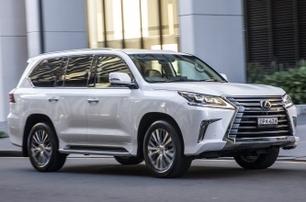
It has that signature Lexus jagged space-age grille, chunky shoulders and beefy back end that suit a luxury SUV dreamed up by folks craving a significant presence and plenty of attention for their product.
Bulky side-steps, an upswept raked profile, scalloped side panels and moon roof all top what is a cool combination of eye-friendly design factors. It's a slick mix of low-level cool and high-end style.
Take a look for yourself and make up your own mind whether you like it or not.
The LX500d Overtrail is 5100mm long (with a 2850mm wheelbase), 1990mm wide, and 1895mm high. It has a listed kerb weight of 2690kg.
It has an almost straight-up-and-down, old-school appearance, and leans more towards the retro-cool end of the design spectrum rather than the sleek end – and that styling, which is THE Overtrail look based on the GX Overtrail, works.
Adding to this 4WD wagon’s overall large-and-in-charge presence are its big front grille, bulging wing mirrors, side steps and those all-terrain tyres.
The Overtrail has black exterior touches (door handles and mirrors, window mouldings, wheel-arch trims), black front and rear bumpers, and bridge-type roof rails that top off its rugged look and further set it apart from its LX stablemates.
There are a lot more identifiably-Lexus, premium-style touches going on inside the Overtrail, including Overtrail-specific premium leather-accented front seats with Monolith colour stitching, Ash Sumi Black ornamentation, a plethora of soft-touch surfaces and a helpful does of durable plastic.
It certainly feels like Lexus designers and engineers have maximised every last millimetre of interior space; there is stacks of room inside with plenty of real-world usable storage spaces, including cup-holders, door pockets and spots for keys, phones and other stuff.
The heated steering wheel, stylish analogue clock, wireless charger, Lexus climate concierge (coordinating all four-zone temperature controls), cavernous centre-console cooler box, and rear-seat entertainment system are all nice touches but pretty much assumed at price-points lower than this one.
The 12.3-inch high-definition media touchscreen is clear and bright and easy to operate, but the Remote Touch Interface, the control near the shifter, is very annoying to use. The toggle/selector is too sensitive, skipping past your actual choice over and over again, while you try to manipulate it just so, so it lands on the option you wanted.
The second-row seating is plush and the seat sections are easily slid forward and tilted.
Lexus claims the 450d offers 909 litres of cargo space if there are five occupants; and 1431 litres if there are only two occupants. If you have some casual weekend touring in mind, with a spot of camping, then this Lexus should cope with your gear, no worries.
Overall, the interior is functional, the build quality is impressive and this is a Lexus so, of course, there are lashings of prestige.
For starters, the seats are comfortable. The 2026 Lexus LX500d Overtrail has a 10-way power-adjustable driver’s seat, and an eight-way power-adjustable front passenger seat and both have four-way Lumbar power adjustment and massager.
The second-row seats in this five-seater are in a 60:40 split folding configuration and are also on the right side of comfortable, which is not always necessarily the case in a 4WD wagon.
The 12.3-inch multimedia touchscreen system dominates the upfront layout and shows navigation, your smartphone desktop, reversing camera view, etc and when off-roading it displays multi-terrain monitor showing the road surface and other conditions.
Underneath that main screen is a 7.0-inch touch display that displays drive modes, adaptive variable suspension, air-conditioning controls and the like.
Both are easy enough to use without hassle.
The driver also gets a head-up display, projected onto the windscreen right in front of the driver, but say hoo-roo to that info once you’ve donned polarised sunnies.
The Overtrail has a powered sunroof/moon roof, whatever you want to call it.
It has plenty of charge points – including two USB-Cs upfront and two for the second-row passengers, and a wireless phone charging pad in front of the cooled centre console – and there are 12-volt outlets front and rear, and a 220V outlet in the rear cargo area.
There are numerous cupholders – upfront and in the second-row armrest – and bottle holders in the doors.
The five-seater Overtrail’s rear cargo area has a 220V/100W socket (to run camp lights, fridge etc), a cargo blind, tie-down points and cup holders on both sides, left over from the seven-seat layout.
Rear cargo space is listed as 1109L with all seats in use, and cargo space is 1960 litres if the second row is folded down.
The rear tailgate is powered and lifts to open rather than swings to the side as the barndoor-style doors do.
Minor gripe: You’d think with the amount of cash you spend on an Overtrail that Lexus would equip the off-road-focused LX with rubber floor mats because its interior should be ready to cop more than its fair share of dirt, sand and mud during its driving days.
Price as tested on our five-seat LX 450d is $136,000. The base RRP is $134,500 and our Lexus had premium paint (Sonic Quartz), which adds $1500; no other options were fitted.
It is absolutely packed to the rafters with high-quality stuff, which is no surprise really because, at this price, you’d expect nothing less. Standard features include a 12.3-inch high-definition screen with nine-speaker, seven-channel audio system (with “digital sound processing”), satellite navigation, and four-zone climate control air-conditioning with climate concierge function and nanoe technology (claimed to purify the air and moisturise hair and skin, according to Lexus). It also has heated front seats, leather-accented trim, a wireless phone charger, cool box, rear-door sunshades, 20-inch alloy wheels with 285/50R tyres, tyre-pressure warning, LED headlamps, daytime running lamps and sequential turn signals.
There are seven exterior colours and two leather-accented interiors from which to choose.
The LX 450d does not have any enhancement packs.
The updated LX range is available as an LX500d in Luxury, F Sport, Sports Luxury or Overtrail spec, all with a 3.3-litre V6 twin-turbo-diesel engine. Or you can opt for the LX600, which is available in Luxury, F Sport, Sports Luxury, Overtrail or Ultra Luxury spec, all with a 3.5L V6 twin-turbo-petrol engine.
Prices start from $158,700 (diesel, excluding on-road costs) or $162,200 (petrol, excluding on-road costs) for the LX Luxury seven-seater through to $220,950 for the petrol-only LX Ultra Luxury.
Our test vehicle, the 2026 Lexus LX500d Overtrail, the supposed off-road hero of the new four-variant LX500d line-up, has a price-tag of $182,300 (excluding on-road costs).
The standard features onboard this five-seater include a 12.3-inch multimedia touchscreen system (with wireless Apple CarPlay and Android Auto), wireless charging, a centre console cool box and more smart device charge points than you can poke a USB-C stick at (six, in fact).
As mentioned, the Overtrail is aimed at being the line-up’s off-road master and to that end it has front and rear locking differentials, Toyo Tires’ Open Country all-terrains (265/70R18 116H) on 18-inch matt grey alloy wheels, an underslung full-sized spare tyre, as well as a stack of driver-assist aids – including the proven Multi-Terrain Select from Toyota’s LandCruiser 300 Series – all aimed at turning you into an off-roading expert.
Exterior paint choices include Moon Desert (on this test vehicle and available only on the Overtrail), Sonic Quartz, Graphite Black, Titanium, Liquid Metal, and Khaki Metal.
All colour choices are standard/no cost on the LX.
The Lexus LX 450d has the LandCruiser's 4.5-litre twin-turbo direct-injection V8 engine, producing 200kW@3600rpm and 650Nm@1600-2800rpm. All of that power and torque arrives evenly and smoothly, helped no end by a slick six-speed sequential-shift transmission.
It has a full-time 4WD system, dual-range transfer case and off-road tech that includes multi-terrain anti-skid brakes, crawl control and a four-camera multi-terrain monitoring system with back guide and panoramic view.
Our test vehicle has a 3.3-litre turbo-diesel engine – producing 227kW at 4000rpm and 700Nm at 1600-2600rpm – a 10-speed automatic transmission and a full-time 4WD system.
This is a big wagon so it takes some encouragement to get going off the mark – it is sluggish rather than zippy around town – but once underway on an open road, especially on a highway, it punts along nicely.
I drove the seven-seater Lexus LX600 Sports Luxury – with a 3.5-litre petrol engine (305kW and 650Nm) – immediately after this test and – with the same dimensions, but 10kg lighter than the Overtrail – it’s more punchy off the mark.
The Lexus LX500d Overtrail has a variety of drive modes including Custom, Comfort, Eco, Normal and Sport S and Sport S+ for on-road driving.
It has front and rear locking diffs, and Multi-Terrain Select (MTS) drive modes for off-roading. Those modes include Auto, Sand, Mud and Rock. Each off-road driving mode adjusts throttle response, transmission shift patterns, wheel-slip control, engine power delivery and braking to best suit the specified terrain.
Lexus claims the LX 450d will achieve a 9.5L/100km figure from combined-cycle driving (that's 4.9L/100km more frugal than the LX 570 is capable of). Lexus reckons, based on that figure, that the diesel LX has a potential range of almost 1000km on a full tank (93 litres) of fuel.
We recorded 12.7L/100km during daily driving (city and suburbs) and 13.5L/100km with some light off-roading thrown into the drive mix.
Official fuel consumption is listed as 8.9L/100km (on a combined cycle), but on this test, I recorded 12.8L/100km.
The Overtrail has 110L fuel capacity (80L main tank, 30L sub tank) so, going by my on-test fuel-consumption figure, you could reasonably expect a driving range of about 860km from a full tank.
However, as with any vehicle, once you’ve loaded it with real-world burdens (e.g kids, dogs, camping gear etc) you’ll soon see fuel-use figures increase.
It’s supremely comfortable and very quiet, wth that customary cocoon-like enclosed sensation that you only ever truly get in a vehicle this far away from cheap.
The 450d is 5080mm long, 1980mm wide and 1865mm high. It has a 11.8m turning circle. It has an official kerb weight listed as between 2510kg and 2740kg.
For something with so many kegs onboard, it’s capable of punching off the mark with a respectable bit of pace; handy for city-street bursts to slip through traffic gaps.
It never feels cumbersome; it actually feels quite light on its toes. In fact this Lexus tends to be more than a little bit floaty at times. You can select different suspension settings – comfort, normal or sport – to suit your preference.
Visibility is generous all-round with clear sightlines in all directions; besides, the reversing monitor with 360-degree view helps if your views are hindered.
Steering is generally active but it does exhibit quite a lot of under-steer on twisting country roads. It has paddle-shifters if you’re that inclined.
The LX 450d rides on 20-inch alloys and 20-inch Dunlop Grandtrak PT2As (285/50F20 112V) – a combination which is fine for bitumen-based outings, but we’d ditch it for rubber with more sidewall to allow for greater freedom to adjust tyre pressures to suit rough terrain.
On-road, the Overtrail is impressive: refined, comfortable, unstressed and it offers up controlled ride and handling.
The Overtrail sits nicely on sealed road surfaces – it has a wide wheel track and long wheelbase – and it maintains that composed posture even on gravel or dirt tracks.
It does exhibit some body-roll when pitched through country bends but in a large 4WD wagon that characteristic is no real surprise.
Ride quality is impressive and the suspension set-up, including the Overtrail’s adaptive variable suspension which adjusts damping force according to the drive mode selected, manages to smooth out the worst of most surface irregularities. Active height control is worth mentioned here because it's designed to optimise the spring rate to keep this wagon stable during turning, acceleration, and braking.
The 3.3-litre turbo-diesel engine and 10-speed auto are a smooth combination producing plenty of power and torque across a broad rev range.
It's mostly quiet in the cabin though wind noise does emanate from the chunky wing mirrors.
One thing I’m not a big fan of is the digital rear-view mirror. I understand the reasoning behind it as it helps establish visibility where you may not have it – for example, if something you’ve packed in the rear blocks your vision, or a second-row passenger’s massive head blocks your vision – but the slightly distorted view depicted on the mirror isn’t altogether helpful and tends to push me into headache territory on longer drives. That’s my story and I’m sticking to it. Maybe my old eyes need testing?
So, how does the Overtrail perform off-road?
Well, you’d expect it to go pretty well, especially as it is equipped with front and rear locking diffs, and a raft of off-road drive modes.
And it does. Mostly.
Steering is nicely balanced and the driver is afforded so much visibility of the track ahead that, even with a massive bonnet in front of you, it’s easy to get your wheel placement spot-on. The Overtrail also has a 360-degree camera system, so that maximises your chances of putting the vehicle on exactly the correct line.
Courtesy of its off-road modes, diff locks etc, the Overtrail drives with impressive composure through most off-road situations, whether that’s along corrugated dirt tracks, up steep rocky hills or through shin-deep mudholes.
It offers a reasonable amount of wheel travel for a large wagon and it has decent all-terrain tyres – Toyo Open Country (265/70R18) – and they provide plenty of grip on a variety of surfaces: sand, loose gravel, shale, even rain-soaked mud which can be very slippery and can quickly fill up tyre tread.
The LX500d Overtrail has 205mm ground clearance which is industry standard for a larger or upper large SUV, but it isn't great for a vehicle that’s intended as an off-road machine. However, worth mentioning again here is the addition onboard of active height control, which automatically adjusts vehicle height – Normal, High 1, High 2, and Low (for easy ingress and egress) – to match the drive mode you select and the driving conditions at any time.
And while the off-road angles – approach (23 degrees), departure (22) and rampover (22.7) – aren’t fantastic, those measurements are industry standard for a larger and upper large SUV, but again, in a vehicle billed as an adventure machine, those angles could be a lot better. In the Overtrail’s favour the underbody is well protected by substantial bash-plates and the Overtrail’s full-size spare is mounted to the underbody.
Wading depth is an estimated 700mm, which is also in the vicinity of standard for an unmodified 4WD wagon.
The side steps protrude and if you fail to drive with consideration then they'll probably cop a scrape and maybe even a bit of a dent.
Towing capacities are 750kg (unbraked) and 3500kg (braked). Payload is 590kg, which is not a lot once you throw in your kids, dogs, and camping equipment – not to mention anything you might be towing at the time. For reference, a 300 Series LandCruiser's payload, depending on the variant, is between 650kg (VX/Sahara/GR Sport) and 785kg (GX).
The Overtrail’s listed kerb weight is 2690kg, gross vehicle mass (GVM) is 3280kg, and gross combined mass (GCM) is 6780kg.
The LX 450d has a five-star ANCAP rating. It has the latest-generation Lexus pre-collision safety system with pedestrian detection, and 10 airbags. Other standard safety gear includes radar active cruise control, lane-departure warning, adaptive high-beam system, blind-spot monitor and rear cross-traffic alert, as well as clearance and back sonar, and reversing monitor with 360-degree view.
At time of writing, the 2026 Lexus LX 500d Overtrail does not yet have an ANCAP safety rating.
Standard safety equipment includes 10 airbags (driver and front passenger, front knee and side, rear side and curtain), as well as auto emergency braking (AEB), adaptive cruise control, lane departure alert, lane trace assist and lane keeping system (with emergency driving stop system), road sign assist, safe exit assist, facial recognition, driver monitor camera, and more.
Driver-assist tech aimed at making you a better off-roader than you already are includes downhill assist control, hill start assist, crawl control, Multi-Terrain Monitor (MTM) with panoramic view monitor, active traction control, tyre pressure monitor, active height control and more.
Warranty is 4 yrs/100,000km. Service intervals with indicative pricing (exc GST) are: six months/10,000km: complimentary; 12 months/20,000km: $535.56; 18 months/30,000km: $598.11; 24 months/40,000km: $800.32; 30 months/50,000km: $502.44; 36 months/60,000km: $676.23.
The 2026 Lexus LX500d Overtrail is covered by a five year/unlimited km warranty.
Capped-price servicing applies for five years/100,000km for a maximum of 10 services.
Servicing is scheduled for every six months or 10,000km, whichever occurs soonest and cost per service, at time of writing, is $595.