What's the difference?
The LDV G10 arrived on the scene in the van segment a few years ago, with the aim of upsetting the equilibrium.
It was a budget-priced, Chinese-made mid-size van with its target set squarely on appealing to customers who might have wanted a HiAce, but couldn’t afford one.
After almost four-and-a-half years on the market in Australia, the LDV G10 is better than ever. It has seen new additions in the cabin, more comfortable seats, and still offers big value for money.
But with the van market moving forward at pace, does the LDV G10 offer appeal beyond the sticker price? We tested the diesel auto model to find out.
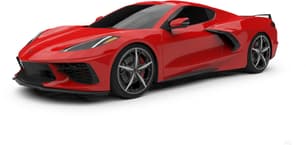
Chevrolet’s Corvette Z06 supercar is an all-American answer to European rivals Lamborghini and Ferrari, but it’s not just this that makes it so appealing.
Spending a week with the most potent Corvette you can get in Australia has left me with a list of notes on this beast I want to hand over to you. Maybe it will help make your mind up about it or change your mind.
What makes the Z06 the flagship of the Australian Corvette range isn’t little luxuries, but seriously upgraded mechanical hardware, much of it track focussed.
Our test car was also fitted with the Z07 Performance package which adds a carbon-fibre aero kit to pin the Corvette down at high speed while also drawing everybody’s attention to it.
Oh, and then there’s the sound of the largest flatplane crank V8 ever to go into a production car… and look out for your ankles - let me explain…
The LDV G10 is a solid option for those buyers who just want a van that gets the job done. It was decent with weight on board, but is probably better suited to parcel carriers rather than pallet shifters.
Safety levels are the biggest concern, as it is falling behind in the class when it comes to active safety tech, and its weak crash test score could be enough to rule it out for some customers.
The Chevrolet Corvette Z06 is truly a supercar offering outstanding dynamics for a lot less money being asked by European rivals - just make sure it's not your only car for those times when you're in a hurry.
The more you see LDV G10 vans, the more regular they look. Familiarity breeds ignorance, I guess, but I still think the G10 looks smart.
It isn’t quite as boxy as some, with its sleeker front-end styling and almost sedan-like tail-lights helping it stand out from the ‘box-on-wheels’ stigma. It gets 16-inch alloy wheels as standard, and has halogen headlights and misses out on daytime running lights.
But it still is a box on wheels, measuring 5168mm long (on a 3198mm wheelbase), 1980mm wide and 1928mm tall. That makes it a darn sight smaller than the new HiAce, which stepped up significantly in size, and about on par with a Renault Trafic SWB or Ford Transit Custom 300S SWB.
The perceived build quality is mostly okay, though our test car had a few loose plastics on the outside and a seemingly mis-fit windshield rubber.
We’re talking about the closest thing to a real-life Hot Wheels car here. See, while Ferraris look elegant to me like expensive jewellery, Lambourghinis like cheese graters and McLaren’s look like slippery alien spacecraft, the Corvette Z06 looks exactly like an American supercar should - an unapologetic, ludicrous beast. And I love that.
Dialing up the wild is that enormous carbon wing and front splitter with dive planes thanks to the Z07 package. Just a word of warning, though, the front splitter and dive planes stick out not just visually, but in the sense that I walked into them often and my ankles still have the scars.
I can’t recall the last time I drove a car with carbon-fibre wheels either - these are the biggest rims fitted to a Corvette and they’re wrapped in Michelin Pilot Sport Cup 2R ultra performance tyres (275/30ZR20 front and 345/25ZR21 rear) that they look like oil drums on their sides.
The best angle? The rear - straight on. Those headlights.
Wait, no, it’s from above - so you can see the V8 through the glass hatch.
Or it could be front-on looking like a giant shovel..
OK, there are no bad angles..
The Corvette Z06 is long at 4734mm end-to-end, broad at 2024mm wide and its height is a both a sitting-on-the-road-low and numerically pleasing 1234mm.
The plainness of the cabin might be a let down to some people after all the exterior wildness. Ferraris and Lambourghis offer extravagant and exotic interiors, but the Corvette’s innards are almost completely void of flare.
The media screen is small (8.0 inches), switches and controls for windows and air vents are basic, and the huge dividing ‘wall’ between the pilot and passenger might be a bit much for some.
That ‘wall’ is dotted with buttons and while it may look very 'fighter jet cockpit', they’re just climate control switches. Sitting in the passenger seat is a lonely place with no screen visibility nor easy access to controls - I'd actually call this out as a bit of a fail compared to the interiors from Porsche, Audi and Lamborghini with their screen-filled cabins offering co-pilots something to do.
Yes, it feels a bit premium with the Nappa leather and the sports seats, but it could feel more special.
All of this plainness, however, is saved from boredom by the glass window behind the seats allowing you to peer into the engine bay at the V8 like at a reptile enclosure at the zoo.
Those dimensions translate to a cargo space of 5.2 cubic metres, with a load space spanning 2500mm long, 1590mm wide (1270mm between the arches) and 1270mm tall. That mightn’t be big enough for you, and that’s too bad - there is no high roof version, nor a long-wheelbase model; but you could get an LDV V80 if you really need to step up in size… but we wouldn’t suggest you do that.
The payload for this model is 1010kg, which is decent but not benchmark-setting. It has a gross vehicle mass of 3000kg, meaning a kerb weight of 1990kg. The gross combination mass depends on the model: the GCM for diesel models is 5000kg for a braked trailer, while petrol models have a GCM of 4750kg for a braked trailer (auto) and 4500kg (manual). All models have a GCM of 3750kg for unbraked trailers.
The petrol versions have 1093kg of payload, if you prefer that fuel type. Interestingly, the manual versions have leaf spring rear suspension, while the auto models have coil springs as part of a five-link suspension architecture.
The load area has a six floor-mounted and four wall-mounted tie-down hooks, and the floor is lined with a vinyl covering while up to half-height the inner walls are lined, too. There are four lights mounted on the walls, which is handy for after-hours work.
And every LDV G10 comes with dual sliding side doors (some brands charge thousands more for this convenience), while the back door is a tailgate as standard, with the option of barn doors for diesel models.
For those who need to fork loads in, the barn doors are a no brainer, because the side door apertures (at 820mm wide) aren’t broad enough to load in using a lift. The tailgate also makes it very difficult to load weight in, as we found on test, as our mates at Crown Lifts had to use long tines to fork in our 750kg ballast.
When it comes to creature comforts up front, there is a pair of low-mounted pop-out cupholders, and an open storage area between the seats. There isn’t much covered storage, so if you often carry valuables, you may need to keep that in mind.
The seats are comfortable and offer good adjustment, and they’ve been changed since the diesel auto model launched. They’re no longer a cheap-feeling fabric, but rather a faux-leather accented, mesh-lined set of seats, and both have armrests. Nice.
The presentation is okay, but the ergonomics could be better. The touchscreen is mounted down lower than most, and means you may need to take your eyes away from the road because the controls are down even lower. And the USB? Near the floor.
That screen is still a 7.0-inch display, but now has the same software system as the newer models in the LDV range. That means a nice crisp colourful display with the added advantage of Apple CarPlay… if you can get it to work. We had a few issues when reconnecting a phone without re-starting the car.
Supercars don’t tend to be built with practicality as a priority but this two-door, two-seat beastie is spacious enough even for me at 185cm tall with plenty of room in the footwell and loads of elbow-, knee-, and headroom.
Cabin storage is limited to a glove box, door pockets, two cupholders, and a wireless phone charger on the bulkhead behind the seats.
As you can see from the images there’s a boot at the rear which will fit smaller bags and a small boot in the front.
I did the school run in the Corvette a few times (I know, lucky kid) and I can tell you a bass guitar in its case and a school bag, plus my own large handbag make for a cramped cabin. A Kia Carnival the Corvette ain’t, but it’s not trying to be one and compared to its rivals it does well for practicality.
If you’re buying an LDV G10, it’s because of the price. The cost of the diesel automatic model we’ve got is usually $32,490 drive-away for ABN holders, but there are promotions running listing it at $29,990 drive-away for ABN holders at the time of writing. If you’re not an ABN holder, just get one, because you’ll save heaps (the G10 diesel auto is $34,147 drive-away for non-ABN holders).
You can get other vans for around this money - the Renault Trafic Trader Life manual, with its gutless 66kW turbo-diesel engine, is $30,990 d/a. But you won’t find a diesel Hyundai iLoad, Peugeot Partner or Toyota HiAce within $10,000 of the LDV.
As for standard spec, you get 16-inch alloy wheels, tyre pressure monitoring, climate control air-conditioning, a 7.0-inch touchscreen with USB connectivity, Apple CarPlay, Bluetooth phone and audio streaming, CD player and AM/FM radio, a digital speedometer, two part fake-leather seats with arm-rests (driver’s side with height adjust), carpet flooring up front, and vinyl floor protective liner in the rear, and a reversing camera.
Standard body fit out is dual sliding side doors and a lift tailgate, though you can get barn doors fitted on diesel models. Unlike some competitors, there is no option for glazing in the rear doors or side panels.
There are also no auto headlights, no auto wipers, push-button start, keyless entry, leather-lined steering wheel, reach adjustment for the steering, and there’s quite a bit missing in the safety section of this review - see below.
Almost never does a car with a list price of almost $400K get full marks, but here we are and I’ll tell you why. The Corvette Z06 in its standard form lists for $336,000 and this is outstanding value compared to its supercar rivals such as the Ferrari F8 Tributo for $484,888, or a McLaren 750S for $585,800 or even an entry-grade Lamborghini Huracan, the EVO, for $383,187.
Australia gets the top 3LZ trim, with the local standard features list for the Corvette Z06 including Nappa leather upholstery, GT2 bucket seats, a 12-inch digital instrument display, a 14-speaker Bose sound system, red seat belts, wireless phone charging, carbon-fibre and suede microfibre trimmed steering wheel, a media system with sat-nav plus wireless Apple CarsPlay and Android Auto, power seats, heated steering wheel, dual-zone climate control, heated and ventilated seats and a head-up display.
Our test car was fitted with plenty of options including the Z07 Performance Package that brings carbon-fibre everything. We’re talking the enormous carbon-fibre rear wing and aero kit with side skirts and a front splitter with dive planes –and there are the carbon-fibre wheels (20-inch at the front and 21-inch at the rear).
The Z07 package also brings a more hardcore suspension tune and carbon ceramic brakes for ridiculously good stopping power.
The Z06 has the most powerful V8 engine in the Corvette range, too, and we'll get to that soon.
Under the bonnet of the diesel G10 is a 1.9-litre four-cylinder turbo-diesel with 106kW of power and 350Nm of torque. There’s the choice of a six-speed manual or six-speed automatic, and the G10 is rear-wheel drive. It has a diesel particulate filter, but not stop-start or AdBlue.
Prefer petrol? There’s a 2.4-litre five-speed manual model (105kW/200Nm) or a 2.0-litre turbocharged six-speed auto (165kW/330Nm). Those models are cheaper - $25,990 for the manual for ABN holders, while the turbo-petrol auto is $30,990 d/a.
The 5.5-litre naturally aspirated V8 in the Z06 makes 475kW and 595Nm. That’s a lot more power than the Corvette Stingray’s V8, which produces 369kW. The GT3 racecar version of the Z06 uses a derived version of the 5.5-litre V8, and actually it shares 70 per cent of the engineering components.
Revving to a high 8600rpm the Z06’s V8 lets out a high-pitched scream when pushed hard, much like a Ferrari because like many Ferraris the Z06 has a flatplane crank V8 - actually it’s one of the largest flatplane V8s to go into a production car.
Corvettes are now mid-engined cars and the Z06 has an eight-speed dual-clutch transmission that changes gears quicker than I can blink, sending all that mumbo straight to the rear wheels.
Acceleration comes hard, fast and loud with the Z06 able to boot itself from 0-100km/h in 2.9 seconds. That beautifully linear acceleration with no turbos will pull you all the way towards its top speed of 313km/h.
The combined cycle fuel use claim for the LDV G10 diesel auto is 8.6 litres per 100 kilometres. The manual version uses 8.3L/100km according to the brand.
On test we saw a fuel use return of 9.7L/100km at the pump, across a mix of urban, highway and freeway driving, with and without a load.
Petrol models use a claimed 11.5L (manual) and 11.7L (auto) per hundred.
As with practicality, fuel efficiency isn’t the Corvette’s priority and after driving it daily for a week in the suburbs, city and a few dashes out to more open country roads the Z06 was using an average of 23.8L/100km, according to the trip computer.
Luckily the fuel tank is pretty big at 70 litres and with an official combined fuel consumption of just under 16L/100km you have a range of 438km… in theory.
You probably wouldn’t choose an LDV G10 as a daily driver if you didn’t intend to use the cargo zone at least 80 per cent of the time.
But if - for whatever reason - you really want to use a van like this on a day-to-day basis, you won’t hate it.
The G10 drives pretty nicely for this type of vehicle. It isn’t as bouncy when unladen as some of the other vans out there, with the suspension proving very quick to settle and mostly very compliant across mixed surfaces.
The steering wheel can jostle a bit over sharp edges, but it steers well, with decent (not too heavy) weighting and predictable response at all speeds.
Without weight on board the engine feels reasonably urgent in its response, which is a bit of a surprise because it’s not a powerhouse based on its outputs. It revs smoothly and pulls with good strength, with little turbo lag to contend with. While it is a bit of a grumbly engine at times, the response is better than adequate.
Plus the transmission is well sorted, with smooth shifts that are predictable.
The braking response is definitely better without weight on board, with a decent progression to the pedal and decent bite when you press hard on the anchors.
What the Corvette Z06 is like to drive really depends where you drive it. Our suburb has a ridiculous number of speed humps, which are like the Corvette Z06’s Kryptonite thanks to its very limited ground clearance and a carbon front splitter that almost skims the road at the best of times.
This made the Z06 one of the slowest fast cars I’ve ever piloted. My son would beg me to drive him to school in it, but the journey would take twice as long as we slowly eased over each hump while holding our breath. A lift system does raise the front of the vehicle but even then, don't breathe out.
The width and poor visibility made inching down narrow streets of parked cars a stressful exercise, too.
The Corvette Z06 is almost too much of a racecar to live with and then you let it free on an open country road and its purpose is clear - it runs like you wouldn’t believe and screams in delight all the way, while clamping itself to the road with sticky tyres, perfectly set up suspension and proper downforce.
Steering feels mainlined though to your nervous system, the pedals under your feel like your actual feet, and it all feels like a dream until you wake up again when you reach the city limits and round abouts, and traffic and yes, speed humps.
The Corvette Z06 clearly is a car that needs to be joined by other cars in your driveway, ones that don’t even notice speed humps.
If safety matters to you, this could be your reason not to buy an LDV G10.
The van scored a mediocre three-star ANCAP crash test safety score - which would be more acceptable if that was under the current, strictest criteria, but it was actually tested in 2015. Which means it would be even lower if tested today.
One of the reasons is the safety equipment - there’s not a lot of it. You get dual front airbags, but no side airbags or curtains. There is no advanced tech like auto emergency braking (AEB), no lane keeping assistance or lane departure warning, no blind spot monitoring or rear cross-traffic alert… But you do get a reversing camera and rear parking sensors.
Along with four airbags, the Corvette Z06 has AEB, forward collision alert, lane-keeping assistance, rear cross-traffic alert, blind-spot monitoring, auto high beam headlights and adaptive cruise control.
An ANCAP safety rating doesn't exist for any member of the Corvette and will likely never due to low volume.
LDV isn’t close to the leaders in the segment for ownership, with a behind-the-times three-year/100,000km warranty (admittedly with the same cover for roadside assist), and no capped price servicing plan.
Service intervals are every 12 months/10,000km, which is short, and you need to get an initial service done at 5000km, too.
If you’re worried about long-term longevity, you can check out our LDV G10 problems page.
GMSV covers the Corvette with a three-year/100,000km warranty which is short by current standards where carmakers typically offer a duration of five years/unlimited kilometres.
One of the appealing sides to the Corvette is that it’s made by a down-to-Earth American car company and a longer warranty offering peace of mind would seem more appropriate.
Service intervals are every 12 months or 12,000km, with capped-price servicing sadly unavailable.