What's the difference?
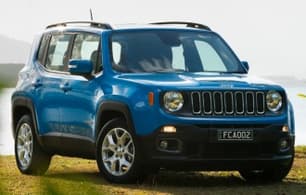
Jeep's Renegade might be late to the mini-SUV party but it comes with a pretty impressive back catalogue to suggest that this is a SUV that can cash the cheques its name can write.
The top of the range Trailhawk can write even bigger cheques than the lower models, bringing with it a range of off-road tech toys to let you really get down and dirty.
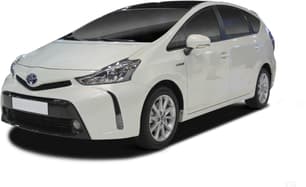
I could use three words to describe this car: Toyota, family, hybrid… A fourth word comes to mind, which begins with 'b' and ends in 'oring'…
That might seem harsh, but this isn’t what I’d describe as an aspirational purchase. If you do aspire to a Prius V, though, you’re probably either a hardcore Toyota fan, someone who has a large family, or someone who likes hybrids.
But then again, if you are a potential Toyota Prius V buyer, you could also be one of the smarter examples of our species. While only about 3000 Aussies have chosen a Prius V since it went on sale in 2012, it’s a very, very clever option for family buyers who want to do their bit for the environment, not to mention their own hip pocket.
The Prius V is the most affordable seven-seat hybrid vehicle on the market, and in terms of price, it competes with mainstream models like the Honda CR-V, Mitsubishi Outlander and Nissan X-Trail. But what about space? Practicality? Performance? Let’s take a deeper look, shall we?
Rugged, dependable and good off-road are the most obvious qualities of the Trailhawk. It stands out from the rest of the mini-SUVs by being able to do the S and the U with plenty of vigour.
It's just a shame that its on-road manners can't match that of its big brother, the Cherokee. Unless you're planning on proper off-roading, the Trailhawk might not be quite what you're looking for.
No, the Prius V isn’t exciting. But it does what it’s designed to do - move families in decent comfort without using much fuel. And if that’s what gets your (hybrid) motor running, then you really ought to take a closer look.
In what is absolutely not a coincidence, the Renegade immediately conjures up the Wrangler. Upright grille from the Willys Jeep (references abound here), round headlights, squared off wheel arches to mimic the Wrangler's guards, short overhangs and big rear view mirrors.
The 17-inch wheels look completely lost in the wheelarches which are even more cavernous owing to the Trailhawk's 50mm of extra ride height. The wheels are also a bit cheap looking but will probably survive the belting the car is intended to take.
Less rugged is the interior, despite a fairly self-conscious effort to make it look and feel chunky. The front seats are flat and unsupportive with the rears just as lacklustre making sure everyone is sliding around together. Luckily, front passengers get a dash-mounted grab handle.
It seems quite well put together, however, but with carpets and easily-marked plastics, you'll hope your passengers don't bring the mud in with them too often. And the "Since 1941" stamped into the steering wheel can go.
The dashboard is reasonably clear and has plenty of information to share via the screen between the dials but whoever thought marking the redline with a water splash graphic in bright orange should probably rethink their design decisions.
Storage is limited to two cupholders up front, door pockets in each door and nets on the front seat backs.
The world was a different place when the Toyota Prius V came out. Back then, the iPhone 4s was at the cutting-edge in phone design, Gangnam Style was smashing it on the charts, and car design was in a very different place.
There are some signature Prius elements, with a swept, aerodynamic looking roofline and sleek front-end styling. The facelift that was applied to the Prius V in 2015 saw sharper lines and more aggression, but it arguably doesn’t have a lot of aesthetic appeal given the way Toyota has evolved its design since then.
It isn’t a traditional people-mover, because it has regular doors at the back rather than sliding doors to allow simple access to the third-row seats. It’s more like a hatchback that’s been stung by a bee, looking a bit bloated. But as one pint-sized tester put it this week, it’s one very big little car.
The inside is a bit of a marvel in terms of space management. This car measures just 25mm longer than a Corolla sedan (4645mm long), and it's only 1775mm wide (the same as a Corolla sedan) and 1590mm tall, because it needs a bit more room to fit seven people in. And it can.
The Renegade range starts at $28,000 for the 1.6-litre Renegade Sport manual front-wheel drive, climbing between $2000 and $3000 through the Sport Auto, Longitude Auto, Limited Auto with a final jump of $4000 to the 2.4-litre auto-only Trailhawk.
Standard is a nine-speaker stereo with Bluetooth and USB, 17-inch alloys, dual-zone climate control, reversing camera, rear parking sensors, keyless entry and start, cruise control, electric front seats with heating, satellite navigation, automatic bi-xenon headlights, auto wipers, leather trim, roof rails, front and middle bash plates, full size spare, heated leather steering wheel, privacy glass, trailer sway control and tyre pressure monitoring.
The lairy Omaha orange is $500, part of an eleven colour palette with only two no-cost paint options (black and white).
You can add lane departure warning, auto-parking and a black painted roof for $500 each, a removable and retractable roof called My Sky Roof for $2200 or a more conventional electric sunroof for $1900.
The Beats-branded nine-speaker stereo is run via Fiat-Chryser's UConnect system, accessible through the 6.5-inch touchscreen. While it improves with every attempt, it's still quite clunky and when the sat-nav is added, becomes a bit of a mess.
Thankfully, not every function has been crammed into the touchscreen interface, so you'll spend more time with your hands on the wheel rather than working out which bit of the screen has the climate control.
Not only is the Prius V the most affordable seven-seat hybrid car on the market, it’s also the cheapest Toyota with seven seats.
It undercuts the Tarago, Kluger and Land Cruiser Prado by a decent margin, with pricing starting at $37,590 for the base grade model and stretching to $45,380 for the top-of-two-tier i-Tech flagship. Should you bother spending up on that version? In short, no.
That’s because the regular Prius V has a pretty strong standard equipment list. Push-button start, keyless entry, sat nav with SUNA live traffic updates, a reversing camera, climate control and a head-up display are all standard. You also get 16-inch alloy wheels, which have a set of plastic wheel covers over the top (great for kerb touch-parkers).
The i-Tech sees the addition of Bi-LED headlights with auto-levelling (as opposed to the halogens with LED daytime running lights you see on the base model), plus fake leather seats (not cloth), heated front seats, a dual-pane panoramic glass roof (which doesn’t open), an auto-dimming rear-view mirror, and a semi-automated parking system.
Plus, whether you choose the entry grade or the high-spec, you get Toyota’s 'Safety Sense+' system - read the details in the safety section below.
Colour options for the Prius V are quite broad. There are nine rather sedate hues to choose from, with eight of them being 'premium colours' that attract an additional cost ($450).
And, as with most Toyota models, there is a range of additional factory-backed accessories that you can choose, such as a bonnet protector, boot scuff guard and even door handle protective film (to stop rings from scratching them up), but things like roof racks/roof rails or a roof pod are unavailable.
The Trailhawk is powered by Fiat's 2.4-litre four naturally-aspirated four-cylinder producing 129 kW and 230 Nm. Jeep reckons you'll get 7.5L/100km on the combined cycle. Our mostly city driving with a longish motorway run produced an 11.0L/100km average over a week.
The transmission is a nine-speed ZF automatic driving all four wheels.
The Trailhawk also has Jeep's five mode Selec-Terrain system which should cover pretty much every eventuality – Auto, Sport, Mud, Sand and, just for the Trailhawk, Rock. The Trailhawk is rated to tow 400kg unbraked and 907kg braked.
Powering the Prius V is a 1.8-litre four-cylinder engine, which uses a CVT auto and combines with a lithium-ion battery pack and two electric motors. It’s what’s known as a series parallel hybrid set-up.
The system can allow the car to run using both the battery and engine, or just the battery, or have the regenerative braking system feed the battery pack more juice. That tech isn’t necessarily cutting edge today, but it was when the car launched (waaaaay back in 2012).
The engine can produce 100kW of power and 142Nm of torque. The electric motor can produce 73kW on its own, but the maximum combined power output is still 100kW.
The Trailhawk name suggest that things are going to get muddy – compared to the rest of the range, the range-topper rides 50mm higher and has exposed, easy-to-reach tow hooks in the fairly unlikely event you get stuck. It also has a 20:1 low-range crawl ratio and Active Drive 4x4 which means it can switch between front and all-wheel drive. It'll also wade through almost half a metre of water. It's a genuine mud-plugging proposition and will take on some much bigger machinery out in the bush.
On the road, where we spent all our time in the Renegade, it's not what you'd call particularly inspiring. There's a number of sources of noise that contribute to a less than quiet cabin and having to constantly correct your course at freeway speeds adds to the tiring nature of the Renegade.
It's much better at lower speeds, pottering around but then again, its nine-speed transmission needs a lot more work on the shift mapping because it seems to forget which gear it needs to be in when you sink the right foot. If you don't need the Trailhawk's extra off-road goodies, consider the 1.4 litre Limited or Longitude.
If you’re a car geek like me, you likely find driving as efficiently as you can fun. If so, you'll love this. You can watch the car switching between EV mode - which it will use for up to about 30km/h, but only for a couple of minutes - and hybrid power. And honestly, if you’ve never driven a hybrid you might think it sounds dumb, but being a fuel miser can be fun!
But the fun factor is pretty much limited to being a cheapskate on fuel. It really isn’t that fun to drive otherwise, but that’s not what it’s designed for.
Still, the drivetrain does a decent enough job for most families - it builds pace pretty easily, and while the refinement and power could be better, if you’re not aiming to break records on the school run, you shouldn’t be too disappointed.
The ride is mostly good, though it can be a little sharp over patchy surfaces, and the steering is decent, if a little lifeless. My biggest issue is the brake pedal response, which takes some getting used to. Sometimes it feels like it won’t stop quick enough.
That, and the adaptive cruise control doesn’t slow to a stop on the highway - it cuts out at about 30km/h, so you’ve gotta be on your toes if the traffic starts to build up.
If you want the latest and greatest in hybrid family friendliness, you really ought to wait for the new-generation RAV4, which - admittedly - mightn’t have seven seats, but it will have a hybrid drivetrain offered. And it’ll be much more modern inside and out.
Seven airbags (including driver's knee bag), traction and stability controls, roll mitigation, blind spot monitoring, ABS and brake assist.
The Renegade does not yet have an ANCAP star rating although it scored five EuroNCAP stars in 2014.
Every Prius V still carries the same maximum five-star ANCAP safety rating that it was stamped with in 2015, even though the car was actually tested in 2012.
The range is covered with the safety systems you’d expect, including electronic stability control, ABS, electronic brake distribution, plus there’s a reversing camera, too. Rear parking sensors are a dealer-fit accessory.
There was a bit of back-and-forth between myself and Toyota Australia over airbag coverage. The company stated on its public site that the car had curtain airbag coverage all the way to the third row, but no image to support that. I’ve since had it confirmed by Toyota Australia that it does definitely have third-row airbag coverage, which is a great added piece of mind element for family buyers (plus there are dual front, driver knee and front side airbags, too).
Airbags are one thing, but what about the other safety kit? Well, every Prius V has Toyota’s Safety Sense plus system, with auto emergency braking (AEB), pedestrian detection, adaptive cruise control, auto high beam lights and lane-departure warning.