What's the difference?
Jeep's Renegade might be late to the mini-SUV party but it comes with a pretty impressive back catalogue to suggest that this is a SUV that can cash the cheques its name can write.
The top of the range Trailhawk can write even bigger cheques than the lower models, bringing with it a range of off-road tech toys to let you really get down and dirty.
For 15 years the Mitsubishi ASX has been one of the most popular SUVs in Australia. Well into its life cycle, it maintained strong sales thanks to keen pricing and a reputation for reliability.
The second-generation ASX is finally here, but it’s a very different proposition to the original.
For starters, the new model is a twin of French brand Renault’s Captur small SUV. That model is not currently sold here, so Mitsubishi has clear air, for now.
Secondly, it’s no longer cheap. Pricing puts this new model into the high-$30,000 section of the segment, but it also gains modern tech and specs.
Whether buyers care that the ASX has gone upmarket remains to be seen. But we attended the Australian launch to see if French flair has improved the ASX formula.
Rugged, dependable and good off-road are the most obvious qualities of the Trailhawk. It stands out from the rest of the mini-SUVs by being able to do the S and the U with plenty of vigour.
It's just a shame that its on-road manners can't match that of its big brother, the Cherokee. Unless you're planning on proper off-roading, the Trailhawk might not be quite what you're looking for.
There is no question the new ASX is a much better car to drive than the model it replaces. This one is actually fun behind the wheel. The tech represents a massive upgrade, so too does the interior design and practicality. The fact is, it’s a much more expensive car than the old ASX. It is a European built and designed small SUV with loads more tech and features so when you consider that, the pricing makes more sense.
Regardless of the previous model, this new ASX impresses. It’s not perfect - the LS is missing too many items, no hybrid, slightly firm ride - but it’s now a genuine rival for higher quality rivals in the small SUV segment. If the ASX is in your price bracket, it might be time to add it to the consideration list.
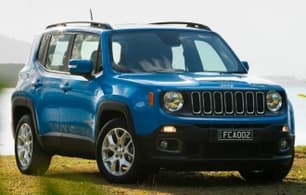
In what is absolutely not a coincidence, the Renegade immediately conjures up the Wrangler. Upright grille from the Willys Jeep (references abound here), round headlights, squared off wheel arches to mimic the Wrangler's guards, short overhangs and big rear view mirrors.
The 17-inch wheels look completely lost in the wheelarches which are even more cavernous owing to the Trailhawk's 50mm of extra ride height. The wheels are also a bit cheap looking but will probably survive the belting the car is intended to take.
Less rugged is the interior, despite a fairly self-conscious effort to make it look and feel chunky. The front seats are flat and unsupportive with the rears just as lacklustre making sure everyone is sliding around together. Luckily, front passengers get a dash-mounted grab handle.
It seems quite well put together, however, but with carpets and easily-marked plastics, you'll hope your passengers don't bring the mud in with them too often. And the "Since 1941" stamped into the steering wheel can go.
The dashboard is reasonably clear and has plenty of information to share via the screen between the dials but whoever thought marking the redline with a water splash graphic in bright orange should probably rethink their design decisions.
Storage is limited to two cupholders up front, door pockets in each door and nets on the front seat backs.
The look of the new ASX is not a huge surprise given it’s based on the second-generation Renault Captur that launched in 2021. Actually the ASX we get is the mid-life facelift for the ASX/Captur twins in Europe, so the design has been refreshed.
At 4238mm long, 1797mm wide, 1585mm tall and with a 2639mm wheelbase, the new ASX is 127mm shorter, 13mm narrower, and 55mm lower than the original, but the wheelbase is only 31mm shorter.
It has a round almost bubble like quality to the exterior design, and not in a bad way. The redesigned front end has Mitsubishi flavour thanks to the ‘Dynamic Shield’ front-end signature, while the sleek headlights and black and chrome grille give off an almost menacing look.
C-shaped tail-lights at the rear flank a massive ‘Mitsubishi’ badge and the lower cladding ensure there’s no doubt this is an SUV.
It’s a handsome car and should get some attention on the road.
Inside, it’s not the last word on interior design, but it’s well laid out and functional. It’s definitely another massive leap over the old model.
At the launch there were no LS grades to drive, but the Aspire comes with cool grey cloth trim and roofliner that adds a nice contrast to the darker plastics and finishes. It’s more vibrant than the top-spec Exceed which has an all-black interior with leather-appointed seats.
The top two grades feature a floating console where the gear shifter is housed (a standard shifter in LS, and notch-like ‘eShifter’ in Aspire and Exceed), while the big multimedia screen dominates the dash.
The Renegade range starts at $28,000 for the 1.6-litre Renegade Sport manual front-wheel drive, climbing between $2000 and $3000 through the Sport Auto, Longitude Auto, Limited Auto with a final jump of $4000 to the 2.4-litre auto-only Trailhawk.
Standard is a nine-speaker stereo with Bluetooth and USB, 17-inch alloys, dual-zone climate control, reversing camera, rear parking sensors, keyless entry and start, cruise control, electric front seats with heating, satellite navigation, automatic bi-xenon headlights, auto wipers, leather trim, roof rails, front and middle bash plates, full size spare, heated leather steering wheel, privacy glass, trailer sway control and tyre pressure monitoring.
The lairy Omaha orange is $500, part of an eleven colour palette with only two no-cost paint options (black and white).
You can add lane departure warning, auto-parking and a black painted roof for $500 each, a removable and retractable roof called My Sky Roof for $2200 or a more conventional electric sunroof for $1900.
The Beats-branded nine-speaker stereo is run via Fiat-Chryser's UConnect system, accessible through the 6.5-inch touchscreen. While it improves with every attempt, it's still quite clunky and when the sat-nav is added, becomes a bit of a mess.
Thankfully, not every function has been crammed into the touchscreen interface, so you'll spend more time with your hands on the wheel rather than working out which bit of the screen has the climate control.
So, let’s get straight to the big news. This new ASX has gone up in price in a big way. The previous entry point was a touch under $27,000 before on-road costs for the GS auto.
The new model now starts at $37,740 BOC, which is about the same price as the flagship grade of the previous-generation ASX.
There are three grades - LS, Aspire and Exceed. Like for like the LS is $7K dearer than the old LS. The Aspire is $42,690 and the Exceed tops out at $46,490.
Yes, this is a significant change in price and positioning for the ASX. But the only relationship this car has to the previous model is its name. If Mitsubishi gave it a different name, the pricing announcement may not have attracted so much attention.
This pricing shifts the Spanish-built ASX into a new sub-section of the mainstream small SUV segment, away from other cheapies like the Suzuki Vitara, MG ZS and GWM Haval Jolion. It’s now closer to the likes of the Honda HR-V, Nissan Qashqai and Subaru Crosstrek.
The previous model was dated in every area, but it really lagged when it comes to in-car and safety tech. This new model addresses that.
In terms of standard gear, the list is decent without being jaw dropping.
The LS comes with a 10.4-inch multimedia screen with wireless Apple CarPlay and Android Auto, DAB digital radio, Bluetooth, six-speaker audio, digital driver display, two USB-C ports, proximity key, keyless entry and start, single-zone climate control, power and heated door mirrors, cloth seats and 17-inch alloy wheels.
Aspire and up gain the Google built-in platform that includes integrated Google Maps, Play and Assistant, as well as in-house sat-nav, three drive modes (Comfort, Sport, Perso), auto-dimming rear-view mirror, wireless device charger, privacy glass, 18-inch alloy wheels and power-folding mirrors.
The flagship Exceed adds a panoramic sunroof, two-tone paint, leather-appointed seats, heated front seats and power adjust for the driver’s seat.
There are no options aside from accessories.
The Trailhawk is powered by Fiat's 2.4-litre four naturally-aspirated four-cylinder producing 129 kW and 230 Nm. Jeep reckons you'll get 7.5L/100km on the combined cycle. Our mostly city driving with a longish motorway run produced an 11.0L/100km average over a week.
The transmission is a nine-speed ZF automatic driving all four wheels.
The Trailhawk also has Jeep's five mode Selec-Terrain system which should cover pretty much every eventuality – Auto, Sport, Mud, Sand and, just for the Trailhawk, Rock. The Trailhawk is rated to tow 400kg unbraked and 907kg braked.
For now, all grades of the new ASX use the same 1.3-litre four-cylinder turbocharged petrol engine offering up 113kW of power and 270Nm of torque. That’s up on the old 2.0-litre naturally aspirated unit’s 110kW/197Nm.
This is paired with a seven-speed dual-clutch transmission driving the front wheels only, so there’s no all-wheel-drive version.
Mitsubishi is looking into the mild hybrid and full hybrid versions that are offered in Europe but not confirmation on those as yet.
The Trailhawk name suggest that things are going to get muddy – compared to the rest of the range, the range-topper rides 50mm higher and has exposed, easy-to-reach tow hooks in the fairly unlikely event you get stuck. It also has a 20:1 low-range crawl ratio and Active Drive 4x4 which means it can switch between front and all-wheel drive. It'll also wade through almost half a metre of water. It's a genuine mud-plugging proposition and will take on some much bigger machinery out in the bush.
On the road, where we spent all our time in the Renegade, it's not what you'd call particularly inspiring. There's a number of sources of noise that contribute to a less than quiet cabin and having to constantly correct your course at freeway speeds adds to the tiring nature of the Renegade.
It's much better at lower speeds, pottering around but then again, its nine-speed transmission needs a lot more work on the shift mapping because it seems to forget which gear it needs to be in when you sink the right foot. If you don't need the Trailhawk's extra off-road goodies, consider the 1.4 litre Limited or Longitude.
Look, it’s fair to say the original ASX was not a driver’s car. Reliable? Yes. Spacious? Absolutely. Great value? You bet. But fun to drive? Not so much.
So it’s good news then that the new-gen ASX is much more engaging to drive. I quite enjoyed the current-gen Renault Captur the last time I drove it, and the underpinnings of the ASX are the facelifted version of that Captur.
The 1.3-litre turbo-petrol unit might not be ultra quick off the mark, but it is sprightly and really comes alive when you’re at speed. It also has a decent engine note.
I've recently driven another Renault model with basically the same powertrain but it suffered from dreadful lag - a combination of a turbocharger and a dual-clutch transmission.
I had expected the same of the ASX, but there’s little lag to speak of. And the transmission is much smoother in this application. It doesn’t hold gears or do anything DCTs are known for, which is a lovely surprise.
Steering is sharp enough and the feel can be adjusted in the settings. Aspire and Exceed grades come with Comfort, Sport and Perso mode, which is for personalisation.
Ride quality is fine on smooth roads but big pot holes and other bumps are felt in the cabin. It is a European car, so no surprise that it’s been tuned for a more European experience. It’s not so firm it’ll dampen the drive experience, but it could be a touch more supple.
On that, the ASX has not undergone a local ride and handling tuning program like the one its larger Outlander stablemate has benefited from.
That doesn’t mean you can’t have fun in the ASX - you can. It handles high-speed bends on country roads surprisingly well, with more grip than you’d expect. There’s a little body roll but nothing dramatic.
More time behind the wheel is needed, but the tight chassis means the ASX likes a corner.
The cabin has better insulation than the outgoing model but it’s still not the most hushed small SUV money can buy. But it’s another element that’s far from a dealbreaker.
Seven airbags (including driver's knee bag), traction and stability controls, roll mitigation, blind spot monitoring, ABS and brake assist.
The Renegade does not yet have an ANCAP star rating although it scored five EuroNCAP stars in 2014.
The new ASX is yet to be assessed for crash safety by ANCAP, but Mitsubishi is anticipating a four-star rating to match its European score.
It comes with six airbags, but no front centre bag for side collisions. It also gets a reversing camera and front parking sensors.
All the expected advanced driver assistance systems (ADAS) are present like auto emergency braking, lane departure warning and prevention, emergency lane assist, traffic sign recognition and a less invasive driver attention alert than is found in some of Mitsubishi’s other models.
The base LS misses out on features like blind-spot warning, rear cross-traffic alert, and adaptive cruise control (it has old-school cruise control) as well as front parking sensors. At least some of these could have been standard.
One neat feature is the personalised driver profile that allows you to determine what ADAS features you want active each time you get behind the wheel.
The launch cars we drove were missing an ADAS feature that will be included on all customer cars, so we will reserve judgement on the effectiveness of the safety suite. However, it doesn’t appear that they are too overzealous.