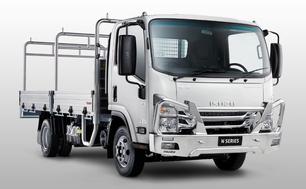
What's the difference?
The dual-cab ute market and light truck market are potentially two very different landscapes.
While the dual-cab continues to storm the sales charts in Australia, there’s also a growing awareness among hardcore users of these vehicles, that a light truck might often be a better solution.
Better payloads and higher Gross Combination Mass ratings in an age of increasing legal and insurance concerns over overloaded vehicles, were once the light truck’s strong suit. But these days, vehicles like the full-sized US-made pick-ups and even the muscled-up Ford Ranger Super Duty have bridged or even exceeded that gap.
At which point, the light-truck’s benefits become the ease with which it can take on heavier jobs and the sheer size of the cargo and cabin area, not to mention those truck-specific qualities born of generations of refining a concept.
In Australia, it’s Isuzu that absolutely brains the opposition in sales terms. And part of the reason for that has been a realisation that not all would-be buyers want the hassle of the traditional truck-buying process of purchasing a bare chassis and then equipping it so suit their needs.
Which is where Isuzu’s RTW (ready To Work) concept comes in. You simply choose the truck you want, choose a tray, van or service body and then let Isuzu deal with it and phone you when it’s ready to collect.
It's so simple, it’s a wonder not everybody is doing it.
The other news is that Isuzu has finally updated its popular N Series fleet after about 16 years. A new cabin, extensive chassis changes, uprated engines, and all-new transmission, improved suspension and a new focus on safety are all headlines. But 16 years is a long time between drinks, so do the improvements make enough of a difference to keep the concept relevant in a changing market?
The idea of a Tesla that can tow sounds about as likely as an astrophysicist with three Olympic gold medals, who also moonlights as a hand model.
The EV brand has blazed a trail for every other mainstream and premium car manufacturer to jump on the electric bandwagon, and today they’ve still got the biggest batteries and most impressive range ratings, while also having the most extensive extensive network of charge stations made up of Superchargers and destination chargers, covering every state and territory.
They’re not perfect though, often displaying niggling build quality issues and production delays for upcoming models. There’s also a degree of uncertainty bred by a founder who flits between the modern-day space race, manufacturing flame throwers and offering to send miniature submarines to rescue stranded children.
But there’s no questioning the overall impact Tesla has had on the automotive industry, along with the incredible brand awareness and aspiration it’s generated from non-enthusiast Joe Average consumers around the world.
The Model X is also rated to tow, with a decent 2250kg braked rating and an integrated tow bar that folds out of sight when not in use, which both fits its SUV character and encourages you to give it a go.
A truck like the NPR (or any other truck, really) is never going to replace a dual-cab ute in terms of its duality. While the latter can tend to weekday chores and be quickly reconfigured for weekend fun, the light truck has no such facility. Nope, it’s a workhorse. Period.
You need a fair bit of real estate just to park the Isuzu overnight and it certainly won’t fit in the typical supermarket car space. It’s hardly sporty to drive, either, although the latest upgrades have made it more user friendly in a total sense and safer than ever before.
But what it does do that a dual-cab ute can’t often do, is tackle bigger, heavier jobs with a fair bit of bandwidth still up its sleeve. And if the nine-to-five side of things is where you need to be, then a vehicle like this has to be worth a look. And if you consistently find that you’re sailing close to the wind in terms of exceeding a ute’s legal payload, towing capacity or GCM, then the extra bigness of a light truck could make a huge difference.
That’s especially so given the price tag. Okay, you’re not buying a lot of high tech for your money, but you are getting some seriously stout engineering and an expectation that you won’t be working the thing to death anytime soon.
Note: CarsGuide attended this event as a guest of the manufacturer, with meals provided.
After nearly 700km of testing with both cars, it’s fair to say that the Tesla is indeed a capable tow vehicle, provided you keep the distances relatively short and plan around charge station locations.
Overall average - Penrith to Bathurst to Penrith
Fuel and energy consumption will always depend on the driving conditions, which is why we chose different routes for each leg of our testing.
Averaged across the two legs, towing the caravan with the Model X used 101 per cent more energy than without, or halved its driving range, which sounds a bit scary.
The LandCruiser by comparison added 63 per cent on average, which is still a big difference, but matters less in the real world when its big fuel tanks would still give you about 760km of driving range, which can be refilled quickly at any diesel-stocked servo.
So you could do a weekend trip with the caravan from Penrith with one supercharge in Bathurst, but it would’ve been highly unlikely to manage the extra 55km if you were leaving from Sydney CBD.
The bottom line is that there’s plenty of things - like smaller camper trailers - lighter than our caravan that will help the Tesla to do the towing job better right now.
Compared to the ‘Cruiser, the Tesla is a lesson in the benefits of a lower centre of gravity and road-focused handling.
As always, bigger batteries and more recharge points will go a long way to rectifying the Tesla’s towing shortcomings, and I'm sure we'll get there eventually.
But no matter what, its acceleration performance under load is simply excellent.
Thanks to our friends at Avida for making this test possible with the use of the 17-foot Avida Wave Tourer Electric Pop-Top single-axle caravan. They can also be reached on 1300 428 432.
Actually climbing aboard the Isuzu is job one, and you’ll need the handles and step to do it safely. Then again, it’s probably no more testing than getting into a really low sports car in a degree of difficulty sense.
With that accomplished, you’re met with two things; the view out and the very un-car-like driving position. The first is fantastic for forward vision. And it’s not just the height advantage over other traffic. The cab-over-engine layout also means you’re almost at the very front of the truck, meaning you can see a lot more of what’s directly in front of you, even if it’s almost under your nose. Jumping back into a dual-cab ute for comparison emphasises the point enormously.
The driving position, meanwhile, might take more getting used to. The steering wheel is almost flat and you tend to sit pretty upright. Long-distance drivers will tell you this is actually great for long stints at the helm, and it honestly feels pretty natural after just a few minutes. But the steering column placement means there’s no chance of left-foot braking which some drivers (this one included) prefer.
Once you’re rolling, the dual-clutch transmission starts to feel pretty handy with short, sharp upshifts and a calibration that sees it keen to downshift on deceleration to help balance the vehicle, take the stress off the brakes and ensure that the engine is in its power band for when you next throttle on.
Speaking of which, the engine is not exactly overpowering, but it does produce the meat of its muscle in the right places, helped no end by having nine ratios to play with. And here’s an interesting point: The way the engine is installed in the NPR – and despite the fact that you’re sitting pretty much right on top of it – there’s less noise and vibration from the 3.0-litre than in an Isuzu D-Max ute. Obviously, low vibrations and less noise are factors in staving off driver fatigue, and clearly Isuzu knows how to achieve this.
Ride quality will vary hugely depending on what’s on board. We tried the NPR with a full load of gear on the tray, taking it almost to its payload limit. At that point, the ride was actually quite compliant, and the only odd sensation is that of having your backside right over the front axle.
The other mantra held dear by fleet managers is that the best way to reduce breakdowns is to take the driver out of the equation as much as possible. That explains the dual-clutch transmission, for one, but it also perhaps explains why the NPR is set up to be actually very easy and simple to drive. It’s definitely scarier to look at than to pilot. And that turning circle is something else!
Energy consumption is just one element of a tow vehicle though, with stability, braking and acceleration performance being the most important details.
The big ‘Cruiser is always a safe bet for towing heavy loads, but it's fair to say its off-road ability, tall body and short wheelbase mean it could be better on the road, and the Tesla goes some way to proving that.
With all those batteries mounted nice and low, the Tesla is significantly more stable with 1.7 tonnes on the back than the LandCruiser, in all conditions. It’s also helped by that longer wheelbase.
The Tesla’s airbag suspension is another surprise advantage, and while it can be a bit choppy around town over minor bumps, bigger bumps on the highway are soaked up really nicely and it all settles quicker than with the LandCruiser - even with the caravan on the back.
Tesla is famous for instant acceleration at any speed, and this effect remains when towing. The LandCruiser’s twin-turbo V8 (with max torque available from 1600-2600rpm) has long been a benchmark for tow vehicles, but the Model X makes it feel sluggish by comparison.
You know how caravan vehicles are usually the slow ones up hills? This time, we were the ones doing the overtaking, even up the steep bends heading out of Lithgow. To overtake, it just takes the slightest flex of your right foot.
Clearly there’s a big caveat though when it comes to how much energy it’s consuming while you’re enjoying that performance, and it’s deceptive because it doesn’t make any more noise like a conventional engine when you’re pushing it.
You’d also think the weight of the van would overcome the engine-braking effect of the regenerative brakes, but they are still very effective at conserving your brakes downhill and preventing the car from running away from you, and no doubt giving the batteries a bigger boost at the same time.
On that note, the LandCruiser’s cruise control also does a great job of witholding speed on downhill runs, proactively dropping gears to engine brake enough to keep the Avida Wave in check.