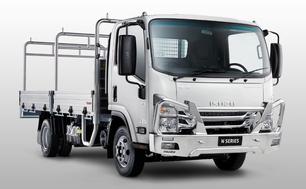
What's the difference?
The dual-cab ute market and light truck market are potentially two very different landscapes.
While the dual-cab continues to storm the sales charts in Australia, there’s also a growing awareness among hardcore users of these vehicles, that a light truck might often be a better solution.
Better payloads and higher Gross Combination Mass ratings in an age of increasing legal and insurance concerns over overloaded vehicles, were once the light truck’s strong suit. But these days, vehicles like the full-sized US-made pick-ups and even the muscled-up Ford Ranger Super Duty have bridged or even exceeded that gap.
At which point, the light-truck’s benefits become the ease with which it can take on heavier jobs and the sheer size of the cargo and cabin area, not to mention those truck-specific qualities born of generations of refining a concept.
In Australia, it’s Isuzu that absolutely brains the opposition in sales terms. And part of the reason for that has been a realisation that not all would-be buyers want the hassle of the traditional truck-buying process of purchasing a bare chassis and then equipping it so suit their needs.
Which is where Isuzu’s RTW (ready To Work) concept comes in. You simply choose the truck you want, choose a tray, van or service body and then let Isuzu deal with it and phone you when it’s ready to collect.
It's so simple, it’s a wonder not everybody is doing it.
The other news is that Isuzu has finally updated its popular N Series fleet after about 16 years. A new cabin, extensive chassis changes, uprated engines, and all-new transmission, improved suspension and a new focus on safety are all headlines. But 16 years is a long time between drinks, so do the improvements make enough of a difference to keep the concept relevant in a changing market?
Finding a half-decent small SUV for less than $30,000 has become quite challenging in the past couple of years. But as mainstream brands march further upmarket, some Chinese manufacturers are happy to grab sales at the lower end of the market.
One such brand, Chery, re-emerged with the Omoda 5 compact crossover about 18 months ago with keen pricing and loads of standard features.
Further pushing the value point, Chery recently added a new base grade of the Omoda 5, the FX. It sits under the Omoda 5 BX and EX with the same powertrain and it only loses a handful of features from the BX.
At $27,000 drive-away, it looks like a steal on paper. But how does the new cut-price Omoda 5 handle urban duties? And does this small SUV offer more than just a solid standard features list?
A truck like the NPR (or any other truck, really) is never going to replace a dual-cab ute in terms of its duality. While the latter can tend to weekday chores and be quickly reconfigured for weekend fun, the light truck has no such facility. Nope, it’s a workhorse. Period.
You need a fair bit of real estate just to park the Isuzu overnight and it certainly won’t fit in the typical supermarket car space. It’s hardly sporty to drive, either, although the latest upgrades have made it more user friendly in a total sense and safer than ever before.
But what it does do that a dual-cab ute can’t often do, is tackle bigger, heavier jobs with a fair bit of bandwidth still up its sleeve. And if the nine-to-five side of things is where you need to be, then a vehicle like this has to be worth a look. And if you consistently find that you’re sailing close to the wind in terms of exceeding a ute’s legal payload, towing capacity or GCM, then the extra bigness of a light truck could make a huge difference.
That’s especially so given the price tag. Okay, you’re not buying a lot of high tech for your money, but you are getting some seriously stout engineering and an expectation that you won’t be working the thing to death anytime soon.
Note: CarsGuide attended this event as a guest of the manufacturer, with meals provided.
There’s little argument that Chery is focusing on value-for-money when it comes to its model range, and that’s absolutely the case with its new range opener - the Omoda 5 FX.
The spacious, flexible and neat cabin also get a tick.
Purely looking at this car on paper, it is hard to beat for $27,000 drive-away. And if you stick exclusively to urban areas without hitting the open road, you might be happy with your purchase.
However, the overall drive experience, including the behaviour of the advanced driver assistance tech, is well off the pace of mainstream rivals from Hyundai, Kia, Mazda, VW and more.
If that price is too good to look past, then be sure to do back-to-back test drives with other similarly priced rivals to compare.