What's the difference?
This is the baby SUV for Hyundai’s line-up but it does tend to remind you of this a little too often for this to truly be fun.
Still, it presents an interesting road-side presence and a comfortable urban driving experience.
Coupled with the competitive price tag, is this the little SUV that could? I’ve been driving it for the last week to find that out for you.
The Volkswagen T-Cross is the smallest SUV in the brand’s entire range, but it’s incredibly practical, great to drive and has an excellent level of safety.
It’s just been updated with some new features and it’s probably more affordable than you think.
So if you are thinking of a Mazda CX-3 or a Toyota Yaris Cross, then put the T-Cross on your list to check out, too.
The Hyundai Venue Elite is a sweet-looking, compact SUV that should suit drivers who only need an A-to-B sort of car in the city. Or an empty nester who doesn’t want to feel flustered by any high-end tech and wants knobs and dials where they expect them to be.
Some elements of the safety set could be better though and that’s something to consider. However, for an urban landscape, you can practically fit it anywhere. With its engine specs, it's also happiest in the city - don't consider this a road trip car.
There are so many new little SUVs out there and it might be easy to think they’re all the same - a tiny cheap SUV is just a tiny cheap SUV. But I’m convinced the Volkswagen T-Cross isn’t like the others.
Yes, it’s tiny and relatively cheap, but it can do more than most of the others from the storage and space it offers to the value-for-money and its level of refinement. Then there’s the way it drives - which can’t in my books be matched by any of its rivals.
The sweet spot in the range is the entry grade Life. At $35K drive-away the value is best and with no difference in engines between the grades there are no huge reasons to step up higher in the range unless you have the money.
Note: CarsGuide attended this event as a guest of the manufacturer, with travel, accommodation and meals provided.
Cute is the adjective that comes to mind when you look at the Venue’s compact styling. And it is compact with its wee 4040mm length. The benefits of its dimensions means that you should be able to tuck this away in most garages or apartment car spots!
The Venue does have a boxier shape than I ordinarily like but because it’s small, it manages to get away with it and still feel sharp.
Our model’s paintwork and roof colour has been finished in Atlas White but you can customise the Venue with a two-tone roof job (either black or white, depending on main body colour), to add some more personality.
You just lose the sunroof with that option, which I actually think adds a lot of oomph to the interior and stops it from looking too plain inside.
Speaking of, the interior is pleasing but simplistic. There are a lot of traditional design elements from the gear shifter and handbrake to the easy-to-access buttons and dials. This is a no-fuss interior that is banking on having a no-fuss sort of driver.
There is some cool cred with the white painted metal accents around the air vents and gear shifter. Plus, the contrasting piping and stitching on the cloth seats adds some fun, too.
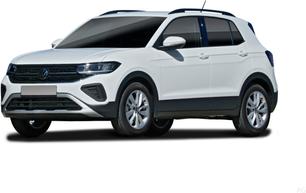
The T-Cross is Volkswagen’s smallest SUV at 4.1m long and even though it’s closely related to the little Polo hatchback it looks more like a mini version of the Tiguan.
It might be tiny and relatively affordable but it has Volkswagen’s premium looks and sharp styling, with creases in the panels so crisp it looks like somebody just ironed it.
This update has brought new front and rear bumper designs, and new styling to the LED running lights and tail-lights. That’s typically how car companies do exterior design updates, inside the styling changes are pretty minimal, too.
There’s new dashboard design and new media screen, but again the design and quality feels refined and high quality, which I can't say goes for a lot of this car's rivals.
The entry-grade Life misses out on the cross design tail-lights of the Style and R-Line, and gets hubcaps rather than alloy wheels like the other two grades.
It ain't a people mover. Period.
If you plan on having regular passengers and they’re tall, look elsewhere because they won’t find much comfort (especially in the back seat).
On the back seat, I barely fit with my 168cm (5’6”) height and had to accommodate my driving position by spreading the ol’ knees apart. So ladylike.
However, kudos to the clever high roofline because headroom isn’t an issue. The 170mm ground clearance also makes this a super easy car to get in and out of.
Front passengers definitely enjoy the most room and amenities but you will be jostling for the premium position on the armrest. The storage is good for this size SUV with a glovebox, middle console, two cupholders and a cute little storage shelf in front of the passenger.
There’s also a dedicated phone tray that has the wireless charging pad, a USB-A and C port plus a 12-volt port too.
The tech is simple to use and it was easy to get my iPhone connected to the Bluetooth and wired Apple CarPlay (there’s Android Auto, too for those users). The new-for-2023 4.2-inch digital instrument panel adds some pizzazz but unfortunately, isn’t customisable.
The boot is a solid size for this class at 355L. You can adjust the floor to sit a little lower and there is a space-saver spare tyre.
No Venue grade has a powered tailgate but honestly, you don’t need it.
You really should take a look at my video to get an idea of how good space and storage is in the T-Cross. I’m tall at 189cm but I can drive with plenty of elbow room and legroom. The front seats also have really long bases which offer great under-thigh support, too.
Legroom in the back is great for the class and I can sit behind my driving position without my knees touching the seatback, while headroom is excellent, too. The second row also slides on rails to increase the boot side which is enormous for the class at 455L.
The second row doors also have large apertures making entry and exit easier.
Cabin storage is great with giant door pockets in the front and back, a wireless phone charger with four USB-C ports (two in the front and two in the second row).
Even though the Elite is the top model for the Venue line-up, it’s just $28,500 before on-road costs.
That puts it on par with the Mazda CX-3 in Maxx Sport guise, but about $4500 cheaper than the Toyota Yaris Cross Urban.
The Elite has an okay spec sheet but is a few items short of feeling like a top model should.
For example, this has wired Apple CarPlay and Android Auto, whereas the lower grades enjoy wireless.
This is a common trait in Hyundai and Kia products due to a quirk with the vehicle architecture. It also just makes do with halogen headlights but they stand out against the rest of the LEDs on the road.
However, the other standard equipment for the Elite still makes it a competitive player, like the tilt and slide sunroof, 17-inch alloy wheels, temporary space-saver spare tyre, steering wheel-mounted controls, tilt and telescopic steering wheel, 8.0-inch touchscreen multimedia system and wireless charging pad.
There are three grades in the T-Cross line up, the entry level Life which lists for $33,990, the Style for $37,490 and at the top of the range is the R-Line for $40,990.
At the time of the launch of this updated T-Cross, Volkswagen was doing drive-away pricing of $34,990 for the Life, $39,990 for the Style and $43,990 for the R-Line.
Compared to rivals like the Mazda CX-3 and Toyota Yaris Cross, a drive-away price of $35K for the Life is excellent and $40K for the Style is also a good deal, especially when you look at the healthy standard features list.
Coming standard on the Life are LED headlights, black roof rails and power folding mirrors, there’s a leather steering wheel, a digital driver display (which is new, too), there’s an 8.0-inch media screen, wireless phone charging, air con, digital radio, Apple CarPlay and Android Auto.
Stepping up into the Style grade adds 17-inch alloys wheels, matrix LED headlights - those are new - chrome-look roof rails, an LED grille strip, proximity unlocking, dual-zone climate control, sat nav, and a new, larger digital driver display. The Style also gets the fancy 'cross' LED tail-lights like the R-Line grade above it.
The R-line is a new model sitting at the top of the line-up and it comes with sporty R-Line exterior styling plus 18-inch alloy wheels and dark tinted rear windows. Inside there’s R-line interior styling, 'Drive Modes' and a Beats sound system.
All Venue grades share the same engine – a 1.6-litre four-cylinder petrol drivetrain with a maximum output of 90kW and 151Nm of torque. Which sounds as gutless as it feels.
The six-speed auto transmission and under-powered engine can feel a bit rough on the open-road when you need to put your foot down.
Basically, you’re not going to do Daytona 500 in this. Think the odd bit of shopping, taking your small lap dog to get trimmed and going for a coffee with your friends.
The T-Cross has a 1.0-litre three-cylinder engine which sounds tiny and it is, but it's turbo-charged and the 85kW/200Nm it produces is plenty of grunt to move this little SUV which at just under 1.3 tonnes is relatively light.
All grades in the T-Cross line-up have this same engine and there’s no high-performance variant, although the R-Line has selectable drive modes. Every T-Cross is front-wheel drive with a seven-speed dual-clutch auto transmission.
This three-cylinder is a mighty little beastie with a growly tone to it. There is some turbo lag during stop-start city driving, but it’s so eager to play that if it was a dog it’d be a Jack Russell with every intention to chase anything it sees but no idea how small it is.
It earns back some points with the fuel efficiency, especially considering how hard you have to drive this to wring out its power.
The official combined fuel figure is 7.2L/100km and I achieved the same according to the trip computer. Not too shabby but there are hybrid versions for the Venue’s rivals now - like the Yaris Cross - so it would be good to see one for this as well.
It has a 45L fuel tank and based off the official combined figure, you should be able to get around a 625km driving range, which means you should be able to go a couple of weeks without filling up if you’re doing shorter commutes.
Smaller engines use less fuel than larger ones and the 1.0-litre three-cylinder in the T-Cross is little and Volkswagen says over a combination of open and urban roads it uses 5.6L/100km.
That’s fuel efficient but these days larger SUVs with hybrid systems are achieving the same low consumption. Toyota’s Yaris Cross is available with a hybrid system and will use about 3.8L/100km.
Volkswagen doesn’t have a hybrid version of the T-Cross, but it should, especially given these little cars will spend more time in urban environments where fuel consumption will generally be higher.
That said, most tiny SUVs don’t have hybrid systems so that makes the Yaris Cross exceptional while the T-Cross is about average.
This is an urban dweller for sure. It’s happiest going under 70km/h but it handles that range very well. You have enough kick to cross traffic without too much fuss and the steering feels direct.
Those feelings disappear on the open road where it’s a struggle to maintain your speed and the engine complains so loudly, I was nervous it was going to conk out.
The cabin also gets loud at higher speeds with wind and road noise, which just reaffirms that this is a city car. At lower speeds, it’s fairly quiet and you can chat without interruption.
There’s some roll when you tackle corners but once you get used to how to drive it, it won’t bother you. The ride comfort is good until you hit bumps and then, you probably feel more connected to the road than you might like but it’s short lived because of the short wheelbase.
I really like the 10.2m turning circle and compact size - it made navigating around tight city streets an absolute breeze. Parking? Hurrah for a small car. I got into spaces that would ordinarily elude me. I just would have liked a clear reversing camera, it’s a bit blurry for a top-spec model.
Quite possibly the best little SUV to drive for this price and size, the only drawback is that there’s a touch of lag in the time it takes the power to arrive at low speeds in stop-start traffic, but that can be remedied by putting the transmission in 'Sport' mode.
The steering is light and accurate, the visibility is excellent thanks to the big windows and raised ride height, the pedal feel under your feet is great and the brakes are responsive.
The car feels stable, planted and secure whether it's on a motorway, or a winding country road, while the little 1.0-litre engine is a champion that keeps punching with a throaty growl that matches its enthusiasm.
The seven-speed transmission is superb and changes gears fast, while the paddle shifter lets you take control to keep the revs high.
These little SUVs aren't sports cars but some are so underwhelming to drive it feels like performance was never thought about while developing the vehicle.
But the T-Cross made me grin until my face hurt on the steep winding hairpin filled roads we tested it on at its launch.
This little SUV has some good safety features that come as standard, like: blind-spot monitoring, auto emergency braking (AEB) with forward collision warning - car, pedestrian and cyclist detection (operational from 5.0 – 60km/h), rear cross-traffic alert, rear parking sensors, driver attention warning, check rear occupant alert, lane keeping aid, rear view camera with dynamic guidelines and tyre pressure monitoring.
However, the Venue was awarded a four-star ANCAP safety rating back in 2019. It missed out on that extra star because of the forward collision system, which had a lower ability to avoid rear-end impacts with vehicles in front. That dropped the Safety Assist and Vulnerable Road User scores down to just 62 per cent. That’s something to consider for the sort of traffic you’d get in an urban setting.
It only has six airbags but that does include curtain airbags covering the back row.
The T-Cross was given the maximum five-star ANCAP rating in 2019. What is truly great is that on every grade you’ve got AEB, adaptive cruise control, lane keeping assistance, rear cross-traffic alert, manoeuvre braking, plus front and rear and parking sensors.
For child seats there are three top tether anchor points and two ISOFIX points in the second row.
A space saver spare wheel can be found under the boot floor.
Ongoing costs are great as the Venue comes with Hyundai’s five-year/unlimited kilometre warranty, which is a standard term for the class.
You can pre-purchase servicing plans for up to five-years or 75,000km (whichever occurs first). The five-year plan averages $315 per service, which is very competitive!
Servicing intervals are reasonable at every 12 months or 15,000km, whichever comes first.
The T-Cross is covered by Volkswagen’s five-year unlimited kilometre warranty.
Servicing is recommended every 15,000km or yearly and while there’s no capped price servicing you can buy a five-year plan for $2800, which equates to $560 per workshop visit.