What's the difference?
The Hyundai Sonata N Line is a sedan. Not a hatchback, not a fastback, nor a coupe and definitely not an SUV.
And even though only a handful of people in Australia buy the Sonata N Line each year it’s been updated with a completely different look and new technology, making it an outstanding car in many ways.
The thing is, because we’re obsessed with SUVs in Australia most people will never know how good this sedan is - unlike you.
So, let me congratulate you for making it this far. There’s probably so few of you I could possibly congratulate all of you in person. In an afternoon.
The big question is, though, is the Sonata N Line fit for Aussie families? Well, it scores well, but maybe not where it counts…
Let’s see what’s new and what the Sonata N Line can do.
There are plenty of reasons why you should still consider a mid-sized sedan like the Kia Optima. I’m sure there are… just let me think about this for a sec…
Okay, so this part of the market is dying. A decade ago, sedans like this were really popular, but now there are heaps of alternative options. Yep, people are going for mid-sized SUVs rather than mid-sized sedans like this.
But that doesn’t mean models like the just-updated 2018 Kia Optima are without their reasons for being. I’m just not sure the facelift has made it more appealing to look at…
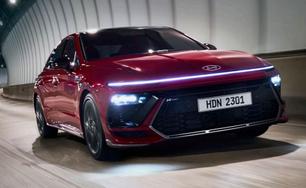
The updated Sonata N Line looks beautifully modern from its new face to the refreshed cockpit, while remaining a ‘driver’s car’ with good dynamics, and a sporty engine.
The Sonata isn’t an ideal family car, however. This is down to a lack of practicality. Although the cabin is fairly roomy, if that roofline wasn’t so coupe-like and cabin storage was better, and the boot had a large hatch opening, and the ride height was more elevated then it would be a great family car. Oh, I’ve just described an SUV.
Note: CarsGuide attended this event as a guest of the manufacturer, with meals provided.
If you travel long distances, want a good amount of space and don’t want to pay big bucks for a new car, then yeah, maybe there is a reason sedans like this will hang around for a while longer.
Sure, the appeal of sedans mightn’t be as strong as it once was, but models like the Kia Optima prove they still have a reason to exist.
So, we’ve established that the Sonata N Line is a sedan and that means if you’re still reading this you are, a) A Sonata owner looking to trade the old one in for this new one, b) Driving another type of sedan such as a Toyota Camry or Volkswagen Passat and looking to update your trusty steed with one from Hyundai or c) Not in the market for an SUV.
Whatever the reason, sedans lend themselves to being sleek and sophisticated in their styling just by being lower to the ground than SUVs and generally longer than sports cars.
The Sonata N Line is long at 4.91m end-to-end. That’s only 8.0cm shorter than the gigantic Hyundai Palisade which has eight seats. I know… it bends the mind.
This new Sonata N Line looks even wider than the previous version, too, with that broad flat bonnet meeting the Seamless Horizon LED strip.
Fact is the Sonata N Line is 1.86m across - exactly the same as the previous version. Remind me never to wear a 'seamless horizon' T-shirt on days I’m feeling rotund.
If you look closely at the photos you can see the hidden LED headlights flanking the large, dark and low-set grille.
The rear of the new Sonata looks so different from the previous version, too, with its boot lid spoiler and LED tail-lights.
The menacing body kit comes with the N Line grade and accentuates the sporty nature of this car. It’s a good thing it has an engine to back up the looks, but more on that later.
Inside, the Sonata has been given the new 12.3-inch curved screens and a digital climate control display, while the steering wheel is new and adorned with the Hyundai 'Morse Code' badge (the letter H is four dots in Morse Code). It’s a premium and modern looking cockpit topped off with suede and leather leather N Line sports seats.
Cosmetic changes for the facelifted 2018 Kia Optima include new headlights and tail-lights with revised LED signatures (but still halogen lamps in the base model), and there are newly sculpted bumpers and new wheel designs across the two-model range.
We had the base model Si, which doesn’t look as good as the GT model, because it has smaller wheels, the sporty body kit and misses out on the LED headlights, but the LED daytime running lights are still present.
The GT has a more aggressive look, and the side skirts, front spoiler and rear diffuser fit it better - there are dual exhausts, but not sporty quad exhaust tips.
In fact, this model is a bit like the old-man version of the Optima. No offence intended to old men, of course. The GT is just heaps sportier, and I reckon it’s considerably more attractive as a result.
Still, the inherent sleek styling of the Optima remains - the chrome highlighting along the window line is a bit too sheeny for me, but the angles and stance of this model are quite gracious. I really dig the fact the top of the windscreen mirrors the ‘Tiger Nose’ grille shape.
I'm no exterior designer, but I liked the existing Optima more - it just looked a bit neater, even though it had a decent amount of bling with its Mercedes-like diamond-pattern grille, as opposed to the cheese grater look seen here.
There’s not quite as much bling inside the cabin of the Si, either, but it is still a well-designed space - just not as special as the premium package offering of the GT (which gets leather trim - not nappa leather, but still a quality cowhide finish, and more). Check out our interior photos to see if you agree - but size and interior dimensions of the Optima are hard to argue against.
Sedans might be sleek and sophisticated but practicality is not typically their strength because their low height means passenger access isn’t as easy as it is with an SUV, but mainly because the cargo carrying ability is limited by the relatively small boot opening.
Still, the Sonata N Line does have a big 480-litre boot and cabin storage has been improved thanks to the gear shifter being relocated to the steering column and freeing up space in the centre console for stowing items and a wireless phone charger.
Rear legroom is also good. I’m 189cm tall and I can sit behind my driving position with space to spare. Headroom back there is also good thanks to contoured heading which has a ‘carved out’ section for extra space.
Along with the wireless phone charger there are two Type-C USB ports up front and another two for the second row.
There are four cupholders (two up front and two in the second row) and decent sized bottle holders in the doors.
This lack of practicality compared to an SUV or even a station wagon means the Sonata N Line really isn’t the perfect family car.
I really like the way Kia designs its cabins. Sure, there’s a lot of black in here, but there’s also a lot of thought put into the usability of the space.
The high-mounted 7.0-inch infotainment and multimedia touch screen in the Si is simple to use, and for 2018 the Optima range gets Apple CarPlay and Android Auto - you couldn’t get that in the Optima up to this point.
Also included are a reversing camera, USB input, Bluetooth phone and audio streaming and six speakers. The Si model misses out on sat nav - you’ll have to use the maps app on your phone. No DVD player either.
Storage is well thought out in here, with big bottle holders in the doors, a good sized pair of cup holders up front, and a nice little storage bin for your phone, wallet, keys and so on.
There’s a driver info screen with a digital speedo, and even on this base model you get a dual-zone climate control air conditioner. The updated Optima gets a new steering wheel, too.
Now, what about the back seat?
It may be considered a ‘mid-sized’ sedan, but there’s limo-like space. With the driver’s seat in my position (I’m about six feet tall) there was still heaps of rear legroom in the rear seat, with ample knee room, good foot room and decent shoulder space, too - three of me could slot across the back bench comfortably, which means kids will fit easily, too. There are three top-tether points and two ISOFIX points as well.
Kids and adults alike will be happy with the rear air vents back here, and there’s a flip down armrest with cupholders, too. Again, big bottle holders appear in the doors, and there are map pockets in the back seats.
What about boot space? With so many people choosing SUVs over sedans because they’re theoretically more practical, the Optima offers good food for thought - it has enough luggage capacity for a bunch of suitcases (510 litres VDA in size) and there’s a full-size alloy spare under the boot floor. If you need more, you could always invest in a roof rack setup?
Hyundai offers one type of Sonata in Australia, so there’s not a lot of choice. Actually there’s no choice: it’s the petrol version of the Sonata in the sporty N Line grade or nothing.
But if I were to choose one Sonata this would be the one, even if at a list price of $55,500 it’s quite expensive and about $3500 more than the previous Sonata N Line.
In return for the almost $56K price you’re getting a lot of standard features, including a mountain of new equipment for this updated model.
So, new for this 2024 Sonata are dual 12.3-inch curved screens for media and driving instruments, the digital climate control display, there’s a column-mounted gear shifter, LED ambient lighting and a hands-free boot lid. That’s in addition to proximity unlocking, sat nav, Apple CarPlay and Android Auto and a 12-speaker Bose sound system.
There’s also suede and Nappa leather seats, a leather steering wheel, sunroof, dual-zone climate control, heated and ventilated front seats, a heated steering wheel, LED headlights and the LED strip which wraps around the front of the Sonata.
Hyundai calls it the 'Seamless Horizon', which sounds beautifully poetic and leads us nicely into the Design section of this review.
Kia dropped prices for this updated and facelifted model range - and not by a small amount, either. So, what's the price? How much does it cost?
The Si model is the entry-grade of two models, and it comes in at the bottom of the price list at $33,290 plus on-road costs (rrp) - an $1100 drop over the previous version. The Si, then, is a value-focused sedan that you might consider if you’ve looked at a Toyota Camry Ascent, Hyundai Sonata Active, Mazda6 Sport or Subaru Liberty 2.5i.
The standard equipment list is pretty good - although there have been some deletions, because the price is down $1100. The rather good HID headlamps with washers have been dumped in favour of halogen projector lights (yeah, not even xenons), and the satellite navigation system (GPS) is gone.
But now the 7.0-inch media screen is capable of doing the Apple CarPlay iPhone connectivity and Android Auto phone mirroring thing, and that’ll serve most people’s purposes pretty well, but there is no digital DAB radio, and no CD player for the sound system. Other standard kit includes a digital driver info display with digital speedo, dual-zone climate control, cloth seat trim, auto-dimming rear-view mirror, a reversing camera, front and rear parking sensors, auto headlights and rain sensing wipers, and 17-inch alloy wheels (with a full-size spare).
New equipment for the Si includes driver-fatigue monitoring and an active lane-keeping assistance system (in place of the old lane-departure-warning buzzer).
If you want all the fruit you really need to fork out the extra cash for the GT, which lists at $43,290 plus on-roads (vs $33,290 for the Si). That is getting perilously close to Kia Stinger territory… but let's not get too far ahead of ourselves - this isn't a model comparison!
You get a fair bit more for your dough, but even the GT has seen a few deletions to help justify its $1200 price drop compared to the pre-facelift model, such as the front passenger seat being manually operated (previously electric), the cooling/ventilation of the front seats has been deleted, and the panoramic sunroof of the previous model is gone, too. And while it rides on 18-inch rims with a new design, the tyre-pressure-monitoring system has been removed.
It uses a new 8.0-inch media screen with extended smartphone connectivity and in-built sat nav (with 10 years of maps included and SUNA live traffic updates), and it also gains redesigned LED headlights but they lose the smart auto high-beam assistance of the old model. The tech doesn't go as far as to include Homelink garage door opening here in Australia, either.
Other standard kit in the GT includes leather seats, electric driver’s seat adjustment with memory settings, smart key (keyless entry) and push button start, a sports body kit, a harman/kardon audio system with 10 speakers and a subwoofer, wireless phone charging (Qi) but no Wi-Fi hotspot, rear sunshades (but no tinted windows), different interior trim finishes, a heated steering wheel, and a colour driver-information screen.
The GT also gets the new lane assist system and driver-fatigue monitor, and the entire safety approach has been improved across the range. See the safety section below for more detail.
There is no launch edition, nor is there a sports edition, but there is a decent array of colours (or colors, depending on where you're reading this) available - black, white, blue, red, grey and silver can be chosen, but not brown, purple or gold... if you wanted those.
Accessories available across both trim levels include tailored floor mats, a dash mat and weathershields, among other items.
The Sonata N Line comes with a 2.5-litre turbo-petrol four-cylinder engine making 213kW and 422Nm, which is plenty of oomph, and it all goes to the front wheels through an eight-speed dual-clutch automatic transmission.
So no, there’s not a diesel version nor an all-wheel drive version, but this sporty engine suits the Sonata N Line perfectly.
That said a hybrid variant would be good seeing it’s 2023.
The Si model is powered by a 2.4-litre four-cylinder petrol engine, which has seen no changes to its specifications for this mid-life update.
Engine specs remain at 138kW of power at 6000rpm, while torque is rated at 241Nm at 4000rpm. It makes use of a six-speed automatic transmission only - there’s no manual transmission here, but you do get paddle shifters - and it's front wheel drive (the Optima isn't available with AWD, or as a 4x4, or in rear wheel drive - the latter is left to its bigger brother, the Stinger).
The GT gets a zestier drivetrain with more horsepower - it has a 2.0-litre turbo four-cylinder engine with 180kW/350Nm, which is much more desirable, but also louder than the Si’s 2.4. It also has a six-speed auto transmission, and is FWD. If you're into ratings and statistics, that 2.0-litre with a turbocharger is one of the perkier offerings for its engine size in the class.
There is no hybrid model available, despite a plug in hybrid petrol version (allowing you to run in EV mode) being sold in European markets. No diesel here, either, while other markets get a 1.7-litre turbo diesel. No LPG model here, or anywhere else, for that matter.
Towing capacity for Optima models is 750kg unbraked and 1700kg braked for the 2.4-litre, and 700kg/1400kg for the 2.0-litre turbo. Tow bar down-weight is capped at 80kg.
If you're concerned about engine problems, suspension problems, clutch and transmission issues, be sure to check out our Kia Optima problems page.
As we were saying above there’s no hybrid variant of the Sonata N Line and there should be. Actually there is, but Hyundai says it isn't available for the Australian market.
So, this turbo-petrol four-cylinder is all we have and according to Hyundai it uses 8.1L/100km on the combined cycle.
When we tested it at the launch our trip computer was reporting exactly 8.1L/100km, but the roads were clear, the traffic was nowhere to be seen, so you can expect that consumption to climb higher if you’re commuting around the city.
Kia claims a very realistic fuel economy rating of 8.3 litres per 100 kilometres for the Si model, and we saw damn close to that consumption during our week of testing. On the highway it will sit at around 6.5L/100km, ensuring good mileage, while city driving will push usage above 12.0L/100km. Our overall average was 8.5L/100km, which is good. Use the eco mode, and you'll get a little better use.
The turbocharged GT model uses a little more, according to Kia’s 8.5L/100km combined average claim, but we guarantee you’ll actually use more than that because it’s more eager to please.
Fuel tank capacity is 70 litres - plenty of size for long distance drives.
The Sonata N Line’s performance matches its sporty looks. That turbo-petrol engine is responsive and provides great acceleration, the transmission shifts fast and the steering is nicely weighted and accurate.
Add to this better rigidity in the car’s structure in this updated model and a feeling of stability thanks to this being a sedan with a low centre of mass and you have a dynamic and enjoyable vehicle in your hands.
Sure it doesn't have the sky-high visibility that comes from the pilot’s seat of an SUV, but the Sonata N Line is for those who like to drive but still want the practicality of four doors, back seats and a boot.
The Optima has some really good elements to the way it drives, but sadly some less impressive bits as well.
Let’s start with the not-so-great stuff - the 2.4-litre engine in this Si model just isn’t as enjoyable as the turbo unit, and the fact that Kia still doesn’t offer a hybrid version here, despite doing so elsewhere, is a bit of a downer.
The drivetrain isn’t terrible - the six-speed auto is smart enough, and there’s usable power if you boot it. The two more sedate drive modes, 'Eco' and 'Comfort', mean the transmission will aim to save fuel and limit throttle response, with a bit more of a lazy feel to the drive experience. But in 'Sport' mode it is definitely more rewarding in terms of acceleration and performance, offering a bit more pep and urgency (we didn't do a 0-100 km/h speed test, but take our word for it); it undoubtedly at the cost of fuel consumption.
It’s just a bit of a shame Kia doesn’t offer the turbo in this spec, too. Fuel use for the Si model is better than the turbo, however, so it could be ideal for buyers who are more worried about the bottom line than design and a sportier drive.
The thing I like most about the Optima is its road manners - the steering and suspension have been tuned for local conditions, just like all Kia products, and it shows.
The electric power steering is really well sorted, making for easy parking moves and good assuredness at higher speeds. And the turning circle is decent, too - 10.9m (so, the turning radius is 5.45m).
Plus the ride comfort is really good. On the highway it coasts along with very little fuss, and around town it deals with lumps and bumps impressively. Sharp edges can upset things a tad, and mid-corner bumps can make it jitterbug a little bit, but not to a degree that would rule it out of contention if you want a mid-sized sedan.
It’s pretty quiet on the open road, too, and the adaptive cruise control makes long-distance driving a simple task. The GT does suffer a little bit more road noise, though.
The Sonata N Line hasn’t been tested by ANCAP, but it does have an extensive armoury of safety tech including AEB (which also works at intersections) able to detect pedestrians, cyclists, other cars and now motorbikes.
There’s blind spot warning which pulls you back into your lane and lane keeping assistance, plus rear cross-traffic alert with braking, as well.
A rear occupant alert will remind the driver there are passengers in the back seat and 'Safe Exit Assist' will protect children from opening the door into moving traffic.
Along with all this, which Hyundai bundles together in its 'Safety Sense' package as standard on the Sonata N Line, there are also side airbags protecting the rear passengers and plenty of airbags in the front for the driver and passenger.
The safety rating of the Optima remains at five stars, as it was when the car was tested in this generation in 2015.
The updated Optima carries over the safety features of the previous model including autonomous emergency braking and adaptive cruise control, while the lane-departure warning system is now supplemented with lane-keeping assistance, and there’s driver-fatigue monitoring added, too. There is no park assist / self parking system.
That’s in addition to a reverse camera, front and rear parking sensors, and all the systems you’d expect, like stability control, anti-lock brakes, hill-start assist and seatbelt reminders.
Airbag coverage for Optima models is six: dual front, front side and full-length curtain. And parents will be happy to learn there are three top-tether attachment points, and two ISOFIX anchors, too.
If you've been wondering to yourself, "where is the Kia Optima built?"The answer is South Korea.
The Sonata N Line is covered by Hyundai’s five-year, unlimited-kilometre warranty.
Servicing is recommended annually or every 10,000km. There’s no capped price serving but you can buy a 'Lifetime' or a five-year plan that work out to be between $350-$400 on average a year.
Kia remains a shining light in terms of its new-car-ownership promise, with a very strong seven-year/unlimited kilometre warranty. It makes a lot of sense if you plan to hang onto the car for a while. There's no extended warranty available, which is understandable.
That plan also includes a roadside-assist plan for the same seven-year period, provided you maintain your car with Kia Australia. So, given you get one year to start with, then you get an extra year of cover every time you go back to Kia to get your car serviced, you could end up with eight years of coverage. Nice!
Servicing is due every 12 months or 15,000km, with the first seven years covered by a capped-price-service cost / maintenance cost plan. The costs are: service one - $289; two - $466; three - $360; four - $559; five - $325; six - $599; seven - $345. That makes a total cost of $2943, which is competitive for its class. Keep your owners manual or logbook up to date, and your resale value should hold up better.
If you have concerns about common problems, issues, reliability ratings and durability, you should check out our Kia Optima problems page.