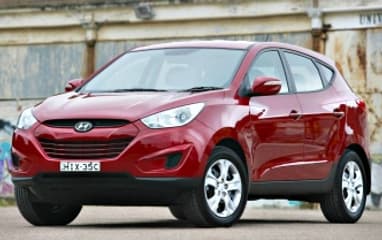
Hyundai IX35 2011 Problems

Are you having problems with your 2011 Hyundai IX35? Let our team of motoring experts keep you up to date with all of the latest 2011 Hyundai IX35 issues & faults. We have gathered all of the most frequently asked questions and problems relating to the 2011 Hyundai IX35 in one spot to help you decide if it's a smart buy.

Hyundai ix35 recalled in Australia
By Joshua Dowling · 26 May 2014
HYUNDAI is recalling every ix35 -- Australia's biggest-selling small SUV -- made over the past three years. The South Korean car maker is recalling 32,525 examples of its ix35 built from January 2011 to December 2013 because the airbag in the steering wheel may not be secured properly and the horn may not work. It is the second recall for the same model so far this year and part of a global recall of more than 137,500 Hyundai vehicles announced last week. In January, Hyundai recalled 6193 of its ix35 SUVs due to a potentially faulty seatbelt pre-tensioner. A statement from Hyundai about the latest safety issue said: "An incorrectly tightened bolt could result in the misalignment of the airbag module, possibly affecting its deployment, and could also affect the operation of the horn." Hyundai says there have been no reported incidents in Australia but customers may notice a rattle in the steering wheel. "It will not cause the airbag to deploy unintentionally," says the Hyundai Australia statement. "(But) the effectiveness of the airbag could be reduced if the bolt is not tightened properly." A safety bulletin has been published on recalls.gov.au and Hyundai customers will be notified by mail in the coming days to have their cars checked free of charge and the bolts tightened if necessary. During preliminary inspections only four vehicles have needed to have their airbag bolts tightened, the company says. In April 2013, Hyundai called 227,000 cars back to dealers to fix a faulty brake light switch that affected eight models, most of its range, after News Corp Australia exclusively unearthed the fault 15 months earlier. But that incident was not documented on recalls.gov.au because Hyundai successfully argued with authorities that potentially faulty brake lights were "not a safety issue" and the repairs could be done as a "dealer service campaign". In its formative years Hyundai refused to issue a recall even after the front suspension assembly of 46 Hyundai Excel cars collapsed while in traffic and/or on the move in 1998. The latest Hyundai ix35 safety campaign is the 33rd vehicle recall so far this year, including one for nine different types of Aston Martin models. The biggest recalls so far this year were Toyota's bulletins issued in April which affected almost 300,000 vehicles: 118,600 Yaris small cars because the seats could slide forward and 179,000 HiLux utilities for a potential airbag failure. Weird car recalls: Land Rover: "assorted models" recalled because the indicators don't flash enough times with one touch (May 2014) Chinese Foton ute: 316 vehicles recalled to replace the wheel jack (May 2014) Aston Martin: all models made between 2007 and 2013 recalled because the accelerator pedal arm may break (January 2014) Ford Falcon LPG sedan: 372 vehicles recalled because the wrong size wheels were fitted (February 2013) Great Wall Motors utes: 23,000 vehicles recalled because some gaskets contained asbestos (August 2012) Holden Commodore ute: 34,432 vehicles recalled because the tailgate could pop open (July 2010) This reporter is on Twitter: @JoshuaDowling  
Read the article
Hyundai recalls 6500 cars
By Karla Pincott · 21 Jan 2014
Hyundai has recalled its popular ix35 for a production defect on the tensioning cable in the seatbelt pretensioner, with insecure crimping meaning the cable could be unleashed and injure occupants or fail to offer full seatbelt restraint in an accident. The recall affects 6552 of the top-selling small Hyundai SUV, which last year led its segment with 19,098 sales -- overtaking the 2012 leader Nissan Dualis with a resounding distance to its 12,434.   The build dates affected by the recall from August 23, 2011 to 24 February, 2012, and the VIN number range is  KMHJT81BLCU373966 to KMHJU81VSCU485865. The VIN number can be found on the build plate in the engine bay. Hyundai says the defect has not been responsible for any injuries in Australia, and that the seatbelts will still continue to operate and protect occupants in the meantime. "There have been no incidents here yet," Hyundai spokesman Guido Schenken told Carsguide. "The defect only affects the pretensioner, so the rest of the seatbelt mechanism works fine. The fix will take about 30 minutes at the most." Hyundai is notifying affected owners by letter, instructing them to return their ix35 to the nearest dealership, where the seatbelt pretensioner will be replaced.    
Read the article
Used Hyundai ix35 review: 2010-2015
By Ewan Kennedy · 23 Feb 2017
Ewan Kennedy reviews the 2010 - 2015 Hyundai ix35 as a used buy. Hyundai ix35 is a small-medium SUV that's proven popular in Australia since arriving here from South Korea in January 2010. Build quality is very good as by this time the two Korean giants were really getting their acts into gear. A combination of neat
Read the article
Used Hyundai iX35 review: 2010-2015
By David Morley · 14 Sep 2026
We’re not sure exactly what was going on in Hyundai’s marketing department at the end of the first decade of this century, but somebody was definitely having two bob each way. Up until 2010, the Tucson had been Hyundai’s mid-sized SUV entrant, but that badge disappeared the same year as the ix35 hit showrooms as the Tucson’s replacement. But after just five years on sale, the ix35 was itself replaced by none other than the Tucson. Confused? Us too, but to keep it simple, if you’re shopping for a Hyundai-made mid-sized SUV built between 2010 and 2015, the ix35 is the badge you need to look for. Meantime, leaving nomenclature out of it, the LM (as it was known internally) ix35 was a bread-and-butter kind of family SUV with familiar overall proportions and nothing too confronting mechanically. It could be had in three trim levels (Active, Elite and Highlander, in that order) and with a range of driveline options. There was a 2.0-litre petrol engine with 122kW, a 2.4-litre petrol with 130kW and a 2.0-litre turbo-diesel with 135kW and lots more torque than the petrol variants. The 2.0 petrol was available with either a five-speed manual or six-speed automatic transmission and was front-drive only. The 2.4 petrol and the turbo-diesel were fitted exclusively with the six-speed automatic and were all-wheel drive, although they used on-demand AWD, and operated as front-drivers in most conditions. Conventional wisdom says late-model Hyundais are pretty stout things, even if they don’t offer much in the way of driving excitement. The ix35 makes sense if all you want is a roomy (for its size) box with which to move people and their belongings. But even then, there are some reliability problems to note, and driveability was never anything better than average. Overall, there are better, more entertaining choices in a second-hand SUV of this type. Again, it goes against the mood for this brand, but the ix35 did have some serious reliability issues that, even though they didn’t affect every example, should make you weigh things up carefully before making a purchasing decision. Something very wrong was going on in Hyundai’s engine department at this point in history. All three of the ix35’s engines suffered (to some extent) with some serious issues that saw Hyundai replacing entire engines under warranty in an attempt to stay in favour with its customers. The problems mainly centred around engines that consumed excess oil (to the point where some owners were caught out with empty sumps between services) and rattling engines that were signalling their death knock. The consensus is these problems were caused by poor manufacturing accuracy, leading to cylinder scoring, at which point the engines became noisy (particularly when cold) and started to burn oil. The fix was to either rebuild the engine with a new crankcase or, more commonly, replace the whole engine. Other issues reported over the years have been interior trim peeling (most notably steering wheel covers) and flaking paint caused by a bad batch of paint that affected other carmakers (including Toyota) and was traced to the top coat not adhering properly to the undercoat at the factory. This model Hyundai has had its share of recall notices over the years, some of them more serious than others, but a couple posing a definite safety risk. They include a recall to check the seat belt tensioning system, and a driver’s airbag that could have been assembled incorrectly and not deploy as it was designed to. Leaks were another ix35 recall theme, with oil leaks from the sump, fuel leaks and transmission fluid leaks all creating recall notices. There was also a recall to check some cars for a brake system that could allow brake fluid to contaminate the ABS module, leading to braking problems. You can check out the full details including what batches of cars were affected at: https://www.vehiclerecalls.gov.au/ If you’re buying a petrol ix35, the ones to avoid on the basis of the engine problems and oil burning were the ones from the first generation built between 2010 and 2013. If, however, you’re after a diesel version, the post-facelift cars (2013 to 2015) seem to be the problematic ones. Either way, you’d want to know the service history of any second-hand ix35 and be prepared to shell out for a pre-purchase inspection which would include a compression test and perhaps even a bore-scope examination of the engine. The number of ix35s still floating around with 250,000km on board, or even more, suggests the engine problems were a bit random and clearly didn’t affect every car. We’d still be a lot happier, though, with an example with less than 160,000km on its odometer, along with an up-to-date and complete service history as some proof of it having a chance at going the distance. A car with a factory replacement engine (and documentation to support this) would also be preferable to one with no history. The turbo-diesel ix35 was always the better one to actually drive thanks to its beefier power and torque delivery. The added safety of all-wheel drive only reinforces this view. The petrol versions do the job, but they can feel breathless and stretched a bit tight at freeway speeds when fully loaded. Right now, you’ll find sellers with early-built, high-mileage examples of the ix35 with an asking price of about $5000 or even less. But these are best left to speculators. Better value is to be found in the $8000 to $10,000 price range where you start to find diesel examples with much more moderate mileage showing. Don’t forget that service history. Hyundai is a big brand not just in Australia, but globally. So, spare parts are not hard to find. Neither is a workshop that can navigate what is, fundamentally, a pretty straightforward vehicle. There’s a huge online market for parts to suit cars like this one, but be wary of online sellers you haven’t used before. Don’t rule out parts recycling yards for spares like body panels and some mechanical parts. Despite the problems some owners experienced with this car, Hyundai managed to sell plenty of them here, with sales peaking at about 18,000 per year at one point. That gave it a huge chunk of the market in its segment, but those mechanical problems took their toll, leading to the badge being replaced by the revived Tucson model in 2015. Some owners were forced to walk away from their ix35s when the cost of repairs became more than the value of the car itself. But the sheer sales figures when things were looking good mean there are at least a couple of hundred ix35s for sale on the bigger online sites.
Read the article
Hyundai ix35 2011: Excessive brake wear
Answered by Graham Smith · 16 Nov 2012

Brake wear is an issue that crops up regularly with most makes, not only Hyundai. It's a fact of life that brakes wear out much faster than they once did, and it's down to a number of things, like the removal of asbestos from brake linings, softer disc material, the introduction of ABS braking etc, heavier traffic, more traffic lights etc. They all contribute.

Nearly new SUVs suitable for families?
Answered by Graham Smith · 19 Jun 2017

I would rule out the CX-7 on the basis of poor fuel consumption, the performance of the iX35 petrol version is a little lacking, the Tucson is a better car, but I would suggest the X-Trail is probably your best bet.

Best medium sized SUV for around $40,000?
Answered by Graham Smith · 05 Aug 2016

In order, I would suggest you consider the VW Tiguan, Kia Sportage, and Mazda CX-5. All are reliable, drive nicely, and are well equipped.

Electrics on 2011 Hyundai ix35 Highlander are falling apart
Answered by David Morley · 14 Jan 2025

When a bunch of electrical functions all go out at once (or within a short space of time of each other) suspicions are always drawn to the car’s body computer. This computer controls all the functions you mentioned as well as dozens of others from the heating and cooling, central locking, lights, wipers, dashboard and much, much more. When the computer starts to die (as most computers eventually do) these functions will start dropping one by one and sometimes in simultaneous batches of failures. Eventually, pretty much nothing will work and the car will not even respond to the key’s inputs.

An auto electrician is the best place to take the car, and as well as the computer, they will also check the car’s battery and charging system and the quality (or otherwise) of the car’s earthing points. Bad earths can cause similar problems to this, but the body computer remains a likely culprit.

This is an increasingly common question as car makers take the decision to delete the conventional transmission dipstick from their cars. It’s probably down to the fact that modern transmissions claim to be sealed for life (many mechanics disagree with this) but the move probably also has something to do with preventing owner tinkering as well as the cost saving in not including a dipstick.

But for car owners like yourself who like to keep an eye on what’s happening under the bonnet, the way to check the transmission fluid all takes place underneath the car. Once you have access to the car’s nether regions, you’ll find an inspection plug on the transmission. If you remove this plug, you should find the level of the transmission just touching the lip of the plug-hole. If any drains out, the transmission is too full. If the level is too low (below the lip) you can add flid through this inspection hole.

The catch is that sometimes (follow the instructions in the owner’s manual for the detailed method) you need to have the car running and the transmission at normal operating temperature. Obviously, there are safety implications involved here, especially if you don’t have access to a workshop with a hoist.

With all that said, some Hyundais are, in fact, fitted with a conventional dipstick, making this check much easier. Again, your owner’s manual should reveal all.

With that list of problems, I’d be looking at having the body computer checked, at either a Hyundai dealership or a known automotive electronics specialist. Modern cars have computers to control not just the engine and driveline’s behaviour, but also the functions you’ve mentioned.

Central locking and sunroof problems are classic examples of a body computer that is not playing the game. You might find a specialist can reboot the computer to fix these flaws, but you may also be looking at a complete computer replacement.

But before you do any of that, try this little hack: Lock the vehicle and when you press the button to unlock it, hold the unlock button down for at least 30 seconds. Believe it or not, this can sometimes re-set the body computer and will fix all your problems. It’s a bit of a long-shot, but definitely worth a try.

Disclaimer: You acknowledge and agree that all answers are provided as a general guide only and should not be relied upon as bespoke advice. Carsguide is not liable for the accuracy of any information provided in the answers.
Have a new question for the CarsGuide team?
More than 9,000 questions asked and answered.
Complete guide to Hyundai IX35 2011
Complete guide to Hyundai IX35 2011 CarsGuide Logo
Reviews, price, specs and more