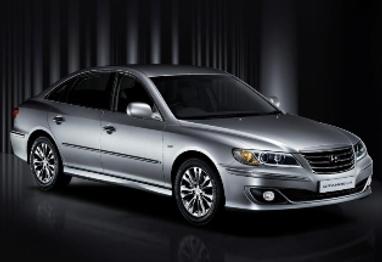
Hyundai Grandeur Problems

Are you having problems with your Hyundai Grandeur? Let our team of motoring experts keep you up to date with all of the latest Hyundai Grandeur issues & faults. We have gathered all of the most frequently asked questions and problems relating to the Hyundai Grandeur in one spot to help you decide if it's a smart buy.

Browse by

Show all

Used Hyundai Grandeur review: 2006-2008
By Graham Smith · 04 Dec 2009
Hyundai today is a very different outfit from the brand that corporate rogue Allan Bond introduced to the market back in the 1980s.  Then it was simply a cheap-and-cheerful brand selling a range of modest small cars at very affordable prices aimed squarely at buyers who were struggling to find enough cash to get into the market.Today it's a full factory operation and a much more sophisticated brand that has won the acceptance of the local market with its range of unpretentious but solid cars that promise not only value-for- money, but also reliability and comfort with a level of refinement Bond and his band could only dream about 20 or more years ago.Cars like the Sonata sedan, and Tucson and Santa Fe SUVs have stretched Hyundai's boundaries and the company is now represented in virtually all the mainstream segments.The Grandeur was the icing on the cake and again expanded the Korean brands penetration of the local market, this time into the prestige segment.MODEL WATCH An earlier attempt to launch a luxury model, also called the Grandeur, into the prestige segment was a dismal failure.  The car was pulled from the market and it was three years before it was willing to have another crack.  In that time Hyundai's evolution into a mainstream, accepted brand had progressed and the time was felt right to re-release the Grandeur nameplate.Luxury buyers weren't necessarily looking for badge credibility, Hyundai claimed at the time of the Grandeur's launch, but they wanted refinement, elegance, comfort and safety at a price that wouldn't break the bank.The Grandeur had the elegance they wanted; it was a handsome car with clean uncluttered lines enhanced with sporty alloy wheels and other touches associated with the image of a prestige model. The interior was restrained, but refined and stylish. There were the usual touches of woodgrain, but it wasn't over the top as it can be with some Asian brands that are over-reaching in the market.Most impressive was the low level of noise, vibration and harshness under most driving conditions. It all added up to a refined drive of the sort expected by the luxury club.Under the bonnet lay a 3.8-litre double overhead camshaft V6 engine with variable intake valve timing and boasting 194 kW at 6000 revs and 348 Nm at 4500 revs.  A five-speed auto transmission was standard, but it had sequential manual shifting for a bit of fun, and the final drive was through the front wheels.The suspension was independent double wishbone at the front and multi- link at the rear; the brakes were a combination of ventilated front discs and solid rears, with standard ABS anti-lock and EBD brakeforce distribution.The earlier Grandeur was heavily criticised for its unruly suspension on local roads, but Hyundai's chassis engineers had taken note of the complaints and worked hard to ensure the new model wouldn't be canned for the same reasons.  As a result the ride and handling were much better suited to Australian roads, although the steering was still thought a little vague.The two-model Grandeur range was made up of the V6 entry level and the Limited.  The V6 came well equipped with standard air, cruise, power windows and mirrors, remote central locking, alarm, leather trim, power seats, parking sensors, eight-speaker CD sound.  Step up to the Limited and you also got heated front seats, a power sunroof and Xenon headlamps.IN THE SHOP With the earliest TG Grandeurs having clocked up just 60,000 km or so it's early days for the luxury Hyundai and few problems of a serious nature have cropped up.  While Hyundai has in the past been thought of as a cheap-and-cheerful brand plagued by the Excel problem of the early 1990s, but it shouldn't be considered so today.The fit and finish of the cars is of a high standard, the equal or any in the price segments it is represented in, and that reflects in the reliability of its cars.  At this early stage of its life the focus of any pre-purchase inspection should be on possible crash damage and subsequent dodgey repairs or a lack of servicing.Check for poor panel fit, drooping doors, scratched or chipped paint, and scarred alloy wheels.  Also check the service record to make sure it has seen the inside of a workshop since it left the showroom when new.IN A CRASH The Grandeur was packed with an impressive array of electronic features that provided a safety net when all turned nasty on the road; there was ABS braking with EBD brakeforce distribution, traction control and stability control.  If all of that wasn't enough to avoid a crash then there were dual front airbags, head airbags and side airbags to provide protection.AT THE PUMP A relatively large V6 engine in a car of generous dimensions the Grandeur is no fuel miser, but Hyundai claimed it would average 10.8 L/100 km, which is competitive in its segment.LOOK FOR . Elegant looks. Refined, roomy interior. Fully equipped. Smooth V6 performance. Comfortable rideTHE BOTTOM LINE Refined, reliable, comfortable and competent, the Grandeur is a real prestige contender.RATING 78/100
Read the article
Used Hyundai Grandeur review: 2008-2010
By Graham Smith · 14 Jul 2011
While it began with small cars it was always Hyundai's aim to expand into more segments as it grew in this market and the Grandeur was its entry into the family car segment. Sales have been slow to be brutally honest. When it was first introduced the Hyundai brand was still finding its way with local buyers and cars like the Commodore and Falcon were the dominant players in the segment the Grandeur was in. Today, Hyundai is well and truly established with a strong reputation, which makes revisiting the Grandeur a worthwhile exercise.In 2009, Hyundai revised the specifications of the Grandeur and reduced the price in the hope of getting sales moving. There were some minor cosmetic changes in the form of a new grille, new flashers on the sides, and new alloy wheels. The features list was revised, with the sunroof, xenon low-beam headlights and pop-up rear headrests all deleted, while rain-sensitive wipers, heated front seats, and new trim was added. But perhaps the biggest news was under the bonnet where Hyundai offered a turbo-diesel engine option alongside the existing V6.The 3.8-litre V6 was unchanged with 194kW and 348Nm and delivered decent punch on the road. The 2.2-litre turbo-diesel, the same engine that powered the Santa Fe SUV, developed 114kW and 343Nm.Both engines were linked to a five-speed auto transmission that offered a manual shift option.On the road the Grandeur offered good ride quality, light steering, while the cabin was impressively roomy.IN THE SHOPFrom small beginnings the Hyundai brand has blossomed into a well- respected one with a suite of well-built, well-specced and overall reliable models.Where once CarsGuide would regularly receive complaints from Hyundai owners they are few and far between these days, which is a sure sign of improved design and production quality.Check for a service record to confirm vital maintenance has been carried out in accordance with Hyundai's service schedule, and also inspect bodywork looking for dodgy panel repairs.IN A CRASHANCAP doesn't give a rating for the Grandeur, but with ABS braking, emergency brake assistance, electronic brakeforce distribution, and electronic stability control, overlaid by front, head and side airbags it's fair to say that the Grandeur was well equipped with safety features.UNDER THE PUMPThe new turbo-diesel engine was the fuel economy star in the Grandeur range, with the company claiming 7.9L/100km as an average.The V6 petrol, which required at least 91-octane regular unleaded but would happily run on E10 blend, would average 10.8L/100km according to Hyundai.HYUNDAI GRANDEUR - 2008-2010Price new: $39,990 to $41,990Engines: 3.8-litre V6 petrol; 2.2-litre 4-cylinder turbo-dieselTransmission: 5-speed autoEconomy: 10.8 L/100 km (V6), 7.9 L/100 km (diesel)Body: 4-door sedanVariants: V6 and CRDiVERDICT Smooth driving, good-looking, comfortable prestige sedan but lacks in chassis refinement
Read the article
Used Hyundai Grandeur review: 1999-2003
By Graham Smith · 28 Jan 2009
The name is a give-away to Hyundai’s grand aim for the Grandeur. It was to be an upmarket car packed with heaps of standard features, but at a Korean price. The question was whether a Korean company, best known for its low cost cars could actually build a prestige model that would compete against established models from long established and highly respected carmakers.MODEL WATCHWhile Hyundai has been selling cars on the local market for some time the company had a reputation for building cheap and cheerful small cars at a price that cash-strapped buyers couldn’t resist.They were so cheap, comparatively speaking, that you could afford to take a gamble on things like build quality and reliability.But when the company inevitably changed direction and began to look further upmarket where there were greater profits in the offing they began to appeal to a more demanding and discerning buyer.Someone who pays $40,000-plus for a car has much higher expectations than someone who forks out $13,000.The challenge for Hyundai was to meet those demands; the challenge for the buyer was to take the plunge and gamble the company would deliver.The Grandeur was Hyundai’s deepest plunge into the local market. It was a medium-sized sedan with pretensions of grandeur; a car that would compete with both locally produced and imported prestige models.Styling was very Asian, a little contrived, but beauty is in the eye of the beholder as the saying goes.Splashes of chrome on the grille, rear garnish mould and door handles provided some sparkle to the exterior, while wood grain touches gave the interior an air of opulence.A spring loaded bonnet badge, ala Mercedes-Benz, was added in 2002 in a further boost to prestige.Power was provided by a competent 3.0-litre fuel-injected double overhead camshaft V6 engine that produced a useable 141 kW at 6000 revs and gave the 1554 kg Grandeur quite zippy performance.The V6 worked in tandem with a five-speed electronically controlled auto trans driving the front wheels.Power steering was standard, along with four-wheel disc brakes, ABS and alloy wheels.As it should be when competing in the prestige market segment the Grandeur was packed with features. It had just about everything you could imagine, which underpinned its value-for-money appeal.The base sedan came standard with air-conditioning, full instrumentation, power windows and mirrors, dual vanity mirrors, remote boot lid and fuel cap releases, six-speaker sound, power antenna, central locking and cloth seats.Step up to the XG and you also received leather trim, keyless entry and alarm, climate control air-con, cruise, traction control, and memory settings on the driver’s seat.It was the Korean formula applied to the prestige segment of the market; that is to deliver plenty of value at a competitive price.IN THE SHOPThe basics of the Grandeur are reliable enough, but mechanics shudder when they arrive at the shop door, as they’re likely to have problems that can be hard to trace and sort out.Korean-built cars in general have a poor reputation for electrics and the Grandeur is packed with systems that rely on good connections and wiring.It’s quite common for owners to report warning lights coming on at random, which makes it difficult for mechanics to trace the cause of the problem. Often it’s found to be a poor connection in the wiring loom and that can take quite some time to locate.Sensors, such as the speed and timing sensors on the engine, can also be a problem.Spark plug leads are also troublesome, and changing them means removing the inlet manifold to get to the rear ones.Signs of trouble are rough running of the engine, and sometimes random stalling while driving along, while problems with the transmission input and output speed sensors are signalled by erratic shifting, sometimes shifting up or down for no apparent reason, or simply refusing to shift.Major service is at 90,000 km and that includes changing the cam timing belt. It also means changing spark plugs, and with long life platinum-tipped plugs that can be a costly exercise.The keyless entry on the XG can be frustrating when it quits and leaves you stranded on the roadside. There’s no roadside solution, the car needs to be towed back to a dealer for correction.IN A CRASHWith ABS standard on both models, and traction control standard on the XG, the Grandeur has the primary systems to get you out of trouble, and dual front airbags and seat belt pretensioners to protect you if you do get into trouble.OWNERS SAYRay Clausen has driven his 2001 Grandeur XG in all conditions, urban and rural and has found it gives him with a sense of safety and ease of comfort. The interior is very well appointed and comfortably seats four adults, while boot space is ample. The battery had to be changed after 18 months, and the ‘Speed Sensor’ and ‘Check Engine’ sensor have also been replaced.Merv Cramer says he has owned many cars over the years, including Holdens and Fords, and rates the Grandeur superior in all aspects, including build quality, attention to detail, and safety. His only gripe is poor resale value.Don Russell loves his 2001 Grandeur. It is luxurious and comfortable, a lot of car for the money. He says it does everything very well and is economical, returning fuel consumption of 8.8 L/100 km. The only trouble has been with the remote locking.The Grandeur’s price was enough to tempt Maurizio to buy one four years ago, but it hasn’t worked out such a good buy. It has been in the workshop more than it has been on the road, he says, with one problem after another. He now wishes he never bought this car; it’s a luxurious lemon with plenty of hidden costs.Jeffrey Gillard has driven Statesmans, Volvos, LTDs, Saabs, and Jaguars, but now drives a 2000 Grandeur XG, which he says is the most reliable and best appointed car he’s have ever owned, and represents great value for money.LOOK FOR• Long list of standard features• Economical on fuel• Very comfortable for four adults• Dual airbags for crash protection• ABS standard• Prone to minor faults, particularly electrics• Poor resale valueTHE BOTTOM LINEGreat value for money, but be aware that electrics are troublesome, and likely to be more so as age and kilometres catch up with the Grandeur.RATING50/100
Read the article
Grandeur value
Answered by Carsguide.com.au · 16 Mar 2007

A DEALER would give you something like $6500 as a trade-in, even though the kilometres it's done are quite low. If you were to sell it privately, you could ask $7000-$8000.

Ask Smithy Xtra electronic throttle motor trouble
Answered by Graham Smith · 10 May 2011

The secondhand fix didn’t work, so you really don’t have an option but to spend the money on a new part. It might be expensive now, but will be the most economical way of fixing it in the long term.

Press menu, select the cog setting, press enter, select the third option down, press enter, select the first option down, then select English.

The Grandeur was Hyundai’s first serious crack at a large luxury car. The V6 engine and automatic transmission seem pretty sound over time, but the kilometres on this example are right up there. Any car with this many kilometres could be a candidate for new suspension, new brakes and who knows what else. So, what may seem on the surface like a bargain (the average price is closer to $6000 or $7000) might not be the case if you have to scrap the car in a year or so because it needs too many repairs.

Then again, at the price, you’re not throwing away the national debt, are you? So perhaps, if you trust your mate, it’s worth a punt, but only if you can comfortably afford to walk away from it if it goes wrong.

Warranty miss
Answered by Graham Smith · 09 Jun 2005

THE aircon components are not generally a problem on the Grandeur, but rear window regulators are. Take it up with Hyundai.

Disclaimer: You acknowledge and agree that all answers are provided as a general guide only and should not be relied upon as bespoke advice. Carsguide is not liable for the accuracy of any information provided in the answers.
Have a new question for the CarsGuide team?
More than 9,000 questions asked and answered.
Complete guide to Hyundai Grandeur
Complete guide to Hyundai Grandeur CarsGuide Logo
Reviews, price, specs and more