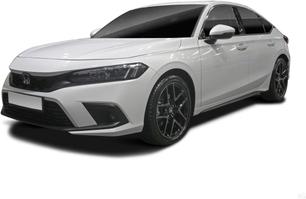
What's the difference?
Before we dive in, this isn’t your typical road test.
That’s because there’s no road, per se. Instead, the majority of what you’re about to read comes from The Bend Motorsport Park in South Australia.
You’ve read the headline, though, so you’re probably putting it all together: a Honda Civic Type R on a well-liked race track must be bliss. Let’s find out.
A very quick catch-up for those not in the know. The Honda Civic Type R (or CTR if you like) is the brand’s only performance model on sale after the demise of the NSX supercar.
The current (FL5) CTR is a little over a year old, having been launched internationally in late 2022, but has only been on Aussie shores for a little while. In fact, we’ve already reviewed it for the road, back in April.
But Honda Australia was keen to get media behind the wheel in a setting it says the CTR thrives in - a racetrack. Its predecessor was a car loved almost universally, can this one live up to the new standard?
While there are plenty of things that somehow improve with age (art, wine, the seemingly ageless Will Smith, to name but a few), the Hyundai Accent is sadly not one of them.
But then, neither does almost any new cars. With new technology, entertainment and safety features launching daily, and with engines that are getting cleaner, more efficient and smoother all the time, a once all-new model can be left looking positively antique in just a handful of years.
But it’s definitely even worse than normal over at Hyundai; the Korean manufacturer that continues to make great forward strides with every new model. From the members of its fast and frantic N Division to its polished SUVs, to the all-new i30 small car, Hyundai is going from strength to strength with neck-breaking speed.
All of which creates a little problem for the pint-sized Accent, which - having launched back in 2011 - is now starting to feel its age. And unlike the Fresh Prince, it isn’t holding up quite so well.
So in lieu of an all new version, Hyundai streamlined the existing Accent family into one value-packed model in 2017, taking the axe to the Active and SR models and replacing both with a single, Sport trim level, which is available in sedan and hatchback guise.
And in creating the Sport, Hyundai aims to blend the best of the Accent range into one handy package. So have they taught this old dog new tricks?
In the realm of factory-built performance road cars for less than six-figures, the track capability offered by the Civic Type R is hard to rival.
The way it communicates and encourages smooth driving is impressive. Its mechanical grip limits are clear well before you reach them and the car is very forgiving with small slides and gentle lift-off oversteer. It lets you know you’re approaching the limits well before you hit ‘em.
Performance hatchbacks from Volkswagen, the Golf GTI and R, are arguably more useable day to day, but don’t come close dynamically. The Hyundai i30 N is wicked fun and deceptively capable for its lower price, but lacks the Type R’s high-shine polish.
Is the FL5 Type R pricey? Yes. Is it worth it? Maybe.
Is it probably the last time a purely combustion-powered hot hatch is going to be this good? Almost certainly.
Note: CarsGuide attended this event as a guest of the manufacturer, with travel, accommodation and meals provided.
It might be getting harder and harder to hide its age, but there is still plenty to like about Hyundai's cheapest car. Those who really love to drive need not apply, and nor should long-distance travellers, but the Accent Sport's alloy wheels, true smartphone integration and plenty of power and USB points will thrill its younger owners, while its long-range warranty and cheap servicing costs don't hurt either.
Still, if you think you can stretch to an i30, you should definitely drive one first.