What's the difference?
Holden wasn't the first manufacturer to find itself bereft of a big SUV when the fuse was lit by BMW and Mercedes as the last millennium came to a close. Ford responded with the Territory while Holden jacked-up a V8 Commodore and slapped the Adventra badge on it. Sadly, it didn't work, and so the Captiva was the next best option, procured from what was then called Daewoo.
As a result of that that little blip on the economic radar, the GFC, and an on-going re-organisation of General Motors, the Korean-built Captiva has lasted rather longer than anyone expected.
It first launched with two bodystyles, but is now down to one, the bigger and more practical seven seat body shell.
When the BMW iX first showed up a few years ago, it was a promising look at what BMW seemed capable of when it comes to electric cars.
While mildly flawed, the iX was fast, comfortable and felt properly premium. Now it’s had a decent update, with the iX xDrive45 M Sport here to replace the former entry-level xDrive 40.
BMW claims among other mechanical and tech updates a power increase of 25 per cent, a 30 per cent greater energy content for the battery, a 38 per cent increase in driving range and a 17 per cent faster charging rate.
But in the time since the iX launched, there have been big strides in the premium electric SUV space, including new arrivals from European opposition like the Polestar 3; even a new American in the form of the Cadillac Lyriq.
The Captiva is very, very long in the tooth and is heading towards retirement some time in the next twelve months. Before then, it's a lot of car for the money, particularly the seven seat LS. It's not fast, flash or futuristic but it will do the job and with all of the early problems sorted, will probably do it for quite some time.
The Captiva's low scores are mostly to do with the car just being old and feeling it, with dodgier plastics, slightly undercooked ride and handling and a lack of engine and safety tech. It doesn't mean it's a terrible car, because it isn't and Holden papers up the cracks with a low starting price and good after-sales.
If anyone was worried that it would be too late to get a decent bit of value out of an entry-level iX, there's reassuring news.
With more power, range and features added to the model and the cost remaining close to its former sticker price, the iX has held up well despite now existing in a more competitive environment.
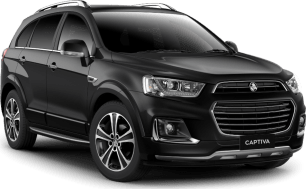
Formerly known as the Captiva 7, the seven seat body has remained mostly the same for its 11 years on sale. The only real changes have been around the front end, with Holden several times fiddling with the grille, lights and bumpers. There's nothing flash about the Captiva, but you know exactly what it is coming at you, with the double grille and big Holden badge.
In profile there's a lot of the original BMW X5 if you squint, right down to the copyright lawyer-dodging shape of the rear quarter window. It also has that X5's big gaps between wheelarch and tyres and a good view of the wheelarch itself. If that's your thing.
Little has changed at the back apart from bumpers and the LED effect lights added in the last update in 2014. It's unlikely you're buying the Captiva as auto haute couture, though.
Inside is basic, and you can place the Captiva's genesis in the mid-2000s, there's a certain generic GM feel to it. The switchgear feels old and clacky, the plastics are hard but do fit well enough. An Audi interior it isn't. The update in 2014 to make the 7.0-inch screen fit in the dashboard is fairly obvious and it's a shame the whole dash couldn't have been replaced. The huge steering wheel surrounds a tightly packed instrument cluster with small dials and a very old-looking LCD panel for trip computer duties.
The iX was a bit divisive upon its original launch, because it was one of the early adopters of BMW’s current ‘big grille’ era.
The good news for the iX is that many have adjusted their expectations on that front and it now feels pretty well at home in the brand’s line-up.
The addition of the 'Iconic Glow' grille surround might be a step too far for some, but overall the iX has aged well and its exterior design hasn’t changed much because of that.
The adaptive LED headlights have new DRL elements, and the M Sport pack is now standard, but if you were only casually familiar with the iX you’d have to be looking closely to spot the update.
The new colour palette for the iX also includes the pictured 'Arctic Race Blue metallic', though I’m personally a fan of the iX in all black, giving it a more monolithic look.
Inside, it’s a similar story - what was once perhaps ahead of its time is now the expectation in an electric SUV. Minimalism in terms of physical controls, but plenty of space.
Helping the feeling of spaciousness is the now-standard panoramic sunroof, though a lack of physical shade is one of the iX’s few interior let-downs. Instead, it can electrochromatically ‘shade’, which still lets in plenty of light.
At night, ambient lighting joins the glow of the iX’s rather large 14.9-inch multimedia touchscreen and 12.3-inch driver display.
The Captiva's interior dimensions are impressive. In seven seat versions, the boot space starts at 87 litres, expanding to a handy 465 litres with the 50/50 split fold rear row stowed. Flop the middle row forward and you're up at 930 litres, a good size cargo area that could swallow a flat-pack wardrobe. If you snaffle a five-seat version, you can remove the boot floor panels to reveal another couple of hundred litres of hidey holes.
There are cup holders up front (two), in the middle row (two) and in the boot (one, strangely) for a total of five. In the seven seater, two will go thirsty.
The space on offer in both rows of the iX is a huge plus, and it might even be enough to make you look past some of the small downsides to the electric Bimmer’s interior.
The iX’s clever two-level central console has the phone charger pad and drinks holders down out of the way and means you can put distractions (phone) and your tall bottles out of the way. There's a slot above for your phone to sit upright with a gap under for charging, too.
The storage bin under the armrest also has plenty of space as well as a little shelf for smaller items you don't want to go hunting for, but the iX’s control panel and dial are still reflective and, at certain times of the day, this means distracting light getting in your eyes.
Speaking of distracting, I have found BMW’s multimedia software to be less intuitive and more complicated with each major update, and ‘OS 8.5’ is no different. At this point, using the brand’s touchscreen feels like operating an iPad on the move, with dozens of menu tiles to sort through.
But back to the physical space that is the iX’s interior - the big EV makes a lot of sense as a family car, especially if your kids are old enough to appreciate (and keep clean) the fit and finish.
Not only does the drive have a nicely adjustable and comfortable sports seat thanks to the M Sport pack, there's also heating and a massage function.
The front passenger gets the same, and the second row is borderline palatial. There's heaps of kneeroom, headroom, and even space under the front seats at their lowest setting to slot your feet.
The four-zone climate controls mean arguments are avoided, there is of course a central armrest, though even with it folded up and a person in the centre there's enough room in the back to be comfortable.
Behind that, the iX’s 500 litres of boot space could probably be expanded but at the expense of rear legroom, so it's acceptable. There is space under the floor for cables, but no space saver spare, just a repair kit.
There's a switch that allows you to fold the seats down from the tailgate, but you can also manually fold the middle seat for a 40/20/40 split rather than the more expected 60/40.
The Captiva's value is heavily dependent on the model you choose. Standard features across the range (starting with the LS) include a 7.0-inch touchscreen running MyLink, a six-speaker stereo with AM/FM radio, Bluetooth, cruise control, rear parking sensors, reversing camera, auto headlights, leather steering wheel, dual-zone climate control, three 12 volt power outlets, keyless entry and start and a tyre inflation kit in place of an (optional) spare tyre.
No Captiva comes standard with sat nav as they all feature Apple CarPlay or Android Auto, which both use your phone's GPS apps.
There are four models, three 'standard' specifications - LS, LT, and the top of the range LTZ, with a fourth version in the form of the five seat only Active 'special' edition, that isn't.
Pricing starts at $26,490 for the 2.4-litre LS (with five seats and five-speed manual gearbox), $28,690 for the auto, and the diesel comes in at $31,690. Seven-seat LS pricing ranges from $30,490 for the petrol and $33,490 for the diesel, both six-speed automatics.
The Active enters the price list at $31,990 drive away. Based on the five-seat petrol LS (to be discontinued in May 2017), the auto-only Active adds 18-inch alloys, textile leather seats and a cargo cover. There's also a similarly specified seven seat version at $33,490.
On to the LT, and the price rises to $37,490 for the petrol and $38,490 for the diesel, both of them seven seaters. Part of the big jump for the LT is explained by the petrol engine switching to Holden's 190kW 3.0-litre V6 and the addition of all-wheel drive (AWD). The LT picks up a sunroof, bigger alloys, side steps, cloth trim with "Sportec" bolsters on the front seats and powered heated mirrors.
The LTZ's pricing is a mixed bag. Ordinarily, the V6-powered version would attract an rrp (carmakers insist we call it MLP, manufacturer's list price) of $40,490, with the diesel adding a thousand dollars to weigh in at $41,490. However, Holden is running a long promotion offering the LTZ V6 at $35,990 drive away with three years of free servicing.
The LTZ has 19-inch wheels, leather-look trim, electric driver's seat and front parking sensors.
You can choose one of seven colours - black, white, red, silver, blue, brown and grey and all but white will cost you $550. Orange is no longer on the menu, no matter how much you want it to be 2007 again.
The sole entry-grade iX is the xDrive45 M Sport, which brings with it more than the original base xDrive40, but also a price a few thousand dollars higher.
It starts from $142,900 but can quickly become much more expensive when you start ticking options boxes. But in this market segment, it's not that unusual, especially considering recent arrivals like the Polestar 3.
Given it’s only a little more expensive than before, the extra kit and higher grade that now forms the iX entry-point is impressive.
The 'M Sport' pack is now standard as the name suggests, plus there’s M trim inside like the steering wheel, the M seats and silver design highlights.
The LED lights are now adaptive and the glowing grille surround has also been added.
There’s also now a panoramic glass roof as standard, rather than an option, plus the steering wheel is heated and there’s now a tyre pressure monitor.
Aside from that, there’s plenty that carries over, like the wireless phone charging, wireless Android Auto and Apple CarPlay, 18-speaker surround sound by Harman Kardon, four-zone climate control and heated front seats.
There’s also an 'Executive Pack' which adds some comfort features like soft-close doors, privacy glass and front seat ventilation with rear seat heating. That one’s $6500.
Then there’s active steering, which brings the rear wheels into play for more manoeuvrability and stability for $3000.
Adaptive air suspension is $4000, while the most expensive option is a 30-speaker Bowers & Wilkins ‘Diamond’ surround sound system for $9500.
If you like a choice of engine size, you've come to the right place. The Captiva has three engine specs in the range - two petrols and a diesel.
The smaller petrol, a 2.4-litre four-cylinder, produces 123kW at 5600rpm and 230Nm at 4600rpm. Driving the front wheels, this motor is available with choice of gearbox, either a six-speed manual or six-speed automatic. This 2.4 is only available on the LS and Active.
The 24-valve 3.0 SIDI V6 is available on LT and LTZ and produces 190kW at 6900rpm and 288Nm at 5800rpm.
The single diesel is a 2.2-litre iron block with common rail direct-injection and makes 135kW at 3800rpm and a stout 400Nm within a very usable range of 1750-2750rpm. You can have the oil burner in all three trim levels, driving the front wheels in the LS and four-wheel drive in the LT and LTZ.
Both the V6 and diesel are available only with the six-speed automatic transmission.
Unlike earlier Captiva models, none of these engines feature a timing belt. Those early engines suffered from issues related to the fabric belt while problems with the later timing chain driven engines are less common. Reliability of the V6 is well-proven in the Commodore while later four cylinders also perform well.
Zero to 100km/h performance varies between the engines. The 2.4 will reach 100km/h in around 10.5 seconds while the V6 is rather quicker at 8.6. The diesel falls right in the middle at 9.6 seconds.
We've not yet carried out a towing review, but according to Holden, towing capacity is rated at 750kg for unbraked trailers and 2000kg braked.
The iX has, as the xDrive part of its name would suggest, a dual-motor electric set-up with all-wheel drive.
Power and torque now total 300kW and 700Nm for the system in the xDrive45 M Sport, up from the 240kW and 630Nm on offer in the outgoing xDrive40.
BMW says the iX is now good to hit 100km/h from a standstill in 5.1 seconds, with its claimed top speed a nice, rounded 200km/h.
If you're after good fuel economy, the Captiva probably isn't the car for you.
The 2.4-litre petrol is quoted at 9.7L/100km on the combined cycle but, as we recently discovered, is more likely to return closer to 12.5L/100km.
Diesel fuel consumption on the official combined cycle is listed at 8.5L/100km but our most recent test yielded a slightly startling figure of 12.9L/100km. The diesel's performance, particularly in the gears, is better than either petrol but it appears you'll pay for it.
The big banger V6's official fuel consumption figure is listed at 10.7L/100km, but past CarsGuide reviews suggest 14.0L/100km is a more likely real world figure. As far as fuel economy goes, diesel vs petrol usually falls to the diesel, but not in this case.
Fuel tank capacity is identical across the range at 65 litres.
The iX’s 94.8kWh battery allows a range up to 522km, but relatively low efficiency because of the size and weight.
Its 20kWh/100km is on the higher side of power use for cars around this size and this is part of the reason its huge battery capacity results in a fairly average driving range.
Maximum power input for DC fast charging is, however, up from 150kW to 175kW with the update, which is good news for those long drives.
You sit on the Captiva rather than in it, a feeling encouraged by the flat, shapeless seats. It doesn't matter which Captiva you choose, the front seats are not exactly huggy but they'll certainly take people of all shapes and sizes.
You twist a funny knob where the key barrel used to be to start the engine. The view out front and out the sides is commanding as there is a fair bit of glass all around, with just the view out the rear window restricted as it's quite small. If you've got passengers, forget it, but the reversing camera will save the day there.
The ride is, for the most part, reasonable, but will deteriorate along with the road surface. The suspension isn't very quiet and the overall firm feeling delivers passable handling, which you'd expect from a big heavy machine like this. It doesn't have anything like the finesse of much younger metal from Hyundai, Kia and Mazda.
The diesel specs suggest strong performance and that's exactly what you get. It's by far the torquiest of the three engines and shifts the Captiva's two tonnes with reasonable verve. It's a noisy, grumbly unit but works well with the six-speed auto.
The engine specs of the two petrols don't really tell the story. While the V6 is quicker in a straight line, its extra weight knocks the shine off the torque increase and the engine itself isn't a shining example of modern engine tech. Actually, neither of them are, missing out on stop-start and other goodies.
This isn't an off-road review, but moderately ambitious mud-plugging is doable in the AWD models, with a ground clearance of 200mm but no low range or off-road mode. We even checked the manual to make doubly sure there wasn't a diff lock button hidden somewhere.
As ever, the idea here is that when you're buying a Captiva you're buying a lot of space and a cheap ownership experience.
The BMW iX was a relatively early entry into the catalogue of electric cars I’ve driven and because of that it had a couple of (in hindsight) unfair criticisms levelled at it.
For a start, it felt heavier than expected and its ride quality didn’t feel up to BMW’s standards - both things that plenty of electric SUVs have struggled with since.
But its drivetrain, design, and interior all impressed, aside from perhaps some of the aforementioned interior reflections.
Now years on, and the iX has aged well.
Some of the mechanicals and suspension also copped a tweak along with the entry iX now being a more powerful ‘45’. The result is a big electric SUV that holds up better than I remember.
‘Smooth’ is the key word that comes to mind in regards to a lot of the iX’s characteristics. While it’s still not perfect and feels heavy, the iX rides well in comparison to many SUVs on the market, including some of its close rivals.
Perhaps key to this is the fact its standard 21-inch wheels leave plenty of tyre to help the suspension soak up sharp edges on bumps, while we’re sure BMW’s handling engineers have learned more about getting the best out of a big, heavy electric vehicle in the last couple of years.
Road noise is well-muted as a result, and the shape of the iX doesn’t seem to lend itself to excessive wind noise. Even when you’re getting rather quick.
Despite being a 2525kg beast, its 5.1-second sprint to 100km/h is in the muscle car realm - the last of Holden’s V8 Commodores would do about that, for reference.
Its acceleration is also nicely progressive, rather than giving you an almighty but unnecessary jolt of torque right as you put your foot down. But once there’s traction and you’re rolling, the xDrive45 is impressive.
Meanwhile, its cornering and braking still reveal the heft behind the iX, it’s not something you can chuck around like a go-kart, but that’s also not really its area.
Anyone familiar with BMW’s steering characteristics will find the slightly higher force required for its weight (and thickness of the steering wheel rim) standard, though it’s still unnecessarily on the heavier side.
The Captiva carries six airbags, ABS, traction and stability controls, hill descent control, brake force distribution, active rollover protection, brake assist and three ISOFIX points, in addition to the reversing camera and rear parking sensors.
The Captiva's maximum five star ANCAP safety rating was awarded in November 2011.
The BMW iX holds a five-star ANCAP rating, which it earned under slightly more lenient testing back in 2021.
Seven airbags, auto emergency braking with cyclist and pedestrian detection up to 80km/h, lane-assist, rear-cross traffic alert and intersection assist, plus a surround view parking camera all help immensely.
As with all new Holdens, the Captiva owner benefits from a three year/100,00km warranty and lifetime capped price servicing. All prices are available on Holden's website.
Service costs for the diesel are significantly higher than the either of petrols, but do include oil changes.
The standard package also includes a year of roadside assist.
For common faults and complaints, check out our Holden Captiva problems page, which covers known automatic transmission problems, engine problems and diesel problems. There aren't any widespread diesel engine problems with the later version.
Resale value is often a consideration and we've looked at the last major update, released in 2014.
A seven seat Series II LS from 2014 - the second major update for the Captiva after the 2011 update addressed lingering problems - cost $30,490 when new and will trade at around $13000-$15000, below fifty per cent of the purchase price, with private sales a little higher.
An LTZ diesel from the same period sold for $41,490 and trades in the 45 to 50 per cent of purchase price and a little over 50 per cent in private sales.
BMW offers a five-year/unlimited kilometre warranty with an eight-year/160,000km warranty on the battery.
BMW servicing takes place as needed rather than on a schedule, meaning you’ll be alerted via the car or app when a service is required in the near future.
For the iX a six-year all-inclusive service pack costs $3475, regardless of how many km you drive.
BMW has 54 servicing dealers listed in Australia, with each capital city covered and many more locations in the eastern states.