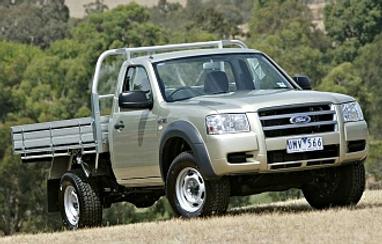
Are you having problems with your 2008 Ford Ranger? Let our team of motoring experts keep you up to date with all of the latest 2008 Ford Ranger issues & faults. We have gathered all of the most frequently asked questions and problems relating to the 2008 Ford Ranger in one spot to help you decide if it's a smart buy.
Show all
It is unacceptable for a chassis to crack under normal driving use, you might accept some cracking if the vehicle was being used in extreme conditions. We haven't had any other reports of Rangers having this problem; the only other vehicle that has been reported to us with chassis cracking is a Nissan Navara. Likewise we haven't had other reports of cylinder head problems with the Ranger diesel. I would expect Ford to come to the party with some of the cost of repairs, but being the second owner and having already had the repairs done you claim has been weakened.
On this model, the sensor in question is located on the crankcase (not the cylinder head as many are). You’ll find it on the driver’s side of the crankcase, below the intake manifold. Replacing it involves removing the old one by screwing it out, and screwing the new one in. But there’s a bit of a process for this, and if you’re not familiar with this type of job, it’s probably one for the experts.
The sensor is located between cylinders three and four and it’s located pretty close to the manifold. The good news is that you don’t need to remove the manifold to access the sensor; you can get to it by going into the engine bay through the wheel-well.
Don’t forget that you’ll lose some coolant in the process, so that will need to be topped up with the correct type afterwards. Remember, too, that the new sensor won’t work unless you correctly reattach the wiring plug that connects the sensor to the rest of the car. This area can be pretty grimy and muddy in a vehicle like this, so cleaning everything off first is a good idea.
We haven’t had other reports of a problem with fifth gear in the Ranger, but we have had reports of clutch problems with the Ranger and the Mazda BT-50, as we have with a number of one-tonne utes. No one has yet to admit to a fault unfortunately, so you’re on your own should your clutch fail.
This sounds very much like a fuelling problem. Since a diesel engine has no ignition system (beyond its own compression) any fall off in performance can often be traced back to the fuel system.
The best bet is to take the vehicle to a diesel specialist that knows this make and model and will have either seen this exact set of symptoms before or will be able to make a logical diagnosis rather than just changing random parts that may or may not be the cause of the problem. Things that are likely causes, however, are the fuel filtering system, fuel pump and injectors. But don’t rule out something simple like a bad batch of fuel that is playing havoc with the entire system.
While the front hubs lock automatically when you engage four-wheel drive, they don’t automatically unlock when you disengage four-wheel drive. To do that you must press the button in the dash. It should all be explained in your owner’s manual.
A lack of oil is the most likely explanation, although it could also have been caused by a manufacturing defect. At this point all you can do is what you have done, and that's to write it off to experience.
The symptoms here point to a stuck flasher relay. This is the electrical component that not only powers the indicator lights, but makes them flash (and produces the steady clicking sound you hear when the indicators are on). The contacts in these units can become stuck at which point the lights can become stuck on.
Why does it still happen when the ignition is off? Because the flasher relay is powered up even when the ignition is not. That’s so you can have the emergency hazard-warning lights flashing even though the vehicle is locked and the keys in your pocket. A new flasher relay unit should fix it.
We were told that the valve clearances are no longer done at 20,000 km, as the dealer told you. We understand it is now done at 80,000 km. As for the charge you need to discuss that with the dealer, and bear in mind that dealers are charging upwards of $140 per hour for work done in their shops.