What's the difference?
Ford's small hatch, the Focus, is criminally under-bought in Australia. The latest model is one of the best hatchbacks on the road and when you chuck in the decent price, impressive equipment and absurdly powerful engine for its size, it's a winner.
But you lot? You don't buy it in nearly the kinds of numbers it deserves. Partly because there isn't a bait-and-upsell boggo model to lure you in, partly because it's got a badge that is not exciting Australians any more and partly because it's not a compact SUV.
Or is(n't) it? Because alongside the ST-Line warm hatch is the identically priced and therefore technically a co-entry level model; the Focus Active. Slightly higher, with plastic cladding, drive modes and a conspicuous L on the transmission shifter, it's a little bit SUV, right?
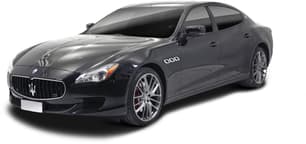
Maserati's Quattroporte is part of a dying breed. A decade or so ago, the European manufacturers took a huge amount of pride in their range-topping big luxury sedans, cars you can either drive or be driven in, bristling with the latest technology.
In 2015, all we hear about are the range-topping SUVs from those makers, with cars like the S-Class and 7 Series fading slowly into irrelevance.
While by no means low-tech, the Maserati Quattroporte takes the high style route, focussing on a luxurious interior with that handmade feel.
Ten years ago, the idea that the higher-riding version of a hatchback would be a good city car would have been laughable. The Focus Active is pitched as a kind of SUV with its different low-grip driving modes, which you'll never touch if you stick to the city.
The Ford Focus is genuinely a brilliant car, no matter where you take it. The Active takes a terrific chassis, tweaks it for comfort but, ironically, doesn't lose much of the speed.
Beauty is way more than skin-deep in the Quattroporte and while the 330 doesn't have the punch of the S, it's hardly that much slower. Maserati reasons you will want to spend the $25,000 saved on options, concentrating on the Italian craftsmanship rather than the outright performance available in the V8 or the efficiency of the less aurally attractive diesel.
As with any car of this type, you've got to want one in the first place, but for a big, beautiful sedan, there's nothing as good looking this side of an Aston Rapide. The Quattroporte 330 does nothing to dim the allure of Modena's big mover and, if you're that way inclined, nobody on the outside will ever know.
For a fairly conservative hatchback, the Focus came under fire for what some termed its derivative styling. I quite like it, and not just because the styling work was led by an Australian. The front end is very much family Ford, as long as it's the European arm of the family, fitting in with its smaller sibling, the Fiesta. The Active scores the usual black cladding, higher ride height and smaller diameter wheels, in exchange for more compliant, higher-profile tyres. All of that takes nothing away from a design that I think looks pretty good.
The cabin is well put together, with just that oddly angled touchscreen causing me a bit of a twitch. The design is a fairly steady Ford interior with a lot of switchgear shared with the Fiesta, but it's all quite nice. The materials feel mostly pleasant and the hardwearing fabric on the seats feels right for this kind of car.
Long, flowing lines mark out the Maserati as something quite different to its German, British and Japanese competition. This Quattroporte has increased in every dimension but the lines cover its size beautifully.
Big wheels, long wheelbase, low ride but it still looks like a sedan rather than pretending to be a coupe.
The elegance of the lines is complemented by a distinct lack of bling – there's little in the way of chrome work or shouty details. There's plenty satin finishes available and the beautiful paint, while available in pretty much any colour you like, is best kept to a restrained, deep hue. Or silver.
The cabin will doubtless age well. Classic shapes house a fairly conventional but hugely comfortable cabin. The front seats have heaps of adjustment and are large but supportive. Naturally, the leather is soft and supple.
The central screen isn't the dominant feature, like a 50-inch LCD screen in a small living room while buttons are kept to a minimum.
The rear seat is sensationally comfortable, with hectares of available space and a seat comfortable for either lounging or working.
The Focus Active wears a $30,990 sticker but the several people I know who bought one haven't paid that much, so Ford dealers are obviously keen to do deals. Even at that price, it's got a fair bit of stuff. The Active has 17-inch wheels, a six-speaker stereo, dual-zone climate control, reversing camera, keyless entry and start, front and rear parking sensors, cruise control, auto LED headlights, LED fog lights, sat nav, auto wipers, wireless hotspot, powered and heated folding door mirrors, wireless phone charging, a big safety package and a space-saver spare.
Ford's SYNC3 comes up on the 8.0-inch screen perched on the dashboard, which weirdly feels like it's facing away from you slightly. It has wired Apple CarPlay and Android Auto, sat nav, DAB+ and also looks after various functions in the car.
The panoramic sunroof is a stiff $2000 and includes an annoying perforated cover rather than a solid one.
The current Quattroporte has been with us now for a couple of years in diesel and petrol turbocharged V6s and turbo V8 forms.
The 330BHP uses the same, Ferrari-built V6 but detuned to 'just' 330 bhp. The price has been detuned too, dropping $25,000 from the V6 S's entry price to kick off at $210,000.
Maserati 330bhp benefits from an overall specification improvement across the range, landing in your garage with a ten-speaker stereo with USB and Bluetooth, power everything, dual-zone climate control, keyless entry and start, front and rear parking sensors with reversing camera, cruise control, sat-nav, auto headlights and wipers, double glazed windows and an interior covered in leather and wood.
Later in the year, your Quattroporte will be available with a new silk trim from Zegna
Only very occasionally does it become clear that Maserati is part of the Fiat Group and that moment comes when you use the 7.0-inch central screen in the dash.
eight-speed ZF automatic transmission
The software is based on the group's UConnect and it isn't great. It's not bad, but it feels its age (however, it's much better than the system on the Gran Turismo), needing a lot more work or a quick surrender to Apple's CarPlay or Android Auto.
Once you work your way through the weird menus, it's fine to use and is miles ahead of the not-much-cheaper Lexus LS unit which is almost unusable.
Sound from the ten speaker stereo is crystal clear and the phone performance is also very good.
Ford does an excellent range of small turbo engines. The "normal" Focus range (such as it is, now the wagon has disappeared from the market) comes with a 1.5-litre turbocharged three-cylinder engine. Bucking the SUV-this-size trend (yes, I know it's not really an SUV), this punchy little unit delivers an impressive 134kW and 240Nm. They're both very decent numbers for such a small engine.
The big numbers continue with the transmission boasting eight gears, a number you don't often find in a hatchback. It's a traditional torque-converter auto, too, so those of you who have bad memories of Ford's old PowerShift twin clutches should worry no more.
Power goes to the front wheels only and you'll get from 0 to 100km/h in 8.7 seconds.
Like the S, the 330bhp is powered by Maserati's twin turbo 3.0 litre V6, made with more than a dash of Ferrari involvement. As the name suggests, it produces 243kW and a chunky 500Nm. With just under two tonnes to shift, the ubiquitous eight-speed ZF automatic transmission whisks the Quattroporte 100km/h in 5.6 seconds, only half a second down on the 301kW V6 S.
Maserati claims 9.1L/100km on the combined cycle (with the help of stop-start), which seems reasonable given our figure of 10.8L/100km, which we got a with a mix of city and highway running as well as a very enthusiastic blast through some secret back roads.
Despite the very mild off-road pretensions, if it's a comfortable city ride you're after, the Active is the Focus to have. While the ST-Line isn't uncomfortable - not by a long way - the Active's more compliant tyres and higher ride height (30mm at the front and 34mm at the rear) iron out the bigger bumps without sacrificing much of the sportier car's impressive dynamic prowess, even with the low-rolling-resistance tyres.
The cracking 1.5-litre turbo is responsive and well-matched to the eight-speed auto. The big torque number pushes you along the road and makes overtaking much less dramatic than a 1.5-litre three-cylinder has any right to.
Ford's trademark Euro-tuned quick steering is also along for the ride, making darting in and out of gaps a quick roll of the wrist, which has the added benefit of meaning you rarely have to take your hands off the wheel for twirling. That darting is aided and abetted by the engine and gearbox, with the turbo seemingly keeping the boost flowing with little lag. It's almost like they planned it that way.
You have good vision in all directions, which almost renders the fact that the blind-spot monitoring is optional acceptable. Almost. It's very easy to get around in, easy to park and, just as importantly, easy to get in and out of. Compared to, say, a Toyota Corolla, the rear doors are very accommodating.
Just a few hundred metres behind the wheel is all it will take to convince you the Maserati belongs in the same class as the competition. It's incredibly quiet – courtesy of the acoustic double glazing – and all occupants benefit from supreme comfort.
While the 330 is 58kW down on the full fat V6, you won't really miss them. There's a fat torque curve, with all 500Nm available from 1750 to 5000rpm, meaning easy progress for the 5.2 metre sedan.
The Quattroporte has two sport buttons to choose from – one looks after the drivetrain and exhaust valving while the second stiffens up the Skyhook suspension.
With the first sport button pressed, you get a more lively throttle, sharper shifts and a glorious noise from the exhausts, although they are a long way from your ears.
It's still a fast car, with strong acceleration from standstill and in the gears, the power as linear as you like with no real turbo lag and a most un-turbo noise to go with the performance.
The only dynamic problem is the electric steering – it seems to get confused between your inputs and feedback from the road, the tyres feeling like they're 'nibbling' an uneven surface, tweaking the wheel in your hands.
The assistance is a little spotty, too, unexpectedly changing weight. It's just a bit weird. In normal driving, you'll never notice it.
The Active has six airbags, ABS, stability and traction controls, forward AEB (low speed with pedestrian avoidance and highway speeds), forward collision warning, lane-departure warning, speed-sign recognition and active lane-keep assist.
Annoyingly - and I can't for the life of me work out why this is a thing - despite some advanced safety features in the base package, you have to pay $1250 extra for blind-spot monitoring, reverse cross traffic alert and reverse AEB, which are part of the Driver Assistance Pack. No, Ford is not the only company to do this.
The back seat has two ISOFIX points and three top-tether anchors.
The Focus scored five ANCAP stars in August 2019.
Six airbags, ABS, stability and traction controls, brake assist, blind spot monitoring and rear cross traffic alert.
There is no ANCAP or EuroNCAP safety rating for the Quattroporte.