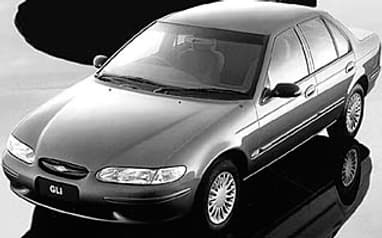
Ford Falcon 1997 Problems

Are you having problems with your 1997 Ford Falcon? Let our team of motoring experts keep you up to date with all of the latest 1997 Ford Falcon issues & faults. We have gathered all of the most frequently asked questions and problems relating to the 1997 Ford Falcon in one spot to help you decide if it's a smart buy.

Used Ford Falcon review: 1992-2000
By Graham Smith · 21 Oct 2003
Before the hot XR6 was unleashed in 1992, fast Fords were V8-powered. So the six-cylinder sports sedan came as a surprise to everyone. The XR6 was a bent-eight beater, but it was much more than that.  It was not only fast, it also handled beautifully and was comfortable.Had we known then what we later found out about Tickford, now called Ford Performance Vehicles, it wouldn't have been such a surprise.  The EBII XR6 was the first glimpse of Tickford's ability to produce a refined sporting sedan that did everything well.  It had often been the case with Aussie-built muscle cars that power was everything.That relentless pursuit often came at the cost of handling, ride and comfort, but Tickford brought a European approach which balanced power and road manners.  Another surprise came in the styling, which was neat and attractive, without being look-at-me in the way of most other muscle cars.  But if the XR6 was rather reserved in appearance terms, there was nothing reserved about it when it hit the road.THE XR6 was based on the EBII Falcon S, a sportier version of the family four-door sedan.  The engine was the Falcon 4.0-litre single-overhead cam unit, an effective but rather harsh and lumbering lump. But it had come under the spell of the engineers at Tickford Vehicle Engineering, Ford's performance partners who started working with the men from Broadmeadows in 1991.By the time Tickford was finished tinkering with the Falcon's head, cam, valves, valve springs, exhaust system and electronics, the fuel-injected six was slamming out a massive 161kW at 4600 revs and 366Nm at 3650 revs. And all of that while running on regular unleaded.It was enough to have the 1529kg sedan sprinting to 100km/h in 7.5sec. The standing 400m sprint was covered in 15.5sec and it had a top speed of 223km/h.They were numbers that had the V8 brigade looking back in horror, but they didn't tell the whole story, which was that the XR6 had plenty of low-end and mid-range punch which made it very driveable.Gearbox choices were a five-speed manual and a four-speed auto which delivered the power to the live axle LSD rear end running a low 3.45-ratio axle which helped it jump out of corners.Back in 1992 Ford was committed to a live rear axle, but Tickford's engineers managed to tame it quite effectively. The XR6 rode lower and had a package of gas shocks, stiffer springs, larger anti-roll bars front and rear which, coupled with revised front-end settings, made the steering precise and responsive and brought an assured balance to the handling.Despite still having 3.1 turns lock-to-lock, the Falcon could be pointed at corners with confidence it would hold its line right through to the exit. There was still some evidence of the roll oversteer associated with the Ford rear end, but it would quickly settle under power.To match the go power, the XR6 was equipped with decent disc brakes, which worked in tandem with ABS. The XR6's rolling stock consisted of 15-inch five-spoke alloy wheels and 205/65R15 Michelin tyres. It stood out from the Falcon crowd with body-coloured bumpers and mirrors, red rub strip inserts and a small rear wing.Inside there were reshaped sports front seats which were more supportive and comfortable than the regular Falcon ones. They had velour facings, were highlighted with red piping, and there was also a leather-trimmed Momo sports steering wheel and gear shift knob.ALL alloy-headed Falcon sixes have a problem with head gaskets. It's not unusual to blow them at any time, but they seem to be more prone to it from about 80,000km onwards.Cylinder head reco experts say there is a problem with coolant circulation, which leads to a steam pocket at the rear of the head which can then lead to gasket failure and cracking of the head.Some even relieve the problem by tapping into the head and allowing the coolant to flow from the problem area through an external pipe.  Suspension bushes can be a problem at higher mileage, and require replacement to restore the XR6's renowned handling.Falcon electrics can also be troublesome. Body control modules are a headache and replacements are expensive, so check the system's operation as thoroughly as you can.  Engine oil leaks are also a common problem. Look at the front cover and power steering pump.MARK Harris bought his white XR6 new in 1993 and has driven it sparingly. It has just 51,000km on the odometer and is driven only on weekends, when he enjoys it very much.  Dion Coughlan bought his three years ago when it had done 175,000km. He has added another 80,000km, and says he drives it hard.It has had a near-death experience when it was hit by a bus. Despite a few rattles, Dion says it still performs well. Apart from minor things such as a fan belt, the only things Dion has had to replace are the front suspension bushes.
Read the article
Used Ford Falcon review: 1997
By Graham Smith · 15 Feb 2003
Falcon GT owners and enthusiasts around the country are holding their breath hoping that Ford doesn't attempt to perpetrate another cruel hoax on them when it unveils the new BA GT this month.  It did in 1997 when it launched the EL GT. In celebrating the 30th anniversary of the great Australian muscle car, Ford delivered a vehicle that fell short of just about every measure that defines a true Falcon GT.In the nine years between 1967 and 1976 the Falcon GT carved out a special place in Australian motoring history. Its combination of performance and luxury defined a new type of car in the local market.Add to that the legendary racing feats of the mighty GTHO at Bathurst and other tracks around the country, and the GT became an icon that is as revered today as it was in its heyday.Ford dropped the GT for on the grounds of politically correctness in 1976, choosing to build special GT models to celebrate anniversaries.  There was the EB GT in 1992 to celebrate the GTs 25th anniversary and the '97 EL GT.  Both were limited editions, and for that reason have become collectable, but to GT enthusiasts they were mere parodies of the real thing.The key to the original GT was its unique blend of performance and luxury equipment, which made it a great high-speed highway cruiser.  But by the time the EL rolled around it had become soft and new-age sensitive, with a clear emphasis on comfort which showed that the youthful tearaway had entered middle age.It was impossible to miss an EL GT. With its Darth Vader grille and high-mount rear wing it could have come straight out of a sci-fi comic.  Unfortunately, its performance didn't back up its aggressive on-road presence, and it was largely dismissed by the GT fraternity.Ford insiders admit today that they wished they hadn't built the EL GT because it sullied the proud heritage of the original GT and created a scepticism in the community about the true credentials of any future GT they built.  For that reason there is a feeling that the new GT has to be true to the heritage while at the same time being a truly modern performance car.Just 250 EL GTs were built in 1997, 135 of which had automatic transmissions – which should give an indication of what Ford was thinking when it built the EL – and 115 had manual gearboxes. A further 15 were built for New Zealand and another two were sent to South Africa.The power came from a hotted-up 5.0-litre V8 which pumped out 200kW at 4700 revs, an impressive figure for the time, and 420Nm at 3700 revs. It had special cylinder heads, high compression, big valves, heavy-duty valve springs, roller cam followers, fuel-injection, a larger throttle body, and exhaust extractors.Ford boasted that a GT equipped with a manual gearbox could race to 100km/h in a little under seven seconds and cover the standing 400m sprint in a fraction over 15 seconds. The auto version was about half a second slower.  On their own the numbers sound respectable enough, until you realise that a GT from the late 1960s or early 1970s would comfortably better them. Gearbox choices were a four-speed auto, which was recalibrated to suit the GT, and a five-speed manual, which had a heavy-duty clutch, strengthened gears and a short-throw gearshift.  It had a lightweight drive shaft connected to a Hydratrak differential running a short 3.45 ratio.Under the sci-fi skin lay uprated suspension and brakes. At the front there were higher-rate springs, re-tuned shock absorbers, a larger anti-roll bar and urethane bushes in locations crucial to handling.  At the back the live-axle was enhanced through higher-rate springs, retuned shock absorbers, a larger anti-roll bar and urethane bushes.Braking performance was substantially increased, with twin-piston front callipers and larger disc rotors front and rear.  The wheel arches were filled with 17-inch alloy wheels wrapped in Yokohama 245/40 VR17 performance tyres.Inside the EL GT was awash with luxury leather and woodgrain trim, along with a long list of creature comforts including airconditioning, power windows and mirrors, and a sound system. Both driver and passenger had the protection of airbags.But there was no sign of the vibrant classic colours like Vermilion Fire, Wild Violet, True Blue and Yellow Ochre. Instead there were three colours on offer with the bland names of Heritage Green, Sparkling Burgundy and Navy Blue.The key to maintaining the value of your GT is to use it sparingly. Many have been bought as second cars to be used for fun on weekends only, and they are the cars to seek out if you want to buy one.Lovingly cared for, these cars rarely have any dings in the bodywork, and the interior is normally in near-new condition.  Check for bodywork damage, in particular look for mismatches in the metallic paint, and quiz the owner on why he or she wants to sell.Most buyers of GTs bought them for the long haul, so question their motive for selling now.  EL GTs have generally done such little mileage that few things have gone wrong with them, and those things that have needed attention have been fixed quickly by proud owners.
Read the article
Falcon's bad vibes
Answered by CarsGuide team · 11 Aug 2005

A LOT of work has been done in recent models to make the Falcon six smoother. A rather large engine, it is subject to vibration. This was regarded as fairly normal in past models because we didn't complain about it. The vibration your father is feeling sounds like a drive-line vibration -- a less-than-pleasant feature of all Falcons of that era. Try looking at the prop shaft, particularly the shaft angles. But it is more likely coming from an overall drive-line stiffness problem, with contributions from many areas, including the transmission housing, the engine and transmission mounts, the prop shaft, prop shaft angles, even the suspension mounts and wheels and tyres. Sorry.

Go for the rumble
Answered by CarsGuide team · 27 May 2004

THE XR6 was something of a revelation from the start. Its performance was close to the XR8, and it had a better on-road balance which made it feel lighter and livelier. The other factor was the price difference which made the less expensive XR6 seem like a good buy against the XR8. Against that, there's nothing like the rumble and feel of a V8, so go that way if that's what you'd like. As for fuel consumption, it depends on whether you're a lead-foot or not. Ford didn't publish fuel consumption figures for their sporty cars, but I would expect around 13 litres/100km from the XR8.

Flood and fire
Answered by Graham Smith · 15 Apr 2004

MORE than likely you have a leaking injector that allows fuel to flow into the cylinders while the car is sitting. When you start the engine, there is so much fuel in the cylinder that it's flooded. The fuel has to be cleared before the engine will fire. Get the injectors checked by a specialist. You may be up for one or more new ones, but the problem should be solved.

Futura idles roughly
Answered by Carsguide.com.au · 01 Dec 2006

Could be. Try to isolate the problem by swapping components between cylinders and see if the problem follows the component. Swap injectors, spark plugs and leads, one component at a time. Check the compression. It sounds more than a blocked injector.

Lock and load
Answered by CarsGuide team · 28 Apr 2005

THIS was quite a common fault with the EF Falcon and was supposed to have been fixed with the EL. It was an adjustment problem and Ford issued a service advice with a solution. When the temperature climbed expansion in the locking mechanism sent the locking system haywire. I'd consult your dealer and have them fix the problem, and ask for it to be done at Ford's expense. An auto electrician will know what to do.

Some blight spark
Answered by Carsguide.com.au · 21 Sep 2006

THE most common cause for an LPG engine to stall is a stray spark igniting the gas in the intake manifold. When that happens it can take some time for enough gas to accumulate in the engine again for it to refire. I would have the fuel and ignition systems thoroughly checked. I would first replace the spark-plug leads.

Disclaimer: You acknowledge and agree that all answers are provided as a general guide only and should not be relied upon as bespoke advice. Carsguide is not liable for the accuracy of any information provided in the answers.
Have a new question for the CarsGuide team?
More than 9,000 questions asked and answered.
Complete guide to Ford Falcon 1997
Complete guide to Ford Falcon 1997 CarsGuide Logo
Reviews, price, specs and more