What's the difference?
Forget California! Ferrari is an Italian brand, so when the time came for the marque to redo its entry-level model - as well as rename it - the geographical tack was at last rightfully placed in its home country.
Enter the all-new Ferrari Portofino 2019 model.
If you’ve travelled the Italian coast, you might know Portofino. It’s located on the picturesque Italian Riviera at the edge of the Ligurian Sea, between Cinque Terre and Genoa, and it’s known for attracting wealth and celebrity to its exclusive shoreline.
It’s gorgeous, classic, timeless; all terms also suitable for this new convertible model, which looks so much better than the California did. And, quite truthfully, it looks more Italian, which is important for this macchina, a true auto sportivo italiana.
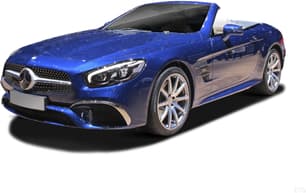
Peter Anderson road tests and reviews the 2016 Mercedes-AMG SL63 with specs, fuel consumption and verdict.
Well. They don't make cars like this anymore, do they? Time was, a big coupe or convertible were de rigeur for the well-heeled banker, with 12 cylinders almost a given and fuel consumption measured in super tankers, or more likely just not talked about at all.
The world has changed but Mercedes’ SL hasn't. That's not strictly true, of course. The SL63 may drop four of the SL65's 12 cylinders, but at just half a litre smaller and still with twin-turbos it generates the enormous thrust a luxo-barge like this needs. The things that made it an icon are indeed still there - lots of tech, a style all its own and a name everyone recognises.
The overall score doesn’t necessarily reflect how good this car is, but that’s because we have to factor in safety kit and equipment. Those things matter, sure. But if you really want a Ferrari Portofino, you’ll probably read the drive impressions and look at the photos, both of which should be enough to push you over the line if you’re not quite there yet.
The Ferrari Portofino 2019 model is not just bellissimo to look at, it’s also a more Italian offering. And that’s buonissimo.
The SL's overall score is somewhat skewed by everyday concerns, and rules are rules - an average punter will find the price of this car somewhat confusing and the devil-may-care attitude to fuel consumption bewildering.
If neither of these things are a problem, then the SL63 makes plenty of - well, not sense, because it's not a particularly clever or considered car - but it fills a niche that not so long ago we all thought would go the way of the dodo.
The fact it sells so few examples is betrayed by some of the cabin amenities and the fact that Mercedes hasn't put much effort into reducing the car's weight to improve its consumption or sharpen up the handling.
The fact it still exists at all is pretty damn cool, though, and for certain people an SL63 purchase is the culmination of a lot of hard work.
If it is your dream car, the SL63 won't disappoint. Everyone who rode with me said it was mightily impressive, but you've got to really want it. When you're not far off buying a Ferrari California T or Aston Martin V12 Vantage S for the money, you'll need a real yearning for the three-pointed star to go this way. And if you do, good luck to you - you've probably worked quite hard to get here.
It’s a more angry-looking entry-level car for the iconic Italian brand, but not in an ugly way.
Sure, some angry faces aren’t pretty. But I bet if Elle Macpherson or George Clooney got cranky at you, you’d still probably find them attractive. And so it is with the Portofino, which has a mildly menacing front end, some scintillating curves over its taut metalwork, and a pair of high-set hips with bold tail lights.
It is undeniably more muscular than the old California was. And filling the wheel arches are 20-inch wheels, which measure eight inches wide at the front (with 245/35 rubber) and ten inches wide (285/35) at the back.
This isn’t a compact car, either - with dimensions of 4586mm long, 1938mm wide and 1318mm tall, the Portofino is longer than some mid-sized SUVs. But boy, does it pull its size off well.
And like many of the beachside manors in the seaside town for which the new model is named, you can shutter yourself in to combat bad weather. The folding electronic roof system takes 14 seconds to raise or lower, and can be operated at speeds up to 40km/h.
I actually think it looks better with the roof on. It’s not often you can say that about a convertible…
The SL has always been completely unapologetic about its size and seems to be designed to accentuate rather than hide its length and width. The long bonnet screams power and prestige, and get out of my way, and is reminiscent of the little-loved McLaren SLR project of some years ago.
The size of the Mercedes logo on the huge front grille leaves you in little doubt about the brand of car that’s about to pass you at speed and some might say (okay, I would) that its large surface area is a little vulgar.
Like the SLR, the design doesn't seem to have a particularly cohesive strategy, with a number of Mercedes elements from around the traps that climb over each other. Roof up it looks awkward because of the gigantic posterior while with the roof down it looks overly long and, again, tail-heavy.
Folding hardtops are notoriously cumbersome and need a lot of room to hide them, but the silent operation is something to behold.
Elements that are worth deleting if possible are the dodgy 'Biturbo' badges. It's that kind of bling that gets people raising their little finger at you.
You aren’t buying a Ferrari if you want the most practical car for the money, but that doesn’t mean there isn't some semblance of pragmatism to the Portofino.
There are four seats. I know, it’s amazing to think there’s a point in making the Portofino a 2+2 seater, but according to Ferrari, owners of the outgoing California model used those back seats about 30 per cent of the time.
I wouldn’t want to be in the back row that much. It’s designed to play host to little kids or small adults, but anyone nearing my height (182cm) will be very uncomfortable. Even tiny adult males (like fellow auto scribe Stephen Corby, for example) reckon it’s tight and not a pleasant place to be back there. (link to existing review). But if you have kids, there are two ISOFIX child seat anchor points.
The boot space is not huge, but with 292 litres of cargo capacity with the roof up, there’s enough room for a weekend’s worth of luggage for a couple (Ferrari says you can fit three cabin bags in that configuration, or two with the roof down). And - a tidbit for the actual customers out there- it has more luggage capacity than you get in a new Corolla hatch (217L).
As for cabin comfort, the front seats are sumptuous, and there are some nice elements like the 10.25-inch infotainment screen, which is pretty easy to use, if a little slow to load when you’re skipping between screens or trying to key locations into the sat-nav system.
There are also two 5.0-inch digital screens in front of the driver, mounted either side of the rev counter, and the front passenger can have their very own display with speed, revs and gear on show. It’s a neat option.
While it may have some long-distance touring pretence, the Portofino isn’t a beacon of loose-item storage. It has a pair of cupholders, and there’s a small storage tray that will fit a smartphone.
“Practicality” is about as relevant to this car as a code of ethics is to a drug dealer or a contract killer, because the SL63 buyer is hardly worried about cupholders and boot space. For what it's worth, there are four cupholders in the two-seater cabin (which might explain why owners aren't worried about their liquid carrying prospects) and a minimum boot space of 364 litres and a maximum - with roof up - of 504, which is actually not bad.
Cleverly, there's a little robot-operated luggage cover inside the deep boot that stops your gear from being crushed when the roof goes down.
There's also space in the long doors where you might secrete a bottle of wine that would get a NSW Premier fired if he thanks you for it, and a bin in the console to hide your phone.
It would be silly to think that people who can afford a Ferrari aren’t conscious of finance. Most people who can buy a car like this are very specific about what they will and won’t spend their hard-earned cash on, but according to Ferrari, about 70 per cent of projected Portofino purchasers will be buying their very first Prancing Horse. Lucky them!
And at $399,888 (list price, before on-road costs), the Portofino is as close to an affordable new Ferrari as you’ll get.
Standard equipment includes that 10.25-inch media screen that runs Apple CarPlay (an option, of course) and includes sat nav, DAB digital radio, and acts as a display for the reversing camera with parking guidance lines, plus there are front and rear parking sensors as standard.
The standard wheel package is a 20-inch set, and of course you get leather trim, 18-way electronically adjustable front seats, plus heated front seats and dual-zone climate control, and there’s proximity unlocking, too (keyless entry) with a push-button starter on the steering wheel. Auto LED headlights and auto wipers are standard, as is cruise control and an auto-dimming rear-view mirror.
Speaking of Ferrari’s fantastic Formula One-inspired wheel (with paddle shifters), the version with the carbon fibre trim and integrated shift LEDs fitted to our car cost an extra $8300. Oh, and if you do want CarPlay, that'll be $6793 (which is more than the best Apple computer you can buy), and that reversing camera will add $6950 to the price. WHATTTT???
Some of the other options fitted to our car included the Magneride adaptive dampers ($8970), the LCD passenger display ($9501), adaptive front lighting ($5500), a premium hi-fi sound system ($10,100), and a foldable rear-seat backrest ($2701), among plenty of other interior elements.
The as-tested price for our just-under-four-hundred-grand Ferrari, then, was actually $481,394. But who's counting?
The Portofino is available in 28 different colours (including seven blue hues, six grey options, five red and three yellow paint choices).
It’s difficult to ponder the idea of value when a car is already approaching $400,000 at a rapid rate even before you start piling on the options. On the plus side, for a list price of $368,715 you do get an extremely long list of standard equipment.
The SL has always been completely unapologetic about its size.
Edited highlights include leather on almost every available surface, heated and cooled electric seats with a fan heater for your neck, a B&O stereo that will shatter the windscreen on request, aluminium trim that's real aluminium (mostly), Active Ride suspension, sat nav, dual-zone climate control, active cruise, LED headlights and a huge swag of safety gear.
The 12-speaker stereo also has DVD, limited smartphone integration via Mercedes' COMAND system, a seven-inch screen and, of course, Bluetooth.
The 3.9-litre twin-turbocharged petrol V8 engine produces 441kW of power at 7500rpm and 760Nm of torque from 3000rpm. That means it has a sizeable 29kW more power (and 5Nm more torque) than the Ferrari California T it replaces.
Plus the 0-100 acceleration time is better, too; it will now hit highway speed in 3.5 seconds (was 3.6sec in the Cali T) and moves past the 200km/h marker in just 10.8sec, if you believe Ferrari’s claim.
Top speed is “more than 320km/h”. Didn’t get a chance to test that, sadly, nor the 0-200km/h time.
The kerb weight for the Portofino is 1664 kilograms, while the dry weight is 1545kg. The weight distribution is 46 per cent front, 54 per cent rear.
The SL63 is powered by Mercedes’ increasingly famous V8, with two turbos along for the ride to add oomph and cut the car's famous consumption, at least slightly. The 5.5-litre unit produces a massive 430kW and a scarcely believable 900Nm of torque.
All of that heads rearward via a seven-speed dual-clutch transmission that helps sling the 4.6m, 1848kg machine to 100km/h in 4.1 seconds.
The twin-turbo-V8-powered Ferrari Portofino uses a claimed 10.7 litres per 100 kilometres. Not that fuel costs are a big concern if you’re spending $400k on a car.
But that’s more than, say, a Mercedes-AMG GT, (9.4L/100km; 350kW/630Nm) but not as much as a Mercedes-AMG GT R (11.4L/100km; 430kW/700Nm). And the Ferrari has more power than both of those, and it's quicker, too (and more expensive…).
Fuel-tank size for the Ferrari Portofino is 80 litres, enough for a theoretical mileage range of 745km.
Much as is the case with the price, there's no real way to soften the blow here - the SL63 drinks like a footballer on Mad Monday, except it does it every day. The official combined cycle figure of 10.2L/100km is quite easy to double, as we did, averaging 21L/100km in mostly flowing suburban traffic. In the car’s defence, the accelerator pedal spent a good deal of time near the firewall.
The SL does have stop-start to help reduce its considerable environmental impact.
Compared to the California T it replaces, the new model is stiffer, has a lighter all-aluminium chassis, gets a reworked transmission and also includes an electronically controlled limited-slip differential.
It’s faster, has more tech - like electronic exhaust bypass valves to make it sound better - and it's gorgeous.
So it's fast and fun? You bet. It has electronic power steering, which mightn’t be as tactile in terms of road feel as a vehicle with a hydraulic steering setup, but it is rapid in its reactivity, and arguably offers better point-and-shoot ability as a result. Old diminutive Corby criticised it for being very light and somewhat lacking, but I reckon that as an entry point to the brand, it serves as a very manageable steering setup.
The adaptive magnetorhelogical dampers do a magnificent job in allowing the Portofino to ride over rough patches of road, including pockmarks and potholes. It hardly ever feels ruffled, although there is some scuttle shake to the windscreen, as is often found in convertible cars.
The most surprising element to this Ferrari is that it is supple and reserved at times, but can turn into a manic machine when you want it to.
With the Manettino drive-mode dial on the steering wheel set to Comfort, you will be rewarded with sedate progress and cushioning from the road surface below. In Sport mode, things are all a bit more growly and rigid. I personally found the transmission in this mode, when left in Auto, was eager to upshift to help save fuel, but still responded pretty quickly when I put my foot down hard.
Turning Auto off means it’s you, the pedals and the paddles, and the car won’t overrule your decisions. If you want to see just how realistic that 10,000rpm tacho top is, you can test it in first, second, third… oh wait, you need to keep your licence? Just keep it to first.
Its braking is tremendous, with aggressive application resulting in seatbelt-tensioning response. Plus not only was the ride comfortable, the balance and control of the chassis was both predictable and inherently manageable in corners, and there was plenty of grip, even in the damp.
With the roof down, the noise of the exhaust is exhilarating under hard throttle, but I found it droned a bit under less-urgent acceleration, and in most instances of ‘regular driving’ it actually just sounded loud, rather than lush.
Things that were annoying? The throttle response is dull for the first part of the pedal travel, making for some testing moments in traffic. Not helping that is the fact the engine stop-start system is exceptionally overactive. And that there’s no fuel use readout on the digital trip computer screen - I wanted to see what the car was claiming in terms of fuel use, but I couldn’t.
There are a number of impressive things about the way the SL drives. Firstly, astronauts will be familiar with the galactic thrust of the V8. It seems endless, seamless and ready to sling the big coupe into the outer atmosphere. Few engines of any kind can match the relentless go on offer in the SL and much of the credit should go to the seven-speed twin-clutch transmission.
When you jump on the brakes and shift down, the exhaust keeps the show going with angry crackles and pops.
Containing a torque figure like the twin-turbo V8's requires a lot of electro-trickery to stop you from being launched off the road. The great thing about all that stuff is that it works unobtrusively and smoothly.
Mashing the carpet in an SL without traction control would create much sound and smoke but little forward progress, such is the twist on tap. The SL has a range of modes from full-nanny (which is meant to keep you on the slippery Alpine road you've chosen to get you to some Swiss ski resort) while turning the dial all the way around to Race loosens the bonds.
It's in this mode you'll have the most fun and it does seem that the intermediate settings are a bit of a waste of time. Race mode does little to diminish the amazing ride quality provided by the active suspension setup, but relaxes the reins on the huge rear tyres. Exiting roundabouts is suddenly a huge laugh, with the tail cheerfully breaking traction and the two-mode exhaust thundering in a most pleasant way.
Better still is that when you jump on the brakes and shift down, the exhaust keeps the show going with angry crackles and pops, with more on the way when you lift off. There's little to match the aural pleasures of a properly tuned V8 and Mercedes has resisted the temptation to quieten it down on the outside and generate a fake noise for the inside. Although that would be stupid in a convertible, if you think about it.
The SL63, despite its AMG badge, isn't about all-out handling, of course. The Ferrari California would definitely show it how it’s done on a winding country road. The SL is more about flow, building momentum and rarely shifting down to second gear. The monstrous torque is enough to keep things rolling but should you wish for a bit more of the exhaust bellow, second is there for the taking.
Hustling the big convertible feels wrong, not because it can't do it, but because it's not really what it's for. Having said that, it offers a kind of fun that nothing else on Earth will provide, not even a Bentley GTC.
With the roof up, the SL63 is a quiet place but not remarkably so. The huge sticky tyres do the cabin's hush no favours, with an annoying roar on a wider range of surfaces than you might expect.
Roof down, it's hardly a paragon of virtue. A lot of wind noise reaches the cabin, even well below the huge speeds the SL can reach. So if you want to talk, it's windows up you'll need to deploy the mesh screen that bridges the roll hoops.
There is no ANCAP or Euro NCAP crash-test score available for any Ferrari model, and it’s fair to state that safety tech isn’t the reason you buy a Ferrari.
The Portofino, for instance, has dual front and front-side airbags, and an advanced stability control system… but that’s about it.
Things like auto emergency braking (AEB), lane-departure warning, lane-keeping assist, blind-spot monitoring and rear cross-traffic alert are all unavailable.
Six airbags, ABS, stability and traction controls, blind-spot sensor, lane-departure warning, brake assist, active safety bonnet, lane-keep assist, driver attention detection, AEB.
Ferrari servicing won’t cost you a cent for the first seven years, and that’s whether you hold on to it or sell it - the new owner will have access to complementary maintenance for whatever is left of the initial seven-year period.
The standard warranty offer from Ferrari is a three-year plan, but if you sign up for the New Power15 program, Ferrari will cover your car for up to 15 years from the first registration date, and that includes cover for major mechanical components including the engine, transmission, suspension and steering. It reportedly costs $4617 for V8 models like this - a drop in the financial ocean at this price point.
The SL63 is covered by Mercedes' three-year/unlimited kilometre warranty. And, er, that's it.