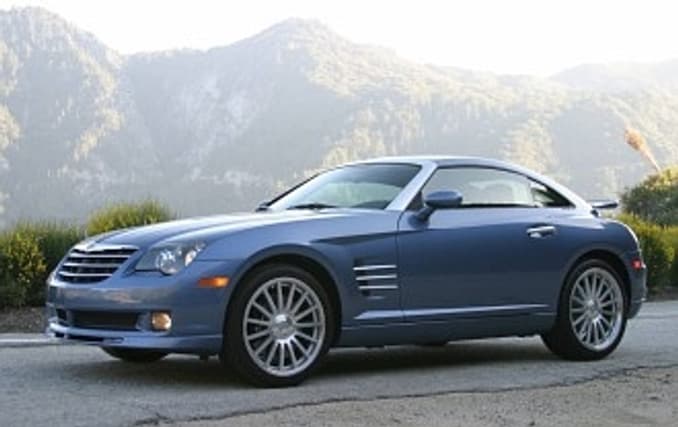
The Chrysler Crossfire was launched in 2003 as a two-door sports car built on Mercedes-Benz underpinnings. Developed during the DaimlerChrysler era, it shared much of its chassis and running gear with the Mercedes-Benz SLK. The Crossfire was built in Germany by coachbuilder Karmann and sold in both coupe and convertible body styles. Its styling stood out with a sharp roofline, wide stance and distinctive rear end.
By 2005, Chrysler expanded the range with the Crossfire SRT-6. This version used a supercharged 3.2-litre V6 from AMG and delivered a sharp performance lift over the standard car. Despite its unique character, sales slowed and Chrysler discontinued the model in 2007. In Europe the car was sold under the same name, with no major regional variations beyond trim levels.
Today, the Chrysler Crossfire is remembered as a rare experiment in trans-Atlantic cooperation. It never reached big sales numbers but found a niche following. The car now occupies a left-field spot in the used market, often attracting buyers looking for something unusual.
The line-up currently starts at $8,800 for the Crossfire (base) and ranges through to $16,170 for the range-topping Crossfire Srt-6 Roadster.
The first thing to do is find out where the leak is exactly. It could be in some of the plumbing that takes the water form the reservoir to the washer jets, but it's probably more likely to be a crack in the plastic reservoir itself.
If that's the case, you could try to mend it with some epoxy (or a lump of some other repair material) but if the tank is old and brittle enough that it's already cracked, the repair will almost certainly be temporary at best. What you need to do is find a replacement reservoir and fit that to the car. The problem there is that even a second-hand reservoir from a parts recycler will probably be just as old as the one you're replacing and might fail in the same way in the not too distant future.
You might get lucky and find an online seller with this exact product brand new, although you might have to order it from overseas. When it arrives you'll probably have to remove the pump unit from your old bottle and fit it to the new one, although some sellers provide the whole battle and pump assembly. That will be the dearer option.
You could also buy what's called a universal washer bottle kit. These are designed to 'fit all cars' but don't actually fit anything perfectly, particularly something relative modern like a Crossfire which has a pretty convoluted bottle shape to fit the space it's designed for.
Show more
You’d expect this to be a yes or no answer, but the reality is a little different. Your car can theoretically use E10 fuel, but only if that fuel has an octane rating of at least 95 RON. Much of the E10 fuel sold in Australia has an octane rating of 94, not the 95 you need, so unless the pump states that the fuel it dispenses is 95 RON, you might be better to stick with normal unleaded.
This suggests that while your car has the specific fuel system fittings that won’t be damaged by the ethanol content in E10, the engine is tuned for 95-octane fuel and could suffer pre-ignition (also called pinging or detonating) if run on 94-octane fuel. In turn, this is probably because the car was designed for a market where E10 fuel is, in fact, uniformly 95 RON, and Australia simply doesn’t line up with that.
Show more