What's the difference?
Chevrolet’s Corvette Z06 supercar is an all-American answer to European rivals Lamborghini and Ferrari, but it’s not just this that makes it so appealing.
Spending a week with the most potent Corvette you can get in Australia has left me with a list of notes on this beast I want to hand over to you. Maybe it will help make your mind up about it or change your mind.
What makes the Z06 the flagship of the Australian Corvette range isn’t little luxuries, but seriously upgraded mechanical hardware, much of it track focussed.
Our test car was also fitted with the Z07 Performance package which adds a carbon-fibre aero kit to pin the Corvette down at high speed while also drawing everybody’s attention to it.
Oh, and then there’s the sound of the largest flatplane crank V8 ever to go into a production car… and look out for your ankles - let me explain…
This week I’m family testing the new Mazda CX-5 Akera G35 and the top-grade model is well-equipped. But it faces stiff competition in the mid-sized SUV market with rivals like the Honda CR-V, Kia Sportage and the ever-popular Toyota RAV4.
How do you remain competitive in one of the most popular SUV classes? My family of three is finding out for you!
The Chevrolet Corvette Z06 is truly a supercar offering outstanding dynamics for a lot less money being asked by European rivals - just make sure it's not your only car for those times when you're in a hurry.
The Mazda CX-5 Akera G35 offers small families a great host of premium features, as well as solid power and handling – all in an attractive package. But the emphasis here is on ‘small’ families because it’s on the compact side for a mid-sized SUV and its rivals offer more back seat space.
Its ongoing costs are reasonable and I enjoy driving it, so it gets a 7.6/10 from me.
My son calls out the back seat as a bit squishy but he otherwise likes it. He gives it a 7.0/10
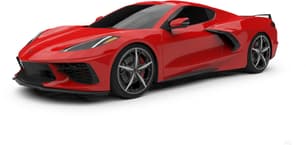
We’re talking about the closest thing to a real-life Hot Wheels car here. See, while Ferraris look elegant to me like expensive jewellery, Lambourghinis like cheese graters and McLaren’s look like slippery alien spacecraft, the Corvette Z06 looks exactly like an American supercar should - an unapologetic, ludicrous beast. And I love that.
Dialing up the wild is that enormous carbon wing and front splitter with dive planes thanks to the Z07 package. Just a word of warning, though, the front splitter and dive planes stick out not just visually, but in the sense that I walked into them often and my ankles still have the scars.
I can’t recall the last time I drove a car with carbon-fibre wheels either - these are the biggest rims fitted to a Corvette and they’re wrapped in Michelin Pilot Sport Cup 2R ultra performance tyres (275/30ZR20 front and 345/25ZR21 rear) that they look like oil drums on their sides.
The best angle? The rear - straight on. Those headlights.
Wait, no, it’s from above - so you can see the V8 through the glass hatch.
Or it could be front-on looking like a giant shovel..
OK, there are no bad angles..
The Corvette Z06 is long at 4734mm end-to-end, broad at 2024mm wide and its height is a both a sitting-on-the-road-low and numerically pleasing 1234mm.
The plainness of the cabin might be a let down to some people after all the exterior wildness. Ferraris and Lambourghis offer extravagant and exotic interiors, but the Corvette’s innards are almost completely void of flare.
The media screen is small (8.0 inches), switches and controls for windows and air vents are basic, and the huge dividing ‘wall’ between the pilot and passenger might be a bit much for some.
That ‘wall’ is dotted with buttons and while it may look very 'fighter jet cockpit', they’re just climate control switches. Sitting in the passenger seat is a lonely place with no screen visibility nor easy access to controls - I'd actually call this out as a bit of a fail compared to the interiors from Porsche, Audi and Lamborghini with their screen-filled cabins offering co-pilots something to do.
Yes, it feels a bit premium with the Nappa leather and the sports seats, but it could feel more special.
All of this plainness, however, is saved from boredom by the glass window behind the seats allowing you to peer into the engine bay at the V8 like at a reptile enclosure at the zoo.
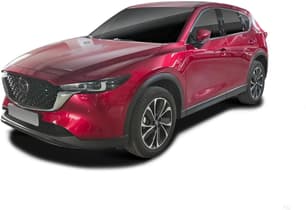
The Mazda CX-5 hasn’t seen much change to the exterior other than a more horizontally-styled grille. It’s a medium SUV with a handsome kerb-side presence thanks to its full-suite of LED lights and 19-inch alloy wheels. It’s an inoffensive design that should appeal to a wide audience.
The interior looks premium with the brown Nappa leather upholstery and black leather trims. The plethora of soft-touchpoints throughout reinforces that the Akera is the top model.
There's one thing I really like about Mazda and that's how it manages to balance the traditional with the new. The cabin is a seamless blend of the two elements.
The instrument panel features a 7.0-inch digital display but still has analogue dials. There's a 10.25-inch multimedia system on the dash but still a bunch of control buttons and dials to press. The gear shifter is coupled with an electric brake, the sunroof is coupled with a manual blind. You get it.
This duology between high-end tech and traditional elements makes the interior feel up to date but very accessible.
Supercars don’t tend to be built with practicality as a priority but this two-door, two-seat beastie is spacious enough even for me at 185cm tall with plenty of room in the footwell and loads of elbow-, knee-, and headroom.
Cabin storage is limited to a glove box, door pockets, two cupholders, and a wireless phone charger on the bulkhead behind the seats.
As you can see from the images there’s a boot at the rear which will fit smaller bags and a small boot in the front.
I did the school run in the Corvette a few times (I know, lucky kid) and I can tell you a bass guitar in its case and a school bag, plus my own large handbag make for a cramped cabin. A Kia Carnival the Corvette ain’t, but it’s not trying to be one and compared to its rivals it does well for practicality.
Despite sitting in the medium-SUV segment, the CX-5 is on the compact side for cabin space and front passengers benefit the most in terms of leg- and headroom.
Back rowers get a decent amount of headroom but legroom is squishy and my legs press into the back of the drivers seat when its in my driving position, and I'm only 168cm tall!
My seven-year old complained about his space and asked Dad to slide forward for more room, which is something to consider if you have gangly teenagers.
The seat comfort sits on the firmer side for both rows and the electric front seats are narrower and shorter than I like for long journeys but for the A to B trips, they’re comfy enough.
Only the driver’s seat gets powered lumbar support but they both have heat and ventilation functions.
Individual storage is average for this class with a smallish glove box and middle console that has a removable shelf. A deep utility tray, which houses the wireless charging pad and a 12-volt port, sits in front of the gearshift and there are two cupholders in the centre console.
Each door has a shallow storage bin and the front doors also get a skinny drink bottle holder.
For individual storage in the rear, you get map pockets on the rear of the front seats and two cupholders in a fold-down armrest.
The armrest also houses two USB-A ports and the heat function buttons for the outboard seats and it's because of this positioning and the narrower width of the seat, that the back row feels more suited to two, rather than three passengers.
The technology on the whole is easy enough to use but the rotary dial operation of the multimedia system is a bit annoying to access while on the go.
The wireless Apple CarPlay and Android Auto is a great feature and means one less cable to worry about but the built-in satellite navigation with 10-year map updates is a highlight. The head-up display pulls through the nav directions, too, which is always handy.
You also get two USB-C ports and another 12-volt outlet up front, so everyone should be sorted for charging.
The boot features a powered tailgate which is a handy family feature and a temporary spare tyre is located underneath the level floor.
You get 438L of storage capacity with the second row seat upright, which is plenty for my errands and grocery shop. That jumps up to 1340L (VDA) when the rear seats are folded.
The cargo cover attaches to the lid, meaning it stays out of the way when you're loading stuff into the boot.
Almost never does a car with a list price of almost $400K get full marks, but here we are and I’ll tell you why. The Corvette Z06 in its standard form lists for $336,000 and this is outstanding value compared to its supercar rivals such as the Ferrari F8 Tributo for $484,888, or a McLaren 750S for $585,800 or even an entry-grade Lamborghini Huracan, the EVO, for $383,187.
Australia gets the top 3LZ trim, with the local standard features list for the Corvette Z06 including Nappa leather upholstery, GT2 bucket seats, a 12-inch digital instrument display, a 14-speaker Bose sound system, red seat belts, wireless phone charging, carbon-fibre and suede microfibre trimmed steering wheel, a media system with sat-nav plus wireless Apple CarsPlay and Android Auto, power seats, heated steering wheel, dual-zone climate control, heated and ventilated seats and a head-up display.
Our test car was fitted with plenty of options including the Z07 Performance Package that brings carbon-fibre everything. We’re talking the enormous carbon-fibre rear wing and aero kit with side skirts and a front splitter with dive planes –and there are the carbon-fibre wheels (20-inch at the front and 21-inch at the rear).
The Z07 package also brings a more hardcore suspension tune and carbon ceramic brakes for ridiculously good stopping power.
The Z06 has the most powerful V8 engine in the Corvette range, too, and we'll get to that soon.
There are five grades for the CX-5. The top two grades, the GT SP and Akera, have a choice between a 2.5-litre petrol or turbo-petrol engine.
On test here is the flagship Akera grade with the 2.5L turbo-petrol engine. Before on-road costs, it is priced at $55,000. That positions it towards the top-end of its competitors with the Kia Sportage GT-Line AWD coming in at $49,920 (MSRP) and the Toyota RAV4 sliding in just under at $54,410 (MSRP). However, the new Honda CR-V is more expensive by $2.0K.
The Akera is well-equipped with premium features like a sunroof, heated and ventilated front seats, heated rear outboard seats, a heated steering wheel and brown Nappa leather upholstery.
The technology is well-rounded with a 10-speaker Bose sound system, wireless Apple CarPlay and Android Auto and a 10.25-inch multimedia system with built-in satellite navigation (including map updates for 10 years).
There are some good practical features, too, like a powered tailgate, keyless entry and start as well as powered lumbar support on the drivers' seat.
The 5.5-litre naturally aspirated V8 in the Z06 makes 475kW and 595Nm. That’s a lot more power than the Corvette Stingray’s V8, which produces 369kW. The GT3 racecar version of the Z06 uses a derived version of the 5.5-litre V8, and actually it shares 70 per cent of the engineering components.
Revving to a high 8600rpm the Z06’s V8 lets out a high-pitched scream when pushed hard, much like a Ferrari because like many Ferraris the Z06 has a flatplane crank V8 - actually it’s one of the largest flatplane V8s to go into a production car.
Corvettes are now mid-engined cars and the Z06 has an eight-speed dual-clutch transmission that changes gears quicker than I can blink, sending all that mumbo straight to the rear wheels.
Acceleration comes hard, fast and loud with the Z06 able to boot itself from 0-100km/h in 2.9 seconds. That beautifully linear acceleration with no turbos will pull you all the way towards its top speed of 313km/h.
The Akera is an all-wheel drive with a six-speed auto transmission and our test model has the 2.5-litre four-cylinder turbo-petrol engine that produces a maximum power output of 170kW and 420Nm of torque. The turbo ensures it never feels sluggish, even when you’re hitting hills.
As with practicality, fuel efficiency isn’t the Corvette’s priority and after driving it daily for a week in the suburbs, city and a few dashes out to more open country roads the Z06 was using an average of 23.8L/100km, according to the trip computer.
Luckily the fuel tank is pretty big at 70 litres and with an official combined fuel consumption of just under 16L/100km you have a range of 438km… in theory.
The compromise for getting extra power from the turbo is fuel efficiency takes a hit.
The official combined fuel cycle figure is 8.2L/100km but my real-world usage came out at 10L/100km. That’s after mostly open-road driving this week, too, so it’s a bit thirstier than I was expecting.
Based on the combined cycle number and the 58L fuel tank, expect a driving range of around 784km – which is still great for the odd road trip.
What the Corvette Z06 is like to drive really depends where you drive it. Our suburb has a ridiculous number of speed humps, which are like the Corvette Z06’s Kryptonite thanks to its very limited ground clearance and a carbon front splitter that almost skims the road at the best of times.
This made the Z06 one of the slowest fast cars I’ve ever piloted. My son would beg me to drive him to school in it, but the journey would take twice as long as we slowly eased over each hump while holding our breath. A lift system does raise the front of the vehicle but even then, don't breathe out.
The width and poor visibility made inching down narrow streets of parked cars a stressful exercise, too.
The Corvette Z06 is almost too much of a racecar to live with and then you let it free on an open country road and its purpose is clear - it runs like you wouldn’t believe and screams in delight all the way, while clamping itself to the road with sticky tyres, perfectly set up suspension and proper downforce.
Steering feels mainlined though to your nervous system, the pedals under your feel like your actual feet, and it all feels like a dream until you wake up again when you reach the city limits and round abouts, and traffic and yes, speed humps.
The Corvette Z06 clearly is a car that needs to be joined by other cars in your driveway, ones that don’t even notice speed humps.
The Akera turbo-petrol delivers a decent well of power to dip into and it feels peppy in most situations. Even when you’re overtaking or getting up to speed you don’t feel like you’re nearing the bottom of the power barrel.
Steering is responsive and the car is agile when you tackle narrow car parks or streets. However, you still get some roll in corners which my passengers felt more than I did.
The cabin is quiet, even at higher speeds and the suspension is firm enough that you feel the bumps but you’re not jostled about. The ride comfort is still good.
I’ve said it before but I love parking medium SUVs because their size is so forgiving in a car park! The Akera is no different and it’s especially easy thanks to the ultra-clear 360-degree view camera system. You also get front and rear parking sensors to help out when needed.
Along with four airbags, the Corvette Z06 has AEB, forward collision alert, lane-keeping assistance, rear cross-traffic alert, blind-spot monitoring, auto high beam headlights and adaptive cruise control.
An ANCAP safety rating doesn't exist for any member of the Corvette and will likely never due to low volume.
The Akera has a bunch of safety features that are always great to have on a family SUV and a standout is the 360-degree camera system. It’s super clear and well-positioned on the dashboard for easy viewing.
Standard safety items on the Akera include LED daytime running lights, blind-spot monitoring, rear cross-traffic alert, lane departure alert, lane keeping aid, a head-up display, adaptive cruise control, a driver fatigue monitor, AEB, forward collision warning and traffic sign recognition.
The previously awarded five-star ANCAP safety rating for this model has just expired and models built from January 2024 onwards are thus unrated. The CX-5 features six airbags, which is a little low for a family car but I like how many safety features this has overall.
There are ISOFIX child seat mounts on the rear outboard seat positions and three top-tethers but two seats will fit best. Front occupant comfort is compromised when a 0-4 rearward facing child seat is installed.
GMSV covers the Corvette with a three-year/100,000km warranty which is short by current standards where carmakers typically offer a duration of five years/unlimited kilometres.
One of the appealing sides to the Corvette is that it’s made by a down-to-Earth American car company and a longer warranty offering peace of mind would seem more appropriate.
Service intervals are every 12 months or 12,000km, with capped-price servicing sadly unavailable.
The CX-5 comes with a five-year/unlimited km warranty, which is average cover for the class but some of its rivals offer longer terms.
There is a five-year, or up to 75,000km capped-price servicing program and services average $423 per workshop visit, which is competitive.
Servicing intervals are reasonable at every 12 months or 15,000km, whichever occurs first.