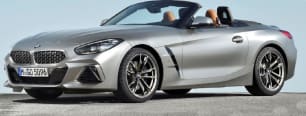
What's the difference?
I remember the first Bond film I ever watched.
I was about eight or nine years old, and it was GoldenEye on VHS. In that film, Pierce Brosnan drove a BMW Z3 convertible, which obviously oozed cool.
I didn’t know at the time that it was just a little bit weird that he wasn’t driving an Aston Martin for the entire duration of the movie, but it didn’t matter, that drop-top Beamer with its radar and missiles imprinted itself on my mind.
As such, I’ve always had a soft spot for BMW’s 'zed' range, so I was quite keen to helm this new one as it came through the CarsGuide office, especially since it shares its underpinnings with the new Toyota Supra.
So, is the new Z4 a case of never meet your heroes? Or did it make me feel a little bit like a secret agent? Read on to find out.
In light of the large volume of dirt-road-friendly camper-trailers being seen on bush tracks of late you’d be safe in assuming that they are the flavor of the month.
Sure, lots of people buy into the idea of the off-road-camping lifestyle and may get a surprise when faced with the reality of it, but the number of those who swiftly grow to love the camper-trailer way, far out-weigh the number of those who don’t.
We took a Hawk Outback into the bush to check it out.
The Z4 didn’t make me feel like Peirce Brosnan’s 007. It’s way too serious – a proper gritty reboot. Maybe it’s meant for Daniel Craig. Either way, its brave design makes it one of the best-looking BMWs of recent memory, and it’s a tech- and comfort-fest that the Bavarian automaker should be proud of. I just wish it was a smidge more fun behind the wheel.
The Jayco Hawk Outback is a solid, feature-packed camper-trailer without being flash about it. It looks good – checker plate is always a nice touch – and it is easy to tow and set up. Sure, it may not be as gung-ho an off-road unit as its name suggests, but it is more than capable of handling gravel or dirt tracks on the way to your campsite and will be a comfortable camper when you actually arrive there.
The Z4 is a convertible, so it’s naturally compromised on space. As far as convertibles go though, you’ll be hard pressed to find one you can fit more stuff into.
The Z4 is wide - the same width, in fact, as a 5 Series - and this carries into the cabin. There are only two seats, but those seats are wide, and occupants will find themselves with luxurious amounts of airspace for their arms, as well as excellent leather-trimmed and padded surfaces for landing elbows on.
Legroom is also great, as the seats have a surprising amount of rail-travel on them, so that even taller folk won’t struggle to fit their limbs in.
A genuinely impressive characteristic of the Z4 is much head room there it is. Despite its low-slung looks from the outside, the roof towers over my 182cm tall head when I’m inside, so this isn’t one of those convertibles that feels like braking too hard might simply decapitate those above six-foot tall.
In terms of storage areas you get some long but shallow trenches in the doors, a bay with connection ports and a Qi wireless charging pad under the air-conditioning controls, a glovebox (hey, not all convertibles have them) and a trick centre console that houses two deep cupholders inside.
There’s also a netted shelf behind the seats that could fit small bags, and given the length of the cabin, you could even fit laptops and the like behind the seats provided you haven’t used the full extent of the seat’s rearward movement.
The boot is deep, wide and long for a drop-top, and offers a total of 281-litres which is more than some popular hatchbacks. It even offers tie-down points and netting either side. To top it off, the fabric roof folds away into its own compartment, so the boot space is unaffected if you choose to drop the lid.
For a convertible – the Z4 is a practicality wizard.
Jayco camper-trailers have a nice touring-friendly floor-plan but where the Hawk Outback deviates from the line-up norm is that its kitchen is positioned to the left of the door as you step inside, rather than in front and to the right of you as you step inside on other models.
The interior height tops out at 2070mm high – pretty standard for these campers – and inside is roomy enough not to feel like a confined space, although it will get squeezy if all four adults and two kids are in here and milling about at the same time.
Looking from the door, to the left is the four-burner stove, then, as you look to the front, the extended lift-up bed and storage, and, swiveling to your right, the Dometic 95-litre fridge (Touring models get the 90-litre fridge), then stainless-steel sink, dinette seat, table, club lounge, double bed, then TV cabinet.
Drawers are all Ezi glide pull-out style. The pop-in/pop-out button on each handle – to lock it in place and unlock it – is generally a good system but can be prone to becoming fiddly, even sticking. This is a minor problem and can be found in many campers with a similar mechanism on their drawers.
Interior lighting includes overhead LEDs for the main area and reading lights for the beds. There’s a fan for the beds.
A car that looks this good better live up to the promise behind the wheel, right?
For the most part, the 30i does, but it’s a victim of its own performance credentials and luxuriousness.
See, a drop-top should be fun-packed, you should feel close to the road, connected. Sadly, a combination Z4’s excellent suspension and not-so-excellent SUV-like interior separates you too much from the surface below.
An advantage, of course, is the refinement on offer. The Z4 is easily one of the quietest, most refined convertibles I’ve ever driven, but it’s a little too insulated.
I can’t help but feel like it’s all business and no pleasure. It feels a little more like I should be cruising to work on the autobahn and a little less like I should be flinging it around corners on a tight B-road.
It feels almost wrong to drive it in a T-shirt. It’s serious and doesn’t want you to mess around, it wants you to wear a suit and tie.
This grand-tourer style feel is one that will keep a lot of buyers in the premium space happy, but I’m of the opinion that BMW will have that segment well and truly covered by the new 8 Series. If the budget allows.
Regardless, the 30i’s four-cyl engine feels like any six-cylinder would have a few years ago. It’s got a surge to it in the straights that’s quite satisfying, and it responds via the exhaust with an angry tone that makes it feel a little more alive, especially with the roof down.
This feeling was all helped along by our car’s M active differential which simply won’t let the fat tyres at the rear slide unless you’ve got high-speeds and loads of tarmac to play with – for better or worse.
The Z4 also has ‘variable sport steering’ which reacts to the car’s speed and position of the wheels to adjust the input ratio. It’s good when you’re at speed, but the weight and response of the steering can make the Z4 feel bigger than it actually is at lower speeds.
The suspension is firm, and can be a little bouncy over rough surfaces, but seems well suited to the Z4’s chassis.
Other than those notable characteristics you’ll find that the Z4 is wonderfully tuned in terms of its inputs, everything is slick and smooth, suited perfectly for long meandering drives.
Because of its compact size – especially relative to caravans which are, by their very nature, generally bigger and bulkier than camper-trailers – the Hawk Outback is a very easy thing tow as it sits low and stable on all surfaces and well within the confines of even narrower bush tracks.
The single-axle camper – 5060mm long (including drawbar), 1910mm high, 2240mm wide, and with a 1285kg tare weight – hardly registered behind our tow vehicle, a 2019 Ford Everest, with the new 2.0-litre four-cylinder bi-turbo-diesel engine (157kW/500Nm).
It always felt secure on the towball (with a 145kg download) during highway, gravel track and undulating dirt-road driving.
The Hawk Outback, like other Outbacks, has a hot dip galvanised Endurance chassis on Jayco’s JTech coil-spring suspension set-up. (Note: Jayco’s Outback models are designed and engineered for, at worst, dirt roads and gravel roads, not 4WD tracks. They are not built for hard-core off-roading.)
Another bonus: visibility is clear and open along both of its sides and even over the top – no need for towing mirrors here.