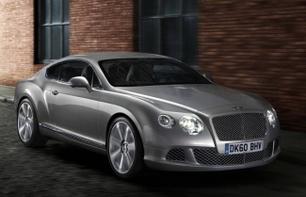
What's the difference?
Close your eyes for me and try to picture a two-door vehicle with a thumping V8 engine, 575kW and a whopping 1000Nm on tap, a 0-100km/h burst of 3.2 seconds and a top speed of 335km/h. Does it look like a Ferrari in your head? Something else Italian, or German perhaps?
Well, what if I tell you it also weighs 2.5 tonnes. Are you imagining a luxe SUV with the rear doors removed, perhaps? Think again, because what we’re discussing here is arguably the very best of Britain (albeit German-owned), the all new and highly impressive Bentley Continental GT Speed.
Gone is the famous and fabulous W12 engine, never to return (Bentley was long the world’s biggest maker of 12-cylinder engines, henceforth it will make exactly none), to be replaced by the one and only power plant the company will now offer, in various tunes, in all of its ICE cars (yes, a Bentley EV is coming, of course).
All that torque isn’t just from the big 4.0-litre V8, it’s also an 'Ultra Performance Hybrid', which will allow you to drive up to 81km in fully silent electric mode, should you be so boring.
We flew to a posh and very private members-only race track in Japan to find it out if this really is, as Bentley suggests, the everyday supercar.
Years ago, McLaren wasn't really making McLarens. The ill-fated SLR was still in production, but was an oddity that made little sense - it was a highly specialised Mercedes and built to sell for crazy money to mega-rich F1 fans. Production was down to a trickle,and the iconic and legendary F1 had completed its run a decade earlier.
The "new" McLaren Automotive had a shaky start in 2011 with the unloved MP4-12C, which became the 12C and then morphed into the 650S, getting better with each reinvention.
The P1 was the car that really grabbed the world's attention and was then-new designer Rob Melville's first project for the British sports car maker.
Last year, McLaren sold its 10,000th car and production numbers are closing in on Lamborghini's. Sales have almost doubled in Australia and Rob Melville is still there, and is now the Design Director. The company, clearly, has done very, very well.
Now it's come time for McLaren's second generation, starting with the 720S. Replacing the 650S, it's the new Super Series McLaren (fitting in above the Sport Series 540 and 570S and below the Ultimate P1 and still-mysterious BP23), and is a car McLaren claims has no direct competitors from its rivals at Ferrari or Lamborghini.
It has a twin-turbo V8, a carbon fibre tub, rear-wheel drive and bristles with cleverness.
Any fears Bentley was heading in the wrong direction by abandoning 12 cylinders for hybridisation (not that it had a lot of choice) should be totally salved by the Continental GT Speed. It is a hugely capable, fabulously luxurious and beautiful to behold grand tourer that deserves extra points for not being an SUV. It might just be the supercar you could drive every day, with no complaints.
Note: CarsGuide attended this event as a guest of the manufacturer, with travel, accommodation and meals provided.
Past McLarens have been accused of being a bit soulless, but this one is alive. The last time I felt like this in a car was a Ferrari F12, one of the scariest but most brilliant cars I've ever driven. Except the 720S isn't scary on the road, just sheer genius.
The 720S doesn't necessarily beat the competition but it opens up new ways of doing supercar things. It's a car that looks amazing, is more than fit for purpose but has a wider range of talents than the others.
That makes it ever more compelling, both as a piece of automotive brilliance to admire, andl as something to consider when you've got half a Sydney apartment to spend on a car.
Australian roads await, but the drive through rural English country roads and villages was a great preview. All I can say is: gimme one.