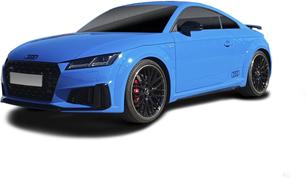
What's the difference?
Do you remember when you first saw an Audi TT? I can go first. It was 1998 and I’d been backpacking through Europe for months and had arrived in Paris just as all my money had run out.
Anyway, as I was beating myself up for spending way too much on a fridge magnet in a souvenir shop (it had a built-in thermometer) when one drove past me.
I saw the Audi badge but before I could work out what it was it turned the corner and was gone.
The mysterious Audi was silver and it looked like it was from the future, but actually it was the original TT, the first one, and being about October ‘98 it would have only just come out.
I would never have believed you if you’d told me at the time that 25 years later I’d be a motoring journalist and that I’d be reviewing the final Audi TT ever.
And here we are with the Audi TT Final Edition. That’s right, Audi has decided to discontinue this sports car after 25 years of production and it’s made this commemorative TT Final Edition that adds unique fettling and some nice features.
So, is the TT Final Edition worth buying? What’s so good about it? And how much more does it cost over a regular TT?
I found out after spending a weekend on some great roads to say goodbye to this icon. Oh, and I still have the fridge magnet.
The 2022 Mitsubishi Eclipse Cross has a new high-tech powertrain that allows it to run as an electric car, or run using the petrol engine, or even use both at the same time.
But the new hybrid SUV is not like a Toyota hybrid - because this one can be plugged in at home to recharge the batteries, and you should be able to get at least 50 kilometres of EV driving out of just a few dollars worth of electricity.
We’re talking about the new 2022 Mitsubishi Eclipse Cross Plug-in Hybrid EV, or PHEV as we’ve called it in the past. The brand has renamed it to include both ‘Hybrid’ and ‘EV’ in the name because, well, it reckons those terms have a bit more cut-through today than when the company first launched its Outlander PHEV back in 2014.
But with the new Eclipse Cross PHEV variants attracting a huge premium over the regular petrol-turbo models, does the extra money buy you a better car? Let’s find out.
Audi is finally saying hooroo to this model which has made the world stop and stare like I did on that Parisian street all those years ago.
The Final Edition is a fitting tribute to this iconic sports car and I’m glad Audi didn’t go ‘OTT’ and deck it out with gimmicky features.
At the same time the Final Edition’s big rear wing, blacked out badges, wheels and interior colour coding hint that this is not just any ordinary TT and those that know will know.
Farewell Audi TT, we hope something just like you but probably electric appears to stop us in our tracks again.
The Mitsubishi Eclipse Cross Plug-in Hybrid EV is an interesting inclusion for the brand, especially as it is typically considered a ‘value player’ in the market.
But with negligible real-world fuel consumption benefits if you drive beyond the limited EV range and a high price premium over the non-PHEV models, it’s important you see if the sums add up for your particular needs.
Primarily going to use the car for running around town? Cool. Think the 50-ish-kay EV range will work for you and make you happy? Amazing. Sold on the look of the car? Hat tipped.
But let me say this - if you are considering the Eclipse Cross PHEV, there are some alternatives you should also have on your list, including the MG HS PHEV, the Hyundai Ioniq PHEV, Kia Niro PHEV, and - the one I’d buy - a Toyota RAV4 Hybrid. For me, plug-in hybrid tech is a bit of a halfway house, in most instances offering too high a price premium for the range you’re getting to drive electric. Heck, a Kona Electric isn’t much more than the top-spec Exceed PHEV, and I’d have that if I wanted a real day-to-day EV experience.